At 90% off, an offer he couldn’t refuse
Some months ago, I answered a few questions privately from a reader interested in Cobblestone Park in Blythewood, SC, 15 minutes from the state capital of Columbia. Cobblestone had a brief flirtation with Bobby Ginn, who took over the community from its original developers, made a bunch of promises and then was forced to divest when his empire began to crumble. Our reader was looking to find a deeply discounted foreclosure or bank-owned property and, from the sound of the note he sent me last night, it appears he has done just that.
I did indeed make the decision to purchase a lot from foreclosure at Cobblestone Park in Blythewood SC. There were and still are many lots for sale by banks for pennies on the dollar compared to the hyped prices in 2005. Mine is a nice sloping lot on the tee on the 3rd hole with views across two fairways. I was able to bargain with the bank to purchase the lot for over 90% off the price paid back in 2005. Realistically, it is probably more like 25% of what it is really worth in today's market. I truly felt this was a one-time chance that would not last long, and I could not let it pass. The best part is not that these lots are being sold by the banks for such a low price (as that does depress the value for sure); but rather that they are now being bought by local folks who want to build and who will use the club and facilities and pay their HOA dues. These are not absentee investors from over 1,000 miles away with no intention to ever see the property, let alone build on it.
 Home On The Course newsletter
Click here to sign up for our Free monthly newsletter, loaded with helpful information and observations about golf communities and their golf courses.
Bank-owned bargains near Outer Banks
Vacationers, retirees and investors have had a choice of some extreme bargains in golf communities these last few years. No reasonable offers have been refused, and a few that reasonable people might consider unreasonable were accepted. But with signs that the leisure residential market might be on the mend, especially in the middle price range, bargain seekers may have to become a little lighter on their feet than in past years. One place they might look is in a small golf community near North Carolina’s Outer Banks, where a local bank is unloading its inventory of properties and three homes at deep discounts to their original prices.
I wrote about the Powell’s Point, NC, community known as Kilmarlic after a visit in February [click here to read]. I didn’t get to play the well-regarded Kilmarlic Golf Club course, one of the high-end daily fee layouts in the area, but I did see enough of it and the surrounding community to have a positive vibe about the place. I was surprised to find that the most attractive section of the community, Kilmarlic Estates, was in receivership, taken back by lenders from the developer. Now, the banks have put their holdings up for sale.
The pricing is impressive. Lots on the golf course that originally were offered at up to $153,000 now command a top listing price of just $109,000 (the banks are listening to lower offers). Three new homes are also included in the sale at prices from $289,000 to $349,000, the latter featuring 3 BR, 2 ½ BA and 2,500+ square feet with views of golf course, lake and conservation preserve.
My real estate agent contact handling the sale for the bank says she has received numerous offers for the properties. She doesn’t know if the bank will accept them or not, but she does think a decision on some or all of the offers will come in the next week or so. If you are interested, contact me and I will put you in touch.

Hole #4 at Kilmarlic. Photo courtesy of Kilmarlic Golf Club.
Cliffs member corrects the numbers
We wrote yesterday that Cliffs members who opted to lend a minimum $100,000 to the developer would achieve a return of around 14% annually. That calculation included a waiver of dues for Cliffs club members.
Without getting into the complicated details, the true annual return is actually 12% for the seven years of the loan
To make the loan offer, The Cliffs split into two parts -– a real estate development company and another legal entity that owns and runs the amenities, including the current six golf clubs and the yet to be built designs by Gary Player and Tiger Woods. It is the latter entity that has floated the bond. The Cliffs and developer Jim Anthony have pledged the amenities as collateral for the loan in case of default. The investors will be represented on the board of the second entity, and according to our correspondent, there are strong provisions for slowing spending if cash flow in the clubs drops below certain levels.
“All in all,” our Cliffs member wrote, “I like this arrangement as it
“It [the loan arrangement] provides professional management, with strong owner representation -- something that a typical developer owned club does not offer.”
We especially appreciate one final point our correspondent makes, that developer-owned and managed clubs might look to the situation at The Cliffs and take away a hard-earned, but important lesson -- that “providing some info on ownership structure, transparency, financial strength, etc. would be a valuable part of any real estate and golf development decision.”
Cliffs gets $60M loan; Tiger does not get it
Waiters, check please. Scores of owners at The Cliffs Communities have taken a wait and see attitude before committing $100,000 or more to the Cliffs financial bailout program. They pledged to contribute if The Cliffs raised the $60 million minimum that it needs to complete all its planned projects, including the first U.S. golf course design by
Speaking of Tiger Woods. He played some impressive golf at Augusta National last weekend after his long layoff. Those who have watched him over the years would not expect him to be happy with anything but winning, but his post-round interviews on Sunday showed him at his most self-absorbed and ungenerous, implying that his failure to execute lost the tournament rather than acknowledging that others had simply played better. Under the duress of competitive golf, it may take time for Woods to live up to his promise of no tantrums or cursing and an overall friendlier demeanor; by those measures, he did not exactly distinguish himself this weekend (except for a few robotic smiles to the galleries). It was after the tournament, though, where his true stripes still showed.
Time for buyers to get off the sidelines? Like the song says, “The best things in life are free”…but only if you take advantage of them. In our latest free Home On The Course newsletter, sent to subscribers yesterday, we tackle the issue of whether this is the right time to stop putting off a move to a new home in a warmer climate. With such beacons of light as the Wall Street Journal declaring in a headline today that “Evidence Mounts of Strong Recovery” and the Dow Jones Industrials average settling above the magic threshold of 11,000, baby boomers are starting to reconsider their plans to move to a place where they can play year-round golf. Golf community developers are reporting increased traffic across the southeast; owners at The Cliffs (see above) tell me that more than 100 tours are planned there in coming weeks. Real estate prices operate exclusively on supply and demand; a large inventory remains but, with increasing demand, we may start to see prices increase by the end of the year. So should you keep your powder dry or pull the trigger? For some thoughts on that question, sign-up for our monthly newsletter (see box at top left of this page), and I will personally send you the April issue. It’s free and, who knows, it could also save you money. (Note: Not guaranteed; we have to say that.)
Non-golfer’s joy living amidst “God’s work”
by Rick Vogel
I am not a golfer, but I am a fan of this blog site. I live in a golf community, and it is fun to compare the benefits of being a non-golfer on a golf course to those of the golfing readers of Golf Community Reviews. I feel somewhat qualified to answer the question, “What positive experiences might await the non-golfer who will own a home on the course?” Surprisingly, the answer is “quite a few” and, except indirectly, none are actually related to the game.
The course that we live on with our dog, Goldie, 30 miles north of Asheville, NC, is the Wolf Laurel Country Club. It is a private club and, in a few ways, not exactly a typical golf course. First, when it was built in the late ‘60s, it was, and may still be, at the highest altitude of any course east of the Rockies. For example, the 4th tee, the highest point on the course, is 4,800 feet above sea level.
Another reason the course is not typical is it is only open for play from May 1st until the end of October, a six-month season due mostly to weather at these elevations. This year, the course endured a total of 118 inches of snow, almost 10 feet, during the six months it was closed!
The fairways at Wolf Laurel turn into a hikers paradise for those six months (assuming no blizzards). For those of us who live on the course, but do not play golf, the 5,000 acres that make up Wolf Laurel provide access to some of the most interesting hiking experiences anywhere. This is no mean feat, considering that the local competition, the Appalachian Trail, makes up the northern boundary of our ski and golf resort.
From a golfer's perspective, the things that make this course a joy to hike can make it a challenge to play. For example, some of the best long-range views while hiking the course are from the tee of the 10th hole, a par five of 535 yards but with a drop of about 200 feet from tee to green. The views are stunning, but the golf daunting.
The course features tree-lined fairways that seem deceptively narrow along the mountain ridges that define the course. On some holes you can kiss your Bridgestone Tour 330 goodbye if you don't keep it straight down the fairway. Sheer drop-offs formed by mountain streams on both sides leave no way for recovery.
When not hosting golfers, the course attracts the area's abundant wildlife. Small herds of white tail deer graze the fairways, sometimes to the considerable consternation of the greens keepers. The deer were here first, the damage is minimal, and so it's only fair that they get to "play" the course. Red foxes, rabbits, raccoons, the occasional bobcat, black bear and Northern water snake, along with myriad other critters, drink and hunt at the frog- and fish-inhabited water hazards.
Surely the age of the Wolf Laurel golf course, along with Mother Nature, has caused the softening of manmade features that now make it difficult to distinguish water hazards from natural ponds and some of the higher fairways from the natural balds of the southern Appalachian mountains. Certainly, there is an argument to be made concerning the pros and cons of golf courses and their effect on the environment, but in my opinion it is possible to integrate them into the natural landscape in a manner described by the legendary designer Pete Dye, when he said of his Bulle Rock course in Havre de Grace, MD, "I did not undo God's work."
*
Former innkeeper Rick Vogel lives in the golf community of Wolf Laurel north of Asheville, NC. He doesn't play golf but he appreciates having a golf course at the core of his development. His last article for us, about the glories of finding golf balls in the weeds, attracted the most comments of any article ever written in this space. Photo courtesy of Wolf Laurel Country Club.
Course Correction: Golf Digest Top 10 new private community goes native with name
It is not exactly typical for a golf course that earns a top designation one year to change its name the next. But that is precisely what Golf Digest’s #9 rated new private golf club of 2009, Innsbrook Golf & Boat Club, did. It is now called Scotch Hall Preserve.
IMI Management, the firm that handled marketing for The Cliffs during that community’s champagne budget years, recommended the name change to Innsbrook’s Austrian investors about the time IMI was chosen to run the sales and marketing activities for the community last year. The Austrians had originally named it for their hometown, the famous Winter Olympics ski resort in their native country. Scotch Hall is the name of a former huge plantation adjacent to the golf community.
The golf course is credited to Arnold Palmer Design, with the lead architect Harrison Minchew. Photos at the
Scotch Hall Preserve is well located, about an hour from the international airport in Norfolk, VA, and two hours from Raleigh. The nearest town of consequence is Edenton, a former Colonial capital of North Carolina and one of the east coast’s most important seaports in pre-Revolutionary days. A few years ago, we toured and reviewed Hertford, NC’s, Albemarle Plantation, which is 30 miles north of Scotch Hall Preserve and whose excellent Dan Maples layout also uses the Albermarle Sound as backdrop. (Contact me for a free copy of my newsletter review of Albemarle Plantation’s Sound Links.)
With an open-for-play, well-reviewed golf course, a plan to begin construciton in the next few months on a “family retreat” (with pool and events area), and deep pockets investors, Scotch Hall Preserve should not be one of those newer, under-capitalized golf communities that are here today and gone tomorrow. Their marketing representative told me that the development is “virtually debt free” and that more than half the roads have been paved.
No firm date yet is set for the clubhouse to be built; that schedule in
Albemarle Plantation and Scotch Hall Preserve would make for an interesting weekend of golf community prospecting in eastern North Carolina; if you would like to visit, contact me and I will be happy to make arrangements for you at both.
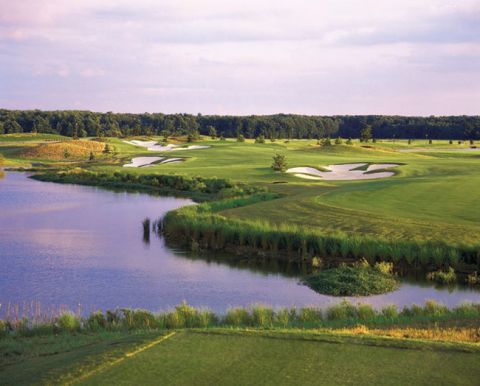
Photo courtesy of Scotch Hall Preserve.
Closeout Special: Florida community offering $45,000 off initiation fee
I was listening to Masters coverage on XM Satellite radio the other day and heard an ad for the Mirasol Country Club in Palm Beach Gardens, FL. They were offering a whopping $45,000 off the price of a membership at the club “just for mentioning the ad.” I could not resist calling and mentioning the ad.
I learned that the 2,300-acre Mirasol, which features two golf courses -– the Sunrise by Tom Fazio and the Sunset by Arthur Hills -– is almost completely sold out. A total of 1,132 homes have been sold of the 1,170 plotted; since purchasers were required to build right away, you won’t find many patches of dirt at Mirasol.
Membership is also mandatory when you purchase a home at
Dues are not cheap at Mirasol; full golf membership runs $15,000 annually, and that is before the 6.5% county tax. The remaining 38 new home packages are priced from $600,000 to $3.5 million, but the lower end provides a nice 3 bedroom, 3 bath home with almost 3,000 square feet of “air-conditioned space” (a Florida designation that means the same as “heated space” elsewhere). Each one features a 2 1/2-car garage -– the half for the golf cart – as well as a 12 x 24 foot in-ground pool.
If you are interested in one of the remaining properties at MIrasol, contact Nancy White at Taylor/Morrison, the developers. She can be reached at (561) 624-7555. The Mirasol web site is MirasolClub.com.Dreams of the Masters
As I watched the Masters coverage on Friday and marveled at my contemporary Tom Watson’s gutty play -– that young whippersnapper Fred Couples wasn’t bad either -– I lapsed into a rich fantasy world in which it is Sunday at Augusta, and Watson is matched in the final pairing with Tiger Woods. The crowd, of course, is cheering loudly for Woods, but even louder for the 60-year old Watson.
The two players come to the 18th tied, with both in the fairway. Watson has a tricky approach shot but manages to sky his four-iron to 35 feet or so of the cup. Woods has a more routine approach, yet he seems to linger over it longer than usual. He makes an unusually tentative swing and pulls it into the front left bunker, then hits a mediocre bunker shot to 8 feet. Those swings on the 18th hole of a major lack the typical force of the Tiger, as if they were played by the more laid-back Ernie Els.
Watson’s lag putt winds up two feet below the hole and he putts out for par. Now Woods, who has been putting well all day, lines up his tying putt. Days later, people who study such things will comment that Woods took about 15% less time to study his putt than he has done for other critical putts in his career. When he does make his stroke, he opens the clubface ever so slightly as the head of the putter comes through the ball. He misses the cup by three inches right.
Tom Watson is shocked, the crowd is shocked, but as it dawns on everyone that a sexagenarian has actually won the Masters, they go nuts as the winner circles the periphery, high-fiving everyone. A photo in all the sports sections the next day shows a jubilant Watson in the foreground and, beyond him Tiger Woods, not hanging his head but looking straight at Watson, a wry and knowing smile on his face, a look that some will interpret later as the face of redemption.Fear factor: Data shows way to hurricane-proof choice of coastal home

If history counts, the Jekyll Island Club and the entire coast of Georgia is not likely to be hit by a major hurricane anytime soon.
The most oft-asked question by my customers contemplating a home on the eastern coast is not about the financial health of developers, or temperatures in summer and winter, or even if a golf community course is in good shape. The most asked question is, “What about hurricanes?”
As the owner of a second home ¾ of a mile from the Atlantic Ocean, I have voted my point of view. I think the fear factor is overrated, an outgrowth largely of the devastation we all witnessed on television in the wake of Katrina. But it is clearly on the minds of many who would live a nine-iron from the beach if it weren’t for the perceived threat of Category 4 or 5 storms.
Getting over hurricane anxiety this year will not be any easier, not with a respected hurricane forecast group
We have been down this path before, years in which forecasters predicted the worst and we wound up with something much less. Of course, during the years of Hugo and Katrina, no one quite forecast the strength and devastating path of those devils. But last year, for example, seemed more typical, when the Colorado State team predicted six hurricanes, and the final tally was just three.
So how big a threat are hurricanes along the eastern seaboard? And are any areas statistically safer than others?
To try to answer the question, I found a map at the U.S. government’s “severe weather” site that charts the landfall locations for all hurricanes from 1950 to 2004. It does not include Katrina and other storms since 2004. If you were to use the map as guidance on where to buy a golf community home, you could easily make the following observations:
1) The entire Georgia coast is safe; it has not been struck by a hurricane in 54 years;
2) Charleston, SC and the Outer Banks of NC have the greatest chance of Category 3 & 4 hurricanes, which pack winds between 111 mph and 155 mph;
3) The chances of avoiding a hurricane altogether are better on the east coast than along the Gulf of Mexico, where an uninterrupted line of landfalls extends from the panhandle of Florida to Houston, TX; and
4) The safest locations on the eastern seaboard are along the coasts of Virginia and the Delmarva Peninsula, and for a stretch of Florida roughly between Daytona and St. Augustine. Check out the map for yourself by clicking here.
Inland locations in the Carolinas won’t ever have to suffer through storm surges, but that doesn’t mean they are immune to flooding and, in higher elevations, mudslides. Not all hurricanes strike a glancing blow on the coast; many proceed inland, diminished but still capable of costly damage. Check out these state-by-state maps that show the paths of hurricanes from 1851 to 2005.
The issue of buying a home near the coast really comes down to potential economic damage, not personal safety. Meteorology has become so sophisticated, the Colorado State team notwithstanding, and the Weather Channel is so ubiquitous that no one need fear a storm sneaking up on them. You always have at least a few days to evacuate, and states with a coastal presence have become adept at organizing roadways for swift and substantially uneventful evacuation. Some people worry, justifiably, about whether they will have a home to come home to in the wake of a major storm, and whether their insurance premiums will affect their financial security. These are real concerns but, perhaps, not enough to tilt a decision away from a place where you really want to live. As the data shows, there are ways to severely limit the risks.
Data and history tell us that the chances of a devastating storm along certain stretches of the eastern seaboard are remote. For those who love the sand and the surf, the minimal risk is worth the rewards.
*
Map of hurricane landfalls from 1950 to 2004: http://www.ncdc.noaa.gov/img/climate/severeweather/hur5004.jpg
Hurricane paths by state from 1851 to 2005: http://www.csc.noaa.gov/hez_tool/history.html
Golf community ad spending hints that recovery might be underway
These have been bad years for those ad agencies that had counted on a continuing stream of media placements from free-spending golf communities. That all ended with the housing crash. In its most flush years, for example, The Cliffs Communities spent $14 million for marketing and bought prime positions in such high-end magazines as The
But since 2006, these high-end communities have largely been absent from the major paid media. We all know what happened in the market, especially at the high end. Over the last few years, only the financially strong –- or crazy –- golf communities have continued to throw good money at advertising, even though one could argue some counter-communications were needed to overcome perceptions that a $1 million home in a golf community is a risky buy. Most communities rationalize their lack of spending; modern customers, they say, use the Internet to conduct research. Maybe, but the hedge fund managers and their ilk who can afford the high-end properties likely have neither the time nor the inclination to conduct Internet searches.
But they do read the Wall Street Journal. And the increasing number of ads popping up for golf communities in
“We have not done much marketing in a while,” says The Landings Vice President of Marketing Bill Houghton, “and we probably fell off the radar screen” amid all the earlier advertising by The Cliffs, Reynolds Plantation and others. Houghton, who recently arrived at The Landings from a similar post at Reynolds Plantation, told me that The Landings' 2010 sales volume is ahead of last year, which gives Landings owners -– its residents –- the confidence to spend.
Just like rehiring and investing in capital equipment typical signal restored health for corporations, advertising by
*
We are still in a buyers market, but that could change by the end of 2010, especially in the mid-level ($400,000 to $750,000) segment of the residential leisure market. If you are considering purchasing a golf community lot or home in the next couple of years, it is not too soon to start looking. Contact me and I will be happy to offer you my thoughts based on your requirements. I never charge for my services.

The Landings in Savannah, which features six golf courses and a debt-free balance sheet, is feeling confident enough to start spending on advertising in such venues as the Wall Street Journal.
Greenbrier owner purchases Glade Springs
Williamsburg’s Ford’s Colony in Chapter 11
Weekend short shots: April 3, 2010
Golf Course Review: Cape Fear National


Now on Sale

- The only book about golf communities in the last 10 years.
- 156-page step-by-step guide to finding your dream golf home.
- Info on nearly 100 golf communities the author has visited.
- Paperback version costs less than a sleeve of Pro VIs.
Here is what the experts are saying:
“The book is chocked full of information…applicable to anyone looking for a move to the Southeast regardless of whether they are looking for a golf community or not.” — John LaFoy, golf architect (Linville Ridge CC, CC of Charleston, The Neuse GC)
“Larry has done a tremendous amount of work and anyone — like me — who is looking to search for a golf home now or in a few years needs this book.” — Brad Chambers, golf blogger, ShootingYourAge.com
“Wow! What a thorough piece of work…a must for anyone moving South. This book will help many people.” — Brett Miller, owner and founder of MMA, Inc, a golf industry consultancy
Buy It Now at Amazon.com or BarnesandNoble.com.