Sunday Best: Week in Review, Feb. 21, 2010
Cliffs Communities founder Jim Anthony was one of the 40 friends of Tiger Woods invited to the fallen star’s mea culpa session on Friday. Anthony has been extremely generous in his comments about Woods since the Thanksgiving night accident that precipitated the unraveling of the golfer’s reputation. No one in the room at PGA headquarters, save for Woods, may have more at stake than Anthony as Woods seeks to repair his personal life and prepare to return to competitive golf. Anthony has asked his property owners to provide up to $100 million to help him finish the Woods course and other amenities at High Carolina, and the golfer’s continued participation in marketing the community, as well as designing the course, is critical.
*
Residential construction costs in the southern U.S. are much lower than a few years ago for a few good reasons: Builders are trying to keep their workers employed and their cash flowing; and material costs are at their lowest in years because demand is so far down. I met with a realtor at the Currituck Club on the Outer Banks of North Carolina last week, and he told me homes in the area are being built for between $120 and $140 a square foot, compared with as much as $220 in 2006. I have had similar conversations with realtors and developers throughout the southeast, and they report similar numbers. A new 3,000 square foot house, dressed to the nines, should not top $500,000 to build. With developer and resale lots at their lowest prices in 10 years, the total cost of a new home is competitive with even the most aggressively priced resale homes.
*
Take an outstanding Rees Jones 27-hole golf course, a 3 BR “craftsman” cottage with views of the course and a lagoon with the clubhouse beyond, a short golf cart ride to the beach, and free golf membership, and you might expect to pay as much as $1 million. Now put all that on an island reached only by ferry, and how about the entire package for $399,000? That is the price of the described home at Haig Point, on Daufuskie Island, where prices continue to fall. If island living is for you, you may never find a better deal than that...except elsewhere on Daufuskie. Contact me if you are interested.
*
Some of our favorite towns in the southeast are on the BestBoomerTowns.com list of "Top Places to Live." They include: Aiken, SC; Asheville, NC; Athens, GA; Chapel Hill, NC; Charlottesville, VA; and Pinehurst, NC. I have visited golf communities and played the golf courses in all these areas and would be happy to make some recommendations about the best ones in the area. Contact me, and I will be happy to furnish you with some ideas.
 Home On The Course newsletter
Click here to sign up for our Free monthly newsletter, loaded with helpful information and observations about golf communities and their golf courses.
The Sycophants’ Ball: Why Tiger’s apology rings slightly hollow
Tiger Woods said all the right things at his non press conference on Friday…and then some. We would have all been okay with just five minutes of scripted mea culpas and without his righteous indignation about the media, which seemed out of place and hypocritical. After all, until the accident and bimbo eruptions, Woods owed his privacy and his “Privacy” (the huge yacht and symbol of his wealth) in large measure to the media’s free and adoring promotion. Some members of the media, according to reports, were aware long before Thanksgiving night of Woods' extra curricula passion, and they knew it wasn’t hiking the Appalachian Trail. The accident, and the National Enquirer, forced their hand.
During the tightly choreographed conference with 40 of his close friends and a few hand-selected media representatives, the main
One of Woods’ female employees cried during the presentation. Was it her boss’ words, or regrets she hadn’t said something to him during his years of debauchery, or guilt for possibly having been the handler who bought an airline ticket for one of Woods mistresses to fly to Australia to be with him? Is there a clinic and therapy for enabler addictions?
In a few weeks, Woods will emerge from his sex addiction therapy and declare himself a new man. Waiting for him, like a faithful girlfriend just outside the prison gates, will be his coterie of enablers. If ever there was a public figure defined by the company he keeps, it is Eldrick “Tiger” Woods. He will not truly be cured until he fires the lot of them.
Cliffs owner explains why he hired Tiger
Cliffs Communities developer Jim Anthony is trying to persuade his property owners that they should help him finance the Tiger Woods golf course and other amenities at High Carolina, the latest in his string of communities. In two years, The Cliffs
Recent public comments by Mr. Anthony are not going to make his fundraising job any easier.
“We hired Tiger for his expertise, not his endorsement,” Anthony told GSA Business, a Greenville, SC, area publication.
Any observer with a modicum of common sense knows that Tiger was hired precisely for his endorsement power, not his design ability, which is totally unproven. Consider that:
1) No one has played a Tiger Woods designed course yet; all three have been held up for a grab bag of financial and environmental reasons.
2) Unlike Jack Nicklaus and other current and former players turned golf architect, Woods has not apprenticed with a professional golf designer. And…
3) The Cliffs’ web site features a video of Woods and Anthony talking as much about the community as they do the golf course. Woods talks about looking forward to bringing his family to High Carolina.
One Cliffs owner told me that since he is not a golfer, Anthony may have an untutored notion of “expertise” in golf design. He may think that a great player is, by definition, a great designer. But he hired the highly experienced Jack Nicklaus and Tom Fazio for their designs at other Cliffs Communities and paid them millions of dollars less than the $20 million he reportedly paid Woods. (Nicklaus and Fazio typically charge $2 million in design fees.)
Cliffs property owners are praising Anthony for “opening up the books” in order to persuade them that the bond he is floating -– at 12% annually for seven years –- is not good money after bad. The Anthony/Woods agreement may prevent public disclosure of the fee and related details, but before Cliffs residents entrust $100,000 or more each to their developer, they need to ask some very hard questions about why High Carolina must be finished now, and why a post-scandal Woods will help sell more properties than the pre-scandal phenom did.
Get Smart: Tap members for best ideas
At the annual meeting of the property owners association of Pawleys Plantation last week, the biggest controversy was over whether to sign up for a three- or 10-year contract with the cable television company (the 10-year contract would have saved everyone about $4 per month). After about 15 minutes of discussion, it occurred to one of the members of the Pawleys Island, SC, community's board that one of the property owners, a cable TV executive from Canada, was sitting in the first row. They invited him to address the question.
“The technology is changing so fast,” he told the more than 200 property owners in attendance, “that it may not make sense to lock yourself into a long contract” to save a few dollars a year.
The spontaneous applause told the board all it needed. They will be signing the three-year contract.
The incident is a good reminder that much expertise is lying in the weeds in planned developments, and that boards would do well to tap the inventory of knowledge and experience of their own residents.
That not only makes good sense; it is also good governance.
Matter of time: Kilmarlic Golf Club and community ready for a market rebound

The 4th hole at Kilmarlic. Photos courtesy of Kilmarlic Golf Club.
Kilmarlic in Powells Point, NC, is the kind of community that has just about everything going for it except market timing; properties there went up for sale just a few years before the recession hit. The golf course is impressive enough to have hosted two state open championships in a state that boasts one of the best rosters of courses in the nation (think Pinehurst to begin with), and the surrounding real estate, some of which bumps up against the beautiful Albemarle Sound, is fairly priced. At under-five hours from Washington, D.C. and three from Richmond, retirees who make Kilmarlic their home are within easy drive of their children and friends. Norfolk International Airport is less than 90 minutes. The proximity to the Outer Banks beaches, just on the other side of the Wright Memorial Bridge, should be another big plus for families and retirees alike.
“In 10 minutes,” says Kilmarlic Golf Club owner Bryan Sullivan, “I can have my feet in the Atlantic.”
Home prices start in the mid $300s and rarely pass beyond $600,000. A newly developed section of the community, Kilmarlic Estates, features a few high-end homes around $700,000, with outstanding views of golf course, water and a Ducks Unlimited conservation area beyond.
Developer home sites in Kilmarlic Estates were recently pulled off the market, but when they come back on in a matter of weeks,
With the winds whipping at up to 50 mph and temperatures in the high 30s, I was not about to test out semi-private Kilmarlic’s Tom Steele-designed layout. It was so cold my camera stayed in the car too (see photos provided by Kilmarlic). But I could tell from the holes along the half-mile drive into the community, and the finishing hole over water behind the clubhouse, Kilmarlic may not need such challenging conditions to test a golfer’s mettle. I look forward to returning to play the course later this year.
Because a combination swim, tennis and fitness club is separately owned (costs are $110 per month to join), Kilmarlic Golf Club members enjoy a pure golf experience for a $10,000 initiation fee and dues of just $225 a month. Compare that with $125 green fees for vacationing golfers during the height of the season, and Kilmarlic membership is a reasonable alternative for those who average a couple of rounds a week.

The 17th hole at Kilmarlic.
In praise of a member-owned community
We received the following thoughtful letter from Mike Tower, one of our faithful readers and a resident of Champion Hills in Hedersonville, NC, a community we have visited and liked. The letter is a response to a topic in our February newsletter and echoes advice we have offered here many times. Thank you for taking the time to share your thoughts, Mike.
I read with deep interest the article you wrote about the demise of the era of big name designers attracting immediate investment and ensuring long-term value. I could not agree more!
We moved from Florida to the North Carolina mountains five years ago. We looked long and hard at The Cliff's communities and, frankly, they had a lot of appeal in offering multiple top-name designer golf course
But the real value is that the club and POA are both 100% member owned and managed with no debt and very healthy cash reserves. We are currently about 75% built out with over 300 homes completed. Our likely total build out will be around 375. With a total membership cap of 285, we likely will have a waiting list for memberships in the future. What I have learned is that the real risk in buying into one of these dream designer communities is to do so in a community that is developer owned. As we have all learned, and I'm afraid will continue to learn at an accelerated rate, the only safe investment is in an established club that is member owned and highly solvent.
As I write this, I am sitting in a rented condo in Palm Coast, Florida where my wife and I came to enjoy a couple of months of warmer winter
The number of properties for sale/rent/lease here and at adjacent communities is just staggering. Prices are as low as they likely can get....Ginn is even offering no-initiation/no dues for two years memberships...and even that does not appear to be working. That tells me that even folks with money are unwilling to take risk because the downside likely remains huge. What happens to the existing members and property owners when the maintenance and management costs keep going on without a source of outside money?
I think you could provide a wonderful service to your readers if you put together a list of clubs/communities like Champion Hills that do have great golf courses, completed amenities, and are financially very healthy. Maybe you could develop a list of questions to be considered before you even begin to look at properties?
Take care and thanks for your insights.
Thank you, Mike. We will have more to say about stable and mature communities in coming weeks.

Champion Hills has but one 18 hole course that is well used, well supported and owned by its members.
Sound Investment: Bridge could increase property values, rentals at Currituck Club
Vacationers from the north heading for the Outer Banks of North Carolina pass near Aydlett, NC. On a clear day, they can see across the Currituck Sound vie miles to Corolla, home to dozens of wild horses, spectacular beaches and the golf resort community Currituck Club. Yet it will take them another 45 miles and as much as 1½ hours during the summer season to get to Corolla.
For almost two decades, state and local officials and environmentalists have debated the notion of a bridge across the Currituck Sound to make the trip easier. Now, it appears, construction could start within the year once a final environmental impact study is reported in the second quarter of 2010. A toll of $8 in high season, about what it costs in gas to drive down to Kitty Hawk from Aydlett and then back north to Corolla, will help pay for the $660 million structure, whose estimated completion date is sometime in 2013.

The Currituck Club's Rees Jones golf course is within view of both the Atlantic Ocean and the Currituck Sound. Photo courtesy of Currituck Club.
A bridge not too far
For owners in the attractive vacation community of Currituck Club, this could mean much more than convenience. With travel from Richmond, Washington, D.C. and other northern points cut by more than an hour, the bridge is likely to encourage much more visitation and propel an increase in Currituck owners’ currently depressed property values. With the increase in values will come an increase in rental prices and the likelihood of more than the customary 15 to 18 weeks of rental income per year. No bet is a safe bet in real estate, but if the bridge gets built, a renaissance in sales could come to Currituck Club and other nearby properties.
Vacation communities in beach-oriented areas have suffered especially significant losses in market values during the recession, largely because they increased so rapidly in value during the run up in real estate values. Now, vacation homes are a luxury many strapped people, especially those who may have lost jobs, can no longer afford. During a drive through Currituck Club with on-site realtor Bob Godley, we stopped in front of a home that sold at foreclosure recently for $750,000. The home is large (see photo) and attractive and features dramatic views of the ocean less than a half-mile away. Its original price was $1.7 million. Earlier, I met Godley at the community’s attractive four-bedroom model home, which is available for $699,000. Its price just three years ago was $1.2 million.
Currituck Club is the most northern golf community and golf course on the Outer Banks and lies just two miles from the end of state highway 12, which runs north along the Outer Banks from Kitty Hawk to a dead end at the beach in Corolla. From there, four-wheel drive cars can access the beach and drive 18 miles on sand to the Virginia state line, past scattered beach houses -– including one that sits in the ocean at high tide -- and acres of dunes land that plays host to wild horses relocated from Corolla (they were getting hit by cars). I’ve been on islands like Bald Head and Daufuskie that are served only by ferries, and I can’t imagine evacuation under the threat of hurricane to be any easier from the northern end of the Outer Banks. For folks who live there, The Weather Channel is a potential life saver.
One golf course, two bodies of water
Currituck Club was built by Kitty Hawk Land Company, which had developed most of the beach resort properties in Southern Shores, about 10 miles south of Corolla. They saw an opportunity to purchase the last large prime piece of developable acreage on the Outer Banks (3,000 acres that had been used by shooting clubs), a long and slender strip, with the Currtiuck Sound on one side and Atlantic Ocean on the other, less than a half-mile off. It is about a four-mile drive from the front gate of Currituck Club to its north end.
Kitty Hawk Land hired Rees Jones to design the course, opened the golf club in 1996, and began selling home sites the next year. The four finishing holes, and two on the front nine, run along the Currituck Sound, and from other holes the ocean is clearly visible. Needless to say, prevailing ocean winds play a factor in club selection and aiming. The back tees carry a rating of 74.0, slope of 136 and yardage of 6,885. The blue tees are a reasonable 71.6/128/6,404 yards. Although it was too cold for me to play on this trip, the par 3s appeared to be especially tricky, with water in play adjacent to the greens on three of the four. The course, which is managed by ClubCorp, is open for play year-round but is not over-seeded in the winter (the bentgrass greens stand in vivid contrast to the tan fairways). The club offers a range of membership options, including full-family golf for residents at an initiation fee of $6,000 and $272 in monthly dues. Club members receive reciprocal playing privileges at Nags Head Links, about 40 minutes south of Currituck Club. For an additional fee, members can join ClubCorp’s Signature Gold program, which offers access to many of its other golf courses nationwide. Non-residents can join the Currituck Club for higher fees.
The Currituck Club community offers the full range of real estate options –- condominiums (just two buildings), patio homes (1/4-acre lots) and single-family homes. Prices begin in the low $300s and run into the low seven figures, with plenty of nice selections under $600,000. New homes, Bob Godley says, are selling at about half of what they brought five years ago. A selection of home sites remain, and with construction costs running under $140 a square foot, compared with $220 just a few years ago, building a new home could be a nice option for owners so inclined.
Rental incomes better than CD rates
The club’s listing sheets helpfully include annual rental income below the listed price. For example, a 4 BR, 3 BA single-family home listed at $525,000 has an annual rental income range between $30,000 and $40,000. A 5 BR, 4+ BA home at $775,000 shows an annual rental income of $40,000 to $50,000. If those rental figures hold up in the coming years, the rates of return will be a lot better than you will get for a CD at your local bank. (Note: Local rental agencies charge owners a modest 20% fee to handle housekeeping and maintenance chores, as well as marketing the rentals. Agencies in other resorts charge as much as 40% for the same duties.)
Many of us shopping for a golf community home in the current environment worry about the financial health of individual development companies. In the case of the Kitty Hawk Land Company, the family that owns Currituck Club also owns a chain of 400 restaurants, many of them of the fast food variety that have not been hit hard in the recession. The golf course is leased to ClubCorp and the developer’s lots are substantially sold. Within the year, Kitty Hawk will pass all the other amenities to the homeowners. Looking from the outside in, things seem to be in order at Currituck Club.
If you would like more information about Currituck Club or would like to arrange a visit, please contact me and we will get to work in your behalf. There is never a fee for our services.

This home at Currituck Club went for $750,000 at a foreclosure sale recently, less than half of what it sold for originally. It features views across the golf course to the Atlantic Ocean.
Bald Head Island Club's 7th hole to die for
What started as a modest tweaking of Bald Head Island’s links golf course has turned into something of an archeological dig as workmen have discovered skeletal remains adjacent to the 7th green. The 7th on the North Carolina course is not notoriously difficult, so archeologists have ruled out that the bones are those of 20th Century golfers; 19th Century pirates are a more likely explanation as that part of the Carolinas coast was a favorite hangout for the famous Blackbeard and his band of plunderers.
Club officials have informed their members, one of whom alerted us to the news. (Many thanks, Skip!) They are confident that work on the course will continue on pace and that play will resume in May. For those planning to play the fine Bald Head links course this summer, our best advice is to use those little suction cup thingies to retrieve your ball from the cup on the 7th green. A hook works for pirates, not golfers.
You can read the story about the Bald Head dig at the Wilmington Star News online.
Vacation play: Bayside a one-season second-home haven

The starting hole at Bayside Golf Club. Golf photos courtesy of Bayside.
For 90% of those who own property in Delaware’s Bayside Golf & Resort community, the nearly two feet of snow on the ground this week is of minor consequence, since they use the homes mostly in the summer. Bayside, located in Selbyville, just a few miles from the popular Ocean City (MD) beaches, draws its vacation homeowners substantially from D.C., Philadelphia and New Jersey. Its part-time residents didn’t choose Delaware with the expectation of balmy winter weather, but this winter has been unusual.
I can’t remember encountering before Bayside’s unique approach to selling homes. The Carl M. Freeman Companies, a noted local developer of beach resorts, opened Bayside five years ago, but after the untimely death of its leader, Joshua Freeman, the company's new leaders struck a deal with NVHomes, a residential builder with 25 years experience and the largest home builder on the local beaches. Freeman still owns all the undeveloped lots, but when NVHomes, which has exclusive rights to sell in Bayside, sells a villa or single-family home, NV purchases the lot from Freeman at a pre-determined price.
It sounds complicated but it is transparent to buyers and seems to work just fine. Since last May, the on-site sales office has sold 50 homes at prices ranging from $299,000 to the $400s. Last month (January), which is notoriously slow, the NVHomes office sold five homes compared with just one in January 2009.
'Tis the season for most residents to say away
Single-family homes at Bayside range in size from 1,800 square feet to 3,200 square feet. The villas (or town homes), which are all 2,400 square feet, are especially attractive from the outside. Nice touches such as gazebo-like pavilions dress up the communal areas. Freeman Companies built a few condominiums when they first opened the community but, thankfully, they stoped there; the condo buildings are not Bayside's most attractive feature and they give a few areas a more mundane appearance than the rest of the 870-acre property.
Certainly with such reasonable price points, the nearby beaches, and huge metropolitan areas within an easy weekend drive -– New York City is a little over four hours –- Bayside attracts mostly families looking for fun in the sun at a reasonable cost. Only about 20% of Bayside’s residents are retirees and only a relatively few of them live in the community year round. With the economy causing retirees to be more cautious than they were in the years of impressive stock market and house price gains, many are downsizing their expectations and the square footage of their retirement homes.
Developer provides music to residents' ears
In terms of amenities, Bayside offers most of those you would expect, such as pools and fitness center, but it still lacks a golf clubhouse. One especially nice touch: A stage near the front entrance attracts concerts and other activities on Thursday through Saturday evenings throughout the summer, most at no charge to residents or the public. Because of the Freeman family's longstanding philanthropy in the area, groups like the Delaware Symphony Orchestra, for example, are booked annually by the Joshua M. Freeman Foundation. A large billboard inside the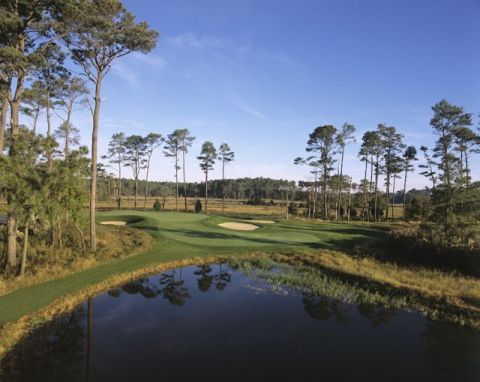 community’s un-gated entrance announces a future indoor arts center.
Bayside's initiation fee for its Jack Nicklaus Signature golf course is comparatively high. At $30,000, it seems out of line with the club’s semi-private status, the modest pricing of the surrounding homes and the lack of a built clubhouse (club members can spread the payments out over 10 years). The $30,000 is more typical of members-only clubs in communities of high-six-figure homes. According to Freeman Companies officials, the $30,000 fee did not seem inappropriate when the median price of homes in the community were around $500,000; it seems Bayside has decided not to alienate its original members by reducing the price and depreciating the value of their charter members' memberships.
It should be noted that Bayside charges half the initiation fee of The Peninsula, a private Nicklaus Signature course in a Rehoboth, DE community about 30 minutes north; dues for full family golf at Bayside are a modest $295 per month, and members enjoy reciprocal privileges at two other nearby courses, Bear Trap Dunes and the Bay Club.
With the snow covering the course, I was not able to take a cart and explore; nor was I able to pick up a scorecard or other information because one of the golf course representative did not make it for our pre-arranged meeting. Despite the miss, I am looking forward to a return visit and a round of golf in balmier times.
If you would like more information about Bayside or would like to arrange a visit (after the snow melts), please contact me.

If you like peace and quiet and a bit of the white stuff, this is the winter for you on the Delaware coast.
Golf Digest blogger suggests Tiger scrap his design gig
Golf Digest blogger Geoff Shackelford suggests in his online column that Tiger Woods follow in the footsteps of Jack Nicklaus, Ben Crenshaw and other golfers turned architects. The writer advises Woods to close down his design business and learn the craft by apprenticing with an experienced designer.
In his “Dear Tiger” letter, Shackelford suggests that “the days of lavish ‘signature’ designs are gone,” and that Woods should “hit Control-Alt-Delete on Tiger Woods Design.” The blogger mentions Woods’ three current design jobs, all currently delayed for economic reasons, including his project for The Cliffs at High Carolina.
You can read the Golf Digest online article by clicking here.
Asheville paper confirms our story on Cliffs
Wilmington, NC market inches ahead
High-end at low point; may be going lower
Crazyiness: The media is not the message

Now on Sale

- The only book about golf communities in the last 10 years.
- 156-page step-by-step guide to finding your dream golf home.
- Info on nearly 100 golf communities the author has visited.
- Paperback version costs less than a sleeve of Pro VIs.
Here is what the experts are saying:
“The book is chocked full of information…applicable to anyone looking for a move to the Southeast regardless of whether they are looking for a golf community or not.” — John LaFoy, golf architect (Linville Ridge CC, CC of Charleston, The Neuse GC)
“Larry has done a tremendous amount of work and anyone — like me — who is looking to search for a golf home now or in a few years needs this book.” — Brad Chambers, golf blogger, ShootingYourAge.com
“Wow! What a thorough piece of work…a must for anyone moving South. This book will help many people.” — Brett Miller, owner and founder of MMA, Inc, a golf industry consultancy
Buy It Now at Amazon.com or BarnesandNoble.com.