If it's good enough for Stewart Cink...
To those who choose to follow me on Twitter, I will do my best to file only relevant information; e.g. nothing about what I had for breakfast unless a) it is in a restaurant I think worthy of your dollars or b) I break a tooth on a raisin and decide to out the cereal maker. Although my initial impressions will be short and sweet, I will follow up with the customary longer reviews and photos right here at Golf Community Reviews.
Twitter confines its authors to no more than 140 characters per communiqué; it will take about 10 seconds to digest each tweet. To sign up to receive my short and sweet observations, go to Twitter.com and follow the simple registration procedure. Once you are signed up, search for "HomeOnTheCourse" and indicate you want to follow me. You can also start tweeting yourself. Or follow Stewart Cink and any of the millions of others who have something to say in less than 140 characters.
I look forward to your feedback. And thanks for reading Golf Community Reviews.
Larry Gavrich, Editor
 Home On The Course newsletter
Click here to sign up for our Free monthly newsletter, loaded with helpful information and observations about golf communities and their golf courses.
Cautious optimism, and bargains, on Daufuskie Island
Mike Kuss of Daufuskie Properties Realty says he has heard some "boat talk" that a few parties are interested in purchasing the resort. I contacted Mike after Daufuskie Properties sent me an email showing some impressively low priced developer lots within walking a short walk of the Atlantic Ocean beach. The four lots in the Oakridge section are priced between $115,000 and $185,000 and, together, comprise about 3.5 acres. Mike indicates these are about ½ off previous prices, before the resort's financial problems.
If a reputable, stable organization buys the resort, these properties could turn out to be quite a bargain. Until then, the limited, but regular, ferry schedule and the lack of any amenities at the resort may scare off some. But for those intrepid golfers who want to play an early Nicklaus gem of a golf course, the advice from someone who has played it is to pack a sandwich, hop the ferry and have at it.
If you would like me to put you in touch with Mike, contact me and will do so immediately.
How low can they go? Myrtle Beach golf condos hitting rock bottom
Tidewater Golf Club is not exactly Pebble Beach, but at least one golf writer has described it as such. In its heyday, the Little River, SC, course was ranked in the top five along the Grand Strand of Myrtle Beach and among the top 25 in the golf rich state. Tidewater may have fallen back a little in terms of reputation but its water holes and impressive marshland views still merit elite status among the Strand's 100+ courses. And by the end of the summer, the course, which closed for renovations in June, should be restored to its former glory.
With that kind of pedigree, you would think the cost of a home along the fairways at Tidewater would run well into six figures. But
With the collapse of the housing market, especially the second-home market, such bargains abound along the Strand. Beside the True Blue Golf Club in Pawleys Island, two bedroom and two bath condos begin under $125,000. At that price, you could reserve a few dollars to pay the green fees at the wondrous Caledonia Golf Club across the street, or at True Blue, where the fees are only slightly lower. (Note: One of the special things about Caledonia is that there are no homes along its fairways, a rare condition in Myrtle Beach golf.) Nearby, condos in the gated Pawleys Plantation, with its Jack Nicklaus golf course and impressive marsh views, are a little pricier. Homes in the section known as Weehawka Woods, which is a favorite of those who like to use their condo two weeks a year and rent it out the rest of the time, start at $149,000. Pawleys Plantation management charges a fee of about 40% to rent out and maintain the condos for their owners; that is fairly typical of such arrangements up and down the Grand Strand.
At the moment, Myrtle Beach has more golf courses than vacation traffic and local play can fully support. That means there is plenty of competition among the courses for the precious golfers' dollars. The price of a round of golf along the Strand has not been lower for decades, and $39 (cart included) is no longer an exception. At that kind of price, and the low price of condos, golfers in love with variety can have their pick of low-priced homes and golf courses along the 90 mile stretch of the Grand Strand.
If you think the time may be right for you, let me know your price range and other criteria, and I will suggest a few possibilities. As always, I do not charge for my services.
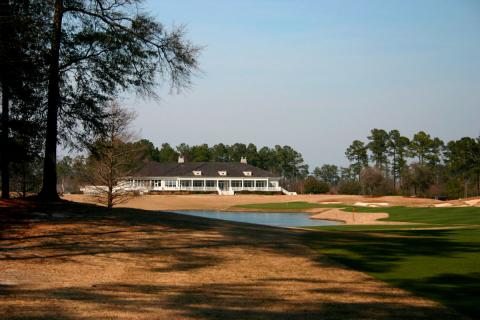
Green fees may be a little steep at True Blue Golf Club in Pawleys Island, SC, but condos are sharply priced, beginning at $125,000 for a 2 BR, 2 BA unit. Photo by Elliot deBear.
If only....
If only a rush of adrenalin had not guided that swing.
If only his putt from just outside the fringe had been four feet less aggressive...and he hadn't totally choked his putt to win.
If only Stewart Cink had not sunk a 12 foot putt on the 72nd hole.
If only a card-carrying baby boomer had won a major tournament.
It was a terrific Open Championship and splendid performance by the 59-year old Watson.
If only golf tournaments were 71 holes.
If only.
There used to be a golf course here
"And the people played their crazy game,
With a joy I'd never seen..."
There Used to be a Ballpark Here, lyrics by Joe Raposo
I missed the Frank Sinatra era by a half-generation or so. My parents were big fans of the crooner. But one of his songs struck me personally in a way few songs of my acid and folk rock generation did. It was titled "There Used To Be A Ballpark Here." It is a sad song, filled with the pathos of loss -- loss of a favorite place but also of lost youth.
I'm thinking about that song lately as I read more and more stories about golf course closings -- some I have played, some I know by reputation and others whose stories I read with a sense of sadness, especially those that are family run and whose closings are so devastating to those who have bet the ranch -- sometimes literally their own ranches -- on success.
A few years after I went off to college, the public golf course where I learned
I didn't have nearly the same connection to the Jack Nicklaus designed Melrose Club at the Daufuskie Island Resort, but I read with sadness a few months ago that it had closed. Part of the Daufuskie Island Resort on an island
The Melrose course is not only a challenging, scenic layout along the Calibogue Sound, with views out to Hilton Head, but it is also something of a museum piece, as it shows Nicklaus' design approach at an early point, a couple of years after leaving Pete Dye's tutelage. Many of the Nicklaus signatures are in evidence, including trees in mid-fairway and a bias toward high left-to-right approach shots to greens. Most of the adjacent homes keep their fair distance from the course, and although some players might recoil a bit at the bright pastel exteriors that frame the tee boxes and fairways of a few of the finishing holes, I loved the contrast against the blue waters beyond.
One of the saddest stories I have heard about a golf course involves the formerly private, 47-year-old North Augusta Country Club, between Aiken, SC, and Augusta, GA. In 2007 one of its members and his siblings bought the club with the idea of upgrading it and adding more members. The timing, of course, could not have been worse, coming just at the beginning of the market
It is expensive to operate a golf course, and it is hard to imagine that the mom and pop courses -- like mom and pop bookstores, retail shops and pharmacies -- can survive in this Walmart world of ours. I see a trend emerging in golf course management that will certainly depersonalize the experience of playing golf but might, in other ways, turn out to be an advantage for golfers, especially those who like to play a variety of layouts. Myrtle Beach, the grand buffet of golf in the U.S. and a place that shamelessly over-built golf courses in the last two decades, is something of a laboratory for this trend. Where more than 120 courses once could sustain visiting golfers from Canada and the northern U.S., the total number of layouts is now closer to 100. Just two weeks ago, the excellent Legends courses in central Myrtle Beach were sold at auction to GE Capital, which held the note on them. Thankfully the Heathland, Moorland and Parkland courses will remain open, at least for now.
Local companies now own most of the courses in Myrtle Beach. The Classic Group, for example, owns four local courses favored
Those clubs that have remained independent have seen fit to forge marketing agreements with others. For example, Pawleys Plantation (single-owner) and Caledonia and True Blue Golf Clubs (one owner of the two of them) have created the Waccamaw Golf Trail with other local courses on the southern end of Myrtle Beach's Grand Strand. Twenty courses north of the North Carolina/South Carolina state line formed a similar trail last year. These marketing arrangements are designed to attract package players to particular areas of the Grand Strand; they are most attractive to those who hate to drive up to 45 miles from hotel to golf course.
Most intriguing of such new strategies is a push by John McConnell and others to "collect" private and semi-private courses into one group and offer memberships to all of them. The McConnell Group of Raleigh, NC, has acquired a half-dozen such courses, most in North Carolina, but they clearly have an eye on expanding toward the ocean. In June, members of the private Reserve at Litchfield Beach voted overwhelmingly to sell the 10-year old club to McConnell in exchange for his pledge not to accept public play there for at least 10 years. Alas, the deal was scotched when former members filed suit to recoup their original equity fees.
The McConnell idea is not a new one. In Atlanta, for example, the Canongate Group makes 26 courses available to members for one annual fee of less than $3,000. Many of the courses are highly rated. And then there is The Cliffs Communities, where one of the selling points to those willing to plunk down a $150,000 initiation fee is the promise of eight top-flight, totally private golf courses, including the first American Tiger Woods design at High Carolina, due to open in 2011. One may wonder how often a resident of The Cliffs at Walnut Cove near Asheville will make the two-hour round-trip journey to play the fine Tom Fazio course at Keowee Vineyard.
But if you have to ask, then you probably can't afford it.
Kiawah's Cougar Point getting older...and better
Reader Elliot de Bear visited Kiawah Island recently and played the vaunted Ocean Course (see his review below) and Cougar Point. His Cougar Point review follows, along with his photos.
Cougar Point, designed by Gary Player, is a 6,875-yard par 72 gem and the oldest of the Kiawah Island resort golf courses. We played the Cougar tees at 6,503 yards with a 127 slope and 71.6 course rating (just short of the tournament tees). The track carries a 4 star Golf Digest rating and should be a solid 4.5 stars when compared with other similarly rated tracks.
Conditions were terrific all around. Cougar Point is very well bunkered throughout, providing great visual frames from the tees and fairways. The course delivers terrific views of the salt marshes and Kiawah River, with generous landing areas on most holes. Cougar has a good variety of long par 4's framed with large southern tree varietals that give the appearance of wide tunnels to hit through. The par 3's are all stunners with distances ranging from 158 to 201 yards from the Cougar tees. The three closing holes, all par 4's, are terrific, with a wonderful 388-yard par 4 18th that is a slight dogleg over water to a long, tiered lima bean shaped green.
This course is a real winner and one Gary Player made sure would be a crowd pleaser among the many courses in the Charleston area. Cougar Point is a perfect resort course, challenging when played from the correct tees and with beautifully laid out holes.
Photos by Elliot deBear


Reader weighs in on Ocean Course at Kiawah
I played the Ocean Course a couple of times many years ago. It left an indeliable impression. GolfCommunityReviews reader and contributor Elliot deBear just returned from a great weekend on Kiawah Island and shares his thoughts and always-outstanding photos below.
by Elliot deBear
The Pete Dye masterpiece measures 7,536 yards, with a whopping 144 slope and 77.2 course rating. There is little to say about this track that hasn't been said before. It is simply one of the most outstanding golf courses I have ever played.
The Ocean Course, host to a past Ryder Cup and future PGA Championship (in 2012), will forever be on the list of top 100 courses in the world. If you go, be advised that morning rounds require you walk and hire a caddy. Walking definitely enhances the experience as it affords the player panoramic views from fantastic vantage points throughout the course. The caddies are extremely helpful in club selections relative to wind conditions, placements off the tees and reading the greens in terms of speed.
The Ocean Course is rated the most difficult resort course in America with good reason. To enjoy your round to the fullest, it is critical that you play the appropriate tees. The starter and caddy will help you choose correctly. For example, I usually play the tips or one down, but at the Ocean Course, with prevailing 30 MPH winds sweeping in from the Atlantic Ocean, I was warned that the course would play 300 yards longer than the scorecard. Based on this, I moved down to the Dye tees at 6,475 yards (136/72.5) and had plenty of course to play, giving me the chance to make a number of pars on my way to a score of 84.
Make no mistake about it, the Ocean Course is expensive and you want to enjoy the experience, not fight your way around 18 difficult holes. Take a camera or you will hate yourself once you see how gorgeous this track is from the 1st tee to the 18th green. The two finishing holes are mint. The par 3 17th, one of the Ocean's signature holes, is a long par 3 to a tight two-tiered green protected by pot bunkers on the left side. Sand dunes, natural grasses and the Atlantic Ocean frame the rest of the green.
The par 4 finishing hole is long, between 396 and 439 yards with wind straight in your face along the ocean. It leads up to the new and welcoming clubhouse, a great place to finish a memorable day.

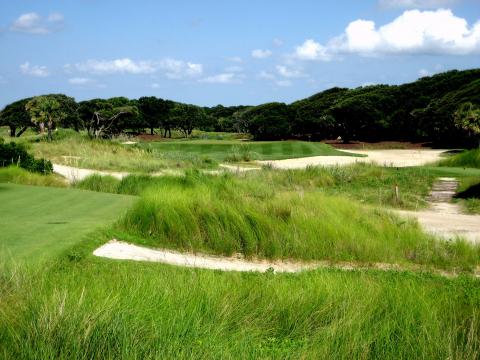
Photos by Elliot deBear
In praise of lightning fast greens
Yesterday, I played in a golf outing at Wampanoag Country Club in West Hartford, CT. Donald Ross designed the Wampanoag course, which opened in 1926 during his most prolific period. There are so many Ross courses dated to the mid-1920s that it makes you wonder if the master architect ever slept.
It would not have been appropriate for me to lug a camera around Wampanoag during the outing, but I hope to play it again before the end of the season and will provide shots here. One thing, however, that cannot be captured in any photos is the speed of the greens. They were fast, the fastest I have played in at least five years, and stopping the ball anywhere but in the cup from above the hole was impossible on most greens. My foursome and I agreed the stimpmeter must have been pushing 12 or more.
I putted the best I have in a long time, knocking down just about everything inside 10 feet. Fast, perfectly rolling greens make you putt better. You don't have to be Butch Harmon to know it is simple physics; the faster the green, the shorter the takeaway on the stroke, and the less bad stuff that can happen from one end of the pendulum to the other. It always irritates me when the former players who populate the TV announcer's booths at golf tournaments whine in behalf of the players about the fast speed of the greens they play. Just once, I'd like to see the PGA tour stop at the East Jabip Municipal Golf Course for a tournament.
Let's see how those buttery professional strokes stand up to the imperfect greens that most of the rest of us encounter.
Approach with cautions: Dunes West second shots of the first rank
by Tim Gavrich
Mt. Pleasant, SC, offers all the modern conveniences and access to necessities of a mature suburban haven. At 10 miles from downtown Charleston, the town appeals to both young families and retirees who prefer the offerings of an urban area without the high-density neighborhoods. Mt. Pleasant also appeals to golfers with a yen for variety.
The town offers a diverse array of courses, most of them taking advantage of the surrounding marshland and nearby ocean. The marvelously marshy Rees Jones-designed Charleston National Golf Club and Arnold Palmer layout at RiverTowne Country Club, which hosted an an annual LPGA event until this year, are two excellent public golf options; and those who want the excitement of a couple of finishing holes on the ocean can pony up three-figure green fees for a shot at nearby Wild Dunes and its recently restored 18th green, which had fallen into the ocean two summers ago.

Water protects the 4th green at Dunes West's first par 5. It is short, but the hazard makes even the gutsy golfer think twice about going for it in two shots.
A few days ago, we played the nearby Dunes West Golf Club, an Arthur Hills track of 1991 vintage. Dunes West, which is surrounded by a large planned development, enjoys a Low Country parkland setting with scenic views of Wagner Creek, a tributary of the Wando River, and the adjacent marsh. The layout holds up well to the standards set by its competitor courses. And it certainly drains well; Dunes West took on three inches of rain in a few hours two days before we played it, yet carts were allowed on the fairways the day we played and there was no evidence of the rain except for a few deep bunkers where the sand on their facings had washed down the slopes.
Hills courses are quite distinct from those of other designers, emphasizing second-shots more than other strokes. Dunes West follows suit, its greatest demands being approach shots rather than tee shots. Also, Arthur Hills, who will never reasonably be called a minimalist à la Doak, Coore & Crenshaw and others of their ilk, sculpts and scoops out mounds that factor into the player's strategies at Dunes West. Those mounds cause either infuriating or rewarding bounces, which is to say shot making on a Hills course is typically fun and exciting. Dunes West fits that pattern; it is an enjoyable and well-balanced layout with a challenging set of green complexes that can change the approach to approach shots day to day.

A drive on the left side of the 5th fairway at Dunes West will force an approach over or around a tree on the par 4.
The four par 3s at Dunes West are not the most eye-catching one shotters in golf, but their varying distances -- from the 168 yard 6th to the 214 yard 17th - make you reach for four different clubs. The 17th is the best of the four, with a light-bulb-shaped green guarded by a pond to the right and grass hollows and a bunker on the left. Coming at a critical juncture in most matches, it will reward a "clutch" long iron or fairway wood, with a par likely to win the hole in a match. The 12th is another compelling one-shotter; it requires a 173-yard stroke to a deep green angled from front-right to back-left and guarded by menacing bunkers on the left. A low right-to-left shot is the best for accessing a middle or rear pin position.
The two-shot holes at Dunes West are an intriguing bunch as well, a combination of clear birdie opportunities -- like the 357 yard 3rd hole - and more difficult king-size par 4s, like the 470-yard 14th. The last two par 4s at Dunes West are the gems of the set. At first sight, the 412-yard 16th appears to peel off to the right, but on closer inspection, the hole actually leans to the left, with a green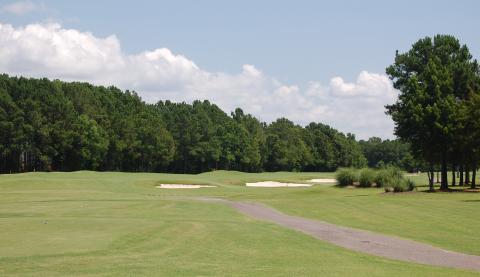 set about 15 feet below the landing area. A pond to the right and a bunker and mounds short and left add up to a scary second shot, even with a short iron in hand. The finishing hole is a 456-yard brute with a shallow, pitched green guarded by marsh from the front left to the rear; just beyond, a huge live oak provides a nice backdrop (chairs were set up there facing the tree and water beyond, the likely scene of an impending wedding ceremony). Reaching the 18th in regulation is a tall order but will put a lot of pressure on one's opponents if a match is close.
The par 5s at Dunes West are not particularly long, but they can make big trouble for players who are overly aggressive. The par 5s on the front side are under 500 yards from the back tees, but water figures prominently on both-by the green at the 489 yard 4th hole and off the tee of the 497 yard 8th. The three-shot holes on the back nine are decidedly longer. The 561-yard 15th hole features two angled strings of bunkers that can gobble up aggressive plays from the tees and on the lay-ups. Playing into the teeth of the prevailing wind, the 15th is a difficult par five and should be respected rather than attacked.
Dunes West is worth a stop for any golfer visiting the Mt. Pleasant, SC, area or for someone considering a permanent home there. Despite being relatively benign off the tee, it will test everyone's iron and short games thoroughly, making for a good mix of fun and challenge. The surrounding gated community of nicely landscaped homes in the $350,000 to $1 million range, which attracts retirees and growing families alike, never encroaches on the course; out of bounds stakes only infrequently demark the boundaries between private property and golf course property.
With memberships in the semi-private club starting at just $2,500, and with dues at a low $252 per month (full-family), Dunes West is a bargain.
Dunes West by the numbers (tees/rating/slope):
Black: 6,859/73.7/139
Gold: 6,508/71.5/131
Blue: 6,100/69.3/122
White: 5,424/66.1/106
Red: 5,208/69.2/118 (W)
If you would like more information about Dunes West or any of the communities in the Charleston/Mt. Pleasant area, please contact us.

The Dunes West clubhouse is beautifully maintained, right down to the perfectly sculpted hedges.
Tim Gavrich, a collegiate golfer, maintains his own blog site at the Hartford (CT) Golf Examiner, where he reviews golf courses and comments on other issues related to the game.
A few favorites on Golfweek's "best courses you can play" list
Golfweek magazine has released it annual ranking of the top publicly accessible courses in the U.S., and the choices could entice a private club member to go public. I have played a fair number of the courses on the list, many of which are withing golf communities.
Nutmeg State gems
In my home state of Connecticut, Wintonbury Hills in Bloomfield and Oxford Greens in Oxford rank #2 and #3 in the state, behind the Lake of Isles North Course at the Foxwoods Casino. I love Wintonbury Hills especially for its provenance -- designed by Pete Dye for $1 as a gift to the town and one of its residents and Golfweek writer, Bradley Klein -- and its proximity to our home, just 20 minutes. The course is mild Dye, except
It has been many years since I played Delaware's Baywood Greens as I made my way to Lewes Ferry to Cape May, NJ, a relaxing way to break up a long trip from south to north. If you catch the ferry right, you can save time and stress by avoiding the Interstate 95 parking lot around Washington and Baltimore. I recall Baywood Greens' sleek layout and magnificent floral arrangements on many of its holes, including a par five that required three shots onto peninsulas, including one of the greens. Baywood is #5 of 5 on the Delaware list.
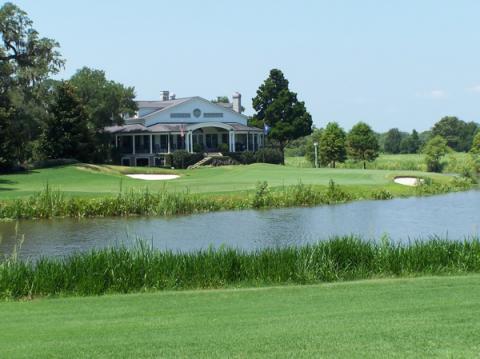
The approach to the 18th at the increasingly popular Caledonia in Pawleys Island, SC, could ruin an otherwise pleasurable round on a beautiful course. Diners who gather on the veranda to watch you putt don't help much either.
Arnie turns impressions around
I was pleased to see the Golf Club of North Hampton in Fernandina Beach, FL, near Jacksonville, just creep onto Florida's list of 25 at #24. That is quite a feat in such a golf rich state, and well deserved in my estimation. North Hampton made me recalibrate my opinion of Arnold Palmer designs, which previously I had found pretentious and generally without subtlety. But North Hampton was a fine links-like course that, despite the amount of homes surrounding it, provided pleasant views of sculpted fairway and greenside bunkers and large and contoured greens. Bravo, Arnie. Not surprisingly, TPC Sawgrass tops the Florida list. The Ocean Course at Ginn Hammock Beach weighs in at #7; despite his financial and public relations problems, few would Bobby Ginn for the quality of the golf courses he has completed.
Like a spotlight in the pines
Golf raters love the design team of (Bill) Coore & (Ben) Crenshaw, as do golfers themselves, and their Cuscowilla Golf Club, the #1 ranked course in Georgia, is one of the best courses I have played in the last decade. The flat layout is a paragon of simplicity and challenge rolled into one (the eye catching red bunkers, a mix of sand and good ‘ol Georgia clay, aren't too shabby either). Located in a corner of the many-fingered Lake Oconee in the northeastern part of the state, Cuscowilla stands up to many local rivals, including three layouts at Reynolds Plantation (#,3, 5 & 8) and the Harbor Club in nearby Greensboro. About an hour south, the two-year old Longshadow Golf Club(#6 of 10) was initially named Madison Lakes for the surrounding residential community. The course has moved up the popularity scale in a few short years and deserved a more distinctive name. My son Tim and I played the front nine there before its official opening, courtesy of designer Mike Young, and it was clear, even before things were finished, that Longshadow had great bones.

The Foxwoods Casino in Connecticut built two courses called Lake of Isles. The private one (pictured) features an interesting and challenging layout; the public one has an equal reputation.
Few golf courses are as much fun to play as The Ranch in Southwick, MA, just over the Connecticut state line. The club's name is a bit of a misnomer, the expectation being of a flat landscape; yet the layout at The Ranch rises gently over the first nine and reaches a lusty altitude on the 16th tee, where drives can easily roll down the mountain nearly 400 yards on the 618-yard par 5. The Ranch is rated #7 in Massachusetts.
Smokin' Tobacco Road
The courses in and around Pinehurst dominate the top 10 list in North Carolina, but Mike Strantz's wild and wacky Tobacco Road, about 45 minutes down the road, hangs in at #5, just behind the new Leopard's Chase, part of the Ocean Ridge Plantation community on the northern outskirts of the Myrtle Beach area. Tobacco Road is one of those courses that you should play once in your life, and I guarantee that someday, on another golf course or at a cocktail party, you will meet someone who also has played it, and you will have lots to talk about the rest of the night.
I have played all but two of Golfweek's top 10 courses in South Carolina, and they seem well chosen. I have no argument with Pete Dye's dunes
Pete Dye's Kingsmill Resort River Course holds down the #9 spot for Virginia. Kingsmill, in the golf rich and historic area of Williamsburg, is the epitome of a golf community for those who prefer to be on a lifetime vacation. The Tom Clark/Curtis Strange-designed Woods Course is almost as popular with Kingsmill guests as is the River Course; no residences pollute the vistas along the Woods layout. A third course, by Arnold Palmer, features large greens but lags the others in popularity. Perhaps the most unusual course at Kingsmill is Bray Links, a nine-hole short course along the river that commands the best views of all.
Upcoming golf community visits and reviews
July newsletter out
Now on Sale

- The only book about golf communities in the last 10 years.
- 156-page step-by-step guide to finding your dream golf home.
- Info on nearly 100 golf communities the author has visited.
- Paperback version costs less than a sleeve of Pro VIs.
Here is what the experts are saying:
“The book is chocked full of information…applicable to anyone looking for a move to the Southeast regardless of whether they are looking for a golf community or not.” — John LaFoy, golf architect (Linville Ridge CC, CC of Charleston, The Neuse GC)
“Larry has done a tremendous amount of work and anyone — like me — who is looking to search for a golf home now or in a few years needs this book.” — Brad Chambers, golf blogger, ShootingYourAge.com
“Wow! What a thorough piece of work…a must for anyone moving South. This book will help many people.” — Brett Miller, owner and founder of MMA, Inc, a golf industry consultancy
Buy It Now at Amazon.com or BarnesandNoble.com.