Hype springs eternal
I was sitting at my laptop earlier today, drinking a cup of tea and trying to decide what I might write about today. Because of a crowded desk, I put the cup down on a window ledge -- on top of a large, leather bound portfolio that was sent to me a few years ago by a central Florida community, Bella Collina. This was real leather, by the way, not faux, and about the size of a calf's back.
I recall wondering what kind of corporate ego would send something like that to potential customers without qualification. Bella Collina certainly didn't
Those who know Bella Collina's parentage know where this is going. Bella Collina is a Bobby Ginn community, and Mr. Ginn's empire is falling in upon itself, as reported here and in local news media in Florida and the Carolinas where Ginn communities have been handed over to other property managers in the wake of the company's default on a $675 million Credit Suisse loan. As we wrote here yesterday, now the PGA is suing Ginn for having abruptly dropped sponsorship of a Champions Tour event scheduled at a Ginn golf course in less than two months.
You can tell a lot about an organization by the marketing material it sends out. When the package is way more elaborate than the content, red
Chances are that residents won't have Bobby Ginn to kick around much longer. The reneging on the Champions Tour and LPGA events signals a crushed ego and a crushed empire. For a discerning few, distress could signal an opportunity. Ginn lots and homes are selling at a deep discount not only to the past pricing, but also relative to the scope of amenities in Ginn communities where the developer kept at least some of his promises. Few criticize Ginn for the quality of those amenities; the golf courses are, of course, good enough to host professional golf events, and some of the clubhouses are described as exquisite even by residents who castigate the man behind them. If a good management company or new owner steps in to manage the Ginn properties -- hotel operator Wyndham is rumored to be considering an involvement -- then things may begin to stabilize and an early buyer could land a bargain.
Still, buying a property in a troubled community is risky business. But if you are in position to shoulder a little risk for the potential of a great lifestyle in a high-end golf community, this might be your time. I have a good real estate contact supremely knowledgeable about Ginn properties; she has visited all of them and was one of the first to warn of Ginn's troubles. If you want more information about Ginn resorts and communities, let me know and I will put you in touch with her.
 Home On The Course newsletter
Click here to sign up for our Free monthly newsletter, loaded with helpful information and observations about golf communities and their golf courses.
Now the PGA goes after Ginn
The hits just keep on coming against the Ginn Development Company, often referred to as Ginn Resorts. The developer and operator of such lush communities as Tesoro, Hammock Beach and Reunion in Florida, as well as Charlestowne, Laurelmor and Cobblestone Park in the Carolinas, is being sued by the Professional Golfer's Association for abruptly dropping its sponsorship of a Champions Tour event that is just a few months away.
According to the lawsuit, "The [Champions] Tour will incur monetary damages, including but not limited to Ginn's agreed-upon contribution to the tournament purses and other expenses of each tournament, as well as lost television fees and other revenues from the tournaments."
The tour had to know what the rest of us knew months ago, that Ginn's empire was in desperate financial trouble. However, according to PGA Commissioner Ty Votaw, "we had been in discussions with them on possible modifications to the agreement." Votaw said there was no forewarning of Ginn's announcement of a pullout. Indeed, last August, Ginn's President implied in a letter to the tour that Ginn would sponsor the March Champions Tour event but was not in a position to do so into the future.
Until recently, Ginn Resorts had mounted a furious defense of its viability, but in the last two weeks, they have stopped all sales and marketing efforts. There have to be a lot of nervous residents inside the gates of Hammock Beach and Reunion. That will make for some unprecedented low selling prices...as well as unprecedented risks. Isn't that always the way?
If you think you might be interested in taking advantage of the situation, let me know (use the Contact button at the top of the page). I have a relationship with real estate professionals who know the Ginn organization and the resorts in question very well. I can provide information suited to your own situation.
North Augusta Country Club and adjacent property fail to sell at auction
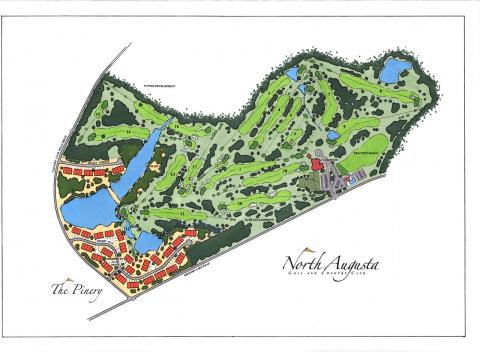
North Augusta Country Club failed to attract an acceptable price at auction on Thursday and is still available for sale. The Pinery comprises an adjacent tract of 35 acres already zoned for multiple-family dwellings and also available for sale. Map courtesy of J. P. King auctioneers.
As reported here in recent weeks, the private North Augusta Country Club, just a few miles from famed Augusta National, was up for auction on site at the South Carolina club on Thursday. According to local reports, it failed to command a bid sufficient for owner Fred Layman to sell the 46-year old club whose clubhouse burned to the ground in 2005, a few days after the developer purchased North Augusta. Although Layman upgraded the course in 2005, efforts to rebuild the clubhouse have been stalled by the economy and what some members of the club say is the owner's lack of desire to do so.
"[The owner] wants about $1.5 million for the place and is stupid enough to think he's going to get it," wrote
"I'll be resigning my membership in the next day."
Even in a bad economy, $1.5 million, if that is an accurate number, seems like a reasonable asking price for 18 holes of golf across 135 acres. An adjacent 35-acre property, zoned for multi-family dwellings, was also up for auction but failed to fetch the required price. According to Layman, the auction house of J.P. King, which organized the sale, will continue to look for a buyer for the club and the adjacent land. If anyone out there would like me to do more research on the property, let me know.
As a side note, Super Bowl coach Ken Whisenhunt of the underdog Arizona Cardinals is a partner in the North Augusta club. Good luck Ken, in more ways than one.
Lereah and Blago, separated at birth
Lereah left the NAR in 2007 -- he says voluntarily -- after pumping sunshine into the housing market
But borrowing a page from the Rod Blagojevich playbook -- or maybe it is the other way around -- Lereah told the WSJ in its January 12 article that he really didn't mean to sound so positive, that his bosses made him do it. According to the Journal, Lereah says that "because the NAR represented the interests of Realtors, he was pressured to say positive things about the association's data releases, but that he pushed back in some instances" and that "he sometimes asked the public-relations department to tone down the quotes about the housing data releases they had written for him." That sounds somewhat like Blago's line that he angered the state legislature because he tried to do good things for the people of Illinois. Lereah's old buddies at the NAR have denied the allegations, and according to the "impeached" economist, they are not returning his phone calls or inviting him to their parties.
I listened to Lereah on some business shows as the storm clouds were forming in 2006 and 2007,
Now the media are turning on him, with his cooperation (echoes of Blagojevich there too), reminding us that bloggers had dubbed him Liar-reah and Baghdad Dave for his spate of disinformation. Under the headline "The Bottom is Near," the Journal on January 11 printed excerpts from Lereah's comments of January 2006 through his "we have reached a bottom" comment exactly a year later. Lest we think the NAR has learned any lessons from the Lereah legacy, look only so far as the man who replaced him at the NAR. In Lawrence Yun's latest comments on the market, he says sales of homes might increase by more than 10% with a "proper real estate focused stimulus measure." Whatever that means.
Note: If you cannot access the Wall Street Journal articles referenced above, let me know and I will email them to you.
News Notes: Ginn quits all golf sponsorships, and more...
State Farm waves goodbye: State Farm Insurance Company has
PURE salvation? One of those insurers is Privilege Underwriters Reciprocal Exchange, the length of whose name reflects the value of many of the homes it insures. PURE writes policies for expensive homes in Florida and South Carolina and recently received licenses to do the same in New York, New Jersey, Connecticut and Washington, D.C., according to today's Wall Street Journal. One South Carolina homeowner indicated his 4,000 square foot home near the coast is insured for more than $1 million for an insurance premium of $7,000 annually...
More bad news for Florida: Mortgage insurer PMI Group predicted recently that at least one quarter of U.S. housing markets will see lower prices in two years. According to the PMI survey, Greater Miami, Lake Havasu-Kingman, AZ, and Cape Coral-Ft. Myers, FL run the greatest risk of lower prices than today. The lowest risk of home price declines are in Pittsburgh, greater Houston and Dallas-Fort Worth...
Aces Wild: If you have participated in charity golf tournaments and
Surrounded by golf, Hampton Lake earns best community award
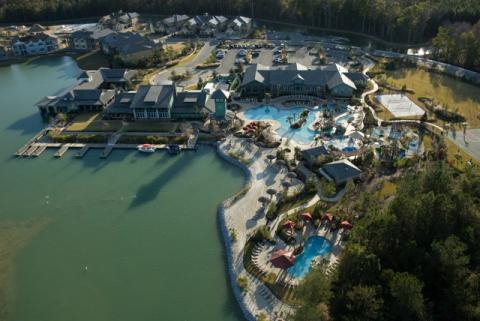
Water dominates the community of Hampton Lake in Bluffton, SC, but there is plenty of high-quality golf just outside the gates. Photo courtesy of Hampton Lake.
The best community in America, by one organization's reckoning, does not include a golf course, but that should be no problem for even the most devoted golfers. Bluffton, SC's, Hampton Lake, which just earned the prestigious "Best in American Living" Award, is within a golf cart ride of one private club -- Berkeley Hall, with 36 holes of Tom Fazio golf -- and just across the street from another, Hampton Hall, which features a Pete Dye course. John Reed, who has been developing properties in the area for 35 years, also developed the Berkeley Hall and Hampton Hall communities, as well as nearby Colleton River, which features two courses, one by Jack Nicklaus and one by Dye.
Hampton Lake received the nod at the National Home Builders Association show last week in the category of communities of more than 150 units. The awards are co-sponsored by the NHBA and Professional Builder magazine. The community opened in 2005 and spans 900 acres just nine miles from the bridge to Hilton Head Island. The area is as rich in well-regarded golf communities as any part of the southeastern U.S., a reality the developers of Hampton Lake factored into their decision to orient activities inside the gates toward a 165-acre lake rather than golf.
Hampton Hall and Berkeley Hall both offer equity memberships for just $10,000. However, dues are significantly different. At the more classic Berkeley Hall, you will pay about $12,500 per year, but membership brings full access to all the club's amenities as well as the two 18-hole golf courses. Dues at Hampton Hall and its one 18-hole course are just $4,000 per year, but only golf-related amenities are available there to Hampton Lake residents. (Hampton Lake, however, has a full complement of amenities other than golf.)
I have not played either of Berkeley Hall's two courses, but Tom Fazio is one of the nation's most consistent golf designers, and comments about the courses are uniformly positive. I walked the Hampton Hall course a couple of times while watching my son compete as a junior golfer a few years ago. The layout is what you would expect from Pete Dye, with mogul-marked fairways and bunkers shaped and sited to intimidate, at least visually. The fairways appeared to provide generous landing areas, and the large greens were not overly sloped. My major nitpick with Hampton Hall was the lack of vegetation and trees on and around the course, making a round on a hot day a brutal exercise and making the adjacent homes seem closer than they actually are.
Hampton Lake offers a total of 908 units across a range of home styles, from carriage and cottage designs to large estate homes. About 200 single-family lots remain, with prices starting at $120,000 and rising to $380,000, depending on lot size and view. Prices for finished homes begin in the $300s for the attached units and rise to seven figures. By comparison, homes in Berkeley Hall start at $725,000; Hampton Hall prices are more in line with those at Hampton Lake.
The Villas at Montelucia, a resort community at the foot of Camelback Mountain in Arizona, earned the Best in American Living award for communities of less than 150 units. The Residence at South Park near Charlotte, NC, earned the top distinction in the "smart growth/suburban" category, and Washington Town Center in Robbinsville, NJ earned the same award in the rural/exurban category. Nearby Miry Run Country Club in Robbinsville bills itself as a "public course with a private feel" and charges just $2,275 annually for a full family golf membership.
If you would like more information about Hampton Lake or any of the communities in the Bluffton, SC, area, or if you would like me to put you in touch with a pre-qualified agent who can arrange a visit and tour, please contact me and I will respond quickly.
Amateurishly edited Golf Channel video gives glimpse of Pawleys Island charms
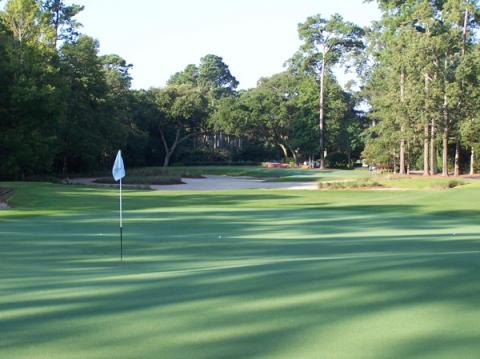
Caledonia's par 3 third hole gives a taste of designer Mike Strantz's dramatic use of sand. The green is the deepest on the course, three levels and about 110 feet front to back.
The Golf Channel's web site is not very user friendly, according to complaints I have read at the site and elsewhere. So I hesitate to recommend anything on the site or provide a link, but I will make an exception for those who have not played Caledonia or Pawleys Plantation, two of the better golf courses on the southern end of Myrtle Beach's Grand Strand.
The five-minute video is poorly edited, but it does provide a few seconds of video from everybody's favorite Myrtle area course, Caledonia, including a stop at the club's fish chowder shack on the way to the first hole. On winter days, when the temperature is in the 50s, you can grab a cup of chowder there, a harkening back to the days when the property was home to a fish camp. Pray that you don't have to listen to someone literally sing the praises of the chowder dispenser (see the video).
I can't argue with host Charlie Rymer's recommendation of Frank's Restaurant, a Pawleys Island landmark for 25 years, although the video also features a clip of Louis's of Pawleys Island, a restaurant that went out of business months ago. And as I sit in Connecticut, where the temperature is barely above 20 degrees today, it warms my heart to see even just a few seconds of the Jack Nicklaus-designed Pawleys Plantation, my home golf club in the south. Rymer and his friends played off the old rice plantation's dyke to the par 3 17th hole, one of many tough ones on the course.
Although Pawleys Plantation is almost fully built out, a nice selection of homes are available for sale. Prices range from around $200,000 for 2 BR, 2 BA units that many people rent to visiting golfers, to patio homes starting in the $300s, to single family homes beginning around $400,000. I know Pawleys Plantation and the entire area south of Myrtle Beach very well, and would be happy to offer ideas to anyone wishing to know more about real estate, golf and the restaurants in the area.
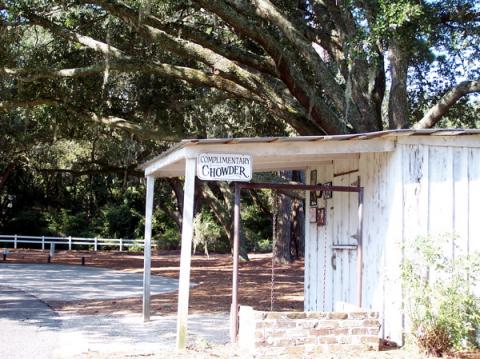
On cool days -- say in the 50s -- the shack on the way to the first tee at Caledonia dispenses a bracing cup of chowder. Caledonia is a former fishing camp.
Some NC homeowners could lose...by a landslide
In 19 counties in North Carolina, state law requires "landslide maps" to
It was left to each county to write the rules on development on potentially slippery slopes. Some developers rushed to get approval for their mountain properties before Buncombe County, which includes Asheville, passed its regulations in 2006. In Buncombe, Jim Anthony, the visionary behind The Cliffs Communities, was one of 23 area developers who took advantage of a three-month window between passage of the slope regulations and its enactment. His High Carolina community near Asheville, which signed up Tiger Woods to make his American design debut, has sold tens of millions of dollars of property since last year.
According to a North Carolina blogger who has been reporting faithfully on the landslide issues at WNCSOS, some High Carolina properties are squarely in the landslide danger zone. At 3,200 acres, The Cliffs at High Carolina is the largest development project in the county. In December 2007, according to the WNCOS web site, The Cliffs won a lawsuit against the county regarding the density of condo and apartment complexes on steep mountain slopes. Given The Cliffs history of development, it is not likely they will cram stack-o-shacks onto the land. According to the Cliffs' Anthony, condominiums will be adjacent to the community's planned "wellness" center.
Laws notwithstanding, Mother Nature still exacts her will. Three weeks ago, rain set off another slide in Maggie Valley's Wild Acres neighborhood, taking a home with it. The lofty Mountain Air property northwest of Asheville also suffered multi-million dollar property damage in recent weeks. The mountains of North Carolina are a wonderful place to live and play. But those contemplating a home there should probably ask their engineering inspectors if they have a degree in geology as well. Or find someone who does.
Dead cat stimulus plan
President Obama may be overdoing the conciliation thing if that is driving him and his economic team to include $300 billion in tax cuts as a major component of his stimulus plan. Congress and President Bush were wrong and stupid to send us $1,000 checks last year when the stakes were not nearly as high as they are today. Those checks stimulated nothing, and a tax break of $300 billion now would be a waste of money at best, and a further step down the ladder toward Depression at worst.
Here is how tax relief checks will be spent. Those having trouble
We Americans had our chance to save, and we blew it through profligate spending, especially on homes many of us could not afford. Now, however, it is almost unpatriotic to save, assuming you have enough discretionary money for that purpose. The best way to stimulate the economy, almost all economists agree, is to spend, spend, spend, not save, save, save.
Okay, if they really insist on giving us the tax break because it will
I did not vote for President Obama because he promised to give all but the wealthy a tax cut. I voted for him, and donated to his campaign, because I thought he was "that one" who is smart enough and tough enough to do whatever it takes to turn this dead cat economy around, even at the cost of a little political capital.
Housing market rebound could actually hurt some who wait for it
I talk with people all the time who ask me if I think prices will fall
If prices were to fall north and south at roughly the same rate, then waiting will be a fool's paradise for many baby boomers moving into their retirement years, especially those who plan to downsize their living space. Simple math argues to sell and move now if you have equity in your home or cash in the bank.
Let's say, for example, that your house is worth $600,000, and you have
A strong case can be made by sheer demographics that the south will rise again faster than the north will, making that spread even wider. Already there is evidence in places like Naples, FL, that a 45% price drop is about the end of the carnage, and people are starting to actually get back into the market there. The millions of baby boomers in the north are not going to defer their dreams of a warm retirement for much longer.
Everyone's circumstances are different, and if you don't have equity in your current home or enough money in the bank, then the above example does not apply. But for those fortunate to have resources, and who are waiting for some alchemical miracle of the markets, be careful what you wish for. A market rebound could negatively affect your dreams.
Flat notes: Beat goes on for housing markets
Southeast golf communities dominate T&L list

Now on Sale

- The only book about golf communities in the last 10 years.
- 156-page step-by-step guide to finding your dream golf home.
- Info on nearly 100 golf communities the author has visited.
- Paperback version costs less than a sleeve of Pro VIs.
Here is what the experts are saying:
“The book is chocked full of information…applicable to anyone looking for a move to the Southeast regardless of whether they are looking for a golf community or not.” — John LaFoy, golf architect (Linville Ridge CC, CC of Charleston, The Neuse GC)
“Larry has done a tremendous amount of work and anyone — like me — who is looking to search for a golf home now or in a few years needs this book.” — Brad Chambers, golf blogger, ShootingYourAge.com
“Wow! What a thorough piece of work…a must for anyone moving South. This book will help many people.” — Brett Miller, owner and founder of MMA, Inc, a golf industry consultancy
Buy It Now at Amazon.com or BarnesandNoble.com.