Golf Course Review: Coosaw Creek short, challenging
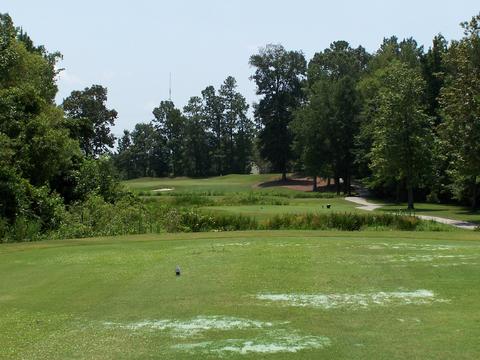
At 224 from the tips, the 11th at Coosaw Creek requires length and accuracy.
I am a big fan of Arthur Hills' designed courses. Everyone of the half dozen or so that I have played stress course management skills. On a Hills course, it is always best to be on the proper side of the fairway before approaching his sloped greens. Rarely is it a good thing to be anywhere but below the hole on the greens.
I was looking forward to a round yesterday at his Coosaw Creek course, a semi-private layout set inside the gated community of the same name in Summerville, SC. The course plays just 6,500 yards from the tips, but the slope is a robust 140, with a course rating of 72.7. Despite some bad swings that left me in impossible positions (some of them wet ones), I thought Coosaw a wonderful design. I probably should have saved the back tees, though, for a slightly cooler day; temperatures reached the high 90s with no breeze, making me hot under the collar and just about everywhere else.
Coosaw Creek is just 10 minutes from Charleston International Airport and close to I-26, which runs between Charleston and Columbia, SC. Look for a review of Coosaw Creek in the next few days in this space, and a more extended consideration of the course and the community in HomeOnTheCourse, our bi-monthly newsletter.
 Home On The Course newsletter
Click here to sign up for our Free monthly newsletter, loaded with helpful information and observations about golf communities and their golf courses.
Addition by subtraction: Myrtle Beach courses gone, but revenue up for survivors
Darwinian selection has a great Petri dish in Myrtle Beach. Dozens of courses in the acknowledged golf supermarket of America have closed forever in the last three years, victims of overbuilding and developers' zeal to build more condos close to the beach. Most of the courses have been replaced by housing developments.
To be blunt, none of the dearly departed courses were very good, although when I was a 20-something avid golfer making my first pilgrimage to the Grand Strand, Possum Trot and Bay Tree Plantation were a step up from the municipal layouts I played at home. But over time, both quantity and quality combined to winnow out the weaker of the Strand's courses, which reached a total of almost 130 in the mid 1990s. No number of Canadian visitors in March and October could fill them all; and the rise in gas prices (and airline tickets) conspired to put the final nails in a few coffins.
Quality became an issue as well; great layouts like Caledonia and Grande Dunes and the designer Barefoot Resort courses made it difficult for the scruffier tracks to generate the traffic they needed. Deep price cuts didn't help; it made the third-tier courses seem like Odd Job Outlets.
Total courses in Myrtle Beach now number under 100. Of course, with the loss of courses, total rounds played year to date on the Strand are down, 100,000 fewer compared with the first half of last year, according to Myrtle Beach Golf Holiday, which coordinates marketing for the area's courses. But golf course operators on The Strand are smiling because they are generating more rounds per course and at higher greens fees. According to Myrtle Beach Golf Holiday, paid rounds per course jumped 123 in this year's three-month spring period compared with the same period last year.
As long as people keep relocating to the Myrtle Beach area, the current number of courses seems more rational and sustainable.
There is talk in the local newspapers about the possibility of new course construction on the horizon, now that area courses are making money again. Given the lessons of the recent past, we would expect any new courses to be more Grande Dunes than, say, Deer Track (another defunct layout). Also, the time may be right for the members at a few semi-private courses to follow the lead of The Surf Club and go fully private. There is room in the Myrtle Beach portfolio of courses for another one or two private courses.
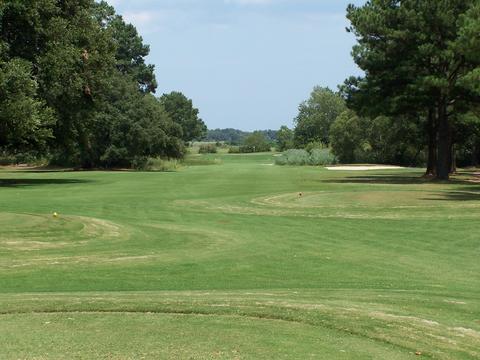
Wedgefield Plantation in Georgetown, SC, hung on through the dark days of the Myrtle Beach golf business and is now generating more rounds and revenue.
My Shameless Commercial: The 10 Brutal Truths about Searching for a Golf Course Community
2. Marinas and equestrian centers are nice, but if you are not a boater or horse rider, you may wind up subsidizing those who are.
3. Real estate agents know how to sell a house. Many don't know squat about golfing communities.
4. A comfortable retirement can be ruined by traffic problems. Just ask all those folks from Florida who are moving to the Carolinas.
5. A golf course that is "open year round" isn't necessarily playable year round.
6. A home outside a golf course community might be a better deal, and provide better golf.
7. What's more important to you? Access to Nordstrom or access to Goodhealth Memorial Hospital? Good restaurants or a regional airport? You will make at least one lifestyle tradeoff in your choice of a place to live.
8. If you are a member of multiple courses, you won't play half of them more than a few times. But you'll pay for the privilege.
9. You can spend $1,200 for a weekend touring a few communities you've heard or read about. Or you can spend $39 to get the in-depth scoop on dozens of them every year...before you visit.
10. Only one source provides objective, unbiased information about golf communities. And it costs just $39 a year.
The HomeOnTheCourse Community Guide. The next issue will be ready August 1, featuring the communities and golf courses of Williamsburg, VA; 14 pages loaded with information, observations and our exclusive golf course ratings.
Don't miss another issue. Subscribe now. Signing up is easy, safe and secure. It may be the best $39 you have ever spent.
As a bonus for subscribing, we will send you one of eight previously published reports, a $15 value. Choose among communities in Georgia, Florida, Virginia, Tennessee and the Carolinas. Act now; click here.
Experienced and neophyte designers helping Dubai to become a golf destination
Yesterday, I received an email message pitching a new development called Whispering Pines that will overlook the Greg Norman designed Fire and Earth golf courses at the Jumeirah Golf Estates in Dubai. Vijay Singh has designed a third course, called Water, which will be ready for play in 2009. Norman, along with Sergio Garcia and Pete Dye, are teaming up to design the fourth track there, a links-style layout, that will be called -- drum roll, please -- Wind. It represents Garcia's first foray into golf course design, but he has two of the world's most prolific designers to hold his hand. I hope the musical group Earth, Wind and Fire has been paid a licensing fee; they haven't had a hit in a while. The course will be ready for play in 2009.
The villas, which have a Tuscan motif to their design, top the US $1 million mark but are spacious and have views of the courses. From the sketches we saw, they look like many of the Addison-Meisner style Mediterranean homes in Naples and other locations in Florida. The community surrounding the two golf courses at Grande Dunes in Myrtle Beach, SC, is of a similar style; homes there sell for US $1 million and higher. At Jumeirah, four different floor plans are offered in three and four bedroom models at prices beginning at US $1.2 million (638,000 in pounds Sterling). Of course, given the current weakness of the dollar, our readers from the UK and the rest of Europe will get a lot more house in the States for their money (that's reality, not chauvinism).
The four courses at Jumeirah are semi-private but offer memberships and the guarantee that at least one will be dedicated to member play only on any given day. There are hole-by-hole descriptions of the Earth and Fire courses at the Jumeirah Golf Estates web site . If any of our readers have played the courses there, we invite reviews.
The pro golfer next door
I cast my vote for Jim Furyk. Tiger won't have time to chat now that the baby is here. David Toms and Ernie Els don't seem like all that much fun: and although Zach Johnson looks like even less fun, I bet there would never be any loud parties at the Johnson house (except after winning a major). Chris DiMarco is a bit intense; I'd be scared to let him near the dog (or vice versa). And Padraig Harrington plays so many tournaments in Europe, I'd wind up taking out his garbage each week and checking that the cat's fed.
Furyk doesn't look like the kind of guy who would own a cat, although he may have learned how to swing a golf club by practicing with one. That's the best thing about being Furyk's next-door neighbor; I don't think I'd be tempted to embarrass myself by asking him for swing tips.
I'll let the poll question run a few more days so that all precincts report. Thanks for voting.
For sale by owner: Deal or no deal?
There are too many psychological traps in the pricing of a home. In our case, we have lived in our Connecticut house for 15 years. We've raised two children there, spent uncalculated thousands on landscaping and other home improvements, and we built a kitchen my wife designed that literally changed our lifestyle by elevating our joy of cooking, entertaining and, of course, eating. We have invested a lot in the house, financially and emotionally. For the right family, we think our home is worth $1 million.
But the truth is, at that price our house would sit on the market until the next housing boom, which may come when I am in a nursing home. Our house is worth only what someone else will pay for it, and we are worse judges of its true value than is the guy who cuts our lawn. Especially in a tough sellers market, pricing a house too low will wind up costing way more than the savings of cutting out the middleman. (Note: If this were a strong sellers' market, I could be writing an entirely different column.)
I did a little test this morning after picking up a booklet with a listing of homes for sale by owner. I compared those listings with listings by realtors representing clients selling the same sized homes in the same neighborhoods. Of course, you cannot know the condition of the properties, the views, and other nuances from four or five lines of agate copy, but I figured the comparisons would give me some anecdotal evidence to confirm my suspicion that owners factor in their commission savings when pricing their homes.
My assumption was wrong. In virtually every instance where I could find homes of similar sizes in the same neighborhoods, the price listed by owner was the same or higher than all others. At the International Club in Murrells Inlet, SC, for example, an owner is offering a small 3 bedroom, 2 bath home for $218,000. The listing by a realtor for the same size house down the street is $219,000. A 3 bedroom, 2 bath condo adjacent to the True Blue Golf Club, a dramatically scaled course by Mike Strantz in Pawleys Island, is listed by the owner at $270,000. The same sized condo was advertised by a realtor in the real estate section of Sunday's paper for $245,000. In the half dozen other comparables I found, the owners' prices were higher than the realtors'.
It is hard to pay a 5% or 6% real estate commission, and the $25,000 savings on a $500,000 sale can purchase a lot of newspaper advertising. You can even rent a billboard for a few months for $25,000. Try asking your real estate broker to advertise your home on a billboard.
But the marketing is irrelevant if the pricing is wrong. Pricing is more important than ever in today's market. A home overpriced from the gitgo will languish, and later price decreases still might not be enough to catch up with comparable homes that were priced right from the start. Readers of this site know we are no shills for the real estate industry (although some of my best friends are realtors, and I know they provide many more important services than simply determining the right price). But when it comes to selling your house, we defer to the warning you see so often on television: Do not attempt this at home.
Top amenity communities list a bit suspect
Living Southern Style magazine, the publication of the Live South organization, recently published its list of the "Top 100 Amenity Communities." Live South, which runs a well-attended series of trade shows that attracts some top southeastern communities and thousands of newbies to the community search process, identifies communities in just nine states, as well as Mexico and the Bahamas, on its amenities list. They promise to add communities in other states in the future.
Although a list of 100 of anything implies a certain comprehensiveness, there are some glaring omissions on the Living Southern Style list. The group of communities with the widest and most lavish array of amenities in our experience, the Clilffs, does not make the list. The Cliffs, besides its seven world-class golf courses, offers equestrian centers, beautiful pool complexes, well-appointed fitness centers and spas, guided nature trails and access for members to its other holdings, one in Argentina's Patagonia region. We don't see the Savannah area's Ford Plantation on the list either; its combination of Pete Dye golf course, marina, and recreational options along a beautiful river is the best we've seen, if money is no object (homes begin over $1 million).
Some communities on the Living Southern Style list don't even feature a golf course. (When did golf fall off the amenities list?) But although we did not check out every community on the list, we did note that most are either advertisers in the Live South publications and/or exhibitors at the Live South trade shows.
We've said it before and this seems the right time and place to say it again: Proceed with caution when you do your home search research with organizations that are paid to promote communities. Live South does its job quite well, but their primary "customers" are the golf course communities they represent. If something strikes your fancy about one of the communities on their list, contact us . If we are familiar with the place, we will tell you what we know. If not, we'll get as much information as we can. Whatever, we will try to cut through the hype.
Review: Wedgefield Plantation, Georgetown, SC
 Par 3s at Wedgefield are not a strong point of the design, but on the 13th, a well-placed pin can provide plenty of challenge from the tee.
Wedgefield Plantation, Georgetown, SC
by Tim Gavrich
Wedgefield Plantation Country Club is a daily-fee golf course located two miles from Highway 701 in Georgetown, SC. It is the southernmost golf course on the famed Myrtle Beach Grand Strand. Designed by Porter Gibson, Wedgefield opened in the early ‘70s on the site of an 18th Century rice plantation. The final green sits in front of the old manor house, which was recently refurbished and began serving lunch and dinner. My rating scale is 1 (for repulsive) to 10 (incomparable).
Golf Course Setting: 6 ~~ Wedgefield was laid out on the site of a former rice plantation, so don't expect rolling hills -- the terrain is almost completely flat. However, twisted, Spanish moss-laden oak trees frame many of the holes, as well as the pleasant entryway onto the grounds (there is plenty of shade in the parking lot, and it was quite a relief not to return to a steaming hot car). There are a few ponds and streams placed in interesting spots throughout the course as well. The only good long-range view to speak of comes at the back of the penultimate green, where the trees open up to reveal the expansive marshland to the immediate north.
Golf Course Conditions: 8 ~~ Wedgefield was in excellent shape, especially in view of the considerable drought that has overcome the Low Country in the last two months. Fairways and roughs were quite lush, with a few brown areas here and there and only a few bare spots. The greens, though a little slow for our liking, putted quite well and had very good grass cover. To my delight, the course is not over watered. Rather, the greens keeping staff maintains firm and fast conditions tee-to-green (sluggish greens notwithstanding), instead of pursuing obsessively the verdant green hue that most softer courses strive for and that is irrelevant to playing conditions. Still, well struck irons stopped a foot or two beyond their pitch marks.
Quality of Green Complexes: 5 ~~The greens and surrounding areas at Wedgefield are decent, though not terribly compelling. Most greens had a modest amount of undulation that made putting a challenge at times. However, the contours were not terribly bold or "fun." Most greens were guarded by a bunker or two (two greens boast three bunkers, and the large 5th green is protected by four). The bunkers are not very deep, and most are set a few paces from the putting surfaces (this is due either to the greens having shrunk over the years, or just a conservative attitude by the architect). The most compelling
Southernmost Myrtle Beach course on the way back
Wedgefield Plantation in Georgetown, SC, is the farthest south of the 120 courses that stretch nearly 100 miles along the Grand Strand of Myrtle Beach. It regained that distinction when the tricky Winyah Bay course closed two years ago to make way for a community of homes. By the way, things don't seem to be going very well in that new development; we drove through last week, and the only thing built is a small clubhouse.
Wedgefield was one of the original 19 courses on the Strand; I use the term "original" to signify the number of courses on the Strand during my first visit in 1969. I played Wedgefield then and recall it seemed like wilderness, just a few homes scattered outside the fairways, and the clubhouse an antebellum plantation house that had seen better days. I did like the golf course because it featured more water than I had ever hit over or around in my seven years of serious golf (at the time). I can report that the water is still there, and the course is undergoing a renaissance of sorts, with better grooming along the fairways and on the greens than the place has seen in decades. And the old brick clubhouse has been refurbished and recently reopened, serving meals at lunch and dinner to golfers and local non-golfers alike. Georgetown needs a quality course, and residents and visiting golfers on the south end of the Strand will find Wedgefield a nice contrast to the notable Caledonia, Pawleys Plantation, True Blue and the soon to open Founders Club in Pawleys Island (the latter the former Sea Gull Golf Club, another on the list of my original 19).
While the course is separate from the surrounding neighborhoods, Wedgefield has very much of a community vibe. The houses are eclectic in style, new mixed with old, well designed mixed with some 35 year old structures that could use aggressive rehabilitation (or tear down). Prices reflect the inconsistent nature of the houses and start at about $200,000. You won't find many that tip the $400,000 scale. A couple with some fix-up energy and no need for too many amenities could do quite well.
In the next day or two my son, Tim, the golf architecture geek (and 1 handicapper), will share his thoughts about the Wedgefield course which he played with me a few days ago. I expect that his comments will reflect that, unlike his old man, he is unburdened by any sense of nostalgia for Wedgefield.
The short par 5 17th at Wedgefield offers a strong reward for a risky tee shot. Drive anywhere left or right of the fairway, and you will need to contend with water that pinches in on both sides of the fairway from 150 yards in to about 50 yards from the green. A good drive and you can comfortably go at the green in two.
Red Tail Mountain hires Troon to manage course
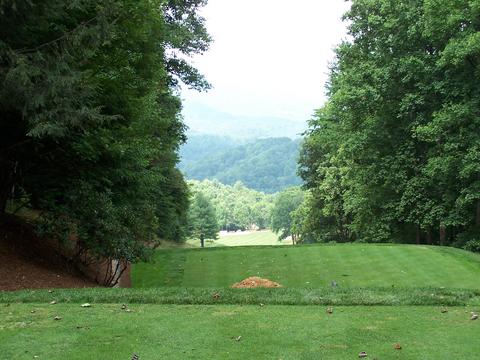
The par 5 12th at Red Tail Mountain starts a few stories above the fairway...
Red Tail Mountain, a two-year old community in a remote area of eastern Tennessee, has hired the Troon golf management company to supervise operations at its golf course. Red Tail Mountain was one of the most interesting courses I played last year, and one of its par 5s is still seared in my memory. It featured a four-story high tee, a fairway that was severely humped in the middle, and most unusual lay-up and approach shots. Entry to the green is over a rock outcropping at right front; behind the green is a sheer two-story cliff that looks as if it will throw long shots back onto the green. According to the assistant pro at the course, it doesn't work that way; he's hit buckets of balls at the cliff and very few bounce straight back.
Red Tail, which is located in Mountain City, is about 40 minutes from the attractive mountain community of Boone, NC. Real estate values currently reflect Red Tail's rural location; combine attractive prices, an intriguing golf course with a dramatic layout, and Tennessee's lack of a state income tax, and Red Tail Mountain has a great shot at success. The hiring of Troon demonstrates that it is serious about upgrading its golf facilities. That won't hurt either.
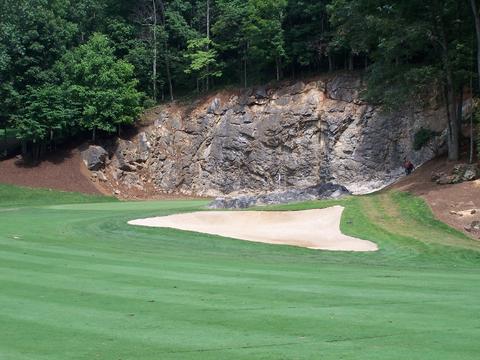
...and gets even "harder" the closer you get to the green.
Myrtle Beach course of history won't change
Chips and putts

Now on Sale

- The only book about golf communities in the last 10 years.
- 156-page step-by-step guide to finding your dream golf home.
- Info on nearly 100 golf communities the author has visited.
- Paperback version costs less than a sleeve of Pro VIs.
Here is what the experts are saying:
“The book is chocked full of information…applicable to anyone looking for a move to the Southeast regardless of whether they are looking for a golf community or not.” — John LaFoy, golf architect (Linville Ridge CC, CC of Charleston, The Neuse GC)
“Larry has done a tremendous amount of work and anyone — like me — who is looking to search for a golf home now or in a few years needs this book.” — Brad Chambers, golf blogger, ShootingYourAge.com
“Wow! What a thorough piece of work…a must for anyone moving South. This book will help many people.” — Brett Miller, owner and founder of MMA, Inc, a golf industry consultancy
Buy It Now at Amazon.com or BarnesandNoble.com.