Golf community choices small but wide ranging in popular Chapel Hill

The Davis Love design at The Preserve at Jordan Lake is tough, with many forced carries.
Few southeastern cities with golfing communities can boast also of professional sports franchises and big-time collegiate athletics. Miami, Atlanta and, to a lesser extent Charlotte, come to mind, but after that the pickings are slim –- until you look at the “triangle” of cities formed by Raleigh, Durham and Chapel Hill. Today, the area has something much bigger cities can only dream about, a world champ team in the Stanley Cup winner Carolina Hurricanes of the National Hockey League.
The University of North Carolina and its 26,000 students are the focal points in Chapel Hill, although Duke and NC State are within 35 minutes, and all the culture that revolves around a major university make the town one of the most desirable places to live in America. The area's international airport is within 35 minutes of most points in Chapel Hill, and healthcare, shopping and employment opportunities, especially in an area of so many universities and the famed Research Triangle Park, are plentiful. The restaurants are good and varied as well (Carolina barbecue, anyone?).
Chapel Hill golf communities are few in number but offer a range of options, real estate prices and golf courses. The Preserve at Lake Jordan presents a community at the rural edge of the Chapel Hill area, with reasonably priced homes for their size and location, as well as a tough golf course. Chapel Ridge, like The Preserve a member of the Bluegreen Corporation group, is just a little over a year old and will appeal to retirees as well as young families. The Bill Moore and Fred Couples-designed course is easy on the eyes and the scorecard. The Governor’s Club is the standard in the area by which all communities are measured. Its undulating roadways, dramatic rock outcroppings, challenging Nicklaus Signature Course and involved members ensure stability and solid resale values.
As an alternative to the golfing communities, Old Chatham, which had the misfortune of opening two days before 9/11/01, offers a strong private club ethos and the closest thing in Chapel Hill to a pure golf experience. No houses encroach on it. In coming days, we will review them all, starting here with The Preserve.
Love is all you need…if you are a masochist
The Preserve at Jordan Lake is more like The Preserve Near Jordan Lake; the lake is actually across the road from the entrance to the community. Nevertheless, the community has grown quickly since properties were first sold in 2002, the same year its golf course opened. More than 250 homes have been built and occupied on the community’s 516 lots, with scores currently under construction. That is a lot of activity for a community that imposes no timetable to build. Lots average ½ acre, although some top one acre, with prices in the $100,000 to $200,000 range. Nice-sized homes of 3,000 square feet begin at just above $500,000. The developers, the well-regarded Bluegreen Corporation, maintain a list of four “preferred” builders who account for more than 90% of the homes built to date.
The Preserve is not gated and, for the time being, anyone can play the “semi-private” course by calling for a tee time. The community, which has no townhouses or condos, has a neighborhood feel to it. Landscaping throughout is well maintained by the residents who are an equal mix of young professionals and “empty nesters,” age 55 and older. However, if you have done your job of raising kids and would like to be in the company of adults-only in your new community, The Preserve may not be your idea of laid-back retirement community. The young adults have produced a significant number of offspring.
All the customary amenities are available on the property. The fitness center is modern but small; more than the current two tennis courts may be needed at full build out. For water aficionados, Jordan Lake is close, but we did not have a peek at it as we made our way around the golf course.
The Preserve, which seems out in the country, is 30 minutes from mall shopping and 15 minutes from a supermarket and pharmacy, but commerce is coming closer every day; a few miles down NC Highway 64, the big handyman chains Lowes and Home Depot have both opened stores. The University of North Carolina Hospital is just 20 minutes away.
You’ll need to warm up on the irons-only practice range before you tackle the golf course. The course is a stiff challenge, right from its opening hole. A short par 5 at just 492 from the men’s tees (512 from the back), it is one of the toughest starters we have played, with a fairway that slopes severely left toward a creek and marsh area and then forces a second shot that must carry the same creek as it meanders across the fairway (and you better hit a power draw to position for a reasonable third shot). The pin on the elevated green was rear right, behind a menacing trap. We prefer our warm-up holes a tad less penal.
Later, have a Power Bar or two at the turn, because you’ll need the energy on the par four 10th. A dogleg right, it plays 438 from the men’s tees (470 from the back) over a stream, with a trap guarding the inside elbow at 222 yards out from the tee box. If you are fortunate to have hit a 250-yard drive down the left side of the fairway, only 180 yards or so remains to carry the stream that guards the front of the long, deep green. That is a big “if,” since the dog’s leg is narrowest where good drives should wind up. We won’t easily forget number 14 either, a 500-yard par 5 that dares you to carry a long second shot (or short-iron third) to pin positions set beyond 30 feet of false front. “False” is putting it mildly, since the front goes almost straight up. We wondered if they throw a rope around the guy who cuts the green to keep him from tipping over.
Players with handicaps of 13 or more shouldn’t go near the men’s tees (rating 72.7 and slope of 140), and many will suffer frustrations from the shorter tees (6,116 yards with a rating of 70.6 and slope of 128). As for the tips at 7,100 yards (75.1 and 145), the scorecard recommends that routing for handicaps of 6 or less. The 6-handicap may be a 10 after a few rounds at The Preserve.
Web site: http://www.thepreserve.ws/golf.

Trouble front and back is typical at The Preserve.
Coming tomorrow: Chapel Ridge
 Home On The Course newsletter
Click here to sign up for our Free monthly newsletter, loaded with helpful information and observations about golf communities and their golf courses.
People who live in glass houses should not live mid fairway
Should any non-golfers be reading this and in the market for a home on the course, here's our take on the best positions for your home. First, behind a tee looking down the fairway; the views will be great and you'll have no chance to be in the way of a 100 mph pellet rocketed at your home. Next choice is at greenside on a par 3, preferably left of the green (ball flights from those who hook the ball, we all know, are more predictable than from those who slice). A body of water separating you from the green adds an extra measure of precaution -- and helps with the view as well. The worst place for your house is about 200 yards down the right side of a par 4 or par 5; if you must have your house there, have a strong roof, preferably not metal, and shatterproof glass. Avoid the ubiquitous stucco exterior so popular in Florida and Arizona lest the outside of your house wind up looking as if it were in downtown Baghdad.
Consider yourself warned.

Two degrees of separation: If you need to live at mid fairway, try to get a body of water between you and a big slice. This home at Debordieu near Georgetown, SC, is well positioned for dent-free living.
Been there, done that
And then we miss the putt. We slink off to the 19th hole, our partner's "that's okay" small compensation (and we don't believe him anyway). But a few beers later, the pain dissipates and we get on with life, never to remember the missed three-foot putt until, of course, the next crucial three foot putt.
We thought of this yesterday after watching Heath Slocum miss something a little over the dreaded three feet which would have sent him into sudden death with Mark Calcavecchia at the PODs Championship, one week after Boo Weekley missed the same length putt that would have won the Honda Classic, what would have been his maiden win (and all the riches and security that would have led to). He lost in a four-man playoff the next day (how excruciating that night's sleep must have been). The next time I stand over a three footer for the win, I'm going to think about Weekley and Slocum, about how much a missed three footer cost them relative to what it will cost me, and I might, just might, do a better job of getting the putter head through the ball. Unless, of course, my partner threatens to throw his arms and legs around me.
Maybe the toughest finishing holes on Myrtle Beach's Grand Strand
Note: We've added to this post a few more photos than typical. They may take a little longer to load. We think your patience will be rewarded.
We have played the majority of the courses in the Myrtle Beach area over the last 30 years, and are familiar with many of the rest. The toughest three finishing holes on the Grand Strand of South Carolina’s coast could very well be 16 through 18 at Pawleys Plantation. Even without the almost relentless breezes that blow in from the ocean just a half mile away, the three may be among the toughest in all of the golf happy state of South Carolina.
The fun starts at the 16th, a long par 4 dogleg left with a huge live oak at the corner that is far enough out to prevent all but the biggest hitters from attempting to cut the corner. Even the big boys have good reason to hold back, since beyond the tree is just about 20 yards worth of fairway before you reach the marsh, which runs from about 160 yards out all the way to the right side of the green. Only a large greenside bunker separates the marsh from the putting surface. The problem is that if you take the conservative route to the wide part of the fairway, you leave yourself anywhere between 165 to 210 yards to a green that has a very narrow opening, with the aforementioned trap on the right and a few mean ones on the left (especially nasty since the green slopes away from them). The green also slopes back to front, with the marsh and the Pawleys Island beach framing the area beyond. Should you rip your approach shot long and left, you could find yourself on the narrow neck of Tiff Eagle grass that connects the 16th green to the tiny 13th, the short par 3 that members love to hate (the hard, small green is surrounded by marsh).
Should you conquer 16 – and by conquer, we mean escape with a one-putt par – the all-carry par 3 17th could dash your hopes for a good score. Typically played downwind, the green is contained in front by a bulkhead that echoes designer Jack Nicklaus’ tutelage with Pete Dye in the early 1980s. The green is no more than 20 paces or so deep, tough to hit on the occasional calm days, nearly impossible on windy ones. The drop area to the right of the green is no picnic either, especially when the pin is way left. The long pitch shot must negotiate a strong slope upward in the green, as well as the putting surface’s strong back to front orientation. Hit too far over the green – we’ve done it a number of times – and out of bounds comes into play. If #13 has a rival for frustration, #17 is it.
The finishing hole is almost a relief, but don’t count on it until after you have hit your drive slightly to the right of the long bunker which appears to cut half the left side of the fairway. Play too safe to the right, and you might find yourself in the trees; at best, you’ll be hitting your approach shot from a bed of pine straw. Pull your approach ever so slightly (if you are a right-handed player) and the large pond that guards that side of the green will drive you straight to the 19th hole. The best pin position – we mean the easiest – is at front, as the green narrows as it moves back and the contour is decidedly toward the water, with only a narrow trap to save you from the deep. It is a good finishing hole, not a great one perhaps, but after the 16th and 17th, you don’t need great.
Pawleys Plantation is a gated community with its entrance on Highway 17 in Pawleys Island, SC. The club is semi-private which means that anyone can play it in the summer months. At other times of the year, first choice for tee times goes to those renting homes in the community and others staying at selected local hotels. The men's tees play at 6,522 yards with a rating of 72.5 and slope of 137. For the low single-digit players, the Golden Bear tees play at 7,026 yards with a rating of 75.3 and slope of 146. All properties in Pawleys Plantation are resales, with 2 BR, 2 BA condos starting around $200,000, patio homes beginning in the mid $300s, and nice single family homes beginning north of $450,000. Your editor owns a condo in the community.

The entrance to the 16th green at Pawleys Plantation is narrow in the extreme, with marsh and traps right and traps and out of bounds left.

#17 is all carry over marsh, typically downwind. The green is not deep, with out of bounds just 15 yards over the back.

The drop area to the right of #17 is no picnic either. The pitch shot is uphill to mid-green, then downhill and left if the pin is on the far side.

The drive on #18 is longer than it looks. It will take about 200 yards to clear the large left bunker. Play too cautiously out to the right, and the trees will block your approach shot.

The last approach of the day cannot be taken for granted. The edge of a large pond guards the front left, and if you fly it, a menacing bunker awaits beyond. The green tilts toward the water, so landing on either side of the green is a dubious option.
Join one club but have "membership" in many
Golf-playing residents of each community are lucky and smart because their membership in one provides them with privileges at the other for the price of just a golf cart rental (about $25). The courses are a mere 25 minutes apart. What’s more, all courses in LandMar’s communities, as well as many clubs managed by the affiliated Crescent Communities, are available to members of any club in the LandMar group (and vice versa),. These include some well-regarded courses such as Ballantyne in Charlotte, NC, Oldfield in Okatie, SC, The Rim Golf Club in Payson, AZ, and Sugarloaf in Duluth, GA. In all, we count more than 20 clubs available to a Landmar (or Crescent Community) golf club member.
This is not unique. ClubCorp, another owner of not only golf clubs but also social clubs worldwide, provides similar perks for its members, including access to the courses at Pinehurst, which ClubCorp runs. And I know from personal experience that the Private Club Network, a division of Creative Golf Marketing, provides reciprocal privileges for members of its client clubs. CGM is working with my home course of Hop Meadow in Simsbury, CT, to increase the number of members; the Hop has joined the Private Club Network, which gives me and my fellow members the ability to play any of 180 courses nationwide for the price of a golf cart rental. I've tried it, and it works well.
Troon Golf, which owns many excellent daily fee as well as private clubs, offers discounted greens fees to most of its courses for members at one. You will pay more than the cost of a cart rental, but to many, access is most important.
As you plan to join your next club (or your first), consider that you could wind up “belonging” to scores of them.

North Hampton Golf Club is the best Arnold Palmer design we have played, and it is available for the price of a cart rental to any member of a LandMar Group golf club.
Hurricane tally: History says Jacksonville, Savannah safest
In those same five and a half decades, the Atlantic coast of Florida bore the brunt of 13 hurricanes, including the catastrophic Andrew in 1992, a Category 5 (winds above 155 mph), and Donna in 1960, a Category 4 (winds 131 to 155 mph). South Carolina took eight direct hits in the same time, including the Category 4 Hazel (1954) and Hugo (1989), and North Carolina a dozen, but only Hazel as high as Category 4.
As we know from recent memory with Katrina, the Gulf Coast, from Texas to the panhandle of Florida, is at high risk of damaging hurricanes. Before Katrina, there was Camille in 1969, another Category 5 whopper. As you look at the NOOA’s map of hurricane strikes, there is a consistent stream of circles (strikes) from the area of South Padre Island, TX to Panama City, FL, then sporadic activity down to the Naples/Fort Myers area. From there it is a pretty constant line of strikes up and around the tip of Florida (and through the Keys) until you get to the Vero Beach area, where the aforementioned David first made landfall in 1979. From there up the coast to the northernmost point in Georgia, we count only Hurricane Dora in 1964, which landed just south of Jacksonville. It was the only hurricane recorded in St. Johns County since such things began to be noted in 1851.
By the numbers since 1955, you are more at risk of a hurricane if you live on Long Island, New York than if you live from Jacksonville to where the borders of Georgia and South Carolina meet. For those who are hurricane obsessed, the areas of Jacksonville and Savannah are historically a safe bet.
The hurricane map is available at the NOAA’s website [click here].
Quote of the Day: Pollyanna turns a little scary
Economists and meteorologists share a common trait: They predict, then they explain why their predictions were wrong, then they predict again...and on and on. Lereah has been predicting the imminent return of the housing market month after month after month. To him, there is never anything inherently wrong with the housing market; not over-speculation, not too many realtors chasing too few buyers, not some agents' pandering to homeowners' lust to get the highest possible price for their homes. No, it is the weather's fault, as if people who are looking for a home don't own warm coats.
Lereah is at his blindingly obvious best when he says, "Housing remains a great long-term investment"; to extend the weather metaphor, that is almost like saying the sun will come up tomorrow. However, if a shill like Lereah, who always predicts happy days just around the corner, is now saying it may take "a couple of months" before we know about the market's status, then we should be afraid. Very afraid.
Golf Course Review: Long Point and good company ends Amelia swing on high note
Long Point is the best course on Amelia Island, the locals say. And we would agree after playing it yesterday, the third we played during our short visit. Tom Fazio's layout threads its way through the marshes at the south end of the island, emerging for two par three holes onto the ocean, just for variety's (and drama's) sake. Fazio works best when the land comes to him, and so at Long Point the fairways are as nature intended -- rolling, not funneled. We forgive the designer for a few uncharacteristically large mounds in mid fairway. But that's a minor nit on an otherwise brilliant track.
We had the great good fortune to be matched with three fine gentlemen from the Jacksonville area: Bill Swerbenski, who arranged the golf; Steve Roberts, a native of Wales; and Jack Hofstetter, a local real estate agent. All are members at th Sawgrass Country Club. Bill is a former accountant and, not surprisingly, he wound up on the positive end of the day's wagers. I paid for a few bad shots, but otherwise had my best round of the week, an 83 (not that you asked). We played the blue tees at a mere 6,121 yards and a rating of 69.6. The slope is a modest 125. The wind blew at about a steady 10 mph, with gusts to 20, and I thought ithe course played harder than the rating.
Long Point, which is a private club but playable if you are a guest at the Amelia Island Plantation resort, is a must play if you are ever in the area. The Jacksonville golf community market has heated up in the last few years, and there are many great options. The area is up and coming area for those who want to live the golf lifestyle; there is much relocation from south Florida to the area, as well as the customary snow bird migration from the north.
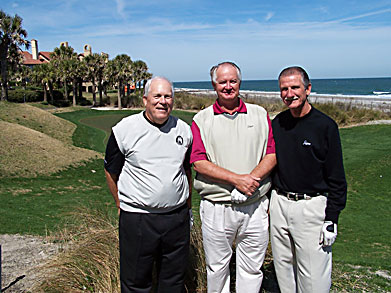
Left to right, Jack Hofstetter, Bill Swerbenski and Steve Roberts at one of the two ocean holes at Long Point, both short par 3s and both dead into the wind.
Golf Course Review: Old Trail community course quirky but playable

Old Trail, which sold its first piece of property in early 2005, is somewhat avant garde among its peer Charlottesville, VA, area communities. The niche for the Crozet, VA, community is more populist than the upscale Keswick or the buttoned up and more dramatically scaled Glenmore, other fine communities in the area which we will review in future posts. Old Trail will have no gate, manned or otherwise. The community includes sidewalks and a park area to promote a sense of neighborhood. When built out, natural spaces will include six miles of walking trails and 75 acres of parkland. A “town center” will be the central point in Old Trail; the furthest extremity from the 250,000 square foot center will be a mere 10-minute walk. Plans call for a restaurant, shops and offices; the first shops should be open by early 2008. The goal is that people from the nearby town of Crozet will also use the town center for shopping and dining.
The golf course is links style, different in that regard from most other courses in the area. Condition of the turf was quite good; we liked especially the Zoysia grass fairways in which the ball sat up nicely. The design by Jerry Kamis, a PGA pro and one of the developers of Old Trail itself, is fairly straightforward, although the layout seemed to require more than typical placement shots from one piece of land to another; we felt as if we had played a dozen par 3s by the end of the round. The course strikes another odd note in that it includes only eight par 4 holes, two fewer than typical layouts. The 18th hole is a little strange. At the midpoint on the dogleg left 406-yard par four (from the men’s tees), the fairway stops abruptly, dropping a good two stories to the level below, the hill padded with thick rough. We opted for long irons rather than metal, believing a layup would leave us a modest approach to the green way below, and that driver would put us on the hill in the rough. We wound up on the hill anyway and were left with a lie that put our right foot almost at waist level in the thick rough. There are better ways to make a finishing hole challenging. That said, nothing else seemed unusual, with the exception of the llamas that stared at us from the backyard next to one tee box.
The Old Trail Golf Club is fashioned after early Scottish clubs in which the public had access and a few “founding” members had extra privileges. Memberships are available at $4,000 for non-residents and $2,000 for anyone who purchases a lot or house in the community. Monthly dues are a reasonable $250; property owner association dues add another $47 to $116 per month, depending on whether you own a single-family home or town home. This week, the modest-sized clubhouse opens; the developers are counting on the town center, not the clubhouse, to be the community’s gathering place. Even the community pool will be located at the town center.
More than 100 homes are occupied in Old Trail. Most of those who have purchased property plan to live there year round. At full build out, which the developers expect to be in nine years, Old Trail will include 2,000 homes of varying styles and sizes, and more than 5,000 people. Single-family houses on the larger lots (up to ¾ acre) range up to $1.4 million for the largest home, at 6,000 square feet. Houses on patio lots are in the $450,000 to $600,000 range. Town homes in the first phase are sold out, but a new phase is planned for June. Architectural standards in the community are strict; we were impressed that no garages are permitted to face the street, and that no vinyl will ever line the exterior of an Old Trail home.
Old Trail is a new concept in golf communities in the Charlottesville area. It is wide open, embracing of the nearby community, and without pretension. It will appeal to those who don’t believe good fences necessarily make good neighbors. The course has a nice links style to it, and a couple of clunky holes do not ruin the fun. Contact Old Trail Village Sales Executive Jonathan Kauffman at 866-567-8100, or JK@oldtrailliving.com. Web site: www.oldtrailliving.com

The Blue Ridge Mountains provide framing for the picturesque Old Trail, designed by PGA pro Jerry Kamis.
Golf Course Review: Ocean Links course short on yardage, long on challenge
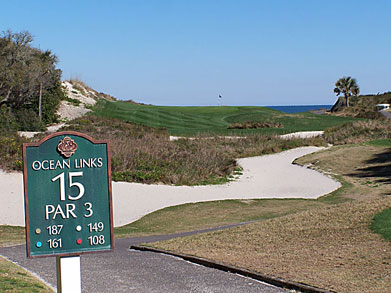
"Jeez," was my first impression when I looked at the scorecard for the Ocean Links course and saw it played just 6,100 yards from the tips (and had six par 3s). "Where are the windmills and the clown's mouth?"
Then I played this fine par 70 Bobby Weed layout at Amelia Island Plantation in Florida and learned there is nothing mini about it.
Weed was given a piece of land not unlike what Pete Dye enjoyed at the famed Ocean Course at Kiawah Island. Dye, however, had nothing but ocean and sky framing his layout; a few of the ocean holes on Weed's course are draped with hulking condominium buildings, some seven stories high. The off-ocean holes are lined with houses, set back in most cases at a safe reserve, but a few are definitely in the danger zone.
Keep your blinders on and focus on the shots before you, and you will enjoy a terrific round. Most memorable is the 15th, a lovely terror that emerges from the beautiful live oaks and runs downhill 187 yards to a green surrounded by sand dunes and backed by the blue Atlantic ocean. It is perhaps the only hole on the course where even your peripheral vision does not capture any manmade structures. My playing partner, also a first timer at the Ocean Links, emitted a "Whoa" when we came up to the tee. This was one of the rare moments of crosswinds during the round, and we both wound up short right, much preferable to left where recovering from the dunes would have been next to impossible.
At the 6,100 yards, the course rating is 69.3 and the slope a modest 128. We found it tougher than that. We will have more to say about Ocean Links and its companion course, the Pete Dye designed Oak Marsh, as well as Amelia's members-only club, Long Point, in coming weeks.
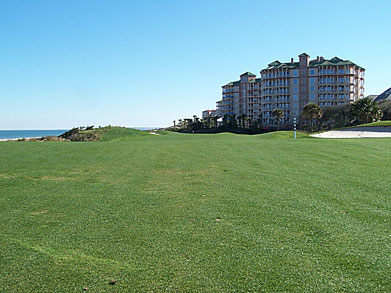
After the tough and beautiful par 3 15th, the tee ball on 16 must thread the needle between the dunes. Hundreds of people could potentially bear witness to your approach shot, a tricky downhiller to a green partially obscured and backed by nasty thick grasses and sand.
Best restaurant in St. Mary's, GA
Now on Sale

- The only book about golf communities in the last 10 years.
- 156-page step-by-step guide to finding your dream golf home.
- Info on nearly 100 golf communities the author has visited.
- Paperback version costs less than a sleeve of Pro VIs.
Here is what the experts are saying:
“The book is chocked full of information…applicable to anyone looking for a move to the Southeast regardless of whether they are looking for a golf community or not.” — John LaFoy, golf architect (Linville Ridge CC, CC of Charleston, The Neuse GC)
“Larry has done a tremendous amount of work and anyone — like me — who is looking to search for a golf home now or in a few years needs this book.” — Brad Chambers, golf blogger, ShootingYourAge.com
“Wow! What a thorough piece of work…a must for anyone moving South. This book will help many people.” — Brett Miller, owner and founder of MMA, Inc, a golf industry consultancy
Buy It Now at Amazon.com or BarnesandNoble.com.