The Big Break: Save thousands by moving
Whether you look at it as money saved or money earned, moving from a high-cost place to a low-cost place will put a pile of dough back in your budget or your bank account. How much depends on your lifestyle and how much you spend on an annual basis.
In conducting research for an article in this month’s Home On The Course newsletter -– click here to subscribe, it’s free! –- we found savings as high as almost 60% if a couple were to relocate from an expensive metro area like San Francisco or New York to a nice golf community in a remote and pleasant low-cost area of the Carolinas or Tennessee. For a couple that spends a total of, say, $100,000 annually -– not hard to do in some of the highest cost metro markets in the nation -– the savings could pay for pricey annual club dues, a complete kitchen makeover and a European vacation.
In our latest issue of Home On The Course, we pick a few city pairs and show specific examples of savings, along with our recommendations of golf communities in the destination towns. We also make the case for why anyone searching for a golf community home should insist on copies of all documents relevant to the development of the community, including covenants and restrictions. One South Carolina community’s residents are suing its club (and other residents) for enforcing a new mandatory membership plan. If only they had read the documents carefully (or at all).
Home On The Course will be sent to our thousand email subscribers in the next couple of days. Sign up now so you don’t miss it.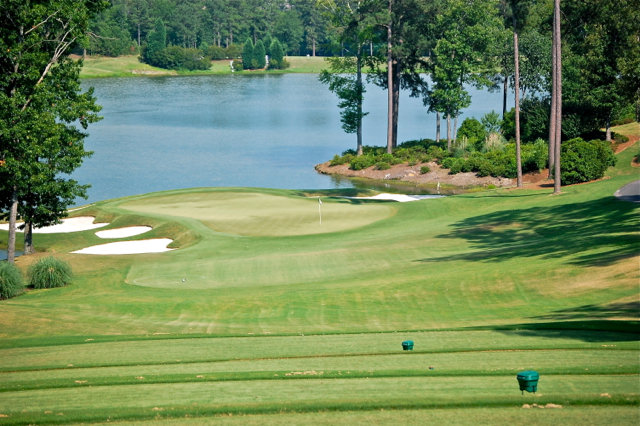 If you were to move from, say, Stamford, CT to this community in Aiken, SC, you would save about 50% per year on your total expenses.
 Home On The Course newsletter
Click here to sign up for our Free monthly newsletter, loaded with helpful information and observations about golf communities and their golf courses.
Gillette Ridge Golf Club Mismanaged to Death
The Gillette Ridge Golf Club was dogged by miscalculation and mismanagement from the moment it opened in 2004. The original owners of the Bloomfield, CT, public facility laid out in the middle of a major office park had the bright idea to task the Arnold Palmer design group with building one of the toughest layouts in the area. What they produced was a golf course that wasn't so much tough as it was unfair. The greens, at opening, were rock hard, and the combination of concrete greens and a bunch of forced carries gave the layout a quick reputation for unfriendliness, especially among women and junior golfers. No one would want to learn to play on a course that difficult. I recall following my son and his high school golf team around the course during a competition, and mid 90s was the median score for kids who typically shot in the mid 80s. Fun and the Gillette Ridge golf course were never mentioned in the same breath by anyone who played it.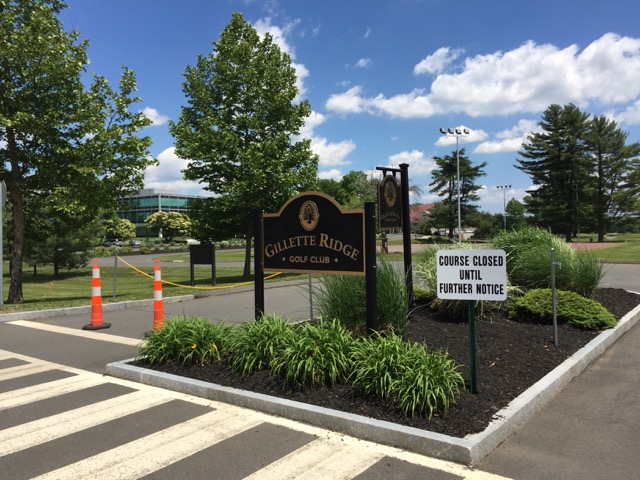 Gillette Ridge Golf Club in Bloomfield, CT, closed without warning a few weeks ago, although warning signs were there last September when the troubled owners filed for bankruptcy.
Those who ran the club, especially the latest owners, were also uncreative in the extreme. Thousands of office workers stroll through the grounds at lunchtime every day, and many of them stopped at the club's competently run restaurant for a meal and drink after work. Whenever I played the golf course in good weather, I noted that the restaurant was nearly filled, the patio included. With that kind of captive audience, all wage earners, you would think any marketing program could have reeled in a good number of them to play the course after work and on the weekends (virtually all of them live in the area).
The club should also have been able to count on the surrounding group of homes that were developed in concert with the opening of the club. With hundreds of residents within an easy stroll of the first tee, one wonders why they could not be engaged to form a core membership in the club. After all, we know that about half of those who live in a golf community do play the game, at least occasionally.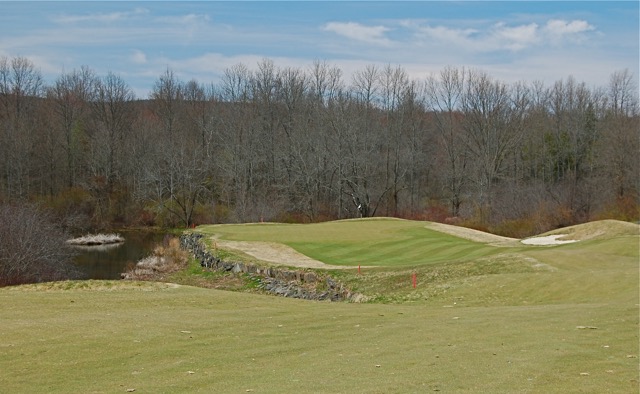 Even after the layout was softened, many golfers found the approaches too severe, such as at the par four 4th hole, with all carry to a small green that tilted hard right to left toward a menacing pond.
Within a few years of opening, the owners of the club softened the golf course's severe layout somewhat, making the approaches to the greens a little easier and doing what they could to make the greens a bit more receptive. But despite a few wonderful holes –- the almost drivable par 4 10th is one of them –- and unusual landscaping touches, such as the massive sculptures beside the 17th fairway, perceptions of the course had already been cemented. Given a choice between Gillette Ridge and nearby Wintonbury Hills, the Bloomfield municipal course designed by Pete Dye and opened within a couple of years of Gillette Ridge's debut, virtually everyone I know would choose Wintonbury.
Gillette Ridge closed a few weeks ago after its owners filed for bankruptcy last September. MDM Golf, run by a former golf pro, had been kicked out of two other golf courses it manages for unpaid bills and mismanagement. At the time of the Gillette Ridge closing, MDM owed its creditors well over $6 million.
I stopped by Gillette Ridge the other day to see if there were any signs of life. One gardener with a weed whacker was attending to the lawns surrounding the parking lot. The course, from the vantage point of the clubhouse patio, was overgrown and the greens I could see appeared to be burned out. The shuttering of Gillette Ridge just as the Connecticut revenue-generating golf season began was sadly ironic for a club whose management never had its timing or organization quite right.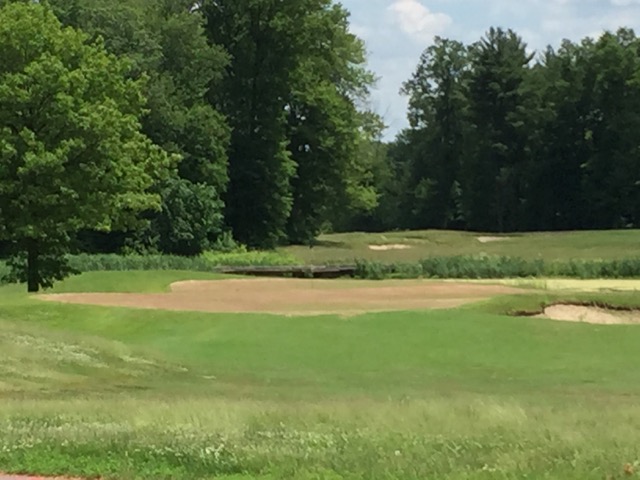 One of the saddest sights for a golfer, a dead green, in this case #18 at Gillette Ridge.
Winning Never Gets Old
At age 67, there are not many more athletic achievements ahead for me. But golf handicaps are the great equalizer in terms of competition, and if you have a good day against your own standards, you might win a dollar or two, or even a trophy. But in order to win an event at a gross score, you pretty much need to be playing on a team of good players.
Yesterday, at Shuttle Meadow Country Club in Berlin, CT, a classic Willie Park layout, our ragtag foursome started well, sagged in the middle of the round, and regained a little momentum by the end. Yet even when my son Tim sunk a 12-foot birdie putt on the last hole we played in the shotgun charity event, we never imagined our -1 score of 70 would get a sniff of even third place in the gross competition.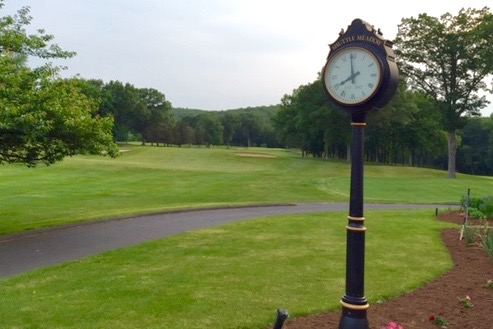 The 1st hole at Shuttle Meadow Country Club in Berlin, CT
For sure, we had no chance in the net competition. Our 'D' player had an awful day and only on two holes was he still in play by the time he made it to the green. (In neither case did he contribute to the net score.) Our 'C' player sculled his tee shot on the first hole, a par three, through tall grass and rough and up onto the green, 15 feet short of the hole. From there he made his putt for a birdie 2 and a net 1. That seemed like a good omen...for two more holes, after which we all sprayed our tee shots into the wind on a par 4 named "Bottle" and posted a gross and net 5, a deadly score when you are competing against 26 other foursomes. (After his initial birdie, our 'C' player had said, in jest, "OK, I'm retiring now..." and he pretty much did the rest of the way.) It only got worse on the 18th hole, the tenth one we played, when the pin position at the very back right of a green that rises a good 10 feet from front to back, gave us fits and led to a gross/net bogey 6.
Tim was our "ringer," a last-minute substitution for a friend who tore a ligament in his thumb three weeks before the event. Tim contributed four birdies against his 1 handicap -– the event was played at 90% of full handicap -- and I pitched in a few pars. Still, the only thing we thought we might win was longest drive; Tim's drive on the 10th hole was 270 into a stiff wind. But at awards time, the announced winner was someone else who, as the emcee shared, "once held the U.S. record for the fastest golf swing." I saw him later and he told me his drive was measured at over 300 yards.
When they announced third place for team gross at par 71, we knew we were in the money. On a match of cards –- we parred at gross the five toughest holes -- we were announced the winners; our prizes were $100 pro shop credit each. I spent mine on a shirt and hat. I would have been happy with just the recognition.
*
The charity golf event, which is held within a couple of weeks of Fathers Day each year, benefits the Fatherworks program at The Village for Families and Children in Hartford, CT, where I have served as a board member for the last 12 years. In a nutshell, Fatherworks encourages young men who have fathered a child to step up to the responsibility of fatherhood and provides them with the tools to be a supportive, nurturing parent. Each year at dinner after the golf, a father The Village has worked with shares his story about how The Village has helped him define his role in relation to his children and, in so doing, has redefined his role as a man. The stories are both riveting and elevating. Fatherworks is a good cause, and if you get anything of value from this blog, I would be grateful if you considered a small donation to a great cause at The Village for Families and Children. [Click here] Thank you.
Golf homes for...$400,000
This is the first in an ongoing series of articles about golf homes in excellent golf communities currently on the market at specific price levels. If you are interested in more information about any of these homes or have your own price range in mind, please contact Larry Gavrich, founder and editor of Home On The Course, LLC, and I will be pleased to provide a selection of current homes for sale in some of the Southeast's finest golf communities.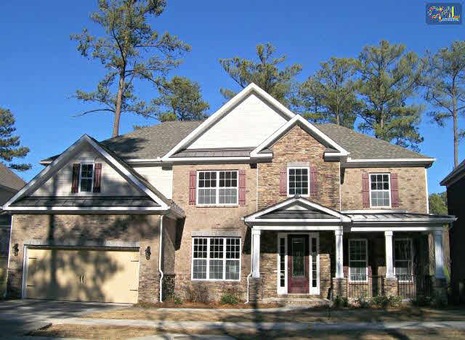
Cobblestone Park
Blythewood, SC
5 bedrooms, 4 bathrooms, 4,045 square feet
$399,900
Cobblestone Park, now dominated by national builder D.R. Horton, features a 27-hole golf course good enough to lure the University of South Carolina golf teams as their practice site. Located just off the Interstate, less than 20 minutes to capital city of Columbia. Positive: Large home priced at $100 per square foot and with views of golf course. Negative: Community had legacy of financial issues; D.R. Horton has stabilized things, but they are building smaller homes than earlier homes, and at lower price points.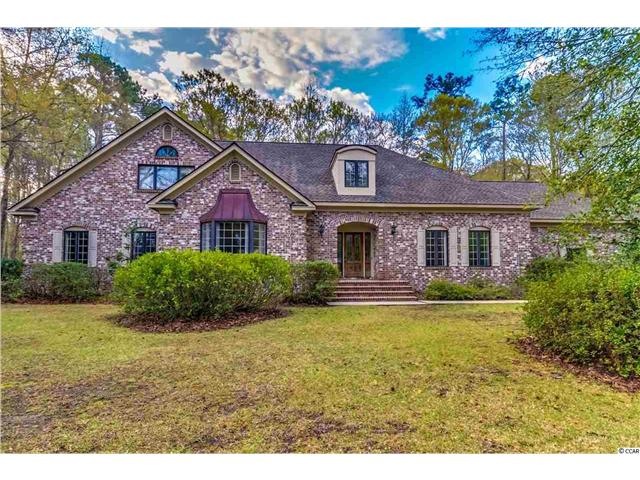
Wachesaw Plantation
Murrells Inlet, SC
4 bedrooms, 3 bathrooms, 3,700 square feet
$399,000
Wachesaw Plantation features a sporty Tom Fazio Low Country designed golf course that finishes along the Waccamaw River (part of the Intracoastal Waterway system). All-brick custom home sits on corner lot just over .56 acres in gated/guarded community. Positives: Inexpensive private club membership; short drive to shopping, hospital, beaches, famed Restaurant Row. Negatives: West of Highway 17 location makes it seem farther from ocean than it is.
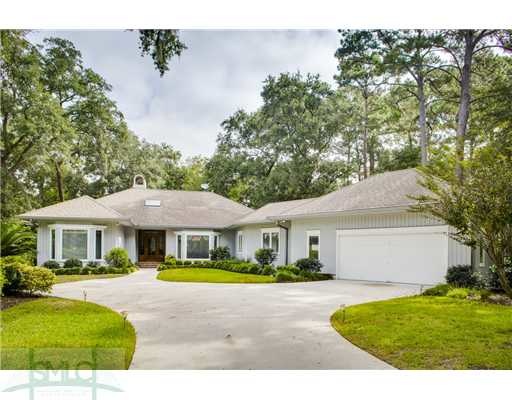
The Landings at Skidaway Island
Savannah, GA
3 bedroom, 3 bathrooms, 3,319 square feet
$399,900
The Landings is one of the best-situated golf communities anywhere, totally secluded but within 20 minutes of downtown Savannah, one of the nation's most interesting cities. The community's six golf courses are impeccably maintained, despite much use by its adoring members. This home is beside hole #4 on the Plantation course and includes a bonus room and one-month old roof. Positives: Golf courses for every taste and skill level; close to major city with all possible services. Negative: 40 minutes to nearest beach at Tybee Island.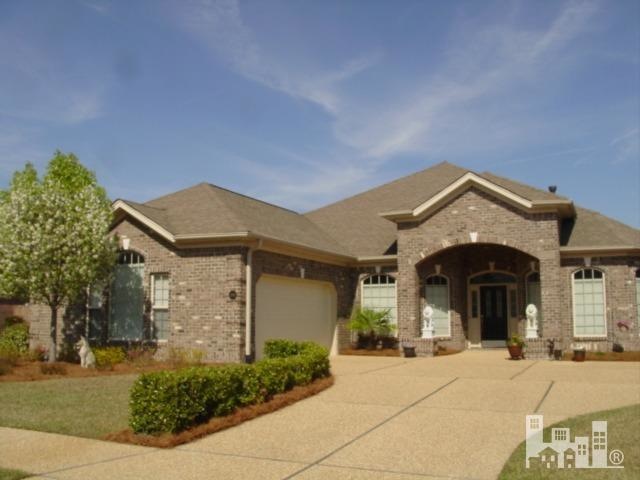
Brunswick Forest
Leland, NC
3 bedroom, 3 bathroom, 2,500 square feet
$399,999
Brunswick Forest is one of the most successful golf communities of the last two decades on the east coast, having skated through the recession of 2008 without any impact on the community. Prices are among the most reasonable anywhere, and the Tim Cate golf course is rated as one of the best to be built in the last 10 years. Positives: 10 minutes to Wilmington, NC; convenient services just outside the entrance to the community. Negatives: No gate, if you care about such things; about 25 minutes to the beach.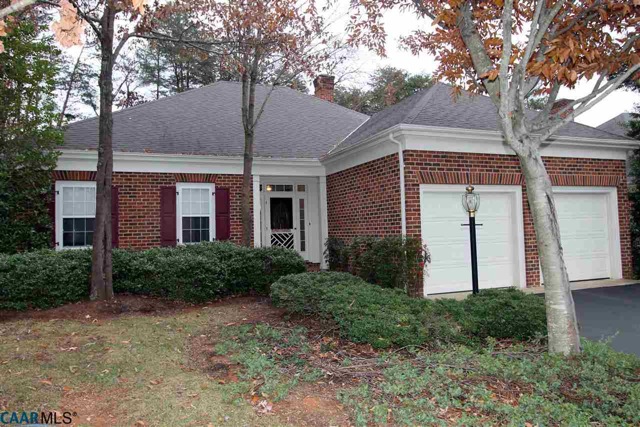
Glenmore
Keswick, VA
2 bedrooms, 2 baths, 1,555 square foot brick cottage
$399,900
Located in the rolling Virginia hills just east of Charlottesville, Glenmore is just a few miles from Thomas Jefferson's Monticello and within easy distance of the University of Virginia, the university the third President built. John LaFoy's 18-hole-golf course is filled with Scottish influences. Positive: Proximity to Charlottesville and events at University of Virginia. Negatives: Real estate a bit pricey, but everything's relative.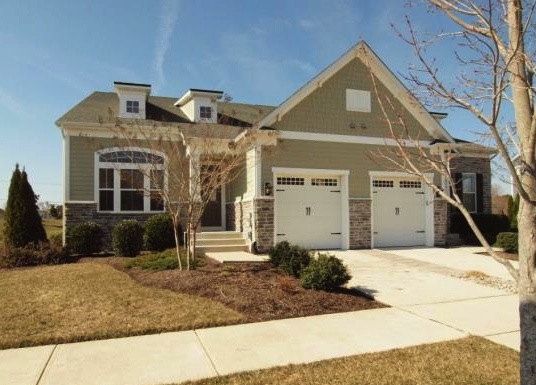
Bayside Resort
Shelbyville, DE
4 bedrooms, 3 ½ bathrooms end-unit townhouse
$399,000
The Bayside Resort is a full service residential resort close to the beach at Ocean City, MD and sporting a well-regarded Jack Nicklaus Signature course, the first in the state. This home sits on a pond and is within a few yards of the Maryland state line. Positives: Access to beaches, proximity the northeast; community is owned by the active local Freeman family. Negative: You will share the golf course with non-residents.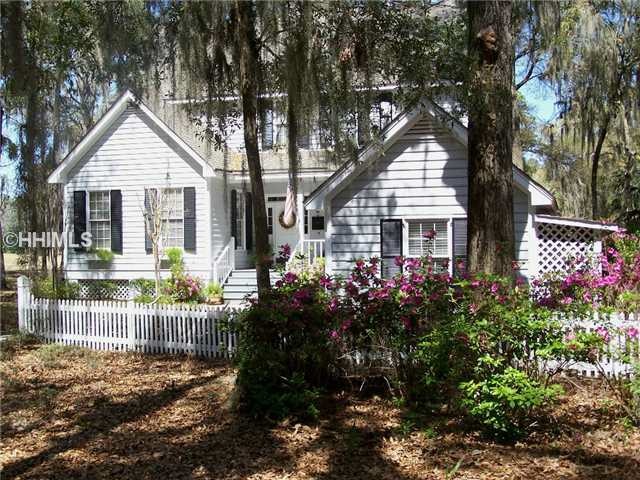
Haig Point
Daufuskie Island, SC
3 bedrooms, 3½ bathroom cottage, 2,520 square feet
$389,000
For those who want the ultimate in serenity, quiet and zero pollution -- no cars allowed – Haig Point is the place, with a 27-hole Rees Jones Low Country layout that looks out across the Calibogue Sound to the lighthouse on Hilton Head Island. Because it is remote and serviced by ferry only, real estate prices are extremely reasonable. Positive: Looks great, smells great (no car pollution) and you are likely to have little competition for tee times. Negatives: The ferry is expensive to run continuously, and overall carrying costs reflect it; supermarket visits (on Hilton Head) require a bit of planning.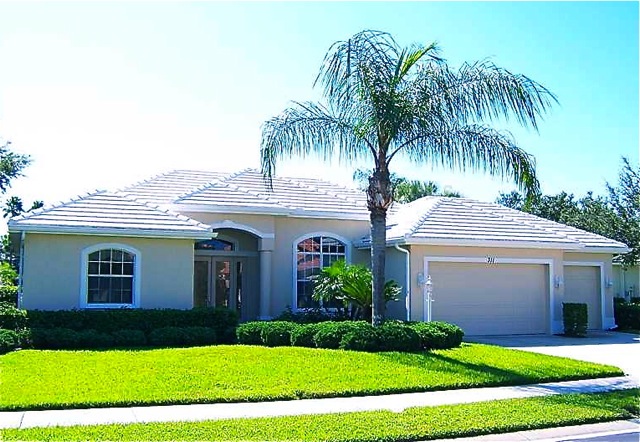
Venice Country Club
Venice, FL
4 bedrooms, 3 bathrooms, 2,581 square feet
$399,500
Located just 20 minutes on the Interstate below Sarasota, Venice Country Club sits on Florida's famed Gulf Coast and offers plenty of house and property for the price, especially given its proximity to the area's famed beaches. Close to the convenience of downtown Venice and to the laid-back ambience of Venice Beach, this home is both spacious and practical and set on a nice lot overlooking a lake. Enjoy the view while basking in a pool with southeast exposure; step out of the pool and flip the burgers on the outdoor summer kitchen stove. Or flip a sand wedge out on the Ted McAnlis golf course.
Fairfield Glade: Cool Living on the Cumberland Plateau
The sprawling community of Fairfield Glade, located on the Cumberland Plateau almost midway between Nashville and Knoxville, TN, has been on my list for a visit for some years now. On a drive from Memphis to our vacation home in Pawleys Island, SC, I couldn't avoid a stop, since the community is just a few miles off the major east/west Interstate 40. It was a short visit, just enough to take advantage of Stonehenge Golf Club professional Jeff Houston's kind invitation to play what most local golfers believe is the best of Fairfield Glades' five courses.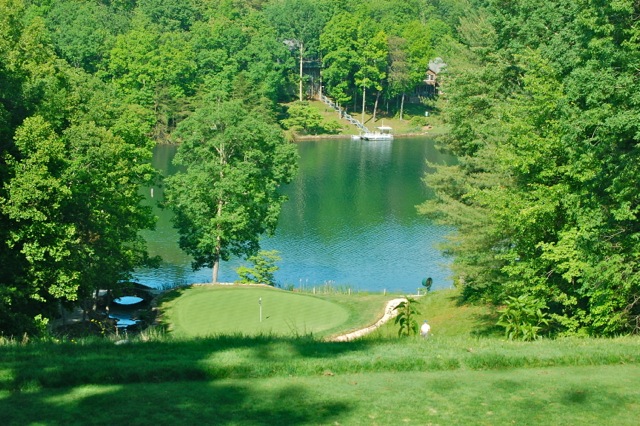 The biggest challenge at the par 3 14th hole at Stonehenge is club selection from 10 stories or so above the green.
Bent grass greens, a golfer's favorite
A site of the state's Women's and Senior Opens, Stonehenge is both challenging and in fine condition as befits a tournament-ready layout. The greens were medium fast and smooth, with plenty of contours. (Stonehenge is far enough north to maintain bent grass greens, most every player's favorite putting surface.) One otherwise routine par 5 featured a long green that ran front left to rear right up a severe slope that I failed to get over after hitting the green in regulation. My second putt, still up the hill, was about 30 feet which I misread, leading to my first four-putt in 10 years. Indeed most of the challenge at the rather short layout – 6,549 yards from the tips – was around and on the greens.
The Hills Are Alive...With Floridians
I finally made a long anticipated stop at Fairfield Glade, the sprawling multi-course golf community on the Cumberland Plateau, midway between Nashville and Knoxville, TN. I'll have more to say about the community in the coming days. During our round at The Glade's Stonehenge golf course, my wife and I were matched up with another couple. Dave and Judy live in Clearwater, FL, but now spend their summers at Fairfield Glade, as of about two weeks ago. Their newly purchased home faces the Stonehenge golf course, but the round they played with me was their first on the Stonehenge layout (they have played the four other other courses).
Of course, I asked why they had chosen this particular community in which to spend a quarter of their year.
"The temperatures and the home prices," Dave replied without hesitation, as if he had explained this to friends and family a hundred times before. He and Judy elaborated that they had had it with the heat in Florida from June through the end of the summer and were looking for a reasonable place to enjoy their retirement summers. Although they had checked out a number of mountain communities in the southeast, there was always something just a little off with the others. For example, one nice northern Georgia community high in the mountains had roads that twisted so much that even the simplest grocery run, they said, would have been a long and arduous journey. Then they found Fairfield Glade, located on the Cumberland Plateau, a flattish region in Tennessee between Nashville and Knoxville that reaches 2,000 feet in elevation and averages 10 degrees cooler than either of the two aforementioned cities (and up to 20 degrees cooler than the hottest days in Clearwater).
Home prices in Fairfield Glade begin in the $100s for condos, and many single-family residences price out at less than $100 per square foot. (More on this in the coming days.) I asked the couple why they hadn't chosen Asheville as a potential area for their home.
"Too expensive," they said almost in unison.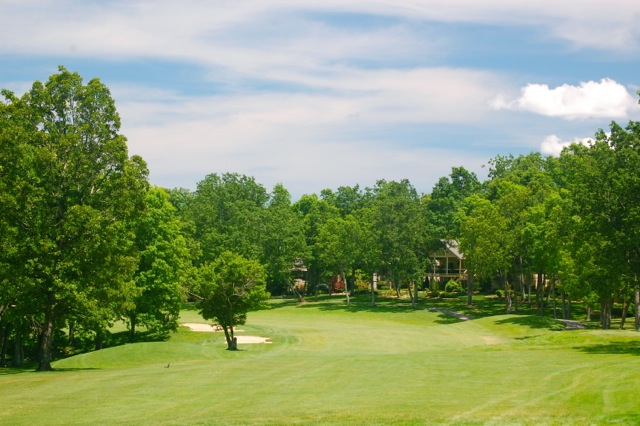 The Stonehenge course is one of five inside the sprawling community of Fairfield Glade, near Crossville, TN.
On our two-hour drive from Fairfield Glade to Asheville, we encountered a surprisingly large number of cars with Florida license plates. Dave and Judy aren't the only residents of the Sunshine State looking for a little summer respite at higher elevations. North Carolina and the upstate regions of South Carolina are attractive lures for those seeking cooler summers. And should a couple from Florida feel the need for a beach in summer, both Carolinas have those in spades, just a few hours from the mountains in both states. On the other hand, Tennessee has no state income tax and treats military and other pensions as well as most states do. There are some cool reasons to consider all three states as retirement venues.
The Case for Mandatory Club Fees
The May issue of our free monthly newsletter, Home On The Course, will be emailed in the next few days. Some of the best golf communities in the Southeast require that when you buy a property inside the gates, you join the club. It's an obligation that, when times are good, can go down as easy as a mai tai on the back deck. But at other times, such as the housing recession that lasted from 2008 to 2012, such fees caused a lot of heartache -- and some surprising bargains for those willing to take on the obligation today. (You will read about $1 lots for sale in top Low Country golf communities.)
In the May issue, we also offer a selection of North Carolina semi-private golf clubs inside the gates of nice golf communities. Some do not even charge an initiation fee. We offer a selection on the coast and inland in the Tarheel State.
Just hit the "Subscribe" button on the top of the page and follow the simple instructions to ensure you don't miss an issue. (All we need is name and email address.) Or click here to subscribe to Home On The Course.
A Kinder, Gentler Cliffs Golf Membership
In the years that preceded the recession of 2008, ownership of a home in The Cliffs Communities, whose properties extend from the Asheville, NC, and Greenville, SC, areas to Lake Keowee, was beyond the grasp of any but the well-to-do. Prices for homes started around the $1 million mark. If you wanted to dip your toe in the water with the more modest purchase of a lot, you faced a personal tipping point within 30 days of closing: Join the club or not. If you decided on membership, you ponied up as much as $125,000. If you decided not to join, then your piece of property forever would wear the golf community equivalent of the Scarlet letter: Neither you nor anyone you sold your home to would ever be able to join the club at The Cliffs. Of course, once the new property owners determined that they had essentially ostracized themselves from the key activities in the community, they were free to buy a second property and attach membership to that piece of land. (Some people actually did that.)
Of course, the recession and a lack of customers changed that particular membership scheme, probably forever; The Cliffs, under its latest owners, today maintains a hybrid of that original plan which provides a bit more flexibility to its resident owners and at a price for full-golf membership that is $75,000 lower than the former peak price. At $50,000, it is a good deal for those who can afford it. The Cliffs at Keowee Vineyard course, designed by Tom Fazio, is consistently ranked among the top layouts in South Carolina. It is one of seven courses available to Cliffs golf club members.
Prices for homes in The Cliffs Communities are moving back toward their pre-recession levels; developer lots begin at $169,000. However, anyone considering the purchase of a resale property at The Cliffs had better make sure to ask their buyer agent if a membership is attached because, in that regard, the new Cliffs owners are adhering to the old scheme.
"If a resale lot does not have an active membership," The Cliffs membership office indicates, "its owner or purchaser cannot obtain one in the future."
Instead, they will need to opt for a developer-owned property -- there are a good choice of those -- and choose from a menu of membership plans within 30 days of closing. If, for example, the buyer selects a "Wellness Membership," she can upgrade to another plan later but will only be able to downgrade the membership upon the death of a spouse or upon demonstration of "hardship."
The Cliffs' full-golf membership for $50,000 provides reciprocal privileges at all seven golf courses and full access to wellness centers, clubhouses, dining and marina facilities, as well as outdoor activity areas, including hiking and walking trails, private parks and pavilions. Monthly dues in 2013 were $892 for play at all courses without the assessment of a green fee; and $802 per month for no-fee play at the member's chosen "home" course and modest green fees when playing any other Cliffs course.
Other Cliffs memberships include a Sports Membership at $35,000 ($453 per month dues) and limited play on Cliffs golf courses; a Wellness Membership ($20,000/$319); and Social Membership ($20,000/$160).
Free 27-page issue from top golf market newsletter
We love Bowden's Market Barometer, and not only because the comprehensive golf industry follower gives us a shout out every once in a while, but also because we learn something every time the bi-monthly digital issue arrives in our inbox.
Bowden's editor Judith Shè actually threw two bouquets our way in her latest issue. She called your editor a "golf communities guru" -– I'm still blushing –- in announcing our new Golf Homes for Sale section and its links to the full listings of properties for sale in some of the Southeast's premier golf communities. And she also referred to a recent "Rant" I published in defense of golf and its future. (I'm still waiting for it to go viral, hint hint). That opinion piece was first published in our own monthly newsletter, Home On The Course, and later reprinted here.
Those with a casual interest in the golf industry, golf real estate, golf resorts and golf marketing should consider a subscription to Bowden's Market Barometer. Here are just a few of the topics covered by the issue that was published earlier this week:
• A comprehensive overview of the "Healthiest Housing Market in Years."
• A forecast for the second-home market with an in-depth look at sports tourism and its effect on the vacation real estate market and the "fractional," or shared-ownership, industry.
• A five-page detailed market overview of the Grand Strand of Myrtle Beach that is as comprehensive as you will find anywhere.
• Updates on new golf courses and resorts; multiple initiatives to "grow" the game of golf, especially in the junior age group; updates on golf communities (some things we learned about in reading the publication); and enough other good material to fill 27 informative pages.
Don't take my word for how insightful and provocative Bowden's Market Barometer is; just send me a note and ask for a copy of this latest issue. I'll email it to you right away (well, at least if it is not the middle of the night). I'll even sign you up for our own Home On The Course free monthly newsletter. (Please make note if you do not want to subscribe.)
Thanks.....Larry Gavrich, Founder & Editor, Home On the Course
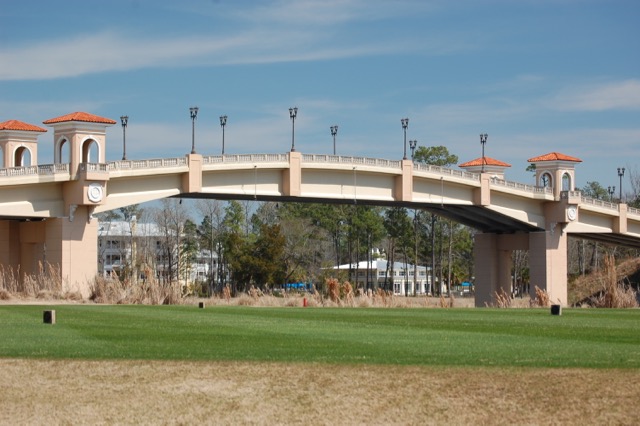 The latest issue of Bowden's Market Barometer includes an incisive overview of the Myrtle Beach, SC, market. Pictured is the bridge that spans the Intracoastal Waterway between Highway 17 and the Grande Dunes Resort.
No Educated Guessing About These Golf Communities
CarolinaLiving.com recently posted an article I wrote for its Compass eNewsletter about golf communities near universities. Large universities and even more modestly sized colleges are magnets for all kinds of cultural events, including concerts, museum shows, lectures by famous and should-be famous people and, of course, sporting contests. Those who like what cities offer in the way of entertainment but loathe the traffic, extreme pace and pollution will find most of the good stuff near a university in the Southeast.
In the CarolinaLiving.com article, I provided capsules of the best golf communities near universities in North and South Carolina. These include Governors Club near University of North Carolina (UNC), Chapel Hill; Landfall, just 10 minutes from UNC-Wilmington; Reems Creek, a few miles north of UNC-Asheville; Green Valley Country Club in Greenville, SC, near Furman University; Wildewood Country Club and the University of South Carolina (USC) in Columbia; Woodside Plantation in Aiken, near that city's branch of USC; and Wild Wing Plantation, virtually across Highway 501 from Coastal Carolina University in Conway, SC, a few miles from Myrtle Beach.
Of course, many more choices abound throughout the region. We have toured and played the golf courses at most of the following communities. For more information, please contact us.
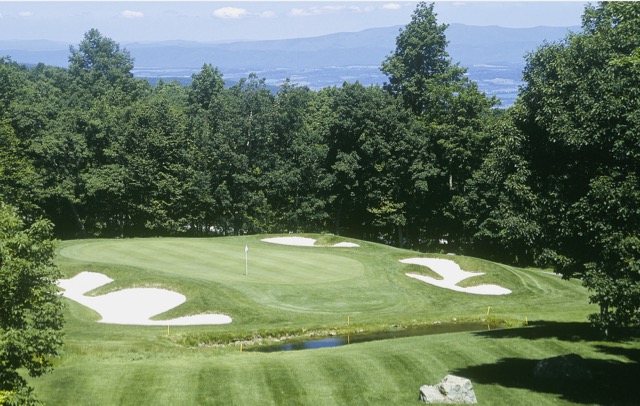 One of the 45 holes of golf at Wintergreen Resort; this is #17 at the top of the Blue Ridge Mountains on the Devil's Knob Golf Course.
Virginia
• Glenmore in Keswick, VA, home to a number of University of Virginia (UVA) professors and athletics team coaches. The entire community, including the John LaFoy golf course, has a Scottish tinge to it.
• Wintergreen Resort, 45 minutes from Charlottesville and UVA but worth the trip given its lofty Blue Ridge Mountains location, 45 holes of excellent golf and reasonably priced real estate
• Kinloch, whose golf course is perennially ranked in the top 3 in the state of Virginia and only a few miles from University of Richmond. Lester George, who designed another top 5 course at Ballyhack in Roanoke, partnered with longtime amateur golfing luminary Vinny Giles to develop the Kinloch layout.
• Viniterra is an unusual combination of Rees Jones golf and a working winery within an easy drive of colonial Williamsburg and one of the nation's oldest schools, William & Mary. Located halfway between Richmond and Williamsburg, Viniterra has the best of both worlds, even if life inside the gates is calming.
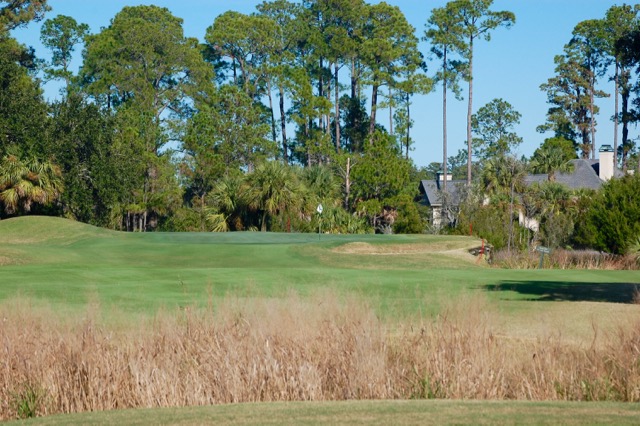 The Landings on Skidaway Island is a mere 20 minutes from downtown Savannah and features six excellent golf courses for one membership fee.
Georgia
• The 4,800-acre Landings at Skidaway Island, with six golf courses, tons of activities and just 20 minutes from Savannah and its highly regarded College of Art & Design, which has helped transform the city and is a magnet for art and culture.
• Athens is the quintessential college town, a vibrant center of creativity. (The rock band R.E.M. formed there while its members were attending University of Georgia.) The Georgia Club offers 27 holes of golf and reasonably priced real estate (homes from the low $300s).
• Champions Retreat, just outside Augusta, is unique; its 27-hole golf course was designed by Jack Nicklaus, Gary Player and Arnold Palmer (one nine each). The community of mostly upscale homes lies along the Savannah River, just a few miles from another golf course you may have heard of with "Augusta" in its name. Augusta State University merged a couple of years ago with Georgia Health Sciences University to form the nearby Georgia Regents University.
 The Audubon golf community is as close as a golf community gets in Naples to the Gulf of Mexico.
Florida
• The Tampa Bay area in Florida offers just about everything in the way of entertainment, services, transportation (great airport!) and dozens of golf communities. Just 45 minutes south of the University of South Florida in Tampa is River Strand at Heritage Harbour, a "bundled" golf community, which means that golf membership in its fine [who] golf club is included in the price of the house. Another five minutes down the interstate, Lakewood Ranch is a city unto itself, as well as a sprawling golf community.
• If you are a college basketball fan, you will remember the terrific March madness run a few years ago by unknown Florida Gulf Coast University in Ft. Myers. Between Ft. Myers and nearby Naples, those looking for a golf community have literally scores of them to consider. For those looking for a 55+ community, we have heard good things about Pelican Preserve in Ft. Myers. In Naples, we loved the golf course at Audubon Country Club, whose surrounding homes are as close to the Gulf of Mexico as golf communities get in Naples.
• In a few weeks, golf fans will turn their attention to the TPC Sawgrass "Stadium" course, just south of Jacksonville where the best PGA golfers will compete in the Players Championship, sometimes called the "fifth major." Divided into more than a dozen small communities, the Sawgrass community offers not only three golf courses but a wide array of real estate choices. Jacksonville University is a half hour away. (The ocean resort Amelia Island and its fine seaside layouts is just 45 minutes from the university.)
If you would like more education on any of these fine college town communities, please contact us.
A Rant in Defense of Golf

Now on Sale

- The only book about golf communities in the last 10 years.
- 156-page step-by-step guide to finding your dream golf home.
- Info on nearly 100 golf communities the author has visited.
- Paperback version costs less than a sleeve of Pro VIs.
Here is what the experts are saying:
“The book is chocked full of information…applicable to anyone looking for a move to the Southeast regardless of whether they are looking for a golf community or not.” — John LaFoy, golf architect (Linville Ridge CC, CC of Charleston, The Neuse GC)
“Larry has done a tremendous amount of work and anyone — like me — who is looking to search for a golf home now or in a few years needs this book.” — Brad Chambers, golf blogger, ShootingYourAge.com
“Wow! What a thorough piece of work…a must for anyone moving South. This book will help many people.” — Brett Miller, owner and founder of MMA, Inc, a golf industry consultancy
Buy It Now at Amazon.com or BarnesandNoble.com.