Sweet Home Alabama: Big discounts for Jones Trail Card holders
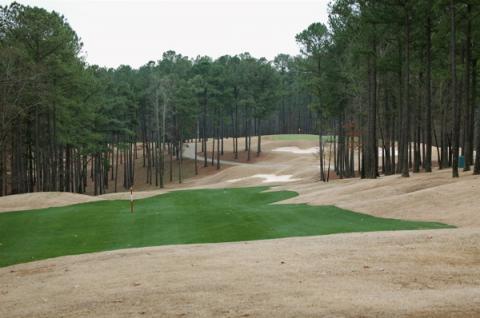
The Oxmoor Valley course on the Robert Trent Jones Trail is one of the few with some housing within view of the course. Above is the unique par 4 12th hole with a double fairway separated by a large grove of trees (to the right here). The left fairway is tougher to hit off the tee, but the easier approach to the protected green.
As the flagsticks go into the cups north of the Mason-Dixon line, golfers in the southern U.S. are already warmed up for the season. Most golf courses in the Carolinas on down have been open all winter except for a few frigid and snowy days. Southern golfers' idea of the new playing season is for the dormant grasses in the rough to go from brown to green. That is starting to happen everywhere.
This is also the season, especially in this economy, when affiliated golf courses offer their discount cards or "passports," which offer low-priced green fees and discounts on merchandise and, in some cases, restaurant meals. No discount program I know of is a better deal than the Robert Trent Jones Trail Card because no affiliated group of courses is consistently better, in my experience.
The card costs a mere $39 annually for residents of Alabama or anyone who lives within 100 miles of a Jones Trail course. By my calculation, that brings some border towns in Georgia and Tennessee into play.
Lucky them. With the Card, discounts range from just $34.95 at Silver Lakes near Anniston (played it, liked it) to $39.95 at Grand National in Opelika (liked it) to $44.95 at Oxmoor Valley in Birmingham (loved it) to the $79.95 at the tournament tested Ross Bridge, also in Birmingham (didn't play). Rates include a golf cart which, at many high-end public courses, can run as high as $30 alone. During the summer, rates for those without the Card run from $62 to $136 for the same courses.
There are very few homes adjacent to the Jones Trail courses, but here are a few listings I found. Of course, there is a wide selection of homes within a mile or two of almost all 26 courses on the trail:
Grand National Golf Club, Opelika, AL
5 BR, 4 ½ BA two-year old home with 3-car garage and deck overlooking course
$545,900
Oxmoor Valley Golf Club, Birmingham, AL
The Cornerstones, 2 & 3 BR condominiums, 1,700 square feet and up, overlooking 17th fairway
Prices begin at $220,000
Lakewood Golf Club, Point Clear, AL
The Commons condominiums, 2 & 3 BR condos, 1,350 square feet and up, near Mobile Bay.
Prices begin at $425,000
 Home On The Course newsletter
Click here to sign up for our Free monthly newsletter, loaded with helpful information and observations about golf communities and their golf courses.
Only natural: Low Country community likes things the way they were
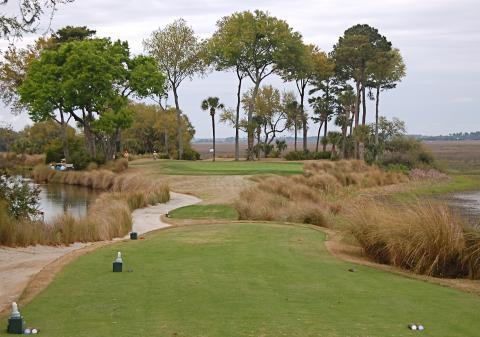
Both beautiful and diabolical, the 17th at Old Tabby forces a straight shot most often into a crooked wind.
Review: Spring Island community, Spring Island, SC
Executive Summary:
18-hole Old Tabby Links, designed by Ed Seay of Palmer Design studio. The course does not have a bad hole on it and includes a few memorable ones. Degree of difficulty increases dramatically as the tees move back.
Full-golf membership is $125,000; dues $11,230 annually (social membership $62,500 and $5,615).
Lots begin in the $200s, homes in the $600s, but more than $1 million is typical.
Top-notch amenities in remote, lush and laid-back community with an emphasis on land preservation and management and its golf, equestrian and tennis amenities.
Having spent 30 years in corporate communication and marketing, I cringe when I read promotional language like, "Now the torch is being passed to a new generation of owners..." or "the last of the great, private sea islands on the Atlantic coast." Such extravagant advertising is a reach that almost always exceeds a community's grasp.
But Spring Island, whose written statement of "philosophy" included the language above, lives up to its own hyperbole. It is at once active and serene, the quality of its amenities and its remoteness -- yet just 20 minutes from Beaufort -- making it the overall best community I have visited on the east coast, surpassing my previous favorite, Ford Plantation, south of Savannah.
Perfecting the golf course, blade by blade
Spring Island residents appear to be fanatical in their dedication to quality in all the community's amenities, and especially the Old Tabby Links golf course. At the first green during my round there, I saw something I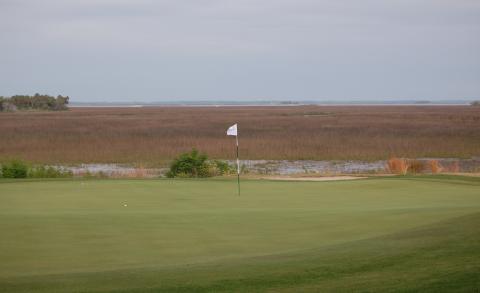 had never seen on a golf course, workers kneeling on the green pulling out single blades of the poa annua to allow faster growth of the bent grass. This is about the farthest south you will find any heat-sensitive bent grass greens; Old Tabby overseeds with bent in the fall and then, in the late spring, the championship Bermuda takes over. Similar attention is lavished on the community's full-service equestrian center, where a stable of horses are available for rent (or you can board your own); its Har-Tru tennis courts; and an upcoming sports complex that will include two additional tennis courts and pro shop, the most up-to-date fitness equipment, and a zero entry pool and lap pool, both heated. A concierge will do your grocery shopping for you if you feel like cooking more than driving. And the on-site Mobley Nature Center is a top flight and active museum and educational center at the heart of the community's stewardship of the island's land and natural resources. One of the top naturalists in the nation runs the programs there.
If you have to ask how much all this costs, then you probably can't afford it. But for the record, and for those among us who always seem to make the right bets during the worst economies, here are the essential costs at Spring Island:
- Full golf initiation fees, $125,000 (80% refundable)
- Full golf dues, $11,230 annually
- Property owner dues, $4,175 annually
- Lots (all re-sales), $200K to $1.75 million
- Homes, $600K to $6 million
Golf or social membership (at half the initiation fees and dues of full golf) is not mandatory, but 378 of the 402 property owners have chosen one or the other, most of them the golf membership. Social members are permitted to play golf once per month in fall and spring and four times a month in summer, which is the off-peak season because of the customary heat and humidity.
Arnie does it right
A total of 240 homes are either built or under construction on Spring Island, which shares a gate with Callawassie Island (see my Callawassie review here) but is separated from Callawassie by a bridge. All lots on Spring Island are re-sales,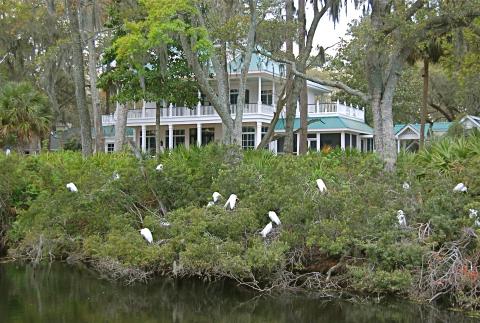 developers Chaffin & Light having turned the community and club over to residents almost 10 years ago. Jim Chaffin, though, still maintains his primary residence on the island, a sign that the handover was harmonious and that Mr. Chaffin, who can choose among lush communities he has developed across the nation, has excellent taste. Almost all homes surpass the $1 million listing price, but three are currently available in the $600s, smaller and of less architectural interest than the more indigenous looking larger homes. Currently available lots begin at $250,000 (1.75 acres with golf view) and range as high as $1.75 million (7.2 acres with marsh and river views). Costs to build can range anywhere from the $200s per square foot to $400 for authentic Low Country design and accoutrements.
Director of Sales and Marketing Jim Early was my host for the day. Before our round on the Old Tabby Links, I had my anxieties. Most Arnold Palmer designed courses I have played have been a bit overwrought, with over-sized bunkers and unnecessary changes in elevation and, overall, much land pushed around. But Arnie, god bless him, made a perfect strategic decision at Old Tabby; he sent his more classically oriented partner, the late Ed Seay, to do the work. Anyone lucky enough to play the course owes Arnie and Mr. Seay a debt of gratitude. This is Low Country golf the way it should be, incorporating marsh, live oaks, stands of pines and salt marsh ponds into the design in a way that seems natural, not fussy at all. In that regard, Old Tabby, which is named for the oyster shell construction of the plantation house ruins adjacent to the 9th green, reflects the understated sophistication of the rest of the community.
The par 4 1st hole shows the stuff the rest of the course is made of, with trees lining both sides of the fairway, a few strategically placed fairway bunkers, and a green slightly elevated and accessible only to those entering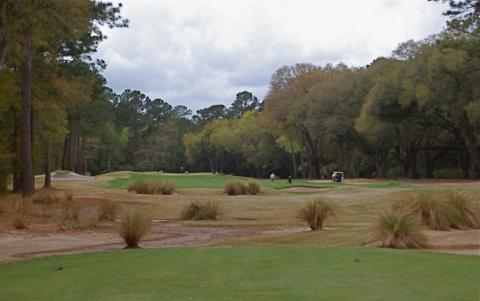 through the narrow front door. This is where I encountered the workers on their knees, picking at the unwanted blades of grass. The green seemed in great shape for a mid-March day, smooth and green enough for my tastes. The par 4 2nd adds water to the mix, all down the right side, a lone big tree and a string of bunkers down the left making a bailout off the tee no sure thing. Short par 3s on good golf courses are almost always all-carry affairs, and #3 at Old Tabby, just 120 yards from the Member tees (total just over 6,000 yards), does not disappoint. Water, a steep bank at the green and bushy saw grass plantings on the bank make it imperative to land your wedge shot on the putting surface and take your chances with a potentially long and undulating putt. The 4th is the first par 5, 500 yards from the Member tees; a good tee shot will make you think about rolling one up the throat to the elevated green, but the sand and water left, and a menacing tree short and right of the green, will make you think again. After a short par 4, the 6th presents yet another target-shot par 3, this time to a green totally surrounded by water and sand. The lake covers the front left half of the green and runs all the way around the back; bunkers cover the entire right front and right sides. I would not want to play the hole when the greens are firm and not holding shots.
Fine design amid the ruins
The front nine finishes with two par 4s and a par 5. The 7th and 8th are pretty much mirror image doglegs, one left and one right around groves of trees to slightly elevated and well-bunkered greens. The 9th comes back to the marsh and the tabby ruins of the former plantation house (click here for an earlier story on the ruins). Number 9 presents a reasonable birdie opportunity if you place your tee shot down the left side, but not too far (bunkers) or too long down the middle (water). A well placed lay-up leaves a sand or lob wedge which you can loft against the wide sky over the marsh that forms the backdrop to the green.
The back nine at Old Tabby opens with a stunning par 4, one of my favorite holes of the round. The water in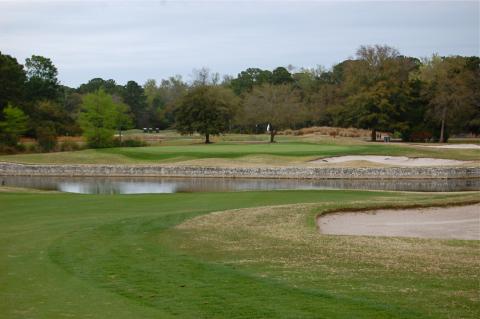 front of the tee and bunkers just beyond are nothing more than visuals, unless you chilly dip your tee shot. Although the fairway is generous, menacing big-lipped bunkers guard the far right side of the fairway, and water on the left extends all the way to the side of the green, where it pinches across the front toward the large bunker that guards the right front. Any shot in the bunkers will almost certainly mean double-bogey or worse, the water as easy to reach as the green. The false front on the green does not make things easier. The 500-yard 12th features a live oak that guards the right side of the fairway in the area of most lay-up shots, and a pond guards the left side of the green, a wall of tabby shells containing the putting surface. The next par 5, the 15th, presents a signature island green, again bolstered all the way around by a tabby wall.
Everything seems almost preliminary to the par 3 17th, one of golf's stunning one-shot holes, perfectly framed by water right and left and the long and wide marsh behind. The thin strip of grass that leads to the green is like an arrow pointing the way, but if the wind is kicking up, your trajectory will be anything but straight. As if the surrounding hazards are not distraction enough, the pond on the left is home to dozens of egrets that turn the trees a bright shade of white and to a family of alligators that hangs out (literally and figuratively) on a wooden pallet in the middle of the water. Old Tabby has many great holes, but the 17th is indisputably the "signature" hole.
After #17, the finishing hole is a rather mild par 4, the entranceway to the green one of the most accessible of the day. Designer Seay probably thought that, after the 17th, Old Tabby's golfers would want to decompress. Those having the financial wherewithal will not find a better community in which to do the same.
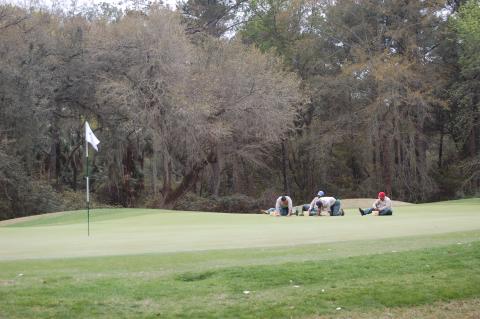
Workers on Old Tabby's first green hand pick poa annua to let the course's bent grass spring forth.
Old Tabby Links
Designed by Ed Seay and Arnold Palmer
Opened in 1992
Palmer tees, 7,004 yards, rating 73.5, slope 142
Back tees, 6,581, 71.6, 135
Composite tees, 6,275, 69.6, 127
Member tees, 6,020, 68.5, 113
Ladies, 5663, 73.3, 137
Half-a-million dollar babies: Two golf homes, north and south, for $500,000
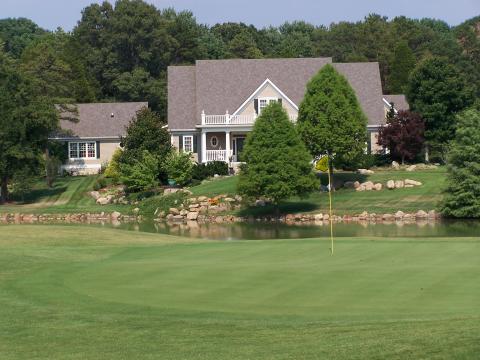
A community grew up around Fox Den Golf Club in Farragut, TN.
My wife and I had "the conversation" this morning: Where do we want to live in retirement? Shall we own one home (in a golf community, of course) and either travel or rent short-term in a city or near our children's homes, wherever they wind up? Or two homes, north and south, possibly both with golf nearby if not within the gates. (Note: If we can afford to have a place in a big city like New York or Boston, I am willing to forgo the close proximity to a golf course in favor of using my feet or public transportation to go to restaurants, shopping, theaters and museums. Anything to avoid the car...)
The conversation, which has been ongoing for a few years and has a few more years to run, got me to thinking about what it would take, financially, to have two homes in golf communities in the north and south. For today, I decided to consider those communities where the total of real estate is no more than $500,000. In the samples below, I am including only communities in the southern U.S. that I have visited and can recommend. I know some of the communities in the north, but some I don't (I am happy to visit those in New England for anyone interested). There are limitless combinations of communities to consider, and if you have a particular state or area in mind, or have a different price range, let me know and I will do the research (no charge, as always).
In coming weeks, I'll offer some ideas for pairs of communities in the $750,000 and $1 million categories.
Not taxing at all: Fox Den Country Club, Farragut, TN, and Owls Nest community, Campton, NH
Both Tennessee and New Hampshire are zero-income-tax states, so those with considerable pensions might find them attractive. Fox Den, which I played and reviewed (click here) a couple of years ago, is a classic course with an involved membership. The course was both smartly laid out and in peak condition; it plays host annually to the Nationwide Tour's Knoxville Open, which is typically televised. The golf course and adjacent neighborhood were not part of the same planned development; some homes are a little closer to the course than in more modern layouts, but rarely is the effect distracting. Current listing: 2 BR, 2 BA condo, $160,000 (sale pending).
Owls Nest is a more traditional planned resort community, with a challenging mountain golf course by Michael Mungeam (rating 74, slope 133). The community is about 30 minutes from Lake Winnipesaukee and two hours from Boston in the heart of New Hampshire's White Mountains. It offers both single-family homes and condos. Annual golf membership is $3,250 for unlimited play (cart extra), but other lower-priced memberships are available if you play outside high-traffic times. Current listing: 2 BR, 2 BA furnished one-level condo with fireplace and mountain views, $299,900.
Life's a beach: Ocean Ridge Plantation, Sunset Beach, NC, and Ocean Edge, Brewster, MA
For those who need the salt air 24 x 365, plenty of options abound north and south. Ocean Ridge is just five miles from the Atlantic and surrounded by six outstanding courses, including the new Leopard's Chase, designed by the hot local architect Tim Cate. Homes are mostly single family but they run the gamut from small and tidy to McMansion size, with most in the area of $600,000. However, in this market, bargains abound. Current listing: 3 BR, 3 BA, single-family, $250,000.
The Ocean Edge community actually goes back to 1890 when it served as a private estate overlooking Massachusetts' Cape Cod Bay. Today, the resort community includes an 18-hole Nicklaus Design course and all the amenities you would expect from a vacation haven. Membership is pricey, at $35,000, with dues of $400 per month, but you can defray some of that cost by renting your unit (most are rented 8 to 12 weeks per year or longer). Current listing: 2 BR, 2 BA condo on 5th fairway, $178,900.
Arnie north, Jack south: Pawleys Plantation, Pawleys Island, SC, & Farmington Woods, Avon, CT
Pawleys Plantation, where my wife and I have maintained a second home for the last 10 years, has an excellent selection of condos and patio homes (on small lots) beginning at under $200,000. Initiation fees for the semi-private Jack Nicklaus golf course (circa 1989) are $15,000; I have rarely encountered a problem arranging a tee time of my choosing because of outside play. All but three holes run along the marsh on the back nine, some of the most attractive golf views in the Low Country. One current listing: 3 BR, 2 BA, single family, $314,900.
Farmington Woods is less than a mile from my primary home in north central Connecticut, about 20 minutes from Hartford and smack in the middle of New York and Boston, two hours from each. The community, a mix of condos and single-family homes, was developed in the late 1960s around a hilly, sometimes quirky design by Desmond Muirhead. All initiation fees for the private course have been waived for 2009, and dues for the year are just $4,700 per couple. I've played the course a number of times, and although its occasionally blind shots and elevation changes will not be to everyone's taste, it is typically in very nice condition, and staff and members are quite friendly. Current listing: 3 BR, 2 BA condo, $186,900.
Connestee Falls, Brevard, NC, and Crail, Scotland
Okay, this may seem a little fanciful, but the dollar has gained 50% in value against the British pound in just the last year, making real estate in the more rural parts of the UK a bargain.
The George Cobb designed golf course at Connestee Falls is one of those that feels private but is actually open to public play. It appeals to all golf abilities, maybe a little more so for the higher handicapper than the single-digit player. The community has a little age on it, at 30 years, meaning some homes are in need of a little cosmetic makeup and bargains abound. Current listing: $3 BR, 2 BA, $330,000.
The small and charming fishing village of Crail might be one of the best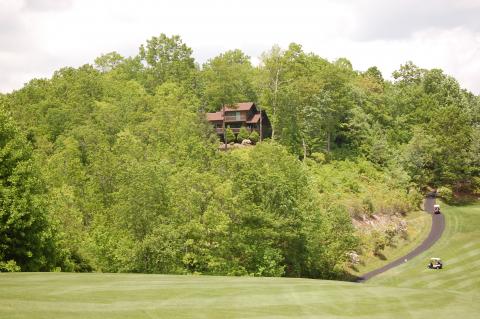 places on earth for golfers resistant to high-priced and busy golf resorts. Crail Balcomie and Craighead Links are within just two miles of the village, and St. Andrews is just a 20 minute drive (and you pass the famed Kingsbarns and the new Castle Course on the way). The Crail Golfing Society offers a special "overseas" membership but it includes only four rounds per year. Green fees, however, are reasonable. Spaces inside Crail’s homes are tighter than U.S. standards, but you will probably want to spend most of your time on the golf courses and strolling through the fishing village (and perhaps some time in the town’s pubs as well). Current listing: 2 BR, 1 BA former doctor’s offices, conversion needed, in village of Crail, $162,000.
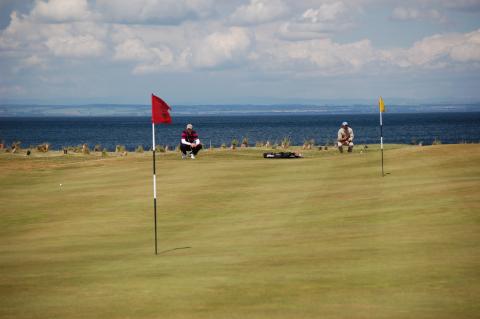
Crail Balcomie Links features double greens and knockout views of the Firth of Forth.
Two Ls, two Ss: The livin' is much easier than the spelling at Callawassie
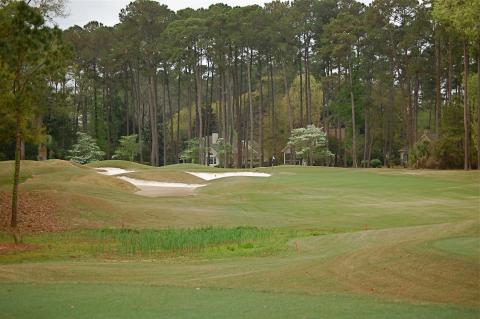
The longest par 3 at Callawassie, #3 on the Magnolia course, is 207 yards to a pin that is only unprotected if it is on the far right of the wide green.
Review: Callawassie Island Club, Callawassie Island, SC
Executive Summary:
27 holes of Tom Fazio golf (Palmetto, Magnolia and Dogwood nines). Each nine is distinctive in character, providing three interesting combinations.
Club membership ($45,000) is mandatory with purchase of home, but many sellers include it in their price; club and homeowner dues are about $9,100 annually.
Lots begin around $50,000; 75 currently on market.
Homes begin around $300,000 (for one of 38 villas) and $350,000 for single-family; 50 single-family homes currently on the market.
A mature, 25-year-old community, just 20 minutes from charming town of Beaufort, less than an hour from Savannah.
Golf community developers have a defining choice when they begin to sell their properties: Insist that owners become club members immediately upon purchase, or make club membership optional in the hopes that those who live near the golf course will join anyway. Both approaches carry risks. Some buyers do not take kindly to being "forced" to join a club before they start living in a community may take their business elsewhere, where they have the freedom to wait awhile to join. But if a developer does not link membership to each property he sells, he runs the risk that revenue from memberships (dues) will fluctuate and, someday, the club will be light on members and consequently light on cash flow.
Well, it seems that for many community golf clubs, someday is now. Where membership is variable, clubs are scrambling to attract new members to make up for a dues shortfall that affects maintenance of the golf course and services provided to members. As a course becomes unkempt, it becomes less attractive to current and potential members, and the cycle keeps going until either the economy turns around or the club takes drastic measures, including opening for some public play or hitting up remaining members for special assessments.
The clubs that bit the bullet early and made membership mandatory, like the Callawassie Island Club near Beaufort, SC, don't have to worry about chasing new members; they just have to focus on keeping happy the ones they have. And, of course, as is the case at Callawassie and elsewhere, the members own the club and can tweak whatever and whenever they want.
Callawassie, an 880-acre gated community that appeals to a wide range of golfers and privacy seekers alike, began to make membership mandatory for all homeowners in 2001. Because year-round residents comprise almost 80% of the community, most of the resident members get their money's worth from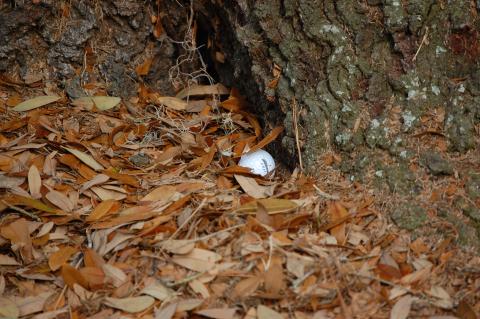 the club. (Winter temperatures average a high of 60 and low of 40, making golf an easy all year activity.) The membership ceiling is 595, a good number for the club's 27 holes of Tom Fazio golf; current members number 500, with an additional 100 "social" members who have use of the clubhouse and other facilities but can only play golf once a month. At a little over $9,000 per year for all homeowner and club fees and dues, or about $750 per month, Callawassie provides excellent value for the serious golfer or couple who want to be close to a city -- in this case, Savannah -- but not too close, in this case about 35 minutes away. For a slightly less urban but charming town, Beaufort is a mere 20 minutes.
Callawassie is an attractive community set a couple of miles from the modest traffic on the nearest thoroughfare, Route 170, which runs between Bluffton and Beaufort. Indeed, before you reach the community's gate, which it shares with the Spring Island community (review coming in a few days), the short trip from Route 170 takes you on a bridge over marsh, which gives Callawassie a remote feel. This is a mature community but not by any means a dowdy one; home exteriors are up to date, the landscaping is neat as a pin, and the overall feeling is that Callawassie has grown gracefully in its 2 ½ decades. I passed people fishing, bicycling, strolling and, of course, playing golf as I entered the community for the first time. It felt comfortable right off the bat. Everyone I would meet in the next 24 hours was friendly and enthusiastic about their community, whether they lived there, worked there, or both.
The vast majority of house choices at Callawassie are single family, although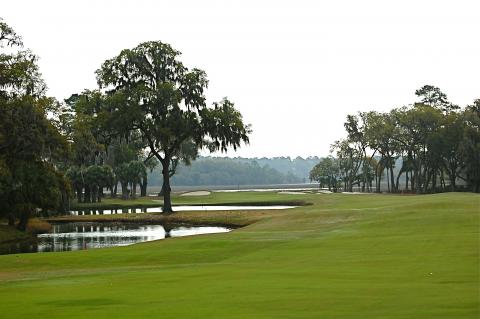 I stayed in one of the 38 comfortable villas that are sequestered in an area called Heron Walk. At present, 75 lots in Callawassie are on the market for prices ranging from about $100,000 for a wooded lot to the mid $100s for a golf view lot, to those in the mid-six-figures and up that have access to a deep water dock. Some nice marsh views are available for less than $200,000. A charming 3 BR, 2 BA, 2,332 square foot home in the woods is currently listed for $475,000 and includes a social equity membership, worth $22,500. My real estate contacts at Callawassie, Chuck Chasar and Bruce Strupp, say that the community's residents are fiscally conservative and did not overextend themselves when they purchased in the community; therefore, prices have not eroded as dramatically as in communities where purchases were more speculative in nature. Nevertheless, one listing for an attractive lot on the 4th hole on the Magnolia nine, for just $64,000, which includes the $45,000 initiation fee for club membership, is well below the norm for the community.
Ownership costs at Callawassie seem reasonable for the 27 holes of golf and the other amenities in the community, which include six Har-Tru tennis courts and a pro shop, a river club which can be used for private meetings and dinners or community barbecues, two swimming pools and a fitness center.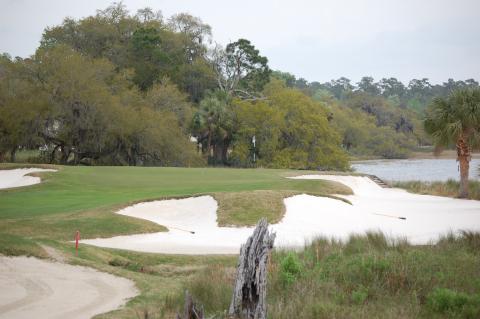 The security gate is manned round the clock. The clubhouse at Callawassie is attractive and warm, but certainly not lavish; it is understated, like the rest of the community. Total annual dues (club and the homeowner) run $9,645 for a resident, and about $2,000 less if your full time residence is elsewhere; that includes a special assessment (see below). Other communities I visited and played golf at in nearby Bluffton charge a few thousand more annually; Callawassie's golf course is as good as any of them, and better than some.
Callawassie's proud members voted a few years ago to update the 25-year old layouts, accepting a $100 per month assessment until the year 2018 to pay for the work. With help from a member of Tom Fazio's design team, 18 holes were completed last fall, and in a few weeks the final nine, The Dogwood, will begin receiving the treatment. Two major issues drove the renovations: first, recent improvements in turf make it possible to have a more heat and salt water resistant grasses. Callawassie has planted a new grass called Mini Verde on the Magnolia and Palmetto nines and will add it to the Dogwood.
Mini Verde, which echoes certain properties of bent grass but is more resistant to heat and salt water, also retains its color year-round, making winter over-seeding unnecessary. General Manager Brian Lasota, with whom I shared a round of golf, told me that this past winter was the first the club did not over-seed its fairways; no members complained. The second reality of older golf courses is that, over time, the greens become smaller as the fringe grass areas encroach. That causes greenside bunkers to recede away from the putting surfaces. Over 25 years of mowing, the greens also tend to lose their original shapes. When the Dogwood nine renovations are completed in the fall, the greens and bunkers on all 27 holes will have been restored to their original shapes and locations.
I am not a good enough golfer for my game to be affected one way or the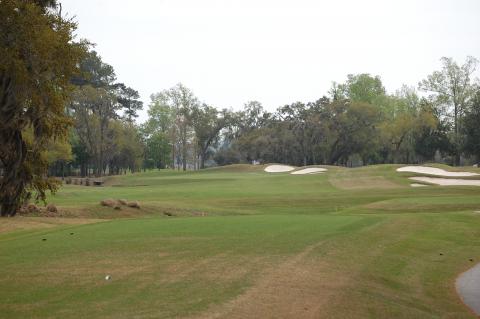 other by grasses. All I can say after playing Callawassie's Magnolia and Palmetto nines was that the changes had taken quite well; there was no evidence of a recent rehab, and all the turf was in splendid condition, especially for mid March after a coldish winter. The greens are fair sized, not humongous; they must have been awfully small before they were restored to their original, and now current, glory.
The Magnolia especially presented one imaginative hole after another, and it was challenging too. The combination played to 6,550 yards from the blue tees, the second longest set, and with a rating of 72.8 and a slope of 132, it was no pushover by any means. Combinations with the Dogwood course, which runs for a few holes along the marsh, change the rating and slope only slightly.
The customary Fazio flourishes are in evidence throughout, including his signature large cloverleaf bunkers, in some cases layers of them. But for me, the trees at Callawassie were the real attraction and, occasionally, a visual distraction (in the best sense). On the Magnolia nine especially, the gnarly live oaks and ramrod straight palmettos and tall pines -- sometimes alone, sometimes in combination -- formed exquisite backdrops to the greens. Oh yes, they also come into play, as on my one slightly pushed drive that wound up in the recess at the base of a live oak. Water, which encroaches mostly near the par 3 greens, is not overly penal and will gobble up only the most errant shots.
None of the par 4s I played was over 400 yards, but Fazio compensates for the short yardage with significant bunkering and greens I found particularly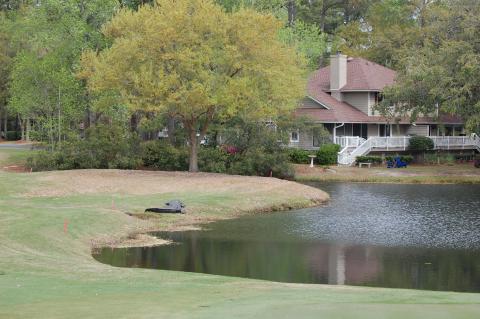 difficult to read. (Editor's note: My eye doctor told me today I have bad cataracts in my left eye, so take what I say about the greens with a grain of salt.) The par 5s were no slouches on distance, all well over 500 yards and with their share of hazards along the way. Par 3s ranged between 165 and 207 yards, the longest #3 on the Magnolia nine, the pin well protected by yawning bunkers that cover the left two-thirds of the green.
All three nines at Callawassie offer different routings and atmospherics. Magnolia is heavily tree laden, and with water and lots of sand, it throws just about everything at the player. In that regard it felt like the most "modern" of the nines. Palmetto is more classic, a little more open and, although it too has its share of water hazards, the effect is subtler than the Magnolia routing. The Dogwood nine could almost pass for a links course as it is more susceptible to the breezes off the marsh, which do affect play on all the nines, but have their most profound effect on Dogwood. GM Brian Lasota pointed to the space between some greenside bunkers and the greens they were supposed to be protecting, and it was clear that bunkers and greens had moved up to 10 yards or more apart over time. When renovation work there is completed in the fall, Callawassie's members may find one of their challenges in choosing which nines to play.
Of course, they can certainly play all three; it's their club.
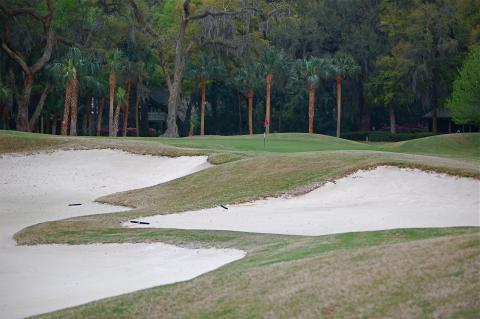
At Callawassie, the mix of live oaks, palmettos and pines form beautiful frames for many of Tom Fazio's green complexes, which were recently restored.
Economy, lack of marketing hangs albatross around Daufuskie Island Resort
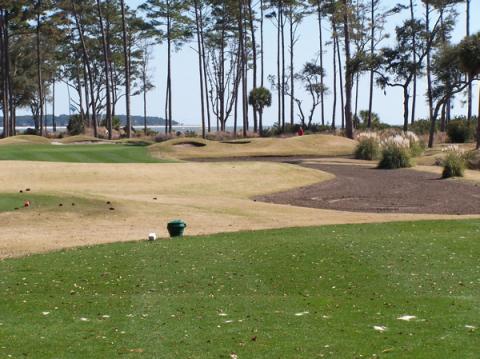 The 16th at Jack Nicklaus' design for the Melrose course at Daufuskie Island Resort with Hilton Head Island beyond. The resort and the course closed just two weeks ago.
For some reason, the Daufuskie Island Resort in South Carolina always kept its light under a bushel. Now, the light has gone out with the announcement 10 days ago that the resort had laid off the remaining members of its staff and closed its doors. Owners of property inside the gates of the resort are understandably beside themselves, according to local reports.
Home to two excellent golf courses, one by Tom Weiskopf and Jay
I never quite understood why the resort and the owners of Haig Point, a beautiful and private community on the other side of the small island, had never organized a combined ferry service. It is expensive to run the boats back and forth all day long, and the community and resort might have saved themselves a little money with some sort of mutual accommodation.
I played Nicklaus' Melrose course a few years ago and it was wonderful, not the best of Jack's layouts but an interesting curiosity because he designed it early in his career, shortly after his tutelage under Pete Dye ended. Present were the ubiquitous Nicklaus trees in the fairway and strongly protected greens that compelled Jack-type shots, meaning high fades. The views on the finishing holes of the Calibogue Sound and Hilton Head beyond, including the lighthouse behind #18 at Harbour Town, added an extra bit of panache.
Here's hoping someone is quick about picking up the pieces...and doing a much better job of marketing than the prior owners.
If you would like to read a local article on the resort's demise, click here.
Fazio vs. Fazio: And the winner is...
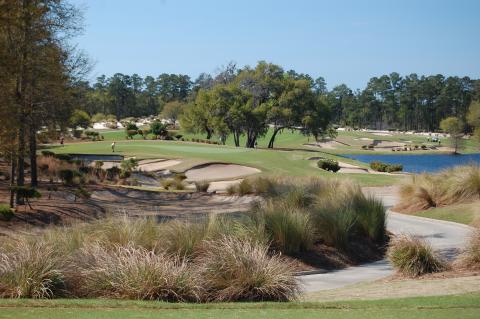
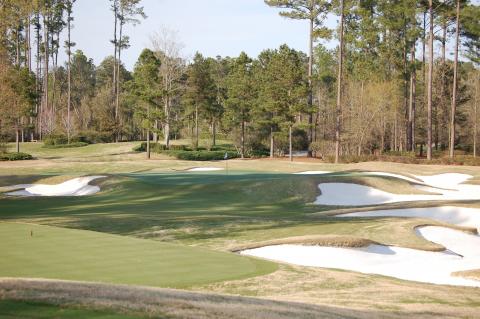
Fazio's design for the par 3 4th at Belfair (above) is a delight for the eyes and the tough-minded ball striker. The designer's best par 3 at the Berkeley Hall South course (below), #16, is more inspired than most of the rest of the layout.
Reviews of Berkeley Hall and Belfair, Bluffton, SC
Golf architects are a bit like many great artists of the past; they depend on commissions from developers for their livelihoods. But with design fees come compromises because, after all, the point of the golf course is not simply to provide residents with an amenity; it is to help the developer sell dirt. Sometimes you can play a planned community golf course and just feel the stifling influence of the developer -- lots of out of bounds stakes between backyards and the course, condos or villas lining the fairways, a few decent views but none of the nearby ocean, marsh or mountains (the home sites get those). But during some rounds, you know the architect was given wide berth because the course makes few, if any, compromises.
This all came to mind last week when I played two Tom Fazio courses in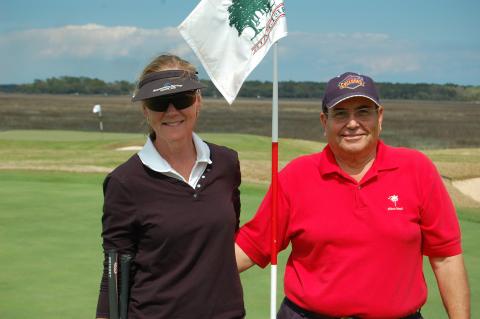 upscale Bluffton, SC, communities -- one in Berkeley Hall and one in Belfair (each community features two 18-hole Fazio courses). The East course at Belfair was challenging, appealing to the eye and straight out of the best of the Fazio oeuvre; comparatively speaking, the Berkeley Hall South course I played the previous day was a rather tame affair with some excellent holes and some utterly undistinguished ones, as if Fazio and his design team were tuckered out from the effort of it all. The Berkeley Hall South course was especially disappointing in view of the marketing of its "core golf" layouts, meaning houses are kept at a distance. Generally speaking that was true, but if the designer was indeed given an unusual amount of freedom, he doesn't always use it to advantage on the South course.
I didn't know this before I played at Berkeley and Belfair, but the South Carolina Golf Ratings panel listed both Colleton River and both Belfair courses in its top 50. A Pete Dye course nearby, at Hampton Hall, also made the list. I have played Hampton Hall and found it unremarkable; that neither of Berkeley Hall's two courses are on the list validated my own impressions. The sad fact of its courses' mediocrity leaves the upscale Berkeley Hall to brag on its web site about its men's locker rooms being named one of the top 50 in golf.
The par 3s on the Berkeley Hall and Belfair layouts are a window into their overall differences. The first one-shotter at Berkeley plays 183 from the next to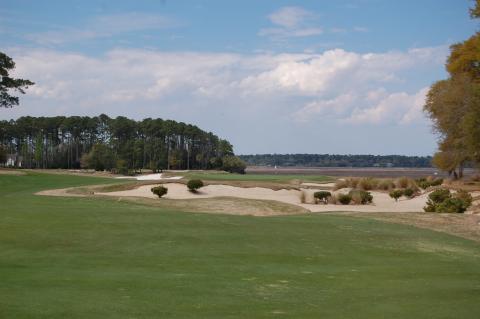 the back tees. The long, meandering bunker that runs the entire length of the hole down the left only comes into play at greenside, and then only for those who overcook their long irons. At 180 yards, the first par 3 at Belfair, #2, is all carry, first over water and then over a high-lipped bunker snuggled up against the entire front right side of the green. Whereas at Berkeley it is easy and tempting to bail out to the right, at Belfair the bailout takes almost as much skill as landing on the green.
The fifth at Berkeley is a modest 151 yards with water tee to green and guarding the left side...sort of. It cuts in 25 yards short of the green and then moves away to the left, leaving a small (for Fazio) bunker at left the only real protection for the green. Again, there is plenty of easy bailout on the right, leaving a routine chip to the pin. At Belfair, #4 is both a work of art and a major challenge at 201 yards over sawgrass and sand to an elevated green whose right side is protected by a lake. You would have to push your ball a bit to reach the water, but seeing it from the tee combined with the bunker that almost surrounds the green on the right makes you think twice about club selection.
The 11th at Berkeley has a little length to it, at 209 yards, but that is about all to recommend it, a straight-on affair to a redan (angled) green protected only by a small bunker at the right. Contrast that with Belfair's #9 at just 170 yards, but with an all carry shot to any pin placed right of center over yawning bunkers. Hit just short of the green and your ball will bound down to the left, leaving a tricky pitch shot across an undulating green.
Berkeley Hall's final par 3, #16, does add some visual and shot making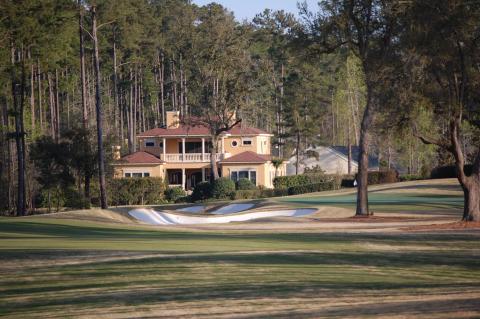 complexity to the round with a wave of bunkers from tee to green down the right side and one good-sized, strategically placed bunker in the notch at the left side of the green. This is the Fazio I love, and I wonder where he was hiding on the earlier par 3s. His two final par 3s at Belfair, however -- the course is a par 71 -- are just as good as Berkeley's 16th, the 14th at 154 yards to a severely sloping surface framed by the marsh, and the 17th coming directly back from the marsh, with sand from tee to the left side of the green and a nasty pot bunker directly in front. At just 137 yards, it's short but tricky, especially when the wind kicks up off the marsh.
The par 4s and 5s at both courses follow essentially the same comparisons, the Berkeley holes showing a little spunk here and there but, for the most part, nothing memorable. Once you play Belfair, its imaginative and visually pleasing routing will make you forget the holes at Berkeley Hall.
I should note that, at Berkeley Hall, I was compelled to bring along a forecaddie since I was an unaccompanied guest. Trey Long provided good company (he laughed indulgently at my jokes) and guidance on reading a few tricky putts. He and I had a good chuckle when one of the Berkeley Hall members picked up my ball and pocketed it after I pulled one into the brush. If you can afford the real estate prices at Berkeley Hall, you should leave the golf balls where they are.
At Belfair, a forecaddie was not required, but about halfway through the round, I met up with members Jim, his wife Connie and their friend. In the spirit of full disclosure, I should say that Jim is not a fan of Belfair's East course. "Fazio never gives you an even lie in the fairways," he told me, "and I hate that."
Horses for courses; he might just like the South course at Berkeley Hall better than I did.
Belfair opened in 1994 on 1,100 acres of a former agricultural plantation. There is no more dramatic entrance to a community than at Belfair, where the arms of ancient live oaks form a canopy over the roadway. The community comprises 730 home sites. Currently, 83 lots are on the market at prices from $33,900 to $659,000. A total of 60 homes are listed for between $469,000 and $1.8 million. Owners of homes in Belfair are all members of the golf club; their total annual contribution for both homeowner and club dues is $11,294. The East Fazio course Medal tees (second to back) plays to 6,479 at par 71, a rating of 71.6 and slope of 128. The West course, a par 72 at 6,637 yards, a rating of 72.0 and slope of 132.
Development of Berkeley Hall began in 1998 on its 960 acres. The drive up to the golf club is impressive, with a long sweep of lawn up to its Federal-style manor house. The range of prices for home sites is about the widest we have ever seen, from $29,000 to $2.2 million today. The 50 homes that are available are listed from $600,000 to $2.6 million. A $7,000 one-time capital reserve fund is required of all new members; annual dues for the club and the homeowner's association run to $13,750. The Fazio South course from the blue (second to back) tees plays to a par of 72 at 6,693 yards par, with a rating of 72.5 and slope of 131. The Fazio North course is par 72, 6,701 yards, a 72.1 rating and 128 slope.
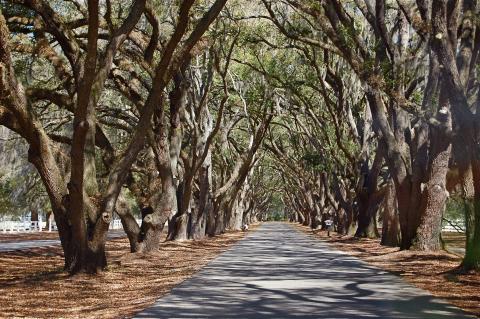
Stately matter: Like soldiers at a military wedding crossing their swords above the lucky couple, the live oaks along the entrance to Belfair make for a grand welcome to all.
Colleton River and Moss Creek anchor top and middle tiers of Bluffton, SC, golf communities
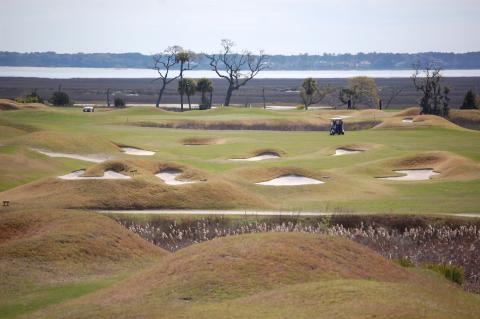
Colleton River Golf Club's Pete Dye course, as seen from one of the community's two clubhouses. The other is at the head of Colleton's Jack Nicklaus course.
One mid afternoon during my stay in the Bluffton, SC area a week ago, I made the mistake of trying to cross Highway 278, which runs from Interstate 95 to Hilton Head Island. I and two others in front of me waited a good six minutes to make the turn, such was the traffic going to and from the popular island. A few times during my week in the Bluffton/Beaufort area, people I played golf with said they had looked at Hilton Head but chose to live 20 to 30 minutes away, because of the traffic. Of Hilton Head, to quote my favorite philosopher, Yogi Berra, it seems as if "No one goes there anymore. It's too crowded."
There are plenty of nice golf communities just off the island in Bluffton, and I explored four of them during the week, and played golf at two. Here are some quick impressions of the two whose courses I did not play, Moss Creek and Colleton River.
Moss Creek is one of the mature golf communities in the area, having
The community seems to have stood the test of time, its three-decade-old homes either already refurbished or in need of just modest facelifts. For that reason, price points for real estate in the community are a little lower than similar square footage in Colleton River, Belfair and Berkeley Hall. Single-family homes in Moss Creek, of which there are 65 currently on the market, range from $200,000 to $1.2 million, with the "sweet spot" around $700,000. A half dozen lots that are on the market range in price from $108,000 to $399,000. Because of the community's age, you will find more foreclosures and short sales in Moss Creek than the others. Moss Creek's proximity to Hilton Head makes it closest to beaches among the off-island communities, and for shopaholics, the large Tanger Outlet Center just outside Moss Creek's gate will provide non-golf diversion. Current dues in the community run $3,972 annually for the club and property association fees; lot owners pay a little less.
Note that all four communities I visited in Bluffton required all residents who built a home to pay a club initiation fee. When the homes are resold, the fee is passed along in the sale. Although fees of $20,000 and higher -- in some
 cases, considerably higher - may have seemed a burden to some early purchasers, the policy makes for stable memberships, a constant revenue source (through dues) and no need to spend excessive advertising and marketing dollars to keep the membership rolls propped up. Membership does not fluctuate because the memberships are tied to the homes, not individuals. For this reason, all courses I saw were in peak condition. For those looking for a home in such a golf community, the club initiation fee, as well as the price of the home, is inherently negotiable.
The long drive into Colleton River is impressive, a two-mile ride through forests of live oaks that provides residents with a feeling apart -- and a drive of almost 15 minutes to the nearest supermarket. Developed in 1990, Colleton River features two 18-hole courses, one by Jack Nicklaus and one by Pete Dye and served as a location for the critically panned but atmospheric golf movie, The Legend of Bagger Vance (Matt Damon starred). Each course has its own clubhouse; one membership buys access to both courses and clubhouses. My local real estate contact and tour guide of the communities, Erin Yocco, told me the prices of home sites in Colleton have not fallen quite as hard as at other local golf communities; the current 81 listings start at $75,000 and top out at $2.4 million for a splendid marsh view. The 52 homes on the market are priced from $599,000 to $3.85 million. Erin took me through a 4,500 square foot home with a pool and view of the Nicklaus golf course and huge rooms inside. It is listed at $1.19 million, certainly a lot of money but also a lot of house for the price. Down the street, the good-sized Nicklaus Golf Cottages (they are near the course) sell for around $900,000 but generate about $100,000 in rental income annually, according to Erin.
Annual dues for both the upkeep of the community and the golf club track
I'll review the two other communities I visited in Bluffton -- Belfair and Berkeley Hall -- in the next day or two. In the meantime, if you would like more information on the wide range of golf community choices in the Bluffton area, let me know and I will put you in touch with Erin Yocco.
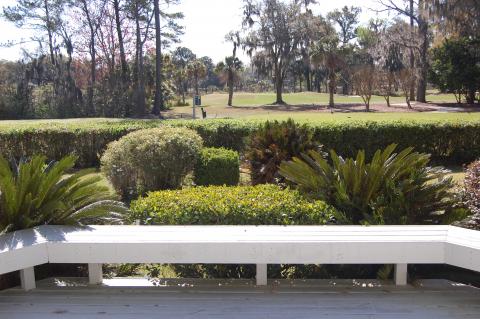
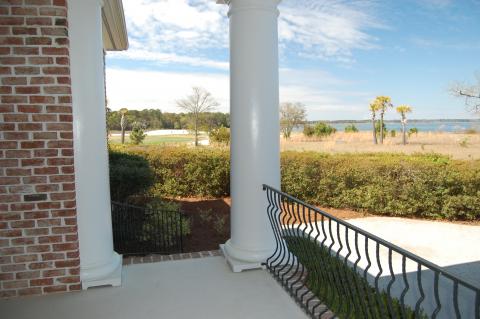
The view from a currently available home at Moss Creek, a nearly 40-year old community in Bluffton with some of the most reasonably priced real estate.
Remote control: Friendly Dataw so near, yet so far from charming town of Beaufort, SC
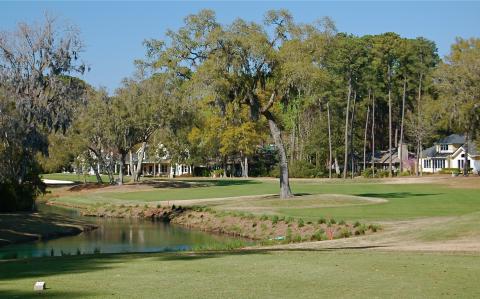
If you dare, hit a three wood or driver over the oak tree at the short par 4 10th on Dataw's Morgan River course, but if you are short of mid fairway, the trees that guard the left side of the green will block you. Better to go around.
Review: The Dataw Island Club and community
Executive Summary:
Two 18 hole golf courses by Arthur Hills (Morgan River) and Tom Fazio (Cotton Dike). Imaginative, challenging layouts in fine condition.
Lots begin at $40,000, homes begin at $230,000
Club membership $24,000 (equity) plus one-time capital contribution of $15,000; dues $6,840 per year (full golf)
Nearest town: Beaufort, SC
Mature community, 80% built out, club owned by members.
I never quite know what reception to expect when I visit a golf community. Occasionally, my hosts won't let me out of their sights, as if I might steal something. Others will just hand me a key to a golf cart and point me to the first tee. I have even had to ask some for a set of basic marketing materials.
The vast majority of golf communities I visit strike a balance between too much
Dataw Island Club Membership Director Silvia Lalinde had arranged things for me and promised that one of the community's residents and club members, Dick Nawalsky, would greet me mid afternoon last Sunday and take me around the golf course. After I was greeted warmly in the pro shop, Dick, who had already played 12 holes with his wife, showed up right on time.
Fazio and Hills, a great combo
Tom Fazio designed the original 18 at Dataw, the Cotton Dike course (Dataw Island is on the site of a former cotton plantation). Although Fazio is one of my favorites, Dick and I played the Arthur Hills Morgan River Course. I am also a fan of Hills designs, especially when he is given wide berth by developers to produce a challenging layout. I knew I'd be playing a few other Fazio layouts during the week, so I was happy to start at Morgan River.
The early holes begin quite modestly, with an opening par 4 that is tree lined
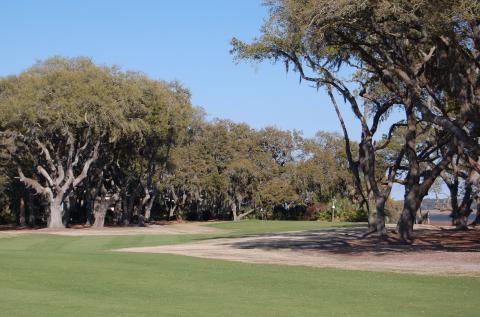 but short (337 yards from the second longest tees); 3-wood off the tee is just fine there. The right half of the green is quite accepting of approach shots, a bunker guarding the left side. But the first few holes are a bit of a tease because, by the fourth hole, a par 5, Hills began to introduce water hazards, in that case a large pond guarding about two-thirds of the right side of the green, with a bunker guarding the left side. The short par 4 fifth, at just 312 from our tees, included water down the right side that pinched in front of most of the green, daring long hitters to bust their tee ball down the left. The pond well in front of the par 3 6th green did not come into play, but the two bunkers that guarded both sides did. However, the real challenge at the 6th, as it was at many holes on the course, was the "false front" which demanded an all-carry shot to the undulating and firm green. The green complex on the par 5 9th hole provided a bold visual statement, with three grass bunkers built into the front side of the green, a sand bunker at left and one at rear right, just over the pond that guarded the extreme right side. Again, big hitters are dared by Hills to go for the green in two at #9, but the price to pay for being offline can be heavy.
Trees a crowd
No hole on the course was more contrived, or ingenious, than the short par 4 10th, a dogleg left that outdoes Jack Nicklaus' own propensity for middle-of-fairway trees. As you look toward the green from the tee, you are faced with
 a sprawling tall oak about 150 yards out. You can fly a big 3-wood or driver over the top, but an equally tall grove of oak trees on the left blocks any shot left of center of the fairway. Land to the right of the trees and you might be rewarded with a short pitch shot to the green and a reasonable birdie opportunity. Or you could wind up in that grove of trees at left or, worse, out of bounds in someone's backyard on the far side of the fairway. A dinky 5-wood or hybrid tee shot, the smart play, leaves just 130 yards or less to the green. It is a beautifully designed short hole.
Hills plays a similar trick at the 13th, a par 4 that demands a tee shot far enough and left enough to avoid a bunch of tall live oaks that jut into the fairway from the right. Hit too far left, though, and you will have to negotiate another cluster of live oaks that jut in from the left, closer to the green. The risk on the 13th, which brings you in view of the marsh for the first time, is that you might still be playing a dogleg hole after your too-short or too-long tee shot.
Finishing touches
The final holes at Morgan River echo most of the elements of the earlier holes, but now you have the prevailing breezes to play with...and against. After a mild par 3 15th, with a couple of bunkers at greenside, the long par 3
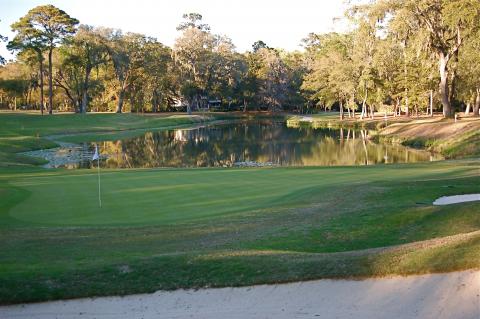 16th (yes, two par 3s in succession), at 190 yards into the wind, is a dazzler, with water down the right side and sloshing along the front right of the green, and bunkers guarding the front and left side of the severely two-tiered green. With water pinching in on both sides about 100 yards from the tee, the layout was a visual interpretation of Popeye -- no waist, all upper torso. Into the wind, I needed lots more spinach to get anywhere close to the pin at rear right. I hit my best shot of the day, a solid 5-wood into the wind. My reward was a straight, uphill 35 footer through the fringe, which I proceeded to hit 15 feet past the cup.
The toughest holes on the Morgan River course tend to be the longest, just because the designer does such a good job of protecting his greens and because the breezes make hitting long, high approach shots difficult. Once on the putting surfaces at Dataw, though, two putts are no sure things as the greens are undulating and medium fast (they'll be faster in a few weeks). Virtually all greens sloped back to front, in some cases severely. I can recall only one or two putts that did not break the width of a ball or more.
Turf on the fairways and tees was in excellent shape, but the greens are the real star here, their firmness and speed making it impossible to get anywhere close to front pin positions. That 5-wood into the wind on #16 was the only approach shot I stopped all day. The rest bounded up to 20 feet past their landing points.
A taste of the Cotton
One small touch that Dataw employs that I have not seen elsewhere: Pin positions are marked by a colored triangular cap atop the 150-yard posts -- red for front, white for middle, yellow for back. Once I was used to checking
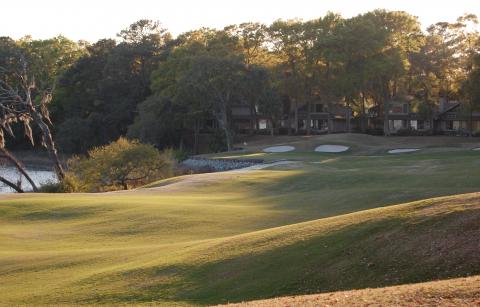 positions that way, I found it an interesting touch; the posts are there anyway, so why not use them for an additional function? And the club doesn't have to keep an inventory of three different colored flags.
After our round, Dick suggested we play the finishing three holes on Fazio's Cotton Dike course. They were the most visually dramatic of the day, the finisher vaguely reminiscent of the 18th at Harbour Town on Hilton Head or maybe even Pebble Beach -- a par 5, with marsh and water along the left side. The green juts out into the marsh, making even a short wedge approach -- assuming two excellent shots before that -- a wind-blown, knee-knocking affair. My thrill of the day -- of the week, actually -- was to loft a gap wedge to one foot, my only birdie of the day.
Morgan River plays to 6,185 yards from the blue tees, with a rating of 71 and slope of 130. Fazio's Cotton Dike course plays to 6,253 from the blue tees at a rating of 70.9 and slope of 131. You can lengthen the course and the rating and slope by moving to the back tees. Cotton Dike opened in 1985, one of Fazio's earliest designs, followed by the Morgan River course in 1989. With just 350+ full golf members, the two courses handle things quite well, although with a mid-Sunday afternoon tee time, we still had groups in front of us and behind, and the practice range was filled when I first arrived. The golf courses are definitely the centers of activity in the community, but those otherwise inclined can choose from the eight Har-Tru courts at the new tennis center, indoor and outdoor pools, a fitness center, a deep-water marina and a croquet court.
All purchasers of property in Dataw are required to pay $15,000 for club membership; an additional $24,000 buys an equity membership, of which 80% is returned upon resignation. In my experience, a $39,000 total initiation fee is not out of line for clubs with two well-maintained 18 hole courses. Annual club dues are $6,840 for a homeowner and $1,200 for a lot owner, and the $800 food minimum is reasonable, especially given the nearly half-hour to Beaufort, the closest restaurants. I did not have a chance to sample the food.
A community built by aluminum
Dick Nawalsky, who was my gracious host for the day, bought his home at Dataw two years ago. He and his wife considered communities along the
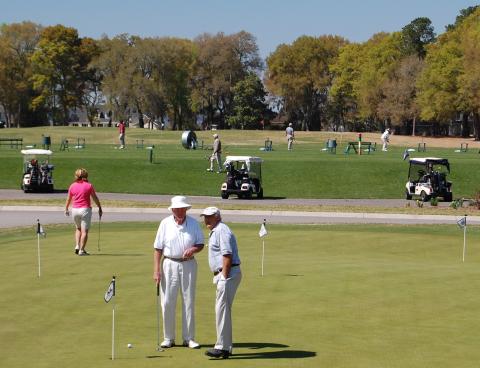 coast, but came to favor Dataw's remote location and modest size (870 acres, capacity for 1,050 homes, 800 currently built). They also like that they are only six miles from a state beach, which is a big lure for their kids and grandchildren during summers. Alcoa Corporation originally developed Dataw in the mid 1980s, in an era when large corporate landowners, like International Paper, Weyerhauser and Alcoa, thought that residential development would embellish shareowner value. Most shed their holdings years ago, but Alcoa turned Dataw over to its residents just last year. The transition, according to Dick, went smoothly, and no governance issues (or sticker shock) have emerged.
Many of the homes that line parts of the golf course are on ¼ acre "patio" lots, in close proximity to each other. Occasionally, out-of-bound stakes at the edge of backyards come into play, but for the most part they are not a distraction. Landscaping is quite nice, with trees on all lots (many of them live oaks), providing a nice buffer between homes. Few homes in Dataw are exposed to the elements, and those that are have marvelous marsh views.
Dataw seems the farthest from "civilization" of all the communities I visited last week, but it is a mere 20 minutes (10 miles) from the active and interesting Low Country town of Beaufort. I dropped off Dick Nawalsky at his home behind the green at Morgan River's 16th hole, about as far from the security gate at Dataw as you can get. It took me about eight minutes to exit the community. For Dataw's residents, I am sure that seems like a very small price to pay.
The Dataw Island Club and community is located in St. Helena, SC, about 20 minutes from Beaufort and a half hour from Bluffton and the bridge to Hilton Head Island. For a map, click here.
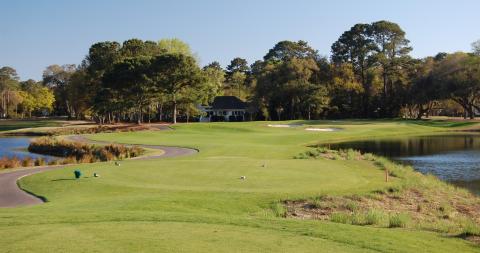
The par 3 16th at Dataw's Morgan River was the toughest one shotter on the course, especially with the pin at far right and on top of the second tier of a sprawling green.
Whose hills these are? Arthur Hills
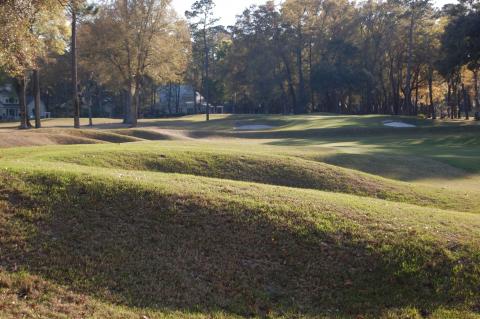
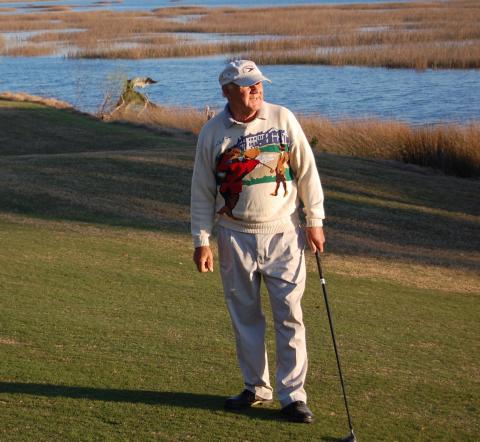
Most of the undulations on the Arthur Hills designed Morgan River golf course at the Dataw Island Club in St. Helena, SC, are on the greens, but at the home hole, Hills' hills are along the left side of the fairway, just waiting to gobble up an errant shot. I liked Dataw, both the community and its two excellent golf courses -- Tom Fazio designed the other. Real estate price to value ratio is among the best I have encountered in my four years of Golf Community Reviews, although the community is approaching its silver anniversary and some of the homes may need a little updating. But from what I encountered, the golf courses are quite up to date.
Look for my full review of the community here on Monday.
Horse Sense: Golf widows find their niche at golf communities' equestrian centers
Golf is a life-long interest for many men, but it leaves behind many widows. More and more, though, golf widows are finding their own passions at a rapidly increasing number of equestrian centers inside golf communities. [Editor's note: This past week, I visited two such communities in the Low Country of South Carolina, Spring Island and Oldfield. I will review both in coming days.] Equestrian centers in golf developments range from "world class," which include impressive indoor arenas and concierge-level services, to small, informal barns with facilities limited to an outdoor ring and trails, and minimal other services.
How should a prospective resident evaluate an equestrian amenity to assure she will be happy there for the long term? Here are a few things to consider:
- Look for options similar to the service and cost levels you expect in other amenities. For example, expect to pay considerably more for services covering complete care of your horse than if you are willing to be more of a hands-on owner.
- Look for age-appropriate emphasis in planned equestrian activities and
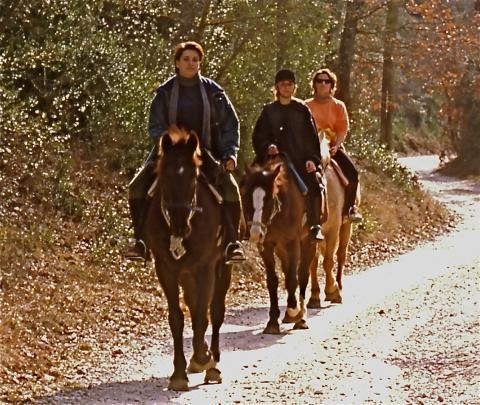
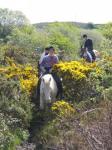 facilities. Jumping involves a willingness to occasionally hit the ground and requires vigorous, athletic riding -- generally better suited to the under-45 crowd. Lower-level dressage, reining and trail riding appeal to the over-45 to 70-something crowd, which is a fast growing riding demographic. Inquire whether the facility you are considering includes these riding disciplines, as well as a nice trail network.
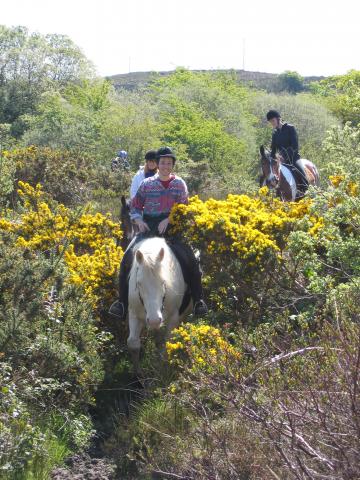
- If you are looking at a community that has an equestrian amenity on the drawing board, make sure you review a comprehensive written "standard of care," outlining programs offered and related fee structures. A horse care program without guidelines can change dramatically with a new manager; the result could be a lack of stability and harmony "in the barn."
- Young horse people, fresh out of school or certification courses, may not have the experience to deal with horse or rider emergencies. Look for a seasoned horse professional as barn manager, someone who has experience equal to the golf club manager or other managers. Outside riding coaches and clinicians, as opposed to just one in-house trainer, provide a diversification that shows a community is serious about its equestrian program.
- Unless you plan to leave the care of your horse and tack to the management, you will want separate tack lockers and multiple convenient places to groom and tack your horse. If you use a common tack room, expect to have your possessions ‘borrowed', which is aggravating. Having your space is important, the feeling that the barn is YOUR home barn, which in fact it is. Likewise, multiple turnouts and numerous arenas, even if very simple, give everyone the space to enjoy their time at the barn.
- Finally, a few community-owned horses -- the quiet, easy-riding kind -- are real assets. They spread the equestrian experience (and cost factor) more widely among the general residents, offer new riders a chance to try horse ownership on a limited lease basis, and provide fun for visiting relatives. There are several breeds of horses that travel so smoothly that their riders could drink coffee at a trot speed. These horse breeds are rapidly gaining popularity as they deliver true riding pleasure for non-riders -- even the occasional golf widow's husband.
Stacey Adams, who provided the photos, is a travel consultant who specializes in trips that involve both golf and horse riding. Ms. Adams is currently offering a Sunday through Friday trip to Gleneagles in Scotland for $2,800.00 per person in a shared room. The trip, which is available weekly, includes full Scottish breakfast, table d'hote dinner and three daily 45-minute semi-private riding lessons or two rounds of golf for each guest per day. For more information, contact Ms. Adams at 800.973.3221.
Walk this way? Uh, no thanks
My golf round in ruins
Bushwhacked by Fazio
Easy does it
Now on Sale

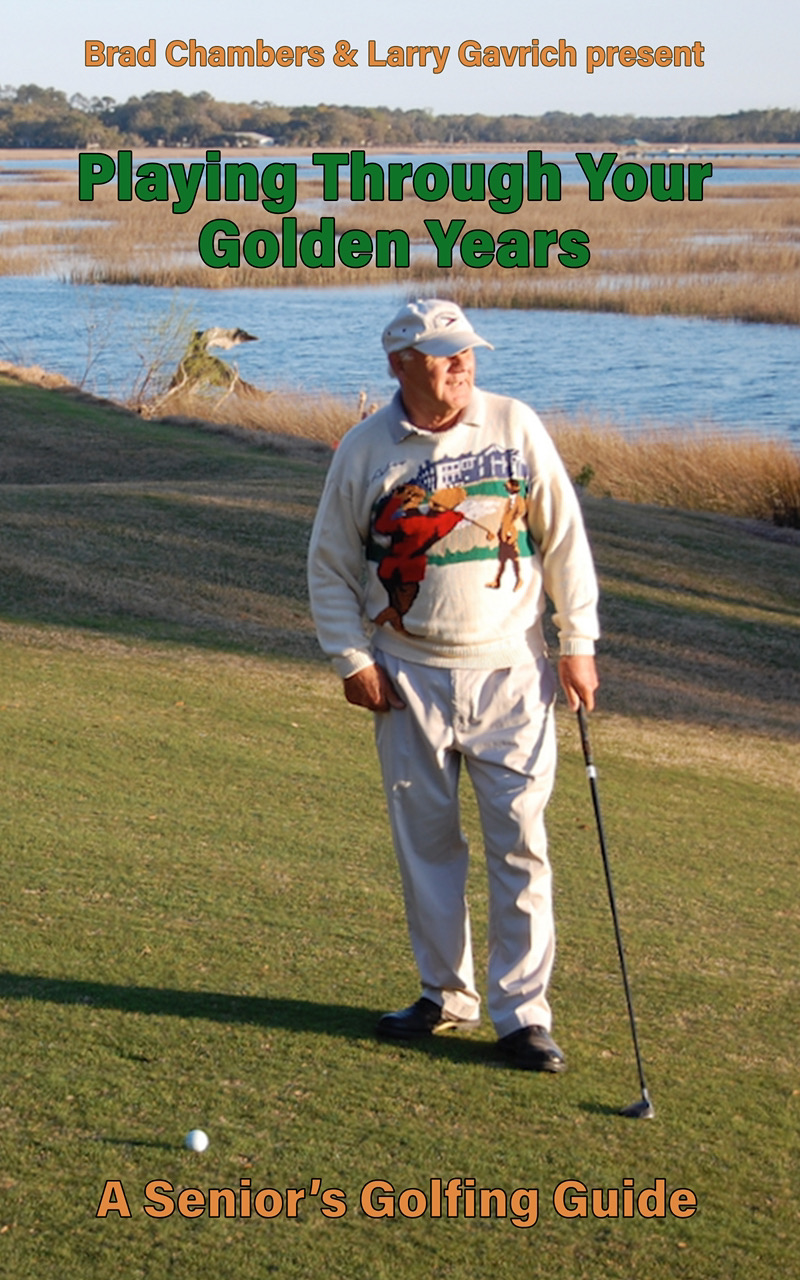
- The only book about golf communities in the last 10 years.
- 156-page step-by-step guide to finding your dream golf home.
- Info on nearly 100 golf communities the author has visited.
- Paperback version costs less than a sleeve of Pro VIs.
Here is what the experts are saying:
“The book is chocked full of information…applicable to anyone looking for a move to the Southeast regardless of whether they are looking for a golf community or not.” — John LaFoy, golf architect (Linville Ridge CC, CC of Charleston, The Neuse GC)
“Larry has done a tremendous amount of work and anyone — like me — who is looking to search for a golf home now or in a few years needs this book.” — Brad Chambers, golf blogger, ShootingYourAge.com
“Wow! What a thorough piece of work…a must for anyone moving South. This book will help many people.” — Brett Miller, owner and founder of MMA, Inc, a golf industry consultancy
Buy It Now at Amazon.com or BarnesandNoble.com.