Bottoms up: Timing the housing market
"More affordable prices, pent-up demand, incentives on new homes, fewer housing starts and expected declines in interest rates for fixed-rate mortgages also should help ease the crisis [by mid 2009], said David Seiders, chief economist of the [National Builders Association]," according to the Wall Street Journal.
"The converted bears, as well as the panicked sellers desperate to bail
Economists and financial program hosts are like meteorologists who tell you the sun is going to shine one day and then spend the next day explaining why they were wrong. (The fault was not theirs but rather some occlusion that no one even as brilliant as they could possibly foresee.)
The fact is they don't know, you don't know and I don't know when prices will begin to stabilize. The only thing for sure is that someday they will. Here are a few hints if you have your eyes on a particular market:
- Regularly check unemployment figures there; most likely they have increased in recent months, but as soon as they start to stabilize, housing prices will follow.
- Check housing inventory numbers; as the median time it takes to sell homes in a market drops, look for home prices to begin to rise. If you are working with an agent, have them get you the data for individual neighborhoods or golf communities in which you might be interested.
- Many vacation and retirement home markets do not have major foreclosure issues, but some of the larger communities may have a few homes in default. Keep an eye on them, as foreclosures will drag down prices in the immediate area until they are flushed out of the system.
- Do not rely on average or median prices in an entire market; a market is composed of zip codes, and zip codes composed of neighborhoods, and it is the prices within a neighborhood that you want to compare, even down to the street level.
- Do not go it alone in scouting out properties. Engage a "buyer's representative," someone who will represent you in your pursuit of a home. There are different types of these agreements, but the most popular is the "exclusive representation" agreement, which obligates you to pay the agent a commission if he/she finds you a house. Keep in mind that, in many cases, their commission will be paid by the seller; but even if it is not, your agent's negotiating skills could save you enough on the purchase price, especially in this market, to more than pay for their services.
- Finally, understand that if you wander into a golf community or an open house somewhere and show interest in a property, the agent you speak with will likely be working for the seller. The agent cannot possibly secure the lowest possible price for you and the highest possible price for the seller. Your interests may be secondary. That is another good reason to identify an agent to represent your interests solely.
 Home On The Course newsletter
Click here to sign up for our Free monthly newsletter, loaded with helpful information and observations about golf communities and their golf courses.
Norman conquests: Wine, women, golf real estate, and a good business attitude
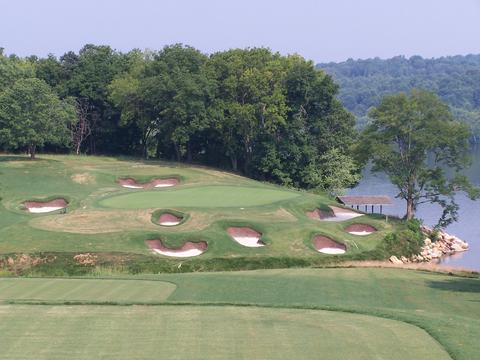
Greg Norman designed the course at Tennessee National to include sod-faced bunkers and a challenging layout along the banks of the Tennessee River.
This week's Wall Street Journal reported that Greg Norman's ex-wife, Laura Andrassy, is buying a nearly $8 million estate in New York's Hamptons. Whereas Mr. Norman found love with former tennis star Chris Evert, Ms. Andrassy collected a divorce settlement from the golfer/entrepreneur of more than $100 million.
The implication, unless Australia is a community property country, is that Mr. Norman is worth many multiples of the settlement. His golf equipment, clothing, cattle ranching, wine making and real estate development enterprises must be doing pretty well. He certainly has the right attitude for these challenging times.
"I've had some three-putts in the business world," he has said, "but if you're going to be in the game, you have to accept those and move on."
In the current real estate market, Norman's imperturbability is surely being tested. His Medallist Company, which develops golf communities around the world, five of them in the U.S. southeast, is suffering through the same slowdown in demand as its competitors, with the inevitable price reductions. South of Knoxville, TN, at Medallist's Tennessee National, for example, a home initially offered at $699,000 is now priced at $599,000. It overlooks the 18th green on the brawny Norman-designed course. You can experience a video walk-through of the house by clicking here. One of the community's golf villas, in a cluster called The Cottages that is adjacent to the 9th tee, is on the market for $585,000. It too is available for viewing [click here]. It is unusual to be able to compare and contrast online the features of two similarly priced homes in one golf community. God bless YouTube.
At $149 for two days and one night, Tennessee National is offering a reasonably priced Discovery Package that includes "an exclusive golf course and real estate tour." I have a call in to their on-site real estate office to determine whether the "golf course tour" includes a round of golf. I will report back when I hear from them.
Carolina mountains high spots for McCain, although Asheville and Charlotte solid for Barack
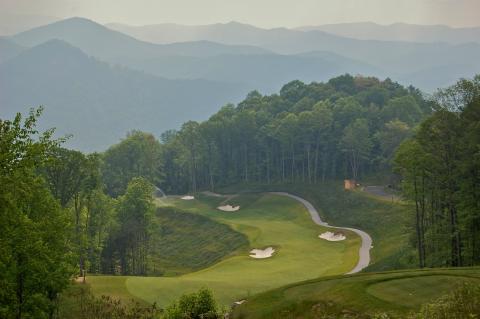
The Nicklaus Design layout at Bear Lake Reserve might make you forget it is only nine holes.
Conservative golfers looking for kindred spirits could find a home in the mountains of the Carolinas. Upstate in both North and South Carolina, I counted only three counties of 25 that went for Obama. Most notable was Buncombe County, North Carolina and its largest town, Asheville, surrounded by red counties but which voted 57% for Obama. Many artists and craftspeople live in Asheville, which is often described as a small-scale San Francisco. The city of 75,000, home to the helpful Center for Creative Retirement at the local branch of the state university, has undergone a significant transformation over recent years as newcomers arrived from the northern and Florida.
In the Asheville area, those looking for a golf community have a wide range of choices, from the upscale and private Cliffs at Walnut Cove to the open and public Reems Creek, which features a sloping and challenging British-designed layout. Yancey County, just north of the city, went slightly for McCain (52%). Its Mountain Air community, with breathtaking views and top-of-the-mountain airstrip, is about a half hour from Asheville. Henderson County, on the other side of Asheville, and home to the mature and member-run Champion Hills community and its classic Tom Fazio golf course, gave McCain a 60% victory.
Brevard, Lake Toxaway and Sapphire comprise Transylvania County, just above the South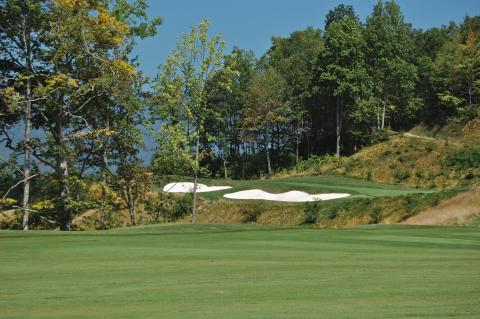 Carolina border in the western panhandle of North Carolina. The county went 56% for McCain. Earlier this year, I played an enjoyable round of golf on the well-conditioned Connestee Falls course in the community of the same name, just outside the charming and vibrant town of Brevard. Other area choices include the recently renovated Sapphire Valley and Glen Cannon, whose par 3 2nd hole plays to a green backed by a dramatic waterfall.
Just west of Transylvania, 52% of Jackson County voters went for Obama, something of a surprise to me after a recent visit to the rural county. Perhaps the presence of Western Carolina University in the county seat of Sylva tilted the numbers Democratic. A few miles down the road from the school, Bear Lake Reserve offers a course at the top of the mountain that is so dramatic in its views that you might not care that it is only nine holes. Neighboring Haywood County (McCain 53%) is chock-a-block with interesting golf courses, including Laurel Ridge, Waynesville Country Club (originally designed by Donald Ross), Maggie Valley, Springdale and the jaw-dropping Balsam Mountain Preserve, whose views from the Arnold Palmer course are distracting, in the best possible meaning of the word. The Windover Inn in Waynesville, a bed and breakfast, is a great place to stay in the area.
The counties surrounding Greenville, SC, home to a number of the Cliffs Communities, all went strongly for McCain, with the mostly rural Pickens County totaling 72% for the Republican candidate. Greenville County, whose population is mostly in the city of Greenville, opted 61% for McCain.
In the lower lying areas of the Carolinas where golf communities are plentiful, voting tended to skew Republican. However, Obama's most commanding victory in the Carolinas was in the Charlotte area and Mecklenburg County, where the economy has soured quickly and the Democratic candidate took 62% of the vote. Charlotte, which is home to the evaporated Wachovia Bank, as well as Bank of America, had maintained its financial footing until September's banking crisis. Now prices on homes in the popular Lake Norman area and such communities as The Point (Greg Norman course) are eroding in the wake of corporate consolidations and layoffs.
In Aiken County, South Carolina, home to Mount Vintage, Woodside Plantation and Cedar Creek, 61% of voters opted for McCain. Up in the Pinehurst area, in Moore County, 60% voted for McCain. Yet in the area of Winston-Salem (Forsyth County), Obama copped 55% of the vote. Most of the good courses in the Winston-Salem area are semi-private or public; you could do a lot worse than a reasonably priced annual pass to Tanglewood, where two excellent courses, including the venue for the 1974 PGA Championship, await.
Speaking of annual passes and reasonably priced public access golf, I was smitten by the few courses I played earlier this year on the Robert Trent Jones course in Alabama, a state that gave McCain a huge 60% to 39% tilt. But Democrats do not despair because 13 counties in Alabama actually gave the nod to Obama, a few of them located along the Jones Trail. Most notably, Jefferson County, which surrounds Birmingham, voted 52% for the President-elect. I loved the course I played at Oxmoor Valley, inside the city limits, but others think the tournament venue Ross Bridge even better. Finally, when I played the Robert Trent Jones Trail golf course at Silver Lakes, near Gadsden, AL, I was struck with the excellence of the golf and the unbelievably low prices of the adjacent housing. However, if your politics tilt Democratic, understand that you will be in the minority in the surrounding Etowah County; 69% of its citizens voted for John McCain.
For those relocating in the next few years, political discussions are apt to be lively, no matter where you choose to live.
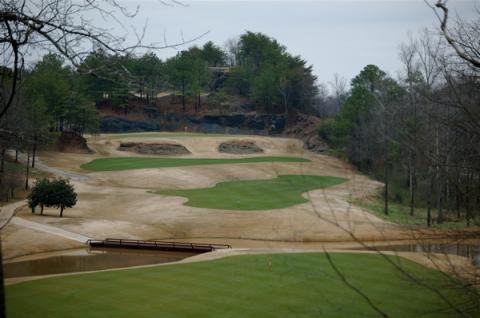
Birmingham's Oxmoor Valley is one of the oldest along the Robert Trent Jones Golf Trail. The county around the city went for Obama but the entire state of Alabama went strongly for McCain.
In election, Atlantic coast communities see red
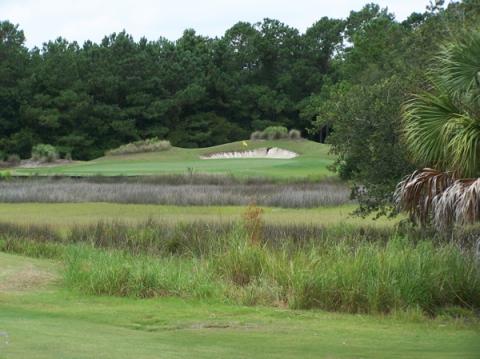
Rees Jones' Charleston National is one of the best looking courses in the Charleston, SC, area. The surrounding community offers plenty of choices of homes.
The primarily Republican residents along the Atlantic coast may be feeling a little blue after Tuesday's election, but they can assuage their disappointment on one of the many excellent golf courses at their disposal.
John McCain carried substantially more counties than Barrack Obama did up and down the coast from Virginia to Florida. For example, Perquimans County, North Carolina, home to Albemarle Plantation, a nice if somewhat remote golf community an hour south of Norfolk, VA, went 57% for McCain. An hour down the coast, in the up and coming New Bern, voters in Craven County gave Senator McCain the same 57% nod. The community called Taberna, home to many retired military personnel, is located just outside of New Bern, a town on many lists of "best places" to live. The Taberna golf course was well groomed and underrated when I played it a few years ago.
Further down the coast in Wilmington's New Hanover County, McCain inched out a 50% to 49% victory, essentially a dead heat. Wilmington's Porters Neck, with a classic design by Tom Fazio, and Landfall, with 27 holes by Nicklaus and Dye, offer a contrast of community designs and price points (and judging by the local voting, diverse political points of view). The most reasonably priced community in the area, Castle Bay, features a golf course designed by its developer who studied Scottish links and crafted a layout that is a joy to play (if you ignore the ubiquitous high-tension wires that thread through the course). Prices for the tidy homes adjacent to the course start below $300,000.
Golf's supermarket, Myrtle Beach, comprises both Horry and Georgetown counties, which went for McCain, 62% and 52% respectively. Out of the more than 100 courses on the Grand Strand, a relatively few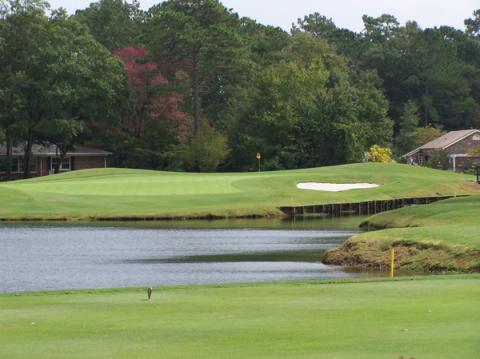 are private, community-oriented clubs, among them Grande Dunes (Nick Price), The Reserve at Litchfield Plantation (Greg Norman), Wachesaw Plantation (Tom Fazio) and DeBordieu Colony (Pete Dye). The private Surf Club, a former public fee course located north of Myrtle Beach, is a reasonable alternative to private community clubs, as is the vaunted Dunes Club, which permits limited play for those staying in some of the area's hotels. The remaining semi-private and public clubs offer a wide range of playing options; with a $39 annual Myrtle Beach Golf Pass, local residents receive discounts up to 60% off green fees for themselves and friends, even at the most popular course in the area, Caledonia Golf and Fish Club.
An hour down the coast in Charleston County, all but a relatively few votes have been counted, and Obama holds a commanding 54% to 45% lead. High-roller golfers will know the area as home to the famed Ocean Course (Dye) at Kiawah Island, as well as the private and highly regarded Cassique Golf Club (Tom Watson). But Kiawah and its neighboring barrier island, Seabrook, offer other splendid semi-private club and golf resort options. For less pricey options, Mt. Pleasant, just north of one of America's classiest cities, Charleston, offers both daily fee courses and one private club, Snee Farm, a classic George Cobb layout that is in way better condition than the club's dated and dismal clubhouse. My favorite daily fee course in town was Rees Jones' Charleston National, which threads its way through the marsh. My day of golf there a year ago was marred only by incomprehensibly indifferent service.
Just a sliver of Bryan County, Georgia separates two Democratic counties, Chatham (Savannah) to the north and Liberty County to the south. Bryan is home to the wonderful and expensive Ford Plantation and its Pete Dye golf course, one of the best I have played. Bryan County went strongly for McCain, with 71% of the vote, although Ford Plantation, with homes beginning in seven figures, is closer to Chatham County than it is to the heart of Bryan County.
The six counties extending south from Liberty County along the coast -- three in Georgia and three in Florida -- all went for McCain. These comprise the many excellent golf communities near St. Simons Island, Sea Island, St. Marys, Amelia Island and the Jacksonville area.
McIntosh County, Georgia, which went 53% for McCain, is home to one of the most interesting golf communities of my travels, Cooper's Point at Shellman Bluff. A good eight miles from I-95, the community is remote but close to a sleepy little fishing village where you can still haggle with a ship's captain over the price for part of the day's catch. The daily fee golf course is surprisingly challenging, lightly trafficked and priced to delight the most conservative spender in Congress.
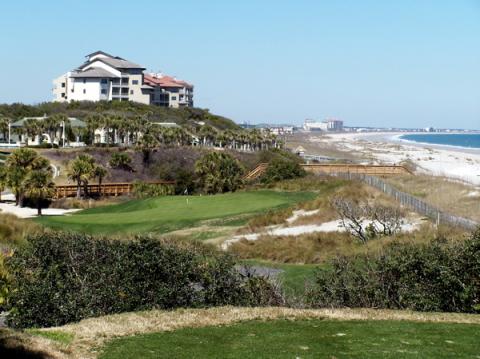
Amelia Island's Ocean Links is open to resort guests and residents who populate the adjoining single family homes, villas and condos. The par 3 6th hole is shown.
Red communities, blue communities
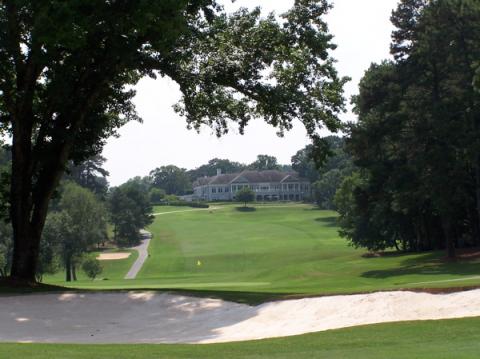
The traditionally and wonderfully groomed private Athens Golf Club is a few miles from the University of Georgia and offers an alternative to planned community development courses.
People choose their places to live based on many factors, among them social considerations. I have met scores of retired folks, and those planning to retire, who have chosen their new and future communities because friends were already living there. People want to live amidst people like them, whether in a 55+ community where they want to be kid free most of the year, or in a college town where they believe they will have plenty of opportunities to work on their intellect, as well as their golf swings, by attending adult ed courses with like-minded souls.
I suppose there are a few among us who find great sport in debate and argument and may, consciously, look for a combative atmosphere. But the vast majority of us choose to live cheek by jowl with neighbors whose core beliefs are like our own. For those who factor such a calculation into their equations, I thought it would be interesting to look at yesterday's voting patterns in counties where some of the best communities are located. I'll start today with college towns and follow in the coming days with other southern counties and communities.
Joe the Professor goes for Obama, with some exceptions
For many baby boomers and others, the idea of living in a golf community near a large college campus is a stimulating notion. Not surprisingly, college towns in the south went blue, but what was surprising was the substantial size of the margins in all but a few cases. In Albemarle County in Virginia, for example, where Charlottesville and the University of Virginia is located, 59% of students, university professors, and their neighbors went for Obama. The area's golf communities include the expensive but well-organized Keswick, the reasonable and communal Old Trail (town center concept and publicly accessible golf course), and the mid-range Glenmore, which has an attractive Scottish feel to its community, as well as its golf course. If you opt for a private club unaffiliated with a community, you won't do better than the historic Farmington Golf Club, where a remnant of Thomas Jefferson's architecture is still used as one of the clubhouse's entrances.
In Orange County, North Carolina, home of the main campus of the state's university in Chapel Hill, voters went for Obama with a whopping 72%; a few miles away in Duke University's Durham County, an even bigger 76% of voters gave the President-elect the nod. (As of this writing, the entire state of North Carolina is too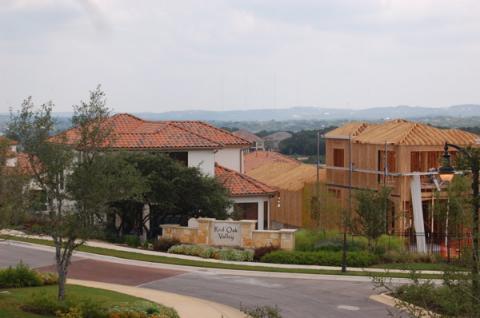 close to call, only 12,000 votes separating the two candidates, with Obama leading). The high-end golf community in Chapel Hill is Governor's Club, with 27 challenging holes by Jack Nicklaus. Other excellent courses include The Preserve at Jordan Lake (Davis Love III) and Chapel Ridge (Fred Couples). The private three-year old Old Chatham Club has received rave reviews among the state's golf raters and could work well for those who may choose not to live in an amenity-laden community. For those who opt to pay for golf as they go, the Duke and UNC school courses are publicly accessible and terrific layouts.
In South Carolina, where McCain won the state with 54% of the vote, Columbia County, home to the state university, gave the nod to Obama 64% to 35%. Cobblestone, a Ginn community, took over and improved the University of South Carolina golf course. But tread carefully because the Ginn organization is in default of a major loan and is in organizational turmoil. Of course, that means reduced prices, but also increased risk. In Knoxville, TN, home of the University of Tennessee, voters went stronger for McCain than voters statewide, 61% and 57% respectively. I liked the semi-private Landmark Golf Club in the community of Avalon and the striking Tennessee National (Greg Norman layout). Fox Den Golf Club hosts an annual Nationwide Tour event and would be an outstanding private club choice; it is not in a developed community, but the surrounding neighborhood offers some excellent house bargains.
In Clarke County, GA, and the town of Athens, where I played the historic and beautifully conditioned Athens Golf Club, Obama earned 65% of the vote. In Austin, TX, 64% of the voters went for the Democrat, swimming strongly against the statewide tide. In the Austin area, I loved the University of Texas Golf Club in the expansive Steiner Ranch community, but there are many other excellent choices within a few miles.
Tomorrow: McCain mostly coasts along eastern seaboard.
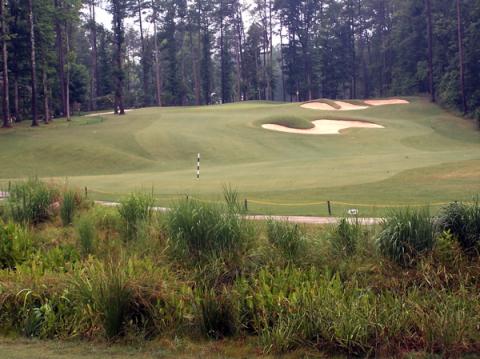
Davis Love III's design at the Preserve at Lake Jordan, near Chapel Hill, is not for the faint of heart. It is one of the toughest layouts in a golf rich area.
Myrtle Beach best golf hole debate
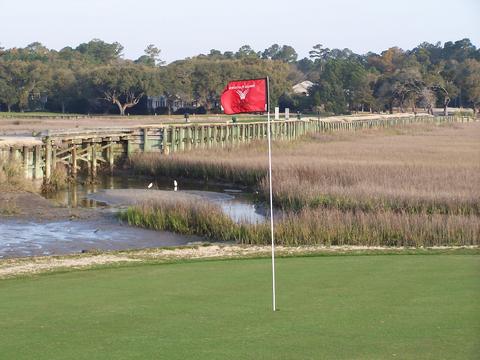
The tee shot from the dike at the 13th at Jack Nicklaus' Pawleys Plantation course is all carry to a green smaller than the famed 17th at TPC Sawgrass. However, #17 at Pawleys is tougher.
Brandon Tucker at worldgolf.com has hit a nerve with an article he posted at the web site today. He proffers his candidates for best hole of the 100+ golf courses along the Myrtle Beach Grand Strand. The comments started coming from readers within minutes. Myrtle Beach, of course, is a magnet for buddy golf, cheap and with more decent or better courses per square mile than virtually anywhere else.
The 13th at Pawleys Plantation, which I have played many times, makes Tucker's top five list, but the 17th is better. I won't belabor the point here because I posted a comment at WorldGolf, but suffice to say #17 is longer, the green is no deeper than is the tiny 13th green, and the wind plays more havoc with shots to the longer hole simply because the hang-time is greater. If fair but tougher means better, #17 at Pawleys is the best hole on the Grand Strand.
Chances are you have played golf in Myrtle Beach. You may want to weigh in at WorldGolf or, better yet, send me your comment and I will post it here.
Time out for America's big day
A number of non-Americans read this blog, and I will assume they are interested in our great national obsession that ends tomorrow. This will be the 10th national election in which I have voted. I started with Nixon/Humphrey, and it was hard to imagine at the time that any one political season could ever be more consuming, more passionately fought, more in our faces every day. Of course, back then all we had to rely on were the daily newspapers and three major TV networks. Now we can choose among dozens of cable stations and all the blogs we can consume.
The current campaign has been the most animated for me since 1968, the equivalent in many ways of a heavyweight prize fight, with all the thrusting and parrying and wild shots and some nice jabs landed. It is unimaginable that there can be anything more we can learn about John McCain and Barrack Obama. Over the coming months and years, we are going to learn a lot more about one of them.
The lines will be long tomorrow, but long lines are a small price to pay to exercise one of our most important responsibilities. The candidates have had their turn. It's our turn now.
Palmer wins big under clouds at Ginn sur Mer
The golf community empire of Bobby Ginn remains in default of a $675 million loan from Credit Suisse and there is talk that the bank could soon put four Ginn properties in the same condition as hundreds of thousands of Americans, in foreclosure. Key members of the Ginn executive team have left in recent weeks, and the executive page on the organization's web site is gone, according to Toby Tobin, a real estate professional in the Palm Coast area who has been following the Ginn troubles closely.
The Credit Suisse loan covers four of the Ginn communities, including Ginn sur Mer in the Bahamas, Tesoro and Quail West in Florida, and Laurelmor in the mountains of North Carolina. The Bahamas resort is a nearly $5 billion project. Ginn has also turned over two of his other communities to other management firms.
Sotheby's has scheduled an auction of some Ginn properties on Nov. 8th in downtown Orlando, and bidders worldwide can join live online. Twenty Florida homes, condos and home sites at Ginn Reunion Resort, Bella Collina and Ginn Hammock Beach Resort will be sold. A Sotheby representative indicated strong interest from the UK, Canada and Europe. Deep discounts are expected, consistent with such a messy situation.
Swing state: What we can expect from Obama's golf game if he wins, and if he ever has time to play
But now that he and Bill Clinton seem to have made up, the two could play
According to reports, Obama is not a bad golfer. Golf Digest wrote a story earlier this year about "golfers in Washington" and ranked Obama 123rd among legislators, lobbyists and other hangers on, but 37th among elected officials and 15th among Democrats. He allegedly sports a 16 handicap, but that is not official or posted anywhere. Earlier this year, during a visit to Hawaii, the candidate played a round at the Olomana Golf Course in Waimanalo and was followed by a TV news crew, which caught a couple of swings. Click here to see it.
A California golf instructor, Brady Riggs, saw the video report and posted an analysis of Obama's swing, at Golf.com.
"Obama is square to the target," Riggs wrote, "with good posture and alignment. This is a well-prepared setup, the kind you'd expect from a Harvard Law School graduate. He looks ready to hit a good shot."
After indicating Obama's backswing is "controlled and focused on avoiding mistakes...[like a] meticulously planned campaign," Riggs added that, "He's got his weight moving in the right direction and makes good contact. The funny thing is that even though he aims down the middle, his shots fly to the left." (I know, the irony is too much for some of you, but let us not forget that John McCain is a lefty too.) Riggs added that Obama can correct the pushes left if he "goes for the jugular" by being "more aggressive through impact."
If elected, Obama will be the fourth lefty of the last five Presidents and join a long list of swingers in the White House. If the subject of golfing Presidents interests you, check out the book "Presidential Lies: The Illustrated History of White House Golf." It has been updated to include a description of Clinton's famous two and a half gainer off Greg Norman's steps.
Ya gotta have heart to buy real estate
I am not looking for sympathy. On the contrary, I have a perfectly
Investing in residential real estate -- raw property or houses - is a dicey proposition in any market, even now in Miami or Vegas where it is tough to imagine prices could go any lower. The stock market, over most periods of time, has been as good an investment as real estate, and certainly a lot more liquid. You can peddle a stock on the downside in a matter of minutes, typically. In Miami, the average wait to sell a condo is something like three years. I admire anyone able to make money in real estate as I admire the 10% of horse players who come out ahead.
In the spirit of full disclosure, I own three properties; I suppose that makes me look like a real estate investor. Okay, as Woody Allen once said, "Guilty, with an explanation." The first property is the home in which my wife and I have raised our children. The second is a condo on the South Carolina coast bought as a vacation home nine years ago. We use it for at least six weeks each year. The third property is a lot, down the street from the condo, that we purchased -- gulp - at the height of the market two years ago with the intent to build in a few years.
Our timing could not have been worse, but we never considered the lot an investment in the strict sense; it was one of the last two properties directly on the golf course with views down the 16th fairway and out to the marsh beyond. We either bought it then or risked never being able to have the house we wanted on the golf course in a southern community we love. We had a lot more heart than head in the decision.
Woody Allen, again, once said that, "the heart wants what the heart wants." You wouldn't think that emotion would trump the cold calculation of those investors who defied gravity and bought overpriced properties at the very top of the market. But it did because, at the end of the day, you have as much as you started with. Caveat emptor.
Okay, so Bobby Jones didn't really design it
Golf Review: Piney Branch, Hampstead, MD

Now on Sale

- The only book about golf communities in the last 10 years.
- 156-page step-by-step guide to finding your dream golf home.
- Info on nearly 100 golf communities the author has visited.
- Paperback version costs less than a sleeve of Pro VIs.
Here is what the experts are saying:
“The book is chocked full of information…applicable to anyone looking for a move to the Southeast regardless of whether they are looking for a golf community or not.” — John LaFoy, golf architect (Linville Ridge CC, CC of Charleston, The Neuse GC)
“Larry has done a tremendous amount of work and anyone — like me — who is looking to search for a golf home now or in a few years needs this book.” — Brad Chambers, golf blogger, ShootingYourAge.com
“Wow! What a thorough piece of work…a must for anyone moving South. This book will help many people.” — Brett Miller, owner and founder of MMA, Inc, a golf industry consultancy
Buy It Now at Amazon.com or BarnesandNoble.com.