Despite poorly repaired ball marks, The Ridges leaves good impressions
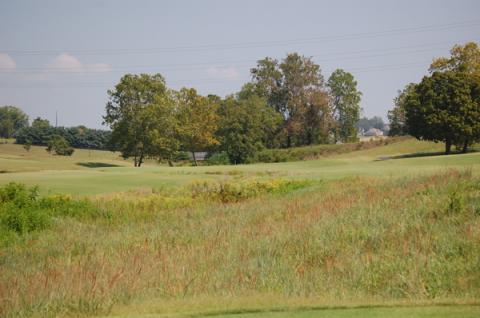
The tee shot at the 8th hole at The Ridges can be played to one of two fairways bisected by a stream.
I could have stopped at any number of golfing communities in western Virginia or eastern Tennessee on my way to a week in the mountains of North Carolina. I chose The Ridges, near Jonesborough, TN, because it was designed by one of my favorites, Arthur Hills. I like Hills because his golf courses are always a surprise, sometimes brutally tough, sometimes as easy as a walk with my dog, and more often a combination of both. Since his designs do not receive the kind of buzz of a Dye, Nicklaus or Jones, it is hard to find much in the way of reviews online. You discover Hills courses for yourself.
I am glad I played The Ridges. Its mostly short par 4s featured elevated greens with some false fronts and, in one memorable case, a yawning bunker the guarded the entire front of a green that was no more than 40 feet deep. Par 5s were not easily reached in two with the exception of #14 (see below), which presented more reward than risk. Although some fairways appear narrow off the tee, many are banked (mostly on the right) so that a play to slightly off the fairway can provide nice positioning as well as safety.
Hills is a good listener, and his courses typically follow the wishes of those who hire him; for example, at Dunes West near Charleston, SC, his rather flat layout appeals to members and guests who want to leave the course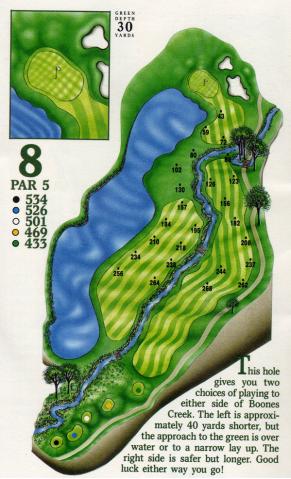 happy with their scores and not exhausted by the experience. At The Landings near Savannah, however, the developers clearly were aiming for Hills' Palmetto layout to be the toughest of the six courses on the property (the others are by Fazio and Palmer). At The Ridges, it appears he was asked to make it look hard but play somewhat easier. I put it in the middle category of Hills courses -- not too hot, not too cold, for the most part just right, and totally dependent on the tees you choose to play from. I chose the "Members" tees (rating 70.9, slope 129), at a total of 6,300 yards; after a three-hour drive from Lexington, VA, I did not want to test myself over 6,730 yards on the Ridges tees (rating 72.9, slope 137). Low single-digit players (and masochists) can try the Championship tees at 7,150 that carry a rating of 74.9 and slope of 140.
The Ridges opens with an attractive, short par 4 that bends and slopes left to right around a grouping of fairway bunkers. I played my shot a little too far left, but it sat up nicely in the dense Bermuda rough, with the best angle to the green. Hills uses gullies and ravines when the local land masses make them available, and a deep gully awaits the approach shot to the par 4 2nd green from a generous fairway. Along this fairway and behind the green, I saw the first of many out of bounds stakes of the day, but the huge homes were well back. With few exceptions, I did not find the encroachment of homes distracting at The Ridges; most sat up and above the fairways and well behind the greens, but clearly the developer intended for the golf course to maximize the real estate.
The rest of the course shuttles between mild and tough, highlighted by the challenging 9th hole, deservedly rated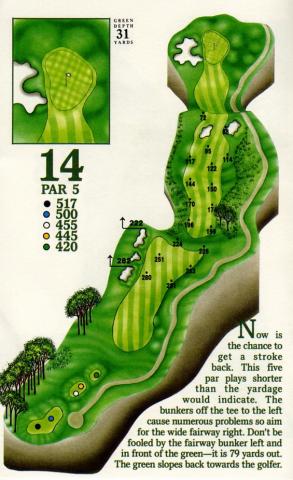 the #1 handicap hole on the course, which I wrote about here last week. Certain Hills flourishes at The Ridges are worth noting. At the par 4 5th hole, a huge mound in front of the green gives the impression that you will not be able to get close to the hole. But there is plenty of room as long as you don't hit the ball a little short and bank off the backside of the mound. The par 5 8th hole is Hills at his most creative, with a fairway split by a stream that runs from the tee and then bends right 90 yards in front of the green on the 500-yard hole. The short route is down the left, but a lake guards the left side of the fairway and the stream guards the right; the long iron or wood approach shot must be played over the end of the lake to a green that is sited horizontally to the shot. The more conventional play, which I chose, was down the right fairway, in preparation for a lay-up shot to about 120 yards, 30 yards or so short of the stream. However, the fairway narrows at its end, and if you overcook your approach, the stream on the left or trees on the right await. From the end of the fairway, the green runs straight back, affording the safest play. It is just a marvelous par 5.
Another par 5, the 14th, provided a more than reasonable eagle opportunity. Playing just 455 yards from the Members tees, the downhill drive carries to the rough on a down slope that separates the upper fairway from the lower. I thankfully kept my front shoulder down as I came through the ball and flew my shot about 180 yards over another deep gully in the fairway short of the green. The ball bounded to the front of the putting surface, from where I had a 60-foot eagle try (I two-putted).
The 18th hole at The Ridges defies the convention of modern courses that the finale must feature visual elements and drama. This one, at just 376 yards and downhill onto a wide fairway, features a pond to the right of the green that encroaches on the approach shot only if the pin is set to the far right on the green. Standing on the tee at 18 with a chance to break 80 or post a career-defining score, the good player's eyes will widen at the potential. It is one of the most realistic birdie chances on the course.
Conditions on the course were excellent, with firm Bermuda grass on the fairways that provided a little extra roll and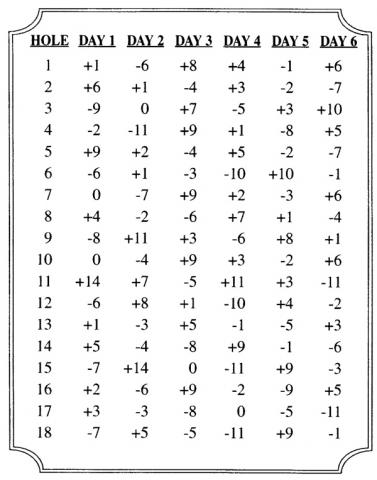 medium-fast greens that were extremely receptive -- maybe too receptive -- to well struck approach shots. The pro shop hands out divot tools freely, but they should include instructions on how to fix the marks. From the first green on, all putting surfaces at The Ridges showed little brown pockmarks, indicating players had jabbed too deep into the surrounding turf, destroying the roots. A visual eyesore, the marks thankfully did not affecting putting on the subtly undulating greens. I had just two straight putts the entire round, but none others that broke more than six inches.
My only other criticisms of The Ridges are mild. The fairway bunkers could use a little more sand; in one, I propped my left foot against the hill below the lip and felt solid ground under less than only an inch of sand. The number of water stations were more than ample, but I saw no beverage cart on a 90-degree day. High-tension poles and wires marred a few vistas on the course; one of my best drives of the day, at the 10th, threaded the wires.
One thing The Ridges does that I have never seen at another course: Before they send you out to the course, they hand you a little "flag stick placement card" that indicates pin placements on each hole for every day of the week. Since I typically forget to check the pin-position signs on the way to the first tee ("Today's pin position is #...") on those courses that include diagrams in their golf carts, I appreciated this creative approach. It also means the golf professional and green superintendent don't have to meet every morning to discuss pin placements. Clever.
An absence of signs at the tee boxes to mark the holes seemed odd to me. Although it was easy to find my way from green to next tee, I missed the welcoming sign that indicates distance and layout of the hole. One shouldn't have to refer to scorecard or yardage book just to find out how long each hole plays. Ridges members should invest in tee markers as a welcome to others who might consider joining the club.
Although OB stakes abound, homes are not in play, most sitting above the fairways and well beyond the field of play. The course integrates nicely with the surrounding community, but if you want homes hidden from view, The Ridges is not for you. This is a community golf course in the strictest sense of the term, and the developers appear to have consciously maximized views of the course.
Amenities at The Ridges are country club nice, with tennis courts and an attractive, inviting pool. The pro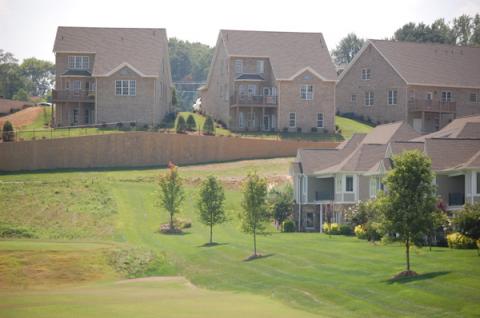 shop is well stocked and its personnel friendly, knowledgeable and competent. The locker room is on the small side; I noted that the area of lockers was considerably smaller than the card and TV room where one member was watching an old John Wayne movie on the Sunday of Labor Day weekend. The nicely sized practice range is about a 400-yard long cart drive from the clubhouse. At $16,000, full family golf membership may seem a little steep for a course nowhere near a large urban area. However, the $16,000 buys an equity membership, and 80% of that comes back at departure. Plus, the $410 per month for dues and assessments ($50) seem reasonable for a country club with such a nice array of amenities.
The surrounding community features impressively large homes (the largest runs to 12,000 square feet), with prices that start around $400,000 and move well past $1 million. Architecture is not uniform and, therefore, you might find Mediterranean style homes next to brick ones, with a typical mountain style home across the way. It looks a little odd at first, but after a while I found it charming, in an eclectic kind of way. I also found the real estate prices overall a little on the high side for eastern Tennessee, pretty close to what I found for similar real estate near the more urbane Knoxville. The nearest city of any size is Johnson City, TN, about 20 minutes away. Asheville is about an hour south, down the nearby Interstate 26. Rumors abound that plans for a new shopping mall a few miles away will be announced soon (Macy's department store is allegedly interested). The area is rich with good hospitals, including a VA facility, and Johnson City certainly has enough shopping and entertainment options to sate any but the most cosmopolitan resident. For intrepid outdoors types, the Appalachian Trail is just a few miles away.
Many of the nicely landscaped homes at The Ridges are out in the open, indicating the course and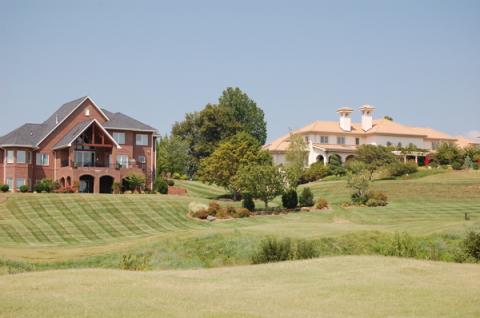 neighborhood were likely built on former farmland. Still, the terrain is pleasantly hilly, and with views to the nearby mountains, the trip around the golf course reminded me of rounds I played in Austin, TX and the Hill Country. I stopped in to look at a few of the homes in a new community called Quail Creek. About 15 of the neighborhood's 29 homes will look down to the golf course (the 10th and 11th holes) and are at the lower end of the market in terms of price, starting at $369,000 for the duplex homes (3 BR, 2 1/2 BA) and the low $400s for the single family structures. They also look down to the roofs of a row of homes that line the 11th fairway.
Although square footages at Quail Creek are in the 2,300 range, purchasers have the option to finish off the huge basements at about $60 per square foot, bringing total heated footage to nearly 4,000. Quail Creek is still waiting to make its first sale - a few spec homes are completed - and the developer is offering a complimentary social membership at The Ridges ($3,000 value) with the purchase of a home. If you are interested in visiting Quail Creek and The Ridges golf community, let me know and I will put you in touch with Joyce vandersommen, the knowledgeable real estate agent who took me on the tour.
The Ridges Golf & Country Club, 1501 Ridges Club Drive, Jonesborough, TN. Designed by Arthur Hills. Phone: 423.913.3164. Web: TheRidges.cc. Par 72. Championship tees: 7,147 yards, rating 74.9, slope 140. Ridges tees: 6,732, 72.9, 137. Member tees: 6,306, 70.9, 129. Women's "Club" tees: 5,218, 73.1, 132.
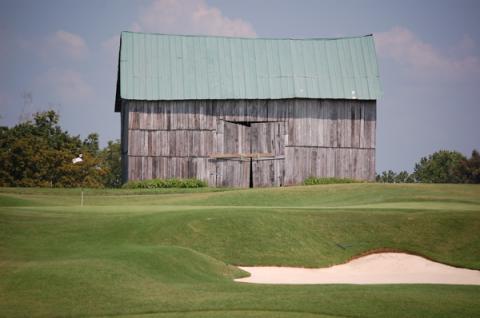
An old barn dominates the view from a number of holes at The Ridges, none morseo than the short par 4 13th, where a bunker protects the entire front of the green.
 Home On The Course newsletter
Click here to sign up for our Free monthly newsletter, loaded with helpful information and observations about golf communities and their golf courses.
Narrowest green in America...again
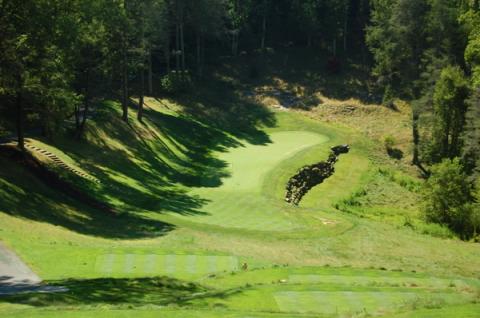
The 9th at Trillium is straight downhill with a friendly bank on the left and death on the right. The green is one of the two most narrow I have played in 50 years of golf.
Senior pro golfer Morris Hatalsky has designed one 18-hole golf course to date, the up and down Trillium Links in Cashiers, NC, and he may have borrowed a little inspiration from an obscure nine hole course in the middle of nowhere Tennessee. Trillium is notable for its dramatic changes in elevation, inlcuding its unique 8th hole, a par four that calls for a 160-yard drive to the top of a hill for a short wedge approach to a green at the edge of a cliff. I'll have more to say about the course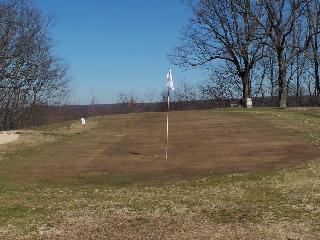 and golf community in the coming days, but one hole, as Yogi Berra might say, was déjà vu all over again for me.
The 9th at Trillium, a downhill par 3, features a green I had seen before at the par 3 4th hole at Sewanee Golf Club in Tennessee, a remote little nine hole layout that was designed in the mid 20th Century by faculty and students from the nearby University of the South. At its most narrow, the Sewanee green was perhaps four steps across the front and no more than five or six at its widest part. The putting surface stretched about 110 feet from front to back.
The Trillium green is a virtual duplicate, maybe 20 feet deeper but almost the same shape as the one at Sewanee. The betting here is that Hatalsky has seen the Sewanee green, either live or in a photo. I have asked Trillium golf professional Tim Laverty to ask Hatalsky, who lives with his wife in the Trillium community, about his inspiration for the 9th green. I will let you know when I hear back from Mr. Laverty.
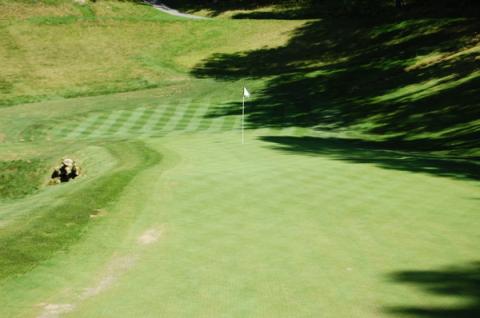
The 9th at Trillium from behind the green. The narrowest part, just about 15 feet, is at the front, where the pin was placed on Thursday. When I played Sewanee a few years ago, the pin was also up front.
Two holes in one: Separate greens provide entirely different experiences
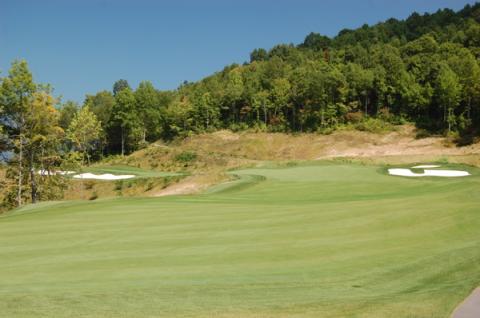
The easiest routing at the 5th hole at Balsam Mountain Preserve is straight ahead, to the rightmost of the two greens.
I played the private golf course at Balsam Mountain Preserve today, a sprawling mountain community about 15 minutes from Waynesville, NC and 40 minutes from Asheville. The layout is an Arnold Palmer Signature design. I'll have a full review of the course and community after I return home to Connecticut in a few days, but let me whet your appetite with a few words on a most unusual hole.
The fifth hole at Balsam Mountain is a par 4 that plays from the men's (blue) tees to either 371 yards or 323 yards. The difference is not in the tee box you play but rather in which of two greens the superintendent has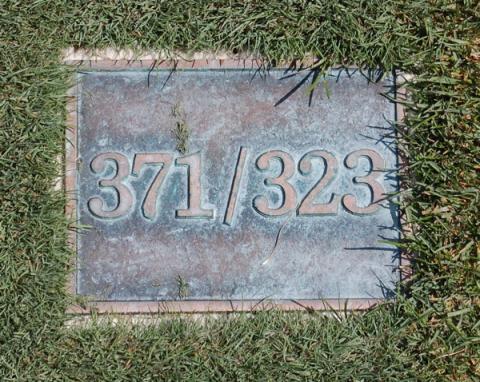 placed the pin. The experiences are entirely different. Today the flag was in the green on the right, which provided the shorter route, straight on from the green. All that is necessary to achieve an easy par is a fairly straight drive to a generous fairway and a wedge approach to a receptive green.
But off to the left is the other green, and the approach is about 50 yards farther and over a wide ravine from which no ball can escape. The narrow green slopes away from near right to back left, making a draw approach shot almost mandatory to keep the ball on the green.
My impression was that there is a half-stroke difference between the two routings. On the card, the 5th hole is rated the 9th toughest on the course, but I'd say the easy route is the easiest par 4 on the course and the longer route, over the ravine, is one of the two or three toughest. It is an unusual hole, to say the least.
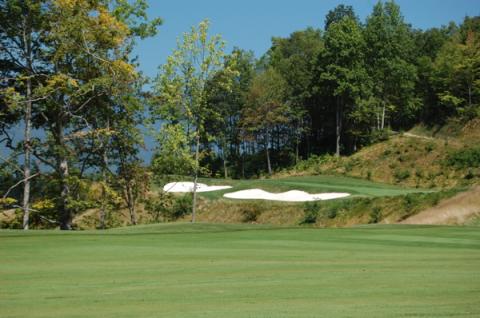
The play to the left green at #5 is over a cavernous ravine. A short approach shot will result in an almost certain double bogey.
Roots of destruction: Many golfers do their greens no favors
The slick, nicely cut greens at The Ridges were a pockmarked mess. Where members had deigned to bend over and repair their ball marks, they had clearly gone about the job with all the finesse of ditch diggers on a deadline. On some putting surfaces, no fewer than 25 little brown spots marred the otherwise nice surfaces.
So, as a community service to The Ridges golfers and anyone else in need of a lesson in divot repair, here is the simple way to do the job properly:
1. If the mark is fairly deep and soft, use your thumb to push back the grassy protuberance. That should cover about half the hole.
2. Insert the ball repair tool into an outer edge of the ball divot. Angle the prongs at 45 degrees. Gently push up and forward to work the turf back into position.
3. Do not dig the tool into the green as this will pull out the roots and kill the grass.
4. Sink your putt.
A cart path that needs a Danger sign
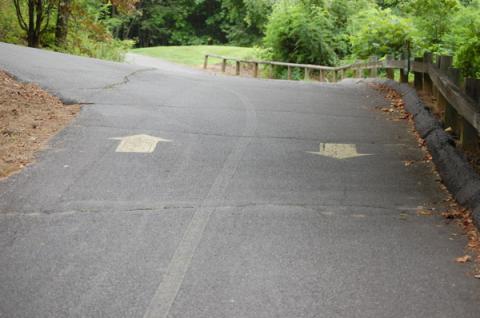
There are plenty of blind shots at Laurel Ridge Golf Club but none as dangerous as the one around the corner on the cart path to the 12th tee box.
Today, I was barreling up the cart path to the 12th hole at Laurel Ridge Golf Club in Waynesville, NC. The tee box was at least five or six stories above the 11th green, and I had to floor it to keep my momentum going. The path was just wide enough for two carts side by side, and as I rounded the first hard curve, another cart came speeding downhill right at me. He swerved and, luckily I turned slightly the other way.
I gave him a dirty look, and he gave me one. It turns out I deserved it. As I rounded the next bend, I noticed that arrows on the path were backwards, with traffic flow decidedly British. I don't know what evil genius decided to switch gears, but it almost stripped my gears...literally. Look for my review of Laurel Ridge in the coming days.
Tough ones: Long and tough and worthy of its designation
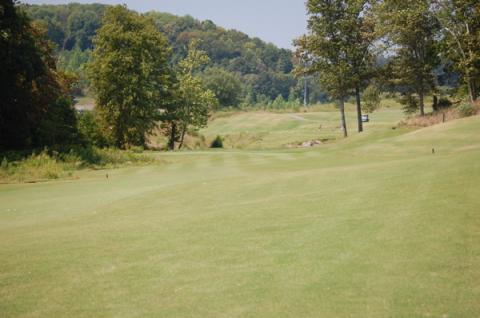
Even if you hit the perfect (and long) drive at #9 at The Ridges, you are still faced with a decision: Aim directly at the green and tempt the creek that runs along the left, or play a safer "carom" shot to the hill that guards the short right side of the green.
I played a round at The Ridges Golf Club in Jonesborough, TN, earlier today. It is golf community course in the strictest sense of the term, with homes lurking above the course at virtually every turn. I'll have more to say about the course in coming days but the #1 handicap hole on the course, the brutish long par 4 9th, is worth adding to our collection of #1 handicaps here.
Arthur Hills is one of my favorite designers, and I have noticed an odd habit he has of combining breather
Intimidated by the trees down the left side of the hole, I pushed my drive out to the right rough, well right of the yardage book's guidance to hit a good one to the center or center right fairway. Still, I hit my drive as far as any during my round and it got a favorable bounce off the side of the hill that runs below the cart path. I was left with about 225 yards in, and aimed my three wood at the right side of the green, as the yardage book suggested. You definitely do not want to go left of the green, where the stream that runs the entire length down the left side of the fairway snakes along the left side of the green.
Fortune smiled on me. My shot hung up on the very top of the large hill that guards the right side of the fairway near the green. Unless you are tempted by a go at the narrow and well-protected green - foolish, in my opinion - it is unlikely an approach shot will come off the hill through the thick rough. I had a great lie in the Bermuda, was able to get a lob wedge under the ball and popped it out to five feet from the hole. When I made the putt, I felt as if I had made birdie instead of a one-putt par. It was the highlight of the day, even though I did make two actual birdies during the round.
I'll provide a full golf review on The Ridges and the surrounding community later this week.
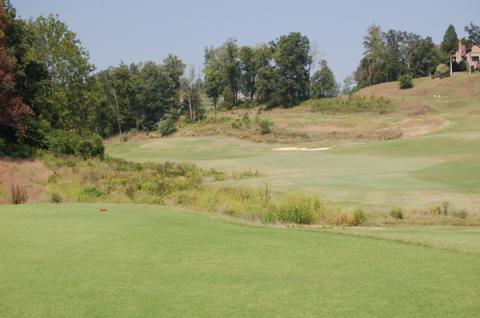
On the tee box at the long 9th hole at The Ridges, you can choose to play it safe to the right or tempt fate, and the stream that runs down the entire left side.
So many courses, so little time
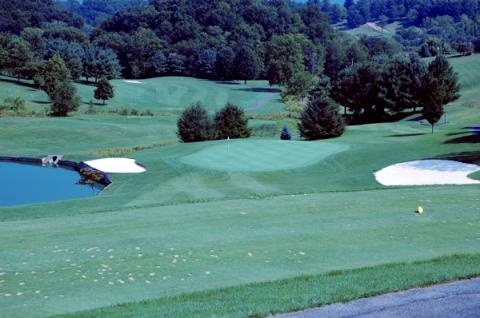
The par 3 7th at Draper Valley combines most of the elements of the rest of the course.
When I am on the road and have a few minutes to spare, I like to follow the signs from the interstate to a golf course I have never heard of. Typically, I don't have quite enough time for a four-hour round, but I'll pick up a scorecard, nose around the clubhouse and take a few photos of the course.
I knew nothing about Draper Valley Golf Club in Draper, VA, but it was just three miles off Interstate 81 and I decided to stop there today. It turned out Draper Valley is in the middle of a golf community of nice homes of recent vintage, well spaced out and almost all with views down to the golf course below (they are serious about the "valley" in their name). Although the landscape appears to be former farmland and, therefore, few home sites have any trees on them, the prices on the home sites and homes for sale seemed quite reasonable. A five-bedroom, three-bath home adjacent to the fifth green is on the market for just $319,900 and lots begin around $60,000.
The setting for the golf course is both convenient - just off the highway - and picturesque, with the Blue Ridge Mountains framing the background. I didn't have quite enough time to play, but from what I could tell, the course was in excellent condition, the greens were small but contoured, and there appeared to be enough sand and water to make things interesting if not particularly challenging. From the tips, the course measures almost 7,100 yards but plays to a rating of 73.5 and slope of just 127, pretty wimpy for any course of that length. Judging from the little hole diagrams on the scorecard, the approaches at six greens must carry over water in front, including at the finishing hole, a short but testy looking par 4 which makes a 90 degree right hand turn less than 100 yards from the green.
Draper Valley, I learned, was rated by Golf magazine in 2007 as one of "The Top 50 Golf Courses in the U.S. for under $50." Sure enough, green fees on the weekend are just $49, electric cart included.
Draper Valley Golf Club is located just off Interstate 81 in Draper, VA. Tel: (866) 980-GOLF. Web: DraperValleyGolf.com. Blue tees: 7,070 yards, rating 73.2, slope 127. White tees: 6,412, 70.3, 112.
If you are interested in a home in the Draper Valley community or any other golf home, let me know and I will be happy to put you in touch with a qualified real estate agent in the area. No cost, no obligation.
Pro golfer penalized for hitting the ball too straight
The bird, it turned out, was a red hawk, which is on the "protected" list. Charged with animal cruelty, Isenhour pled no contest today and accepted one year of supervised probation, four hours of anger management classes and 100 hours of community service, of which 40 hours will be at an animal shelter or wildlife preserve. He will also pay a $500 fine.
No doubt Isenhour learned more from his own instructional video than anyone else will.
Faint praise?
I'll write a full-fledged review after I finish the book, written by Andrew Blechman, but I feel compelled to share a quote from one of the opening pages. The author's neighbor, who made the decision to relocate to The Villages with her husband from their quaint New England town, says of her new home:
"I can only equate it to the movie The Stepford Wives. Everyone had a smile on their face like it's too good to be true. But it really is."
I now understand why my wife, who just completed the book, muttered "ohmygod" often while she read it. I am looking forward to the rest of it.
Exchange agent: New service saves money, makes friends on golf vacations
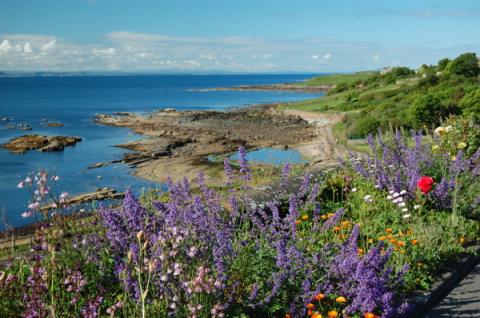
Thanks to a home exchange program, I was able to stay for free at a cottage in the charming coastal town of Crail in Scotland, just two miles from a fabulous links course and nine miles from St. Andrews. (Photo by Larry Gavrich)
Note to readers: I am picky about who is permitted to advertise on this web site. Only products and services that I deem of benefit to our readers will ever grace this space. Senior Golf Exchange is one such service, run by a veteran golf traveler, Graeme Smith, who is offering free two-year memberships and no initiation fee (a total value of $300) to the first 10 readers who sign up. Just click on his ad at left; at his home page, click "join", and then when asked, "How did you hear about us?" select "Recommendation" and then enter the promotion code "GCRPromo" when asked who recommended Senior Golfer Exchange.
The best golf vacation I have ever taken, this past June in Scotland, was made all the better by staying rent free near St. Andrews and making golfing friends for life.
It was just good fortune that George and Dorothy Horsfield of Glasgow, Scotland had seen the listing for our vacation home in Pawleys Island, SC, and contacted me about a swap. We all subscribe to HomeLink International, a service that facilitates home exchanges. Most of these are
New house exchange service for senior golfers
HomeLink does not focus on golf, so it is a little cumbersome for those seeking a home on or near a golf course to find the appropriate listings. Now, however, a new service based in Australia has narrowed the home exchange program to golf only, and narrowed it further by gearing it to senior golfers (over 50). Senior Golf Exchange, the brainchild of traveling golfer Graeme Smith, debuted in May as "A Private Members' Club for Home Exchange and Hospitality Exchange -- for senior golfers worldwide." I like the concept enough that I have invited Graeme to advertise here at Golf Community Reviews. You will note in his ad and at his web site that he agrees with one of my favorite pieces of advice -- stay for a while in a place before you consider buying there. His program makes it easy and inexpensive and facilitates introductions to people who live in the community.
"The research confirms that most home exchanges are of three to four days duration," says Graeme, "and within driving distance of home." Some, Graeme points out, can last a month or two if the parties are willing.
Senior Golf Exchange can also save the traveling golfer the sometimes-expensive payment of green fees. In many cases, where a club permits it, member golfers not only exchange homes but also member privileges. But what if the exchangers' clubs do not offer such unaccompanied guest privileges?
"If my wife and I were not at home to host our guests," Graeme says, using himself as an example, "I would make arrangements with appropriate
Senior Golf Exchange also supports "hospitality exchanges," essentially a reciprocal hosting program. You stay in another golfer's home, play golf with them at their course and, at a later date, they do the same at your home.
A record of safe house swapping
Obviously, I like the concept of home exchange since it has worked for me. It is a boon for those golfers "of a certain age" to have a golf home exchange program dedicated to them. As for anxieties about letting perfect strangers loose in your home, I admit my wife and I were nervous initially. But after numerous email exchanges with George and Dorothy, I felt I knew them as well as I do some of our good friends, and I had no anxieties at all about the exchange. They took wonderful care of our home.
"In 50 years of home swapping, and more than 100,000 exchanges per year," says Graeme about industry statistics, "there has never been a reported case of malicious damage." Graeme adds that insurance companies prefer exchange partners staying in your home compared with an unoccupied house.
Complimentary membership to readers of GolfCommunityReviews
A critical mass of listings will be essential to making the Senior Golfer Exchange service work well for all its subscribers. The more locations senior golf exchangers have to choose among, the faster the service will gain traction and the more of us will be flying around the country and globe without having to worry about lodging expenses. To help reach his goal of 1,000 subscribers in his first year of operation, Graeme is making available a limited number of free charter memberships, including a two-year subscription to Senior Golfer Exchange, exclusively for registered users here at Golf Community Reviews. This is a total $300 value, as he customarily charges $99 to join and $99 per year. Once you sign up, just fill in the required information about your property and yourself, and you are ready to start fielding exchange requests and making those requests yourself.
Membership in Senior Golf Exchange will provide you with the opportunity to experience the program without any financial risk at all. I have already signed up at Senior Golf Exchange and filled out the member and property listing information. I look forward to seeing others of you list your homes and start traveling.
Graeme is making this offer only to the first 10 people who sign up. Click here if you would like to become a charter member, then enter the promo code "GCRPromo" when prompted.
If you have any questions, check out Graeme's web site at Senior Golf Exchange.
Big week for housing reports
A satisfied customer buys in Chapel Hill
National rags ignore small southern towns
Golf course review: The Ranch, Southwick, MA
Now on Sale

- The only book about golf communities in the last 10 years.
- 156-page step-by-step guide to finding your dream golf home.
- Info on nearly 100 golf communities the author has visited.
- Paperback version costs less than a sleeve of Pro VIs.
Here is what the experts are saying:
“The book is chocked full of information…applicable to anyone looking for a move to the Southeast regardless of whether they are looking for a golf community or not.” — John LaFoy, golf architect (Linville Ridge CC, CC of Charleston, The Neuse GC)
“Larry has done a tremendous amount of work and anyone — like me — who is looking to search for a golf home now or in a few years needs this book.” — Brad Chambers, golf blogger, ShootingYourAge.com
“Wow! What a thorough piece of work…a must for anyone moving South. This book will help many people.” — Brett Miller, owner and founder of MMA, Inc, a golf industry consultancy
Buy It Now at Amazon.com or BarnesandNoble.com.