The Donald adds a note to his opus
On Trump's latest foray to Scotland, he stopped at the family's old stomping grounds - his mom was born somewhere in the area of the Outer Hebrides Islands - and the remote but famous Stonoway Golf Club offered him membership. He accepted, although if his course in Aberdeen doesn't get the green light, it cannot be too likely that Trump will revisit or that Mr. Henderson will get to play his "few holes" with the confection-coiffed one.
Trump, who probably believes in the old adage that there is no bad
"If Birkdale were a one-hole course," Ogilvy told the press, "this green would be out of character with the rest of the course. It's out of character with the land. It's out of character with the hole."
The 17th hole brought Trump into play because Martin Hawtree, the Donald's architect in Aberdeen, had been commissioned to redesign it. Hawtree responded to the complaints by Ogilvy and others by blaming the Royal & Ancient Golfing Society. "The R&A wanted spectator mounds," Hawtree told the press. "So now the green forms too much of a bowl shape. I'm taken aback by the depth of the reaction." He pledged to restore it to the original design he presented to the R&A if they ask him to do so.
If Mr. Hawtree believes the R&A pushed him around, wait until he starts his work for the Donald. The London betting house Ladbrokes will quote odds on just about anything, and it will be interesting to see if the odds are in the esteemed Mr. Hawtree's favor, or if he is more likely to be called into the boardroom eventually to hear the dreaded words, "You're fired!"
 Home On The Course newsletter
Click here to sign up for our Free monthly newsletter, loaded with helpful information and observations about golf communities and their golf courses.
More small talk...from one of our readers
Our good friend and longtime reader, Brent Heppner, sent the following to me regarding the article yesterday on the trends toward downsizing and green living:
"Great article, Larry. Much like [your wife], my wife and I want to build green and "Simplify, Simplify, Simplify." You are right on point about the smaller houses stacked right on top of each other. I do not like it either. One of the things I struggle with is the fact that the developers scalp the land to make small home sites; this practice is far from green.
The competition to get the most amount of money out of the land by golf community developers lends itself to the smallest lots they can get away with, and still sell. This can be seen at many communities. The challenge is finding a community that is environmentally sound, yet not so ridiculously expensive that only a few can afford to live in it.
Keep up the good work."
As he prepares to move in a few years to a golf community, Brent has done way more research on the subject of building green than anyone I know, and I look forward to hearing about and reporting on his progress.
Small talk: Living simply improves the planet, and maybe your golf game
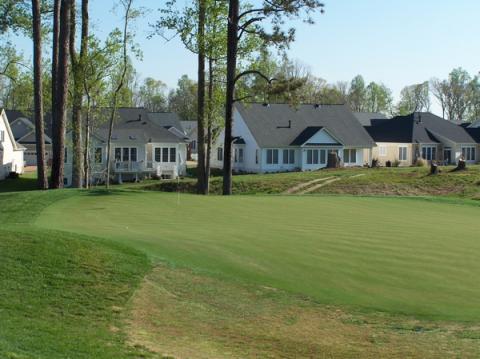
At Colonial Heritage in Williamsburg, VA, the houses are nice and small, but perhaps a little too close for some.
A few years ago, my wife Connie found in a small shop a wooden board with the words "Simplify. Simplify. Simplify." on it. It hangs in our kitchen today. About the same time, she also discovered a book called "The Not So Big House" which, you might have figured from the title, extols the glories of downsizing your living space. Doing so removes complications from your life, the book argues. It also lowers your negative impact on the planet, since less space to heat and air condition means less environmental badness. I thought the downsizing notion made sense, but to cut your living space, say, by half, seemed a little extreme.
According to an article in the New York Times online real estate section on Friday, an increasing number of people are cutting their living space by even more than half and making do in homes of 1,000 square feet.
Planned developments have been slow to catch on to the emerging trend, especially among planet-conscious baby boomers, to build small. I wrote here some months ago about one of my loyal readers who was rebuffed in his attempts to build a "green" home in a southern golf community. The developers' "preferred" builders had no experience in construction of green homes, and our reader wanted to bring in his own expert. After months of wrangling, the community relented, figuring it was better to catch the wave than to swim against it. One of the developers' preferred builders will now participate.
To this point, small homes in planned communities have been mostly the province of retirement and age-restricted (55+) properties at the lower end of the price range. I was impressed with the golf course and clubhouse at one I visited, Colonial Heritage in Williamsburg, VA, but could not quite envision myself in a home a few feet from my neighbor's. For me it was more about the claustrophobia than the size of the house. I wandered into a couple of model homes at Colonial Heritage and thought they were sensibly laid out and with enough space for retirees who wouldn't (or couldn't) climb stairs or push a vacuum around 3,000 square feet.
But now, if the Times article has caught onto something more than just a blip on the radar screen, we could begin to see more and more golf community developers offer smaller homes on smaller lots but with some separation between them (to satisfy claustrophobic guys like me). I am approaching the age when to simplify is less choice and more necessity. Who knows, removing distractions around the house just might improve my golf game.
Adult education: Greens on Jones' remote New York course not for the untutored

The approach to the par 4 10th hole at Colgate requires a deft touch when the pin is up front. Land beyond the pin and the dowhnill putt is slick.
Unless your child is attending the excellent Colgate University or planning to, there really isn't any great reason for you to trek to Hamilton, NY. It is a good drive - depending on how you define "good ride" - from anywhere. From our home outside Hartford, CT, it takes about 4 ½ hours. From most other population centers in the northeast, it takes about the same or longer.
I find myself in Hamilton this weekend for a wedding, the bride to be the daughter of one of my wife's college roommates. The groom's parents were kind enough to arrange a block of tee times at Colgate University's home course, Seven Oaks, a Robert Trent Jones Sr., track that mostly doglegs its way across streams and through trees and around the architect's signature sand bunkers. Getting to the greens, though, is less than half the fun. The monster putting surfaces were the slickest I have faced in years.
The course plays somewhat like a Donald Ross track in that the fairways are generous but the area around the greens, and the greens themselves, are where most of the action is. This is understandable given that Jones actually designed the course in 1934, toward the end of the Ross era, but because of the Depression, didn't get to build it until the 1950s. The second nine was added in the ‘60s and today, Colgate is regarded by folks who care about such things as one of the best college golf courses in the nation.
I understand why. The immaculate greens are huge and sloped, typically back to front and side-to-side, and I felt lost not knowing which side of the pin to play to. At 6,425 yards from the men's (maroon) tees, where I played, the course certainly is not long, although the tougher holes tend to be the longer par 4s (the 433 6th and 432 9th, for example). But the 71.8 rating and especially the 136 slope, which represents the degree of difficulty for bogey golfers, is a fair indication of what those greens are like.
Conditions were immaculate, especially on the bent grass greens which were perfect, held shots and made any putts from above the hole an exercise in frustration. I read putts from both sides of the holes and yet I read two different breaks, and invariably I guessed wrong. The surrounding mountains seemed to be of no help in terms of guidance.
Besides the greens, the most visible feature of the Jones layout are the tee boxes which seem to run forever, permitting the course to be played at varying lengths from each set of tees (it also saves wear and tear on specific areas on the tee boxes). The course also features a few severe dogleg par 4s where placement rather than length will lead to a potential birdie. But the best opportunities for birdie are on the par 5s, which are not long but require deft positioning. Patience on these can lead to virtuous birdies for those who hit their approach shots below the holes. The par 3s, only one (the 11th at 192 yards) of any great length, also are easy to approach if not to master because of the sloping and extremely fast surfaces.
Hamilton itself is hard to get to but easy to be in. In July, even though school is out, the city is abuzz with music on the green and a decent selection of restaurants for such a modestly sized burgh. The Colgate Inn is the place to stay, a comfortable hotel that is well run and surprisingly alive at night when its bar fills up with locals, summer college students and wedding guests, some of whom order an extra beer to try to forget how many putts from above the hole they hit to the front edge of the greens.
Seven Oaks Golf Club at Colgate University. Designed by Robert Trent Jones. Back tees: 6,915 yards, rating 74.4, slope 144; Maroon tees: 6,425/71,8/136; White (Men), 5,910/69.6/126; Grey: 5,250/72.1/125. Telephone: (315) 824-1432. Web: sevenoaks.colgate.edu. Non-member rates are $70 weekday, $80 weekend with cart fee of $30 (for two).
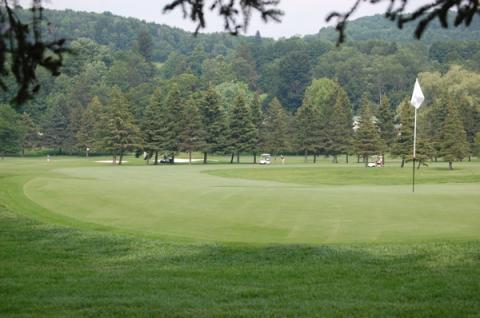
The R. T. Jones layout at Colgate features a number of severe doglegs.
A good flight story
I have used this space occasionally to get even with bad airline service and incomprehensible business conditions (like charging customers more money for non-stop flights than they do for two flights, the second of which leaves from the same airport as the non-stop flight). Ten days ago, I railed against Spirit Airlines for nickel and diming its customers and for an evil web site that gave me a flight I did not want.
But to be fair, the roundtrip I took between Atlantic City and Myrtle Beach turned out to be a positive experience given the price ($220 including all the customary fees and taxes) and the convenience of the flights to and from the easy-in/easy-out Atlantic City and Myrtle Beach airports. Plus I witnessed something on the return flight that I hadn't seen in years.
One of the flight attendants on the return from Myrtle Beach to Atlantic City actually helped customers entering the plane to find their seats and to place their luggage in the overhead bins. She readjusted bags in the bins to ensure that the carry-ons were close to the customers so they wouldn't have to "swim upstream" to retrieve their bags when the plane landed. And she did all this with a smile on her face and a most pleasing demeanor.
I will fly Spirit again if their prices remain low. Once again, a service employee - not management - has saved the day for a service company.
Groin pains: Structures could hold back sands, but will the costs pit neighbor v neighbor?
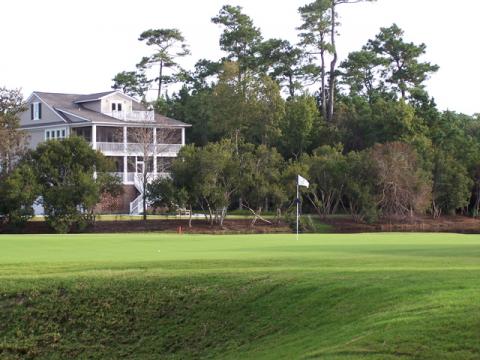
DeBordieu is the premier community at the south end of Myrtle Beach's Grand Strand, featuring a Pete Dye golf course and private oceanfront beach that is losing sand.
Residents of DeBordieu Colony, the upscale community south of Myrtle Beach, are facing a classic battle that is pitting private interests against ecological interests, according to reports in the Myrtle Beach Sun News. DeBordieu may win the battle, but an ensuing internal war could pit neighbor against neighbor. As it always seems to be, money will be the issue.
DeBordieu, which loosely translated means "close to God," has appealed to the South Carolina Department of Health and Environmental Control for
A public hearing is slated for July 23 at which time DeBordieu owners and their representatives will present their own environmental impact reports and will stress that they intend to pay for the groins themselves (by law, private beaches must do so). Should the residents prevail, the next battle could be internal, among the winners themselves. What, one could ask, is the rightful share of costs between the owner of a home a 7-minute bicycle ride from the community's beautiful beach and the owner of one of DeBordieu's oceanfront homes, valued at up to $5 million?
Beach erosion up and down the east coast is robbing local residents of access to the main attraction for living there in the first place. The people of North Topsail Beach, NC, for example, have been arguing for years over who should pay to stop beach erosion and an encroaching ocean that has already claimed a number of homes. Last year at this time I putted on the 18th green of the Ocean Course at Wild Dunes and noted the ocean water not only lapping at greenside but also encroaching on the adjacent condos. A month later, the green was gone, fallen into the sea. I would not want to be the owner of one of those seven-story condos.
The lesson here for any of us shopping for a home in a beach community is to look well beyond view and price. Being close to the water is one thing; being in it is quite another.
Different strokes: Tales of three couples show what dreams are made of
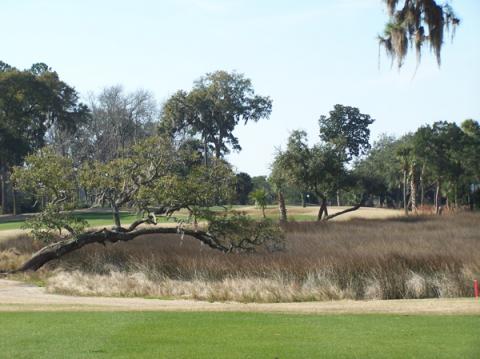
The Arthur Hills designed Palmetto course at The Landings is one of six in the community, the most challenging and, some believe, with the best views.
In the last few months, three of your fellow visitors to this space have purchased property in the southeastern U.S., all as second homes. These couples had in common the wherewithal to afford a second home now, without having to first sell their primary homes. And all recognized that, although prices in the south may erode a little more in the next year or two, their leverage with the owners and developers who sold them their properties might never be as strong.
Two of the couples plan to move to their new homes permanently within
I was glad to be of help to all of them, referring them to agents I knew in the areas and to communities that I had visited and reviewed earlier. The couples chose Ocean Ridge Plantation in coastal North Carolina, The Landings near Savannah, and Governor's Club in Chapel Hill, NC, all outstanding properties but all of a decidedly different character. The Ocean Ridge and Governor's Club couples bought property and will build; The Landings couple purchased a 20-year old home on a nice, treed piece of property overlooking one of the greens on the Arthur Hills Palmetto Course, arguably the best layout of the six at The Landings.
As investments, all seem solid. Ocean Ridge's well-regarded courses are semi-private which means a stream of green fees income to support maintenance of the course. The community sits just a few minutes from the sea, an attraction to tourists and residents alike since the beginning of tourism. The ocean is always a draw, and real estate a few miles away should always hold its
It is easy to get caught up in the headlines about foreclosures, the housing market and the economy in general and conclude that no one is able to sell a home and, therefore, no one is buying in the south. True, things have slowed dramatically, but as these three couples show, there is always a flight to quality, even in the toughest times.
If you are contemplating purchase of a home in a golf community or a home in a more traditional neighborhood, but near high-quality golf, I would be happy to provide some ideas at no cost or obligation. You can reach me via the "Contact Us" button at the top of the page.
Is it time? If so, some tips for selling your house now
In short, the Journal's real estate expert, David Crook, advised not to wait if you want to sell, price your home "cheaply," consider providing some financing for a qualified purchaser (if the house is paid off), and accept a buyer's offer unless it is ridiculous.
What's ridiculous? Well, like beauty, that is in the eye of the beholder, but the latest national and regional housing data help with a definition. A sidebar to the Journal article indicates that, in May, prices of single-family homes nationwide dropped 6.8%; in the southeastern U.S., prices dropped 4.6%. If you have plans to move from a rapidly depreciating market to a slower depreciating market like many in the southeast, that 2% spread, played out over a number of months, could argue for accepting an offer of 15% less than you had expected. And if a condo is in your future, note that May condo prices in the southeast actually increased, albeit fractionally. For folks in the Western region, the spreads are greater; prices for all types of houses in the West dropped by double digits in May.
These are all generalized data, and the numbers by market or, even better, by zip code, are much more reliable. But as a guidepost to when (and how) to sell the home you want to sell, the Journal article is helpful.
Click here for the link to the article online. If it is no longer available, let me know (use the "Contact Us" button above), and I will email it to you.
Reeling Land Resource goes to British Open
I was watching the final holes of the final round of the PGA John Deere Classic yesterday, and there was Williamson with a chance to get into a playoff. Williamson attended Trinity in Hartford, CT, just down the road from my home, and I was rooting for the local boy.
CBS showed a close-up of Williamson and there, on his visor, were the words "Land Resource." Williamson, I came to find out, and Land Resource CEO Mike Flaskey are neighbors in Orlando and became friends a few years ago. The company's name was on Williamson's visor last year (and on his bag and shirt) when the pro almost won the Traveler's Championship in Hartford. He lost in a playoff.
On the first playoff hole at the John Deere yesterday, Williamson was in prime position off the tee. But then he pull-hooked his 185-yard approach into the water and that was that. Kenny Perry won.
All was not lost for Williamson, though. Since Perry had chosen not to compete in the Open Championship at Royal Birkdale next weekend, Williamson earned the trip there by virtue of his second place at the Deere. Given the worldwide exposure of the British Open and the many sponsors who will probably pay handsomely to be on Williams' visor, it might be the noble thing to do for his friend and neighbor to release him from his contract. We'll see.
Developer's belly up is heads up for rest of us
A real estate agent friend sent me a note about Grey Rock, a community near Lake Lure in North Carolina. Grey Rock closed its operations last week after three years. Only three homes have been built at Grey Rock, one of them a House & Garden TV Dream Home. Grey Rock's developer, Land Resource, also closed six other of its sales offices and laid off a total of 70 employees.
Although not a golf community -- it is just down the road from Queens Gap, another fledgling community with a Jack Nicklaus Signature course under
Grey Rock looked promising from its earliest days of operation, and scoring the HGTV Dream Home was a big coup that added luster to its marketing efforts. It had an experienced developer behind it in Land Resource, which has been in operation since 1997 and whose CEO had experience in the luxury resort business. Grey Rock sold more than 400 lots in its first few years, not bad in the softening market, but it ran into problems with its infrastructure. Some of its road construction caused significant soil erosion issues, and Land Resource was fined by the state enviros and then sued by some of its own landowners whose home sites were soiled with extra soil.
The pressure from inside and out, plus the eroding market, apparently did the company in. As in most of these deals, the early investors - many of them pure play speculators -- are the losers when a developer goes belly up. But we should feel less sorry for them than for the 25 employees at Grey Rock who won't find landing another job easy in the remote Lake Lure area.
Land Resource's web site is not functioning except for its home page. Its statement of purpose on the home page ends with the line, "A great eye for beauty combines with a thorough knowledge of property infrastructure to create communities that are wonderfully distinctive and built to endure." For the sake of those owning property at Grey Rock, we hope the community does endure. But it will almost certainly be under new ownership.
Pete Dye is no Karl Litten
Feeding the hand that bites me

Now on Sale

- The only book about golf communities in the last 10 years.
- 156-page step-by-step guide to finding your dream golf home.
- Info on nearly 100 golf communities the author has visited.
- Paperback version costs less than a sleeve of Pro VIs.
Here is what the experts are saying:
“The book is chocked full of information…applicable to anyone looking for a move to the Southeast regardless of whether they are looking for a golf community or not.” — John LaFoy, golf architect (Linville Ridge CC, CC of Charleston, The Neuse GC)
“Larry has done a tremendous amount of work and anyone — like me — who is looking to search for a golf home now or in a few years needs this book.” — Brad Chambers, golf blogger, ShootingYourAge.com
“Wow! What a thorough piece of work…a must for anyone moving South. This book will help many people.” — Brett Miller, owner and founder of MMA, Inc, a golf industry consultancy
Buy It Now at Amazon.com or BarnesandNoble.com.