Review: Lexington Golf & Country Club
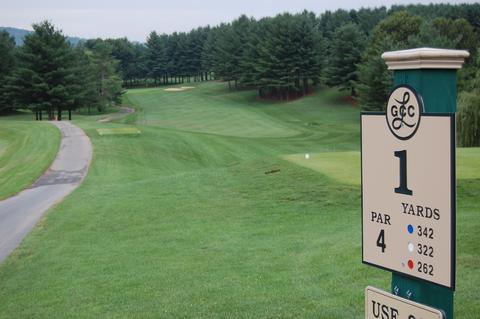
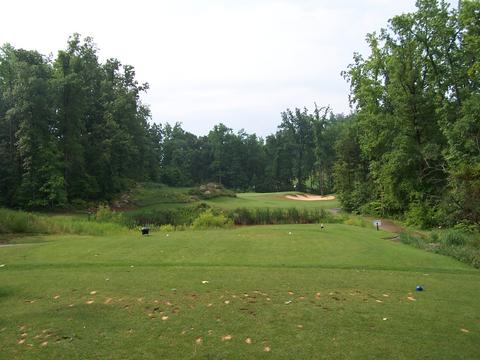
The routing at Lexington begins with a sloping fairway, a sign of things to come.
Lexington Golf & Country Club, Lexington, VA
by Tim Gavrich
The Lexington Golf & Country Club is a private course located adjacent to one of the town's most upscale communities, with home values averaging in the mid six figures. (The median value of houses in Lexington is $230,000.) The houses, however, do not encroach at all on the golf course. Housing prices in Lexington have escalated in the last few years as people from Washington, D.C., and Richmond have begun investing in Lexington's downtown property and some of the horse farms in the area.
The original golf course was laid out in 1902 by the club's charter members and redesigned and expanded to 18 holes in 1971 by Ellis Maples and Ed Seay. It is located just south of town and a few miles from Interstate 81. The club permits some outside play at times of low traffic (call ahead as we did; the folks in the pro shop are very friendly and accommodating).
Lexington is home to Washington & Lee University and Virginia Military Institute. It is a charming town with good restaurants, interesting shops and a friendly vibe. It is a nice place to visit, to go to school and to live.
Golf Course Setting: 7 ~~ Lexington Golf & Country Club is set on approximately 150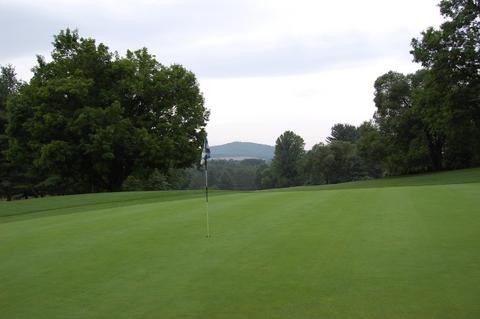 acres of rolling hills. Trees come into play on most holes and make positioning off the tee critical to a good score. Views of the surrounding Blue Ridge Mountains provide nice framing to many holes. The driving range is barely 225 yards long and, therefore, permits only iron play off the practice tees. The clubhouse sits on a hill overlooking the 9th and 18th greens and 1st and 10th tees.
Golf Course Conditions: 7 ~~ The greens at Lexington were medium speed, mostly owing to the recent rains that had also softened the fairways that had not been mowed in a few days. The course, whose rating and slope are fairly high for a short layout, would have played even tougher with slicker greens. Though a little hairy, turf both on and off the greens was in fine shape.
Quality of Green Complexes: 7 ~~There are some "classical" movements in the greens at Lexington. Most of them are pitched from back to front in varying degrees 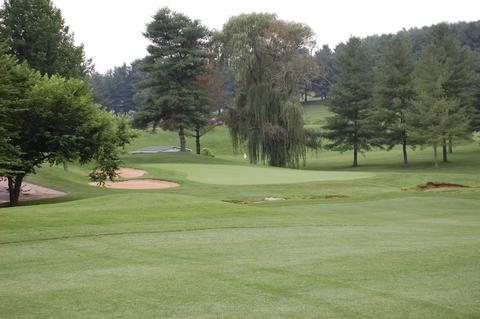 of severity. You won't find the dedicated chipping areas prevalent in modern course designs, but missing Lexington's greens left, right and especially long will make bogey a real possibility. Lexington saves its most challenging green (by far) for last at the 18th, a kidney shaped surface with three tiers that make it tough to land an approach shot on the same level as the pin. But it also makes for creative bank shots from off the green.
Quality of Par 3s: 5 ~~ The par 3s are not terribly compelling at Lexington. Holes 4 and 17 are of similar length (about 170 yards), and both play across ponds to fairly mundane greens. Holes 2 and 8 play downhill and are within six yards of 170 from the back tees. The best of the five par 3s is the 14th, which has an interesting oval-shaped green that is slanted away from the tee and offers a narrow landing surface.
Quality of Par 4s: 7 ~~ The par 4s at Lexington are a fair challenge, but only two extend beyond 400 yards from the men's tees (total yardage 6,068). The narrow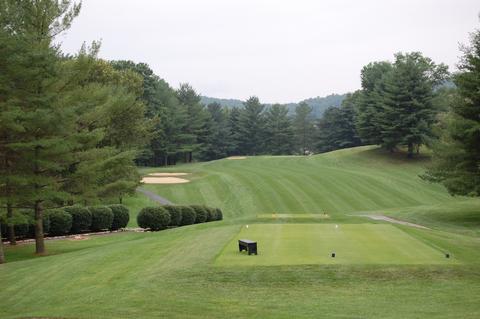 fairways, however, demand precision tee shots. Even for the grip-it-and-rip-it players, there are no drivable par 4s. The most compelling four-shotters at Lexington are holes 10 and 12, both of more than 430 yards from the tips that call for the player's best drives and accurate long irons.
Quality of Par 5s: 6 ~~ The four par 5s at Lexington provide the golfer with four great chances to gain ground on par. They are all reachable in two, although the 6th green is protected by a stream and should be approached with caution. The strongest of the par 5s is the 11th, which calls for a tee shot that bends right to left to a fairway that tilts down in the same direction. The second shot is a downhill thriller to a green benched into the side of a hill; shots that run through the green will leave the player with a steep uphill pitch.
Routing of Golf Course/A Good Walk: 7 ~~ Because of its relatively short length and the proximity of most tees to the previous greens, Lexington is an enjoyable course to walk. The presence of ample trees and shade also provides welcome relief from the summer heat. There are a few healthy walks from one green to the next tee, but they are nothing like the distances on more modern courses.
Overall Rating: 6.5-7 ~~ On its small scale, Lexington Golf & Country Club is an enjoyable course. It has classic good looks, a well-groomed landscape and enough variety of shots to retain a player's interest over many rounds. In styling, it stands in stark contrast to the brawny Vista Links, the other quality course in the area that was reviewed here earlier. Lexington requires more brain than brawn.
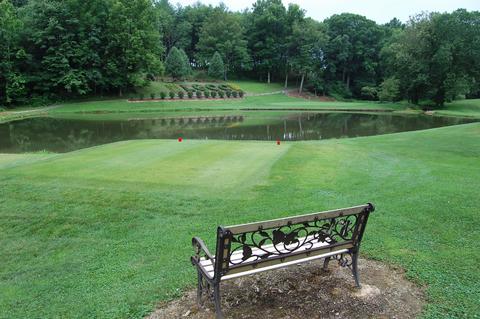
Lexington defines classic private country club...except non-members can play it.
Lexington Golf & Country Club, 141 Country Club Road, Lexington, VA, 24450,
(540) 463-3542
Yardage, Rating, Slope:
Back tees: 6,365, 71.2, 135
Men's tees: 6,068, 70.0, 131
Women's tees: 5,293, 71.5, 126
 Home On The Course newsletter
Click here to sign up for our Free monthly newsletter, loaded with helpful information and observations about golf communities and their golf courses.
Review of Vista Links, Buena Vista, VA
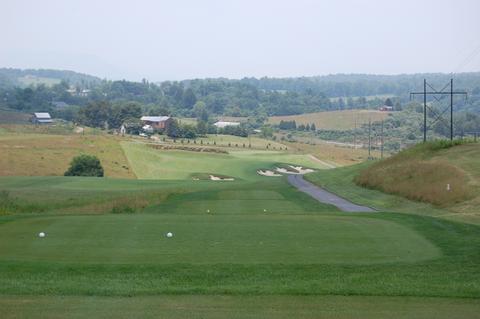
The 2nd at Vista Links features a large rock outcropping that guards the left half of the fairway, setting up a risk-reward lay-up shot.
by Tim Gavrich
The Vista Links, a daily fee course located about six miles from Lexington, VA, and Interstate 81 in western Virginia, opened in August of 2004. Designed by Rick Jacobson -- a former member of the Nicklaus Design team - the course provides an engaging trip through the Blue Ridge Mountain foothills, with heaving fairways, rugged bunkering, and undulating greens. I judged it on a 1-10 scale (1 being ‘repulsive' and 10 being ‘incomparable') in the following categories:
Golf Course Setting: 8 ~~ Vista Links is sited on a large and hilly piece of property just under 1,000 feet in elevation, which adds a little distance to the longer shots. The player is afforded many wonderful views of the Blue Ridge Mountains at points throughout the round. Despite the haze on the day we played, the scenery was well worth the trip and certainly worth the modest greens fees.
Golf Course Conditions: 6 ~~ The greens rolled fairly true, but they were not terribly fast. They were reasonably firm, to be expected in a three-year-old course, but most well struck iron shots stopped just a few feet beyond their pitch marks. The fairways were quite wet and had not drained very well from the previous afternoon's rain. In addition, the grass on the fairways was quite long, so we were not able to enjoy as much roll over the wide, dramatic landing areas. On days of firm, fast fairways and greens, shot making would be at more of a premium, with extended drives but also with the risk of rolling through fairways and into Vista Links' deep and large fairway bunkers.
Quality of Green Complexes: 8 ~~ Undulations-subtle and marked-dominate the greens at Vista Links. The greens are of average to slightly larger-than-average size, but designer Jacobson has built some nooks into the corners of the greens, making for challenging pin positions and the sense the greens are smaller than they actually are. Bunkers are generally large and deep but fairly easy to negotiate around. Shoulders and small chipping areas at most greens compel extra thinking on recovery shots (e.g. whether to pitch into or over a slope bank, or to chip or putt). However, because the grass at greenside was not cut low, balls hang up on the down slopes, limiting some of the variety of recovery shots and making up and downs a little easier. With less grassy slopes to carry the ball down the hills, Vista Links would play significantly different, and harder.
Quality of Par 3s: 7 ~~ The four par 3s at Vista Links were each different and interesting. Two of them (the 5th and the 13th) played significantly downhill. We would have liked to see more variation in length among the par 3s; from the back tees they play at 148, 186, 152, and 181 yards. The highlight among them is the 5th hole, which plays sharply downhill to a large green above a small valley. It is the most visually intimidating hole on the course and, interestingly, the only hole on the course without a bunker. The green is situated such that any shot hit beyond the back edge will kick down a hill into an unplayable lie (assuming the ball can be found in the high and thick grasses).
Quality of Par 4s: 8 ~~ Vista Links' 10 par 4s are of high merit. Though none of them bend sharply to the left or right, gentle turns in the fairways necessitated a solid array of approach shots. The two shortest par 4s-the 4th and 11th-are not drivable, but they provide risk-reward opportunities that can leave the golfer with either a very reasonable birdie putt or a hard-fought par. 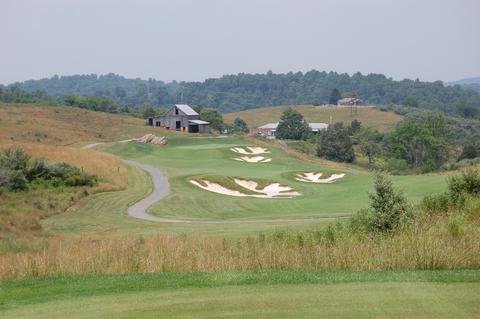 Each nine closes with a 460 yard-plus par four, with the 18th-a 467 yard hole that challenges the player to cut off as much of a deep complex of bunkers as he dares on his final tee shot-being the longer of the two. The best feature of the par 4s at Vista Links (the par 5s, too) is that the golfer may hit driver on each. There are no forced lay-ups, and the boldest players may "swing for the fences" (but beware if you go over one of Vista's few fences).
Quality of Par 5s: 7 ~~ The four par 5s at Vista Links are each a nice change of pace from the other holes. They vary in length such that for lower-handicap players, two of them are generally reachable in two. The most compelling par 5, though essentially unreachable in two, is the 2nd hole. At 587 yards from the backmost tees, it is the longest hole at Vista Links. The fairway is a few stories below the tee, and a well-placed drive sets up a fantastic risk-reward lay-up. The conservative play is to a wide (though sharply tilted) fairway, leaving a blind third shot of about 150 yards. The aggressive play is to challenge the rock shelf that dominates the left half of the fairway, leaving an open approach of less than 100 yards to the green. It is the beginning of a pleasing set of par 5s.
Routing of Golf Course/A Good Walk Not: 5 ~~ This is the area of weakness at Vista Links. It is not a golf course that one would be happy to walk, 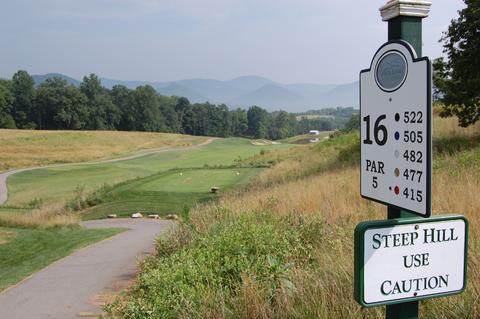 as there are many switchback cart paths on the steep hills that are laid out like the famed Lombard Street in San Francisco, as well as some very lengthy journeys from greens to tees. The essentially treeless course offers little protection from the hot sun during the summer. The heat, combined with long walks over many hills, makes Vista Links a golf course best enjoyed from a golf cart.
Overall Rating: 7 ~~ Vista Links is a solid golf course, and a tremendous bargain, with greens fees and cart under the magic $50 mark. On wet days, the course requires more muscle than it will on days when tee shots are getting some roll down the fairways. Nevertheless, Vista Links overcomes its less-than-compact layout and walker-unfriendly nature by being challenging, fair and great fun. If the true test of a course is whether you would like to play it again, then we liked Vista Links and hope to play it many times in the future.
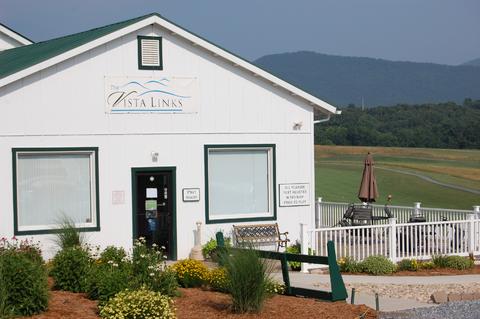
The Vista Links, 100 Vista Links Dr.,Buena Vista, VA 24416, (540) 261-4653
Par 72
Yardage/Rating/Slope:
6855/72.1/127
6447/70.1/124
6057/68.1/118
5466/65.9/105
4924/67.7/111
Rough enough: Natives restless at Pawleys Plantation
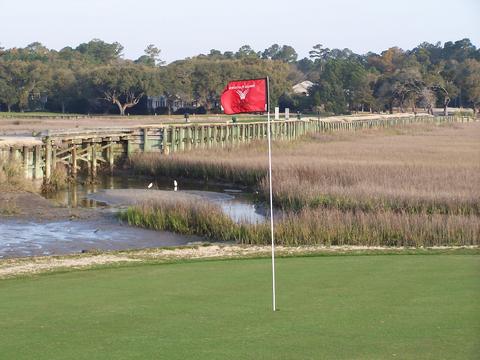
The dike at Pawleys Plantation holds the tee boxes for #13 (shown here) and #17, two challenging par 3s. New sod will be added to tees next week.
Some of my fellow members at Pawleys Plantation in Pawleys Island, SC, are starting to grouse about course conditions and apparent plans to add more rough to a Jack Nicklaus Signature course that is already tough enough. The recent departure of the club's pro and the serious illness of the course owner have just added to the sense of anxiety.
The coastal areas of South Carolina have received little rain over the last two months, and the fairways and greens at Pawleys are starting to show the effects. We are used to almost universally good lies in the fairway, but yesterday we had to move the ball a few times from bare spots. The greens were also a little thin in the grass category, although few putts rolled anything but true. Frankly, coastal courses like Pawleys Plantation go through these cycles with the grass, and we are not overly concerned about the long-term conditions.
But what members seem most concerned about are the painted white lines that signal gnarly Bermuda rough will narrow the fairways and be brought much closer to greens that already have more than enough trouble around them. Pawleys was built early in 1988, at a time when the still-learning designer crafted his layouts to suit his personal playing style -- i.e. to hit high shots into greens. Pawleys' greens are firm, well bunkered and not very deep. The few greens that are deep are also narrow side to side. Add the complexities of ocean breezes to a course that is less than a half mile from the Atlantic, and encroaching rough will make the already brutal course even tougher, no matter what tees you choose. (From the tips, at 7,000 yards, the course has a 75.3 rating and 146 slope; from the blue tees at 6,500 the rating is 72.5 and slope 137.)
The club's management has made a number of improvements to the course over the last year, investing in sodding to improve the off-fairway areas and replanting a few greens that were having trouble growing grass. Next week, they will re-sod the dike that holds the tees for the 13th and 17th holes, both signature par 3s over the marsh. These are all improvements that are good for members and for attracting resort play that helps keep dues low. But unless club owners are expecting to host a U.S. Open, they should leave rough enough alone.
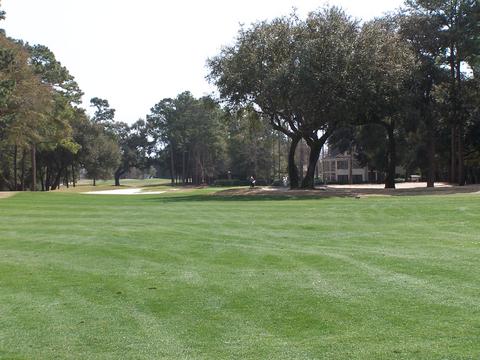
As if narrow, well-bunkered greens are not challenging enough, Nicklaus puts a live oak in a large trap that guards the right half of the fairway just 70 yards from the green on the par 5 11th. Course management plans to bring the rough in closer to the fairways and around the greens.
Safety's sake: Firm lists cities by danger factor
Of all 371 cities in the survey, Cary, NC, shows up as the 8th safest. Cary is just west of Raleigh. Coral Springs, FL, which is a half hour northwest of Ft. Lauderdale, comes in at #10; Roswell, GA, which is immediately north of Atlanta, is #18, and Port St. Lucie, FL #25. On the "most dangerous" side, Birmingham, AL, is 6th, Richmond, VA, #15, Atlanta 17th, and North Charleston, SC, #20.
Of the 344 metro areas surveyed, the safest in the southeast was Harrisonburg, VA (14), the only southeast town to make the top 25. On the dangerous side, Florence and Myrtle Beach, SC, came in at 5th and 6th respectively, Charlotte/Gastonia, NC at #12, Macon, GA, #20 and Sumter, SC, at 24th. The formerly overheated housing markets of Las Vegas, Miami and Phoenix all made the top 25 most dangerous as well.
For the record, the safest town is Brick Township, NJ, and the most dangerous is St. Louis.
If you want the rankings of all cities and metro areas, you'll need to purchase the report at Morgan Quitno's web site .
Maggie Valley trying hard, succeeding
We believe it. Our friend, Henry Lister, who runs the Off The Beaten Cart Path web site, took a look recently when he played the William Prevost designed course. Henry was impressed by the improvements in condition over the three years since he lasted played it, and added: "It passed my one true test...I wanted to play it again tomorrow." You can read Henry's full review , and others from off the beaten path, at his web site.
I am hoping to play the course myself this summer, and to explore the community that is expanding around the 1962 layout. New cottages, luxury condos and a limited number of home sites are available. The cottages feature 2,000 square feet, 3 bedrooms, porch, and exterior maintenance supplied by the developers, with prices starting in the $400s. Persimmon Pointe is the condo neighborhood, with 2 and 3 bedroom units averaging 1,600 square feet and with prices from the high $200s. The 23 single-family properties in Scarlet Oaks range in size from ¾ acre to 2 acres and in price from the upper $100s.
Right on 'cue in Asheboro, NC
The restaurant is Henry James Barbecue in Asheboro, NC, named not for the guy who wrote paragraph-long sentences we English majors hated, but rather for the two partners (first names Henry and James) who opened it in the mid 1970s. The only literature Henry James Barbecue can claim is its no-nonsense menu, a wonderful piece of non-fiction that celebrates the almighty hog in all its slow-cooked goodness.
After an overnight visit with good friends and excellent hosts, the Harrises, at their lovely Smith Mountain Lake home in Virginia, we took the inland route toward the coast, down US 220 into Carolina, around Greensboro and into Asheboro. Henry James Barbecue is just two miles off the highway. Our trusty bible, "Tar Heel Barbecue," said the magic words about the restaurant's chopped pork - "moist and lean with no fat" and a "fresh roast pork taste." Barbecue is a guilty addiction for us, and any time good ‘cue can be made to sound healthy (no fat!), count us in.
We ordered two large plates of the chopped and one large plate of the sliced. Both were moist and lean as advertised. The slices were kissed with a slightly sweet, slightly peppery vinegar sauce that defines North Carolina ‘cue (and for the record, not a speck of fat on them). The chopped pork seemed positively infused with the same sauce. Some will find the Henry James chopped pork a little too wet, but the pork taste came shining through for us, and the sauce punched it up even more. We liked this marriage made in the kitchen.
Nowhere will you eat this well for the price; the large platters, which include outstanding cole slaw, french fries and hushpuppies, were priced at $6.95, and the portions were huge. Those accoutrements were indeed as good as the barbecue. The cole slaw was chopped, crunchy and very wet, with a nice tartness to it. The french fries were cut from fresh potatoes, not frozen, and weren't greasy at all, even though they had a nicely firm exterior. The hushpuppies, those marshmallow sized drops of deep fried cornmeal that are to Carolina barbecue what Burns was to Allen, were also greaseless. Hushpuppies, for those unfamiliar with the treat, were so named by dog owners who found that the deep-fried morsels were a cheap way to silence their yowling dogs. In many barbecue joints, they are an afterthought, but not at Henry James.
The Henry James offers beef ribs, which we will try next time, as well as barbecued chicken. Service at the counter where you order and pick up your tray of food was efficient and friendly. The place is very clean and orderly, showing a pride that comes through in the cooking as well. The restaurant has a deserved reputation locally; as we waited for our order at 2 p.m. on a 95-degree Saturday, the drive thru was handling a steady stream of cars. For barbecue this good, any time is the right time.
Now for the promised golf connection. As we neared the restaurant, we came upon the 9-hole Asheboro Municipal Golf Course designed by none other than Donald Ross. The course was built during the Depression (1935), most likely as a government project, and for years was unrecognized as a Ross course until the town's recreation director discovered the blueprints for the original course routing. The slope is 123, the rating 34, and the greens fees $20, making it as great a bargain as The Henry James Barbecue Restaurant. We plan to savor both on our return trip north next month.
Asheboro Municipal Golf Course, 421 Country Club Dr, Asheboro, NC. (336) 625-4158. Greens fees $20 weekdays, $22 weekends.
Henry James Barbecue, 2004 South Fayetteville St., Asheboro, NC. (336) 625-1649. Cash only.
Pine Needles one of many options in Pinehurst area
Ms. Kirk is an icon of women's golf. She and the legendary Babe Zaharias formed the first women's professional tour. Kirk and her late husband Warren Bell purchased the Pine Needles property in the early 1950s. At the time, the original course, built in 1927, was not in the best of shape, but the couple and a few other investors, including the former PGA pro Julius Boros, had a vision for the entire property. They built a chalet-style clubhouse, then lodges that mimicked the clubhouse style, a pool, conference rooms and the modern accoutrements of a top resort (but always with restraint so as not to detract from the golf). Kirk created one of the best teaching facilities in the nation, and concentrated much of her time instructing women.
The resort, with just 75 or so rooms, is small by golf resort standards; its guests like it that way and the return-stay rate is high. With coverage on national television this weekend, those unfamiliar with the course will get a taste of classic Ross. With Pine Needles and Pinehurst #2, the ultimate Ross course, just a few miles apart, the dedicated golfer can fashion quite a nice weekend of early-20th Century golf in the Sand Hills of North Carolina.
As for real estate, the Pinehurst area offers a wide range of options on or near the golf courses. Prices, which have held up nicely, range anywhere from around the $300s into the millions. Pinehurst membership costs $40,000 and confers access to six of the resort's eight courses, including #2. Dozens of other excellent courses are within a half hour.
Love not all you need at Chapel Hill community
You'll need to warm up on the irons-only practice range before you tackle the golf course at The Preserve at Jordan Lake near Chapel Hill, NC. The Davis Love III course is a stiff challenge, right from its opening hole. A short par 5 at just 492 from the men's tees (512 from the back), it is one of the toughest starters I have played, with a fairway that slopes severely left toward a creek and marsh area and then forces a second shot that must carry the same creek as it meanders across the fairway (and you better hit a power draw to position for a reasonable third shot). The pin on the elevated green was rear right, behind a menacing trap. We prefer our warm-up holes a tad less penal.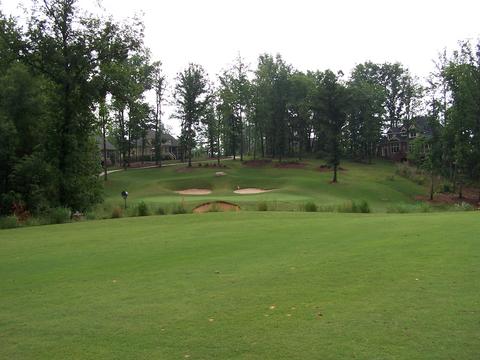
Later, have a Power Bar or two at the turn, because you'll need the energy on the par four 10th. A dogleg right, it plays 438 from the men's tees (470 from the back) over a stream, with a trap guarding the inside elbow at 222 yards out from the tee box. If you are fortunate to have hit a 250-yard drive down the left side of the fairway, only 180 yards or so remains to carry the stream that guards the front of the long, deep green. That is a big "if," since the dog's leg is narrowest where good drives should wind up. We won't easily forget number 14 either, a 500-yard par 5 that dares you to carry a long second shot (or short-iron third) to pin positions set beyond 30 feet of false front. "False" is putting it mildly, since the front goes almost straight up. We wondered if they throw a rope around the guy who cuts the green to keep him from tipping over.
Players with handicaps of 13 or more shouldn't go near the men's tees (rating 72.7 and slope of 140), and many will suffer frustrations from the shorter tees (6,116 yards with a rating of 70.6 and slope of 128). As for the tips at 7,100 yards (75.1 and 145), the scorecard recommends that routing for handicaps of 6 or less. The 6-handicap may be a 10 after a few rounds at The Preserve.
The community that surrounds the course has grown quickly since properties were first sold in 2002, the same year its golf course opened. Lots average ½ acre, although some top one acre, with prices generally running from $150,000. The developers maintain a list of four "preferred" builders who account for more than 90% of the homes built to date. The Preserve is not gated and, for the time being, anyone can play the "semi-private" course by calling for a tee time.
The Preserve, which has no townhouses or condos, has a neighborhood feel to it. Landscaping throughout is well maintained by the residents who are an equal mix of young professionals and "empty nesters," age 55 and older. However, if you have done your job of raising kids and would like to be in the company of adults-only in your new community, there may be better options than The Preserve. The young adults have produced a significant number of offspring.
All the customary amenities are available on the property. The fitness center is modern but small; more than the current two tennis courts may be needed at full build out. For water aficionados, Jordan Lake is close, but we did not have a peek at it as we made our way around the golf course.
The Preserve, which seems out in the country, is 30 minutes from mall shopping and 15 minutes from a supermarket and pharmacy, but commerce is coming closer every day; a few miles down NC Highway 64, the big handyman chains Lowes and Home Depot are both putting up stores. The University of North Carolina Hospital is just 20 minutes away.
The Preserve at Jordan Lake is more like The Preserve Near Jordan Lake; the lake is actually across the road from the entrance to the community. Nevertheless, the community is finding its audience.
The Preserve course is tough enough without pins tucked behind bunkers.
Austin defies gravity of housing trends
A few areas around the country have so much to offer to so many that they defy the gravity (double entendre intended) of falling house prices and the reality of higher home inventories. Austin, TX, is a prime example (as opposed to a subprime example -- sorry, couldn't resist).
Austin has been considered for decades one of the best values in retirement living. Texas has no state income tax, and Austin is a huge-university town (University of Texas) with all that has to offer in the way of vitality, continuing education and a stable economy.
Real estate reports in Austin indicate that May was good month. Single family home sales were up 2 percent over the same month in 2006, according to the Austin Business Journal, the highest May ever. The median price for a home, a reasonable $183,160, was up 5 percent year over year.
Although total listings were up 8 percent, houses were closing faster, at just 55 day, down 7 percent from May 2006. Best of all for local homeowners, prices appreciated more than 10 percent in the first quarter of this year compared with the same quarter last year; that was double the national average.
Real estate in the Austin area remains reasonbly priced; you can find a nice single-family home with golf views, three bedrooms and three baths for less than $400,000.
Our real estate contact in Austin, a member of our growing network and a golfer, is familiar with all the golf course communities, private clubs and best neighborhoods in the area. If you would like us to put you in touch with him, please let us know. Remember there is no cost or obligation for you. Later this year we will visit Austin for in-depth reviews of the golf communities in the area.
Roads less traveled
Airline travel is becoming more inhuman by the week. Computer malfunctions, toilet backups, cattle car seating are just the most notorious stories. We used to fly back and forth to South Carolina from Connecticut, but we are doing that less and less (We lament the loss of Independence Air, which seemed to be doing almost everything right except making money). It's too much work to find a seat at a halfway decent price, and no price is worth the inconveniences.
For others who travel between homes north and south, or who vacation at southern golf resorts, driving isn't the worst option. There are essentially three major routes south that we have used, and they all have their positives and negatives. For convenience, I refer to them as: The Inland Route; The I-95 Route; and the Ferry Route.
The Inland Route is along Interstate 81 through central Pennsylvania and relatively short drives through small swatches of Maryland and West Virginia before the interstate moves through the states of Viriginia and North Carolina. The positives: generally clear sailing and nice views of the mountains. The I-95 Route is the traditional one most folks take to Florida. It is the most direct when you can avoid traffic in Baltimore, Washington and Richmond. That's a big if; many veterans of the trip drive through the night to limit the chances of a two-hour stoppage (that's happened to us too many times during midday drives). The most services -- restaurants, gas stations, etc. -- are along the I-95 corridor.
The ferry and Chesapeake Bay Bridge-Tunnel is a nice option but, like I-81, will cost you a few hours. But what you lose in time you more than make up for in lack of stress. The ferry from Cape May, NJ to Lewes, DE -- and vice versa -- will give you an hour to unwind outside your car. And side benefits are that both Cape May and Lewes are charming seaside towns with cafes and shops that will provide a nice diversion if you are early for your ferry crossing. There is also something to be said for the drive across (and under) the Bay, a $12 adventure that also chops off a good piece of geography on the road south.
I head south on the I-81 route today. In the coming weeks, I'll offer some ideas about golf courses and other attractions along these routes, each of which offer benefits and downsides. Weather and traffic permitting, I may even get in a round of golf today in Virginia.
Housing numbers disappointing...again
Vacation homes strong in weak overall market
Rubs of the green

Now on Sale

- The only book about golf communities in the last 10 years.
- 156-page step-by-step guide to finding your dream golf home.
- Info on nearly 100 golf communities the author has visited.
- Paperback version costs less than a sleeve of Pro VIs.
Here is what the experts are saying:
“The book is chocked full of information…applicable to anyone looking for a move to the Southeast regardless of whether they are looking for a golf community or not.” — John LaFoy, golf architect (Linville Ridge CC, CC of Charleston, The Neuse GC)
“Larry has done a tremendous amount of work and anyone — like me — who is looking to search for a golf home now or in a few years needs this book.” — Brad Chambers, golf blogger, ShootingYourAge.com
“Wow! What a thorough piece of work…a must for anyone moving South. This book will help many people.” — Brett Miller, owner and founder of MMA, Inc, a golf industry consultancy
Buy It Now at Amazon.com or BarnesandNoble.com.