Editor’s Travels: Hot Golf in August
My wife and I are off to Pawleys Island this week for a four-week stay at our second home and a few rounds of hot golf (literally). Admittedly, this is a bit of a contrarian play, given that temperatures in the Low Country have been consistently close to 100 degrees the last couple of weeks. But a scan of the forecast in Connecticut shows a week ahead that will be warmer on some days than on the southern coast. Mark Twain once had something to say about the peculiarities of New England weather (“…wait and minute, and it will change.”) So off we go.
During our summer vacation, I plan to play a lot of golf, including the well-regarded layouts at Haig Point on Daufuskie Island and

Part of the Haig Point layout runs along the Calibogue Sound, with views of Hilton Head Island across the water.
Haig Point is an idyllic place, about as remote as you can get on the east coast since it is reached only by a ferry from Hilton Head Island. (Community residents have access to one 24 hours a day, but the cost to maintain and run it is reflected in the property owners’ comparatively lofty dues.) Haig Point’s residential neighbor, the Daufuskie Island Resort, which features two excellent golf courses, fell on hard times a few years ago, and the resort and its Jack Nicklaus Melrose Golf Club were sold earlier this year at a bargain basement price of $13 million. The nearby Bloody Point Golf Club, designed by Tom Weiskopf, was sold separately for less than $2 million and is currently closed. An eventual reinvigoration of the resort should help drive up interest in Haig Point, where prices have reached a low ebb during the housing recession.
You can read my original review of Callawassie by clicking here. I have referred to Haig Point, which is across the water from Savannah, numerous times in this space; enter the term “Haig Point” into the search box on this page for a link to all of those. I also produced an edition of the original Home On The Course newsletter (I once printed and mailed it to subscribers) after my Haig Point visit, and I would be happy to email a copy to anyone who is interested (that same issue of the publication also featured reviews of other Savannah golf communities, as well as the golf course at Bald Head Island Island, like Daufuskie reachable only by boat or helicopter). Just contact me with your email address and I will send the publication; though a bit dated, the information is still relevant (except for prices, which have dropped).
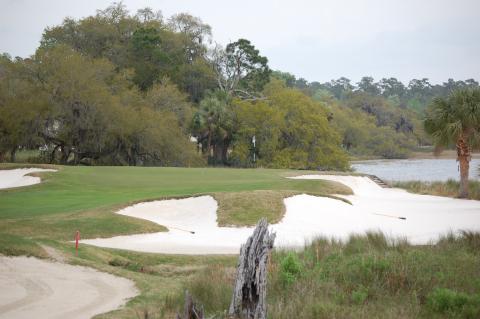
Callawassie features some typical Tom Fazio bunkering throughout its 27 holes.
Also, if you have been thinking about a move to a golf community in the Myrtle Beach or Charleston areas, let me know and I will be happy to do some on site research while I am in the south. Realtors in the Low Country have been reporting more visits by baby boomers in recent months, and it just might be that prices have reached their lowest point and are poised for a tick upward -– assuming our legislators in Washington don’t do significant damage to the nation’s credit worthiness and interest rates.
*
We hope it goes without saying that the publisher of Golf Community Reviews and Home On The Course, our monthly newsletter, has never hacked anyone's telephone, bribed any high-ranking police officials or politicians, threatened any golf community with bad coverage because its officials didn't bow to us, or showered them with favorable coverage because they cowered before us. But given the latest news of the world, we thought we should say it, for the record.
 Home On The Course newsletter
Click here to sign up for our Free monthly newsletter, loaded with helpful information and observations about golf communities and their golf courses.
TPC course to join McConnell Golf portfolio
According to sources, the acquisitive multiple-golf-course owner John McConnell is at it again: As soon as a week from now, his organization
TPC Wakefield is located about a half hour from Treyburn (in Durham) and Raleigh Country Clubs, two other McConnell facilities. The Hale Irwin designed course, like most TPC layouts, plays host to an annual professional golf event, in Wakefield’s case the Nationwide Tour’s REX Hospital Open. McConnell’s most recent purchase before Wakefield, Sedgefield Country Club in Greensboro, hosts the PGA Tour’s Wyndham Championship. John McConnell himself speculated recently that the PGA Tour put TPC Wakefield up for sale because its focus had shifted to ownership of courses in resort areas and away from “community” clubs. The McConnell organization’s own strategy targets upscale golfers willing to pay up to $25,000 in initiation fees and mid-range monthly dues for the privilege of access to multiple well-conditioned golf courses designed by some of golf’s foremost architects.
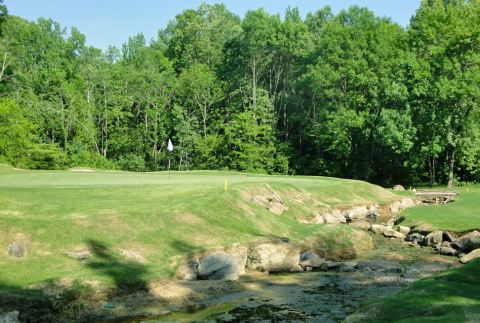
McConnell Golf's Treyburn Country Club is at the heart of a neat-as-a-pin golf community in Durham, NC. It is one of two Tom Fazio courses in the McConnell portfolio.
However, local homeowners are quite happy with McConnell on the scene. He has a reputation for taking marginal golf courses and improving them substantially, and taking good courses and making them even better, as he did at The Reserve in Litchfield, SC, where he closed the Greg Norman course the day after he bought it and redid all the greens and many of the bunkers. Homeowners inside The Reserve were especially grateful that their golf club, on the verge of bankruptcy when McConnell became interested, was restored to health. Some estimated it meant a bump up of 10% in home values.
McConnell’s portfolio of courses has been well designed, spanning the range of classic to ultra-modern layouts, reflecting the subtleties of Donald Ross (Sedgefield) and the drama of Tom Fazio, whose Old North State Club layout in remote New London, NC, consistently ranks among the top three courses in the state. Other McConnell clubs include the brutally challenging Musgrove Mill (Arnold Palmer) in Clinton, SC, and the quirky but exciting Cardinal (Pete Dye) in Greensboro. Given that they are a decent car ride from the Raleigh area, Old North State and Musgrove Mill feature golf cottages that visiting members can use for overnight stays before and after a round of golf. The Reserve, the course that is farthest from McConnell’s core base in Raleigh and a couple of tee shots from the ocean, is within a mile or two of many town homes and condos that can be rented by the day. McConnell also offers pricey golf packages for non-members; a seven-day package can run as high as $2,600. When it reopened after its renovation last year, The Reserve at Litchfield offered full-golf memberships for just $5,000, which included access to all other McConnell courses. Today, membership is $10,000, still a bargain for the roster of courses available to McConnell members.
*
Editor’s Note: Although most of the courses the McConnell Golf Group have purchased are at the heart of golf communities, McConnell has chosen not to purchase any available lots. However, after visits to Treyburn, The Cardinal, Uwharrie Point (the community surrounding the Old North State Club) and The Reserve, I can recommend all as worthy of consideration for those considering a home in a golf-oriented venue. If you would like more information about any of these communities or more information about McConnell Golf’s membership plans, please contact me.
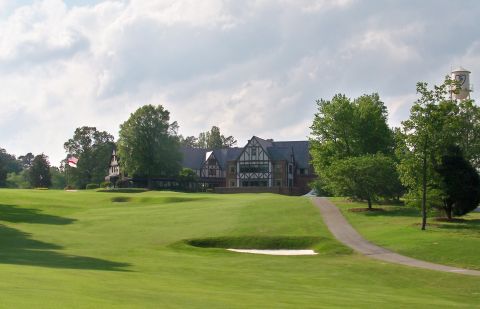
Of its eight golf clubs, McConnell can boast two designed by the legendary Donald Ross -- Raleigh Country Club and, above, Sedgefield, host of the annual PGA Tour's Wyndham Championship.
Budget cut a landslide defeat -- literally -- for some NC mountain homeowners
To buy or not to buy, that is the question. Landslide mapping, soil surveys, landslide histories and common sense dictate that dangers lurk on the steep slopes of western North Carolina's most popular properties. Some developers, realtors and their political enablers argue there have
This move begs the question: Was it truly budget concerns and cost savings that prompted these lawmakers to target landslide hazard mapping? As Asheville-based Southern Environmental Law Center attorney D.J. Gerken points out, "Certainly some of the legislators have been very open in their statements that they viewed these maps as a backdoor to regulation and were not the least bit sorry to see these maps go away."
What is missing from the debate -– the prospective buyer -- is more important than the motives of elected officials who have effectively moved to hide this information from the public. What prospective buyer of steep slope property would be comfortable in making an informed decision about safe building
The truth of the matter is much simpler than any interest in the public's needs. The fact is that landslide mapping would result in some property being deemed not safe to sell or develop. It is unimaginable that this information would not be of interest to a prospective buyer. Outrageous is the only word that can be used to describe the self-serving choices of some developers, realtors and numerous political hacks working in concert to keep this information as far away from interested buyers as possible. Why would they do this? Greed, plain and simple, the very same mindset that is responsible for the current economic downhill slide.
There is no insurance available to cover any loss caused by earth movement, manmade or otherwise. The only protection you can buy that might tell you if construction is safe and your investment is likely secure is the initial site-specific survey prompted by landslide mapping information. This one time cost is arguably the most important money that you could spend related to a mountain home, and yet some NC elected officials have voted otherwise. The argument against continuing state landslide mapping is simply dumb and potentially dangerous for the eventual occupants of the property.
Rick Vogel, who has contributed articles to Golf Community Reviews in the past, and his wife Lynne reside in the golf community of Wolf Laurel near Asheville, NC, and are among our web site’s most dedicated readers. Although Rick’s opinions in his editorial are his own, count your editor as four-square in support of more information for prospective buyers, especially where safety is concerned. I invite other readers to contribute their own opinions on this and other subjects related to real estate, golf and, especially, the combination of the two.
Bayside Resort: Nicklaus Signature golf course a bear, but a good one
by Tim Gavrich
Opened in 2005, the golf course at Bayside Resort in Selbyville, DE, is the newest of the three main public options around Rehoboth Beach. It was designed by all-time great player Jack Nicklaus and is a test that would stretch the abilities of the Golden Bear himself, even in his prime. At 7,545 yards from the back tees, with a rating of 77.4 and a slope of 146, it is one of the toughest golf courses anywhere and certainly not a place where a beginner will enjoy learning the game (although billed as a “resort” course, it is possible to be stuck behind a player whose time – and yours – might be better spent on a less rigorous routing. However, a shrewd under-20-handicap player will be able to navigate the course after choosing the proper set of tees, in spite of Bayside’s many hazards.
As one of his more recent efforts, Bayside is indicative of Nicklaus’ maturation as a golf architect. He has been active since the 1970s, and his earlier designs were often heavily sculpted and manufactured, bursting with chocolate-drop mounds, small greens, and nightmarish bunkers. Though some of his earlier efforts, such as Loxahatchee in Jupiter, FL, and Grand Cypress outside of Orlando are still well-regarded by golf architecture buffs, his more recent efforts, such as May River outside of Hilton Head, SC, and, indeed, Bayside display a greater grasp of subtlety and a nod to the game played by higher-handicap players.
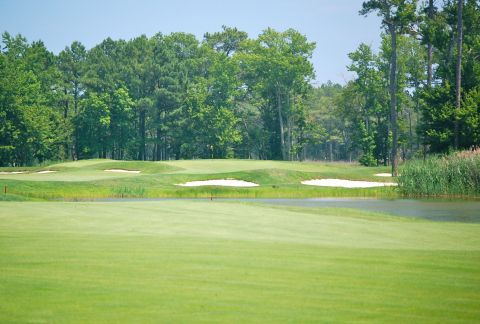
The approach to the par 5 2nd hole at the Nicklaus-designed Bayside.
Photos by L. J. Gavrich
Bayside weaves in and out of forest and expansive wetlands that border nearby Assawoman Bay. The golf course features quite a few forced carries, but if a player chooses the correct set of tees, lost golf ball totals should be kept fairly low. At the par five 2nd hole, for example, the longest tees encourage the low-handicap golfer to play diagonally across a corner of a pond, but the shorter tees offer a more straight-on angle up the broad fairway, with room to avoid the pond to the right.
Nicklaus tends to build exemplary par threes, and Bayside is no exception in that regard. The 227-yard third hole (172 from the middle set) demands a long iron or fairway wood to a small green surrounded by large short-grass chipping areas and a tiny bunker off to the left. Even if the player misses the green — not unlikely — there are myriad ways to play the next shot. Allowing the golfer to agonize over whether to putt, pitch, bump and run or flop a ball near the hole is part of what makes for successful, entertaining green complexes that stick in the player’s head long after the round is over.
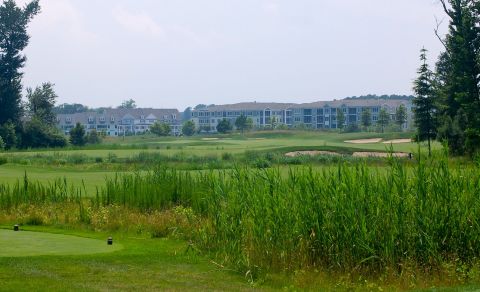
Bayside's real estate runs the gamut from single-family homes to multi-floored condos that dominate a few of the vistas from the golf course.
Another lovely short hole at Bayside is the beguiling 13th, the shortest on the golf course at 174 yards from the back tees (142 from the middle tees). Its slender, two-level green is angled from front-right to back left and sits confidently in an idyllic setting amidst marsh and pines. A rear pin position encourages a running shot that lands in the middle of the green and drifts down a slope towards the hole. Errant shots will likely find one of three bunkers from which an up-and-down could provide a big lift to the round.
In addition to its tough, well-maintained, enjoyable golf course, Bayside Resort delivers a large grass driving range, as well as a modest but, nonetheless, functional putting green. The day we played, LPGA Futures Tour player Ayaka Kaneko was practicing her putting at Bayside, further legitimizing the quality of the conditioning and practice facility.
Bayside’s peak-season green fees top out at $119, which is in line with the quality of the golf course and facilities. We played in the afternoon and the $84 we paid made Bayside a better value and overall experience than nearby Baywood Greens.
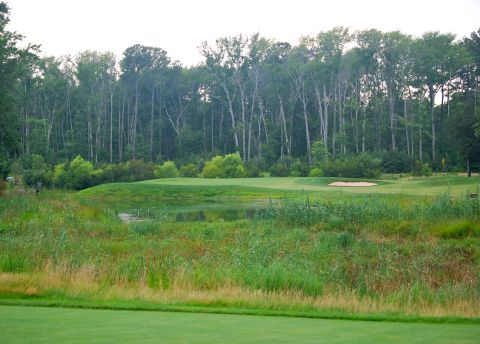
The marsh is ever-present at Bayside, as it is at the par 3 15th.
*
Editor’s Note: Our one and only previous visit to Bayside was two winters ago, a couple of days after a record-breaking snowstorm. Roads were nearly impassable and the golf director did not show up for a scheduled meeting. I understood. In the heat of summer, the views from the golf course are all over the place, literally and figuratively. The marsh is as attractive as parts of the Carolinas low country, and the spectre of the large hotels along the beach at Ocean City, MD, about four miles in the distance is strangely attractive, especially when lit from the west in the afternoon. That said, the developers of Bayside made an unappealing choice in mixing attractive single-family homes on small lots between multi-story condo buildings that some might label “stack-a-shacks”; unfortunately, those hulks dominate some of the views from an otherwise impressively laid out and challenging golf course.
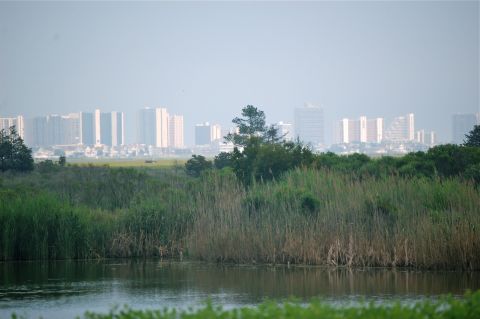
The monolithic hotels of Ocean City, MD, are just a few miles from Bayside.
Flower Power: Baywood Greens epitomizes "pretty" good golf
by Tim Gavrich
Rehoboth Beach, DE, is a popular summer vacation destination spot with a good spread of golf courses to occupy residents and visitors alike. The three main private clubs in the area — The Peninsula Club, Kings Creek Country Club and Rehoboth Beach Yacht and Country Club — primarily service residents and second-home owners. Three upscale daily-fee courses fight for business from the more casual golf-hungry travelers. They are Baywood Greens in Millsboro, Bayside Resort in Selbyville, and Bear Trap Dunes in Ocean View. All three golf courses are within 40 minutes of Rehoboth Beach, with their peak-season (summer) rates ranging from $120 to $135. First up: Baywood Greens.
The golf course at Baywood Greens is good, not great. Originally designed by Bill Love, it was finished, landscaped and laid out by landscape architect Larry DeWitt and owner/developer Larry Tunnell. The layout, comprising the Woodside and Waterside nines, will be joined by a Duneside nine in 2013; the land across from the entrance on Route 24 has already been scraped and appeared to be taking shape as we drove up to the golf club. The current golf course routing plays to just under 7,000 yards from the back “Gold” tees, with a rating of 73.4 and a slope of 135. The markers that attract the most play, the “Green” tees, play to 6,088 yards, with a rating of 69.0 and a slope of 125.
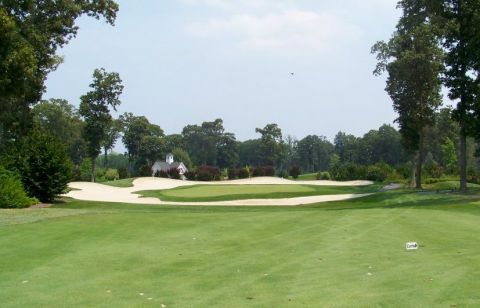
The par 4 10th at Baywood Greens. Photos by Tim Gavrich
There is no denying the emphasis on landscaping at Baywood Greens. According to the website, “200,000 flowers, shrubs and trees were planted; tons of pine needles were imported from Georgia; and acres and acres of wildflowers and other perennials were used to decorate the course.”
They’re not kidding: Sections of the Baywood Greens layout are festooned in floral displays. At the par four 14th hole, for example, the bridge that carries players from the tee box to one of the two landing areas is dense with a multi-colored display of pansies. Yet despite the beautiful distraction, the serious golfer may find the window dressing does not distract enough from an odd, even gimmicky hole. If you take the much shorter route on #14, you play a long iron or fairway metal from the tee to an area of land that appears to be the equivalent of a large green surrounded by water (with that flowered bridge at left front). This odd design feature makes a straight hole out of an otherwise dogleg-left. Both landing areas are very narrow, leaving higher-handicap players to pray that they are lucky enough to find land. But the flowers are certainly very pretty.
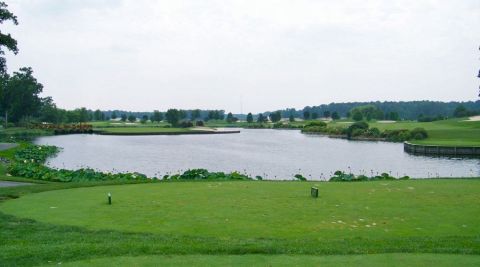
The par 4 14th at Baywood Greens can be played as a dogleg left or straight on, with a fairway metal or long iron to a peninsula, which shortens the hole considerably.
Despite such occasional bows to the out-of-the-ordinary, Baywood Greens is certainly worth a play. It is well maintained and its best holes are both interesting and challenging. The par three 6th hole, for example, measures 223 yards from the back tees and offers a full 90-degrees difference in playing angles, depending on what tee the golfer chooses. From all but the front tees, the hole calls for a carry over wetlands to a large, undulating green guarded by bunkers short and long. The par five 16th is also attractive; after a good drive, the player can attempt a heroic fairway wood to carry a corner of a lake at the edge of the green (or play a mid-iron for a conservative lay-up). This is the kind of risk-reward chance the serious golfer looks forward to on a well-designed golf course. But in its totality, Baywood Greens is merely a good course well tended, plenty enough challenge for the occasional golfer but nothing to match the Jack Nicklaus course at Bayside Resort, which we review here in the next few days. The greens at Baywood Greens, by the way, were quite smooth if a little slow, which was a blessing for the two high-handicap players in our group on those few greens with holes perched atop modest swales.
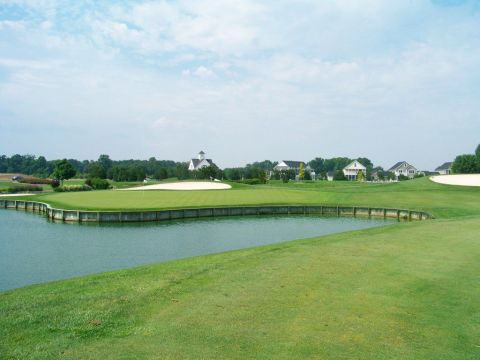
The approach shot on the par 5 16th hole at Baywood Greens.
A few of the peripheral features of the experience bear mentioning. On the first tee, the starter subjected our group to a 10-minute speech about the golf course. We were told at length about the cart rules and the particular idiosyncrasies of a few holes, even though the GPS systems in our carts were sufficient. During the starter’s soliloquy, the first hole was wide open in front of us, and our group’s itchiness to just get on with it and play golf was evident. The golf carts did not have rain canopies to protect our golf clubs in the event of a downpour, which happens often on a hot summer afternoon (thankfully not to us this time); at a holiday rate of $129 for green fees, that seemed a bit cheap. On the plus side were 10-minute tee times helped foster a comfortable pace of play; a wide practice facility, with 20-bay range and chipping and putting greens; and a friendly staff. (Note: The loquacious starter was quite cheery and difficult not to like, in spite of our readiness to just play.)
All in all, Baywood Greens is a good daily-fee facility that appeals to vacationers to the Rehoboth Beach area and provides a good day of golf to its customers, albeit at a fairly steep maximum price. Check the course out at www.baywoodgreens.com.
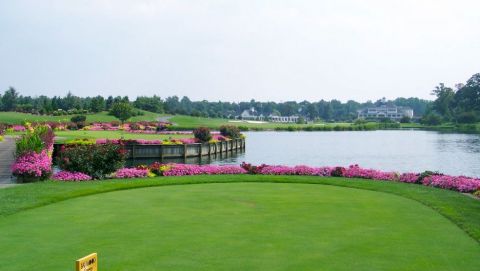
Baywood Greens' floral displays, such as here at the 18th tee, are unmatched by other public golf courses.
Editor's Note: Mostly small homes and condominiums surround the Baywood Greens golf course. Townhomes are priced from $199,000 and single-family homes from the $300s. The real estate at Baywood Greens appears to be as harmoniously organized as the landscaping on the golf course. A home there would be especially ideal for those who would like to be within a few hours drive of Philadelphia or Washington, D.C. If you would like more information at Baywood Greens, please contact me.
Local Market Monitor economist looks to slow growth
by Ingo Winzer
Yes, the economy keeps improving; but yes, it's only doing that slowly. Retail sales in May were up 8 percent over last year. But 2 percent was due to higher gasoline prices, and after adjusting for inflation the real increase in sales was only 2.5 percent, pretty anemic. Retail jobs increased 1 percent, in line with the modest volume gain. Overall, jobs in May were up 0.7 percent. That's not bad, considering that annual job gains back in the heydays of 2004 and 2005 were only 1.8 percent, but it's not very good if you want work for the 5 million people who lost their job in the recession and still haven't found a new one.
Consumers keep digesting the mountain of debt they loaded up on before the recession. They won't buy stuff until their credit card balances again seem manageable. When will that be? Consumer debt is down 12 percent since the 2008 peak and falling a third of a percent each month. In the last big recession, 20 years ago, consumer debt fell 14 percent before spending resumed. So we might have another year of sluggish growth ahead of us. The economic problem is complicated by the wars in Iraq and Afghanistan, which we paid for by borrowing big bucks from China.
In other circumstances, the government could goose the economy with tax cuts or direct spending, but by doubling US debt in the last 10 years -- to $14 trillion -- we can't afford to do either.
Ingo Winzer is president of Local Market Monitor, and has analyzed real estate markets for more than 20 years. His views on real estate markets are often quoted in the national press and, in 2005, he warned that many housing markets were dangerously over-priced. Previously, Ingo was a founder and Executive Vice President of First Research, an industry research company that was acquired by Dun and Bradstreet in March 2007. He is a graduate of MIT and holds an MBA in Finance from Boston University. He resides in Cambridge, Massachusetts. The boldface passages were chosen by Mr. Winzer.
*
Note: Local Market Monitor is offering a special 25% discount on its reports and subscriptions to readers of Golf Community Reviews. Just enter the special coupon code “golf” (don’t use the quote marks) at LocalMarketMonitor.com and sign up for either a one-market report ($99 before the discount) or a full-year subscription for monthly updated reports on one market ($297 before the discount). If you would like to sign up for a full subscription to all 315 markets that LMM covers, please contact COO Carolyn Beggs toll free at 800-881-8653, extension 105.Record month for Golf Community Reviews
It has been almost 4 ½ years since we launched the Golf Community Reviews web site, and although we never set specific readership goals, we have quietly raised a glass as we reached a few round-number milestones. But June’s results were a big deal for us, so pardon a little boasting. June
Our base of customers searching for golf community homes is growing as well. Currently, we are working with nearly three-dozen couples in various stages of their search for a golf-oriented home in a warm weather climate. Some are looking to the mountains, some to the coast and still others haven’t quite made up their minds. But the wide selection of properties across the south, and the low prices –- historically low, in some cases -– are convincing people that they have the resources to move from the dream stage to a more active footing. For those just about to put that foot forward, we are eager to help.
As a reminder, we do not charge a fee for our services. We are paid a referral fee by realtors who help our customers purchase a property, but there is never an obligation whatsoever (and the realtors in our growing professional network do not charge a fee either). Although we are working with a number of couples who intend to purchase a golf home in the next 18 months, we would be happy to offer some ideas to those looking a little farther down the line. Contact me for a free, no-obligation consultation about which areas of the south and which specific golf communities might best suit your requirements. (Note: As long-time New England residents, we know quite a bit about the combination golf and ski communities in the northeast.)
Over the past 4+ years, we have tried to be true to our mission -– to offer unbiased and objective reviews of specific golf communities, as well as the occasional piquant observation about the current housing market, especially as it affects those of us considering a home on the golf course. By the numbers at the web site, we are pleased that we must be doing something right. Thank you all for your continued support.
Larry Gavrich, Founder & Editor
Pending home sales in north may lead to renewed burst of activity in southern U.S.
The greatest impediment to the sale of golf community homes in the southeastern U.S. is not an issue of inventory, foreclosures, or even the well-publicized financial difficulties of some former high flying communities, like The Cliffs Communities and Reynolds Plantation. The biggest obstacle to golf community home sales getting back to where they once belonged has been the inability or unwillingness of northern baby boomers to sell their primary homes and relocate south.
That may be changing, if the May pending home sales report issued today by the National Association of Realtors is any indication. Pending sales were up in all regions of the country last month, including in such “feeder” cities as Hartford, Minneapolis and Indianapolis whose retirees have historically relocated south for their retirement years to enjoy the warm weather, golf and other activities.
I can sense the southward migration picking up steam in my discussions with real estate agents from Virginia to Florida. “Sorry,” one emailed me today in response to my request for a phone conversation. “I can’t talk until day after tomorrow” because he was working with customers from the north (one of which I referred to him from upstate New York). Other agents have frequently used the word “slammed” to communicate how busy they are.
Prices on properties in nice southern communities have become so
Living up north is becoming more stressful and unpredictable (and colder; global warming has not reached New England in winter yet). The cost of living, especially on the tax side of the equation, is increasing in poorly managed, economically fragile states like Connecticut, where your editor lives. The battles between our governor and the state unions cannot have a happy conclusion; one way or the other, services will be cut and taxes will go up. The reasons to move south for folks who can afford to do so have never seemed more compelling.
*
If you have been thinking about a move to a southern golf community and would like to discuss what areas and specific communities would best suit your requirements, please contact me for a free analysis.
Shortest, most fun par 4 in competitive golf
It was not surprising that some of the biggest crowds at this weekend’s Travelers Championship near Hartford, CT, gathered around the shortest par 4 on the PGA tour -– and planted themselves there for a few hours. The make or break 15th hole at TPC of River Highlands demands some patience, from spectators and PGA Tour players alike.
The tee box of the 15th sits on a rise almost embedded into the woods, a mere 285 yards from the elevated green. The hole is so short, in fact, that most players eschew the driver, fearful of rolling their tee shots through the green and into a thick, downhill lie beyond, leaving a second shot with basically two choices –- play short for a difficult downhill 20 foot birdie putt, or try to get your chip close to the front left pin and risk too much over-spin that will carry the ball down the slope in front of the green. A recess across the middle of the green just makes the chip -– and any putts from the middle -– that much more problematical.

The 285-yard par 4 15th at TPC River Highlands is the shortest on the PGA tour, a hole where dreams live and die.
All photos by L. J. Gavrich
With a stroke average during the tournament of just 3.68, some contending players on Sunday at The Travelers are scared to death they will only make par at the 15th. A par can snatch defeat from the jaws of victory for the tournament leader. (On Sunday, though, eventual victor and front-runner Fredrik Jacobson opted to play for par after a birdie on 14.)
The vexing issue at #15 is that 3-wood is barely enough to reach the green, even for the long hitters, and the tendency is to over-swing in a vain attempt to run the ball down the fairway far enough to make it up the three-foot-high slope at the front of the green. A pull hook can easily reach the lake that encroaches just below the left side of the narrow green. But the water takes a back stage to the trees and tall grasses that line the right side. Last year, Bill Haas was so deep in the weeds that he accepted an unplayable lie and then walked straight up a hill into a condo owner’s backyard to hit his shot to the green –- a good two stories below. This year, a similar fate befell no less than veteran Vijay Singh who took a drop from the weeds into less gnarly weeds five feet further away, made a miraculous weed-whacker of a shot that rolled up the side slope and onto the green 20 feet away, and then just barely missed his par putt.

Vijay Singh needed a weed whacker when he missed the 15th green high and right. He settled for a drop and an eventual bogey on a hole where par loses a fraction of a stroke to the field.
With that large stand of trees covering the entire right side of the hole and the iconic three-acre lake to the left, the wind often blows across the fairway from lake toward trees and then sometimes swirls back toward the tee box. That might have happened to the long-hitting Bubba Watson, who won his first PGA tournament at The Travelers last year. On Sunday, the grip-it-and-always-rip-it Watson came up a good 25 yards short, pitched up and over the slope to two feet and made his birdie putt.
The challenge at the 15th is really all about that green, which is about 90 feet deep, about 35 feet across and sits on a puckered-up piece of land that makes it look a little like a volcano that blew its top. Of the hundreds of pros who had a go at the hole over the four-day event, just eight managed eagles -– and 53 left the green with their shoulders sagging under the weight of bogey or double bogey. You can’t ask for better performance from a par 4 of under 300 yards.

The 15th green at TPC River Highlands is fully elevated. A tee shot left short or right leaves a tough pitch up to a front pin position. A tee shot that rolls through the green could leave an impossible one.


Last year's Travelers champion Bubba Watson left his tee shot about 25 yards short of the green and chipped (top photo) to within two feet, from where he made his birdie putt.
Good for Game: In youth, golf may be served
Where have you gone Tiger Woods? A golf nation turns its lonely eyes to…kids.
I write this as I watch the Travelers Championship at the Tournament Players Course just south of Hartford, CT. Unless you have stopped at this web site in error, you have an interest in golf and, no doubt, have read the big news from the TPC; a 19-year old amateur, Patrick Cantlay, had the
Cantlay and McIlroy, as well as others still too young to shave every day, may be the change the golf tour and the game itself have been waiting for, at least in the U.S. How refreshing, for example, to read the exhaustive coverage in this morning’s Hartford Courant and see just two passing references to Tiger Woods, neither having to do with how pathetic the game of golf is without him. When is the last time a story on golf made it through more than a few paragraphs without at least a hint of a woe-is-us reference to the state of the game without Tiger?
The truth is that the game -– any competitive game -- is better off when there is actual competition. Tiger at his peak turned his fellow PGA touring pros into a bunch of girly men who spent more time explaining
Imagine, if you will, a tour without Tiger Woods. Consider -– it’s not that big a stretch -– that the imperturbable young Mr. Cantlay and the baby-faced and sweet-natured Mr. McIlroy are golfers as good as they appear. They are undemonstrative, for sure, but real golfers and true fans care about the performance, not the sideshows, the drama not the fist pumps. Dream of a June Sunday, say, in 2018; the two 20-somethings are strolling up the 18th fairway together at Shinnecock Hills, with the U.S. Open on the line.
Wouldn't that beat a Tiger cakewalk any day?
Cliffs sues its old bank and new “partners”

Now on Sale

- The only book about golf communities in the last 10 years.
- 156-page step-by-step guide to finding your dream golf home.
- Info on nearly 100 golf communities the author has visited.
- Paperback version costs less than a sleeve of Pro VIs.
Here is what the experts are saying:
“The book is chocked full of information…applicable to anyone looking for a move to the Southeast regardless of whether they are looking for a golf community or not.” — John LaFoy, golf architect (Linville Ridge CC, CC of Charleston, The Neuse GC)
“Larry has done a tremendous amount of work and anyone — like me — who is looking to search for a golf home now or in a few years needs this book.” — Brad Chambers, golf blogger, ShootingYourAge.com
“Wow! What a thorough piece of work…a must for anyone moving South. This book will help many people.” — Brett Miller, owner and founder of MMA, Inc, a golf industry consultancy
Buy It Now at Amazon.com or BarnesandNoble.com.