Sleepy Hollow CC Review (part 2)
by Scott Simpson
This is the second and final part of a review of Sleepy Hollow Country Club by reader and golf club architecture afficionado Scott Simpson, whom we thank for his interesting and wonderfully written contribution.
Despite some inconsistencies in design features, inevitable given the number of people that have touched the course and the significant changes in routing, Sleepy Hollow is a delightful track, worthy of its reputation and pedigree. The course is characterized by imaginative use of the terrain, some of which would undoubtedly be daunting to a designer, especially one without recourse to modern earth-moving equipment. Most notable is a ridgeline in the midst of the property, along which the 5th, 15th and 16th holes are imaginatively routed.
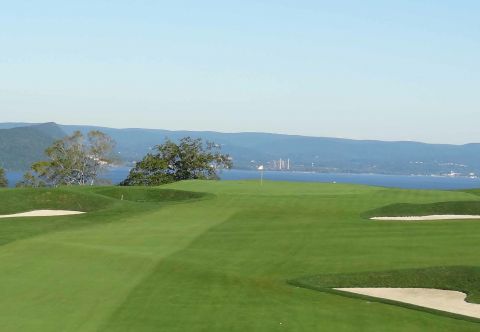
The 5th green appears to be suspended directly above the Hudson River. After an extensive tree removal program, one member is said to have asked his caddy, “When did they put in the river?”
The green complexes at Sleepy Hollow are mostly of the push-up variety (the infinity-style 5th green pictured above is an exception), to be expected since both Macdonald and Tillinghast excelled at building greens slightly elevated from the surrounding landscape. Because of the raised greens, the bunkers remain mostly at fairway level, yet provide a substantial lip to be carried by the player’s explosion shot.
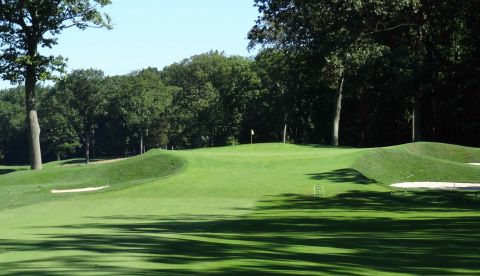
The 11th is typical of the push-up greens found at Sleepy Hollow. Players who miss the green with their approach shots will invariably face a delicate pitch or chip with only the top of the flagstick visible.
The greens themselves were simply spectacular, a tribute to the greens staff. Despite consistent rain in August, including heavy showers the evening before, the greens ran true and fast -- so fast that we all struggled with our speed initially, but greens that a golfer would sell his soul to play on a regular basis. An MGA official told us later that they were running 12.4 on the stimpmeter at the start of play that morning, readings that I hasten to note are by design taken on the flattest terrain.
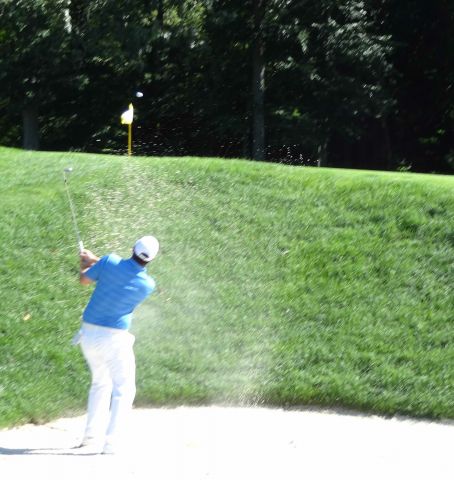
Anthony adroitly escapes from a greenside bunker on the 11th, one of the deepest on the golf course. While not an issue for a player of Anthony’s skill, the challenge for us mere mortals is obvious.
One minor quibble with the bunkers is that the actual surface of the sand in many cases is quite flat, and balls can frequently end up against or even under a lip of 3 inches or more. When this happens, especially when the ball rests against the back lip of the bunker, the player has absolutely no shot in any direction. Given the raised greens, ensuring that the bunkers play as hazards with sufficient challenge to the recovery shot, I would prefer to see a slight sloping of the bunker, so that balls would feed at least a short distance from the edges.
Macdonald’s use of template holes was designed to ensure that his projects included no weak holes, an admittedly impossible standard. But the strong holes predominate at Sleepy, and we’ll look at some of the best and most interesting amongst them. The 7th hole is Sleepy Hollow’s Redan, though it is technically a reverse Redan and a downhill one at that. Because the downhill shot comes in at a steeper angle (as well as the fact that the shape calls for a fade), the ball will not release on the green as firmly as it does on the original Redan at North Berwick in Scotland. However, the ground leading to the green also slopes severely from the player’s left to right, and Macdonald recognized that players could utilize that landing area to great effect.
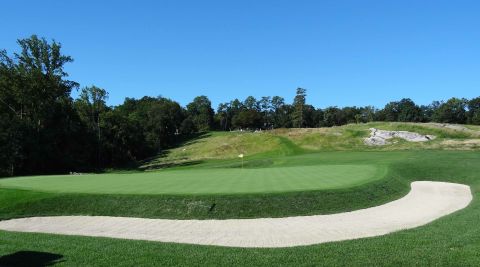
Macdonald’s reverse Redan as seen from behind the green. Despite the flattening effect of the lens, the pronounced slope of the ground short of the green is the ideal landing spot, as the green itself slopes away from the player.
I can’t render a personal verdict on the hole, as my 5-iron sailed long and left, leaving me no viable shot to the green for my second. The downhill nature of the hole certainly lends an air of drama, awaiting the inevitable hard right bounce. My crooked number notwithstanding, I would happily spend an hour on the tee box experimenting with different clubs and shot shapes, searching for that perfect landing spot, but aware that each day would bring different wind and turf conditions and pin placements to which the player must adapt. In that sense we can declare Macdonald successful in adapting the strategic concepts of links golf to an inland setting.
Amusingly, I similarly butchered the original Redan, the 15th at North Berwick, on my only visit to that shrine, though my excuse there was that the hole plays mostly blind. While Redanaphobia is not a widely recognized psychological disorder, my wife Theresa would be well advised to consider a press on the tee when we play the Old Macdonald Redan.
The 10th hole is a similarly dramatic downhill Par 3, especially photogenic with the fronting water hazard and wooden bridge. The golfer instinctively tenses as his ball seemingly takes forever to fall to earth, unsure as to whether the distance has been correctly gauged. Judging from the contours of the green, the drama might not end after landfall. The back of the green, where my well struck 8-iron plugged, is severely sloped. In typically firm conditions, my shot would clearly have spun back towards the center of the green. But, looking at the falloff to the water and the narrow collar of longer grass, it’s unclear whether a shot that lands on that slope remains on the green or even stops short of the water.
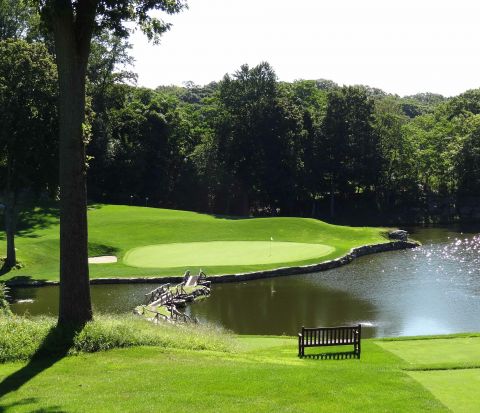
Though not tied architecturally to the remainder of the golf course, the 10th is still an awfully idyllic spot at the far end of the Tillinghast corridor of tree-lined holes. The long walk with a putter must be especially pleasing to club members who have hit the green, as the last segment is over water.
Sleepy Hollow finishes strong, as the routing heads back towards the Hudson and offers up some memorable holes. The 15th is called Punchbowl, the name graphically describing the cylindrical shape of the green and surrounding complex. Any approach shot within the contour of the punchbowl feeds down towards the green, but those left short or offline will produce an interesting third shot, one that can be delicately chipped or pitched or, if the line of play is through the short grass, putted.
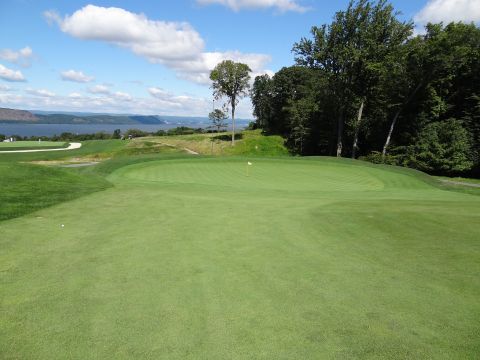
The entrance to the Punchbowl 15th green. Again the camera flattens the perspective, as the slope is at a much steeper pitch than it appears. Mitch wisely putted his ball, visible on the left side of the fairway, and barely had to touch it to run it into the middle of the green, despite extremely soft conditions (in dryer conditions, the approach shot probably feeds onto the green).
We played the hole as a longish Par 4 at 437 yards from the white tees, which was certainly Macdonald’s original intent (and is consistent with the punchbowl template holes at venues such as The National and Seth Raynor’s Yeamans Hall near Charleston, SC). However, an interim renovation of Sleepy Hollow moved the tees back some twenty-five yards and converted the hole into a short Par 5, resulting in most club-players hitting a short, though blind, wedge into the green. The course currently plays as a Par 70, so the temptation to add a third Par 5 is perhaps understandable. But to me (and Macdonald, Raynor, Hanse and Bahto can all be presumed to be in my camp), the challenging longer shot, completely blind except for a directional marker, is the more strategically appropriate, since the challenge of landing a wedge in a punchbowl seems minimal. However, both our newly famous caddy Sean Wolff, a noted good stick per this recent New York Times article and Anthony preferred the 15th as a three-shot hole. I can only attribute this to their skill and length, since even the lengthened hole would effectively play as a long Par 4 for them. They would rarely face the flip wedge into the punchbowl and would obviously relish the legitimate eagle opportunity.
The 16th hole, called Panorama, is a classic Macdonald/Raynor short hole, and by virtue of the Hudson River backdrop, one of the more
A review of photographs of the hole over the years confirms the success of the Hanse/Bahto restoration work. Tillinghast broke up the one bunker into several of his typically large sloping bunkers, presumably retaining the challenge but sacrificing the unique visual effect of his predecessors’ work. But far worse lay in store for this hole, as Rees Jones rebuilt the bunkers into his typically shallow, saucer-shaped hazards. I’ve never understood his bunkering, as the shallow saucers present little challenge to the player and are visually boring. In this instance, he placed two such rounded saucers just short of the green and an elongated saucer in front, resembling a sand-filled emoticon. Fortunately the “Open Doctor’s” design malpractice was mercifully short-lived.
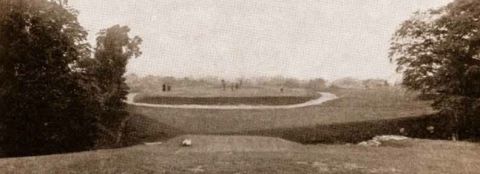
The long and the short of Sleepy Hollow’s short hole. The original Macdonald/Raynor design in 1914 (top). A.W. Tillinghast’s version of the hole, with his typically steeply sloped bunkers, did not improve things (below left). The Reestrocity (below right) made it even worse. (Did players getting up and down from the front bunkers get smileys?)
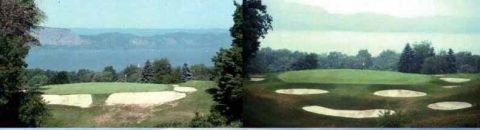
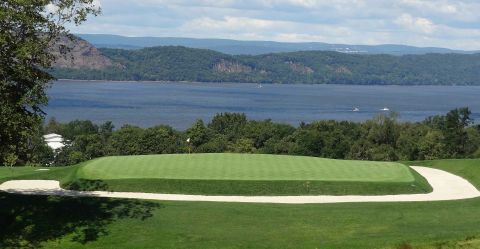
The current 16th (above) restored to its former glory. Below, the view from the front left corner gives only a sense of the contour of the 16th green. My shot spun all the way back from the middle of the green to this low spot, leaving a long uphill birdie putt, though the player will be fortunate to escape with his par.
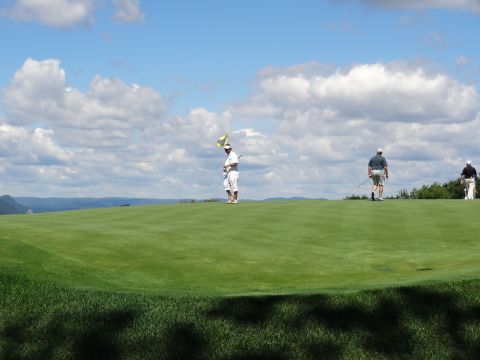
Sleepy Hollow presents an exhilarating challenge for golfers, testing all aspects of their games as they traverse the course’s visually spectacular terrain. Our story also has its own happy ending, as for once the quality of our golf measured up to the venue. Our three amateur partners contributed five natural birdies, which combined with Anthony’s typical firepower, allowed Team Willow Ridge (our club team) to tie for low net in the Pro-Am competition. While we unfortunately didn’t win any money for our professional partner, I’m informed that a beautiful rendering of the 16th hole is being sent to each of the amateurs. I’ll be sure to find a place of honor for it in my home office, as a memory of a delightful day on an exceptional golf course, thankfully restored to its prior glory.
 Home On The Course newsletter
Click here to sign up for our Free monthly newsletter, loaded with helpful information and observations about golf communities and their golf courses.
Sleepy Hollow CC: A Legend Reclaimed
Special to Golf Community Reviews: Text & photos by Scott Simpson
Sleepy Hollow Country Club is a justifiably storied name in the history of American golf, amongst a handful of clubs where the game of golf put down its roots in this country. The club’s original membership formed a Who’s Who of American business and society, including William Rockefeller, John Jacob Astor, Cornelius Vanderbilt, Oliver Harriman and Harrison Williams, amongst other prominent personages. Befitting its location, the club took as its logo Washington Irving’s iconic Headless Horseman, though the imagery is perhaps even more appropriate than it initially seems, as headless horsemen also have deep roots in both Scottish and Irish folklore.

The finishing hole at Sleepy Hollow is an uphill Par 4 appropriately named Mansion Rise. This hole was added by Tillinghast, as Macdonald’s original routing stayed on the lower ground of the property. The outdoor space under the green awning is a particularly delightful spot for lunch or a post-round adult beverage.
The 338-acre property in the “Washington Irving” hills was originally purchased by Rockefeller and Frank Vanderlip in 1910, including a 75-room Neo-Renaissance mansion built for but never occupied by Vanderbilt’s granddaughter, and sold in 1911 to the organizers of the club. The newly formed Sleepy Hollow Club retained the services of Charles Blair Macdonald, considered the father of American golf course architecture (in fact, it was Macdonald who coined the term “golf course architect”), to design its course, which opened in 1914. It was Macdonald’s second design commission after the completion of his masterpiece, The National Golf Links of America on Long Island.
I was particularly excited to play Sleepy Hollow as my golf travel plans include an early October return trip to Bandon Dunes to check out Old Macdonald, the recently completed TomDoak/Jim Urbina homage to Macdonald. With hopes to extensively research the man’s work, I spent the summer shamelessly begging all who crossed my path for entrée to The National but, alas, came up empty. Unless a kind-hearted reader of this blog site comes to my rescue, you’ll likely find me in the gallery when the Walker Cup returns to The National in 2013 (the club hosted the inaugural Walker Cup in 1922).
I was fortunate to play Sleepy Hollow as part of the Met Open Pro-Am
Macdonald collaborated on virtually all of his best-known designs with Seth Raynor, an accomplished designer in his own right, and their joint legacy includes, in addition to The National, such notable tracks as The Mid-Ocean Club in Bermuda (specifically built as a refuge from Prohibition), Yale Golf Club, The Greenbrier and the reputedly spectacular but now lost for the ages Lido Golf Club. Macdonald, an American, was sent to live with his Scottish grandfather in St. Andrews as a teenager, before golf had crossed the Atlantic. I expect to have much more to say about Macdonald after our Bandon Dunes trip, covering his unique experiences in St. Andrews (his introduction to the game came via Old Tom Morris), his rather large self-regard, as well as his formative role in promoting the game in the U.S. Amongst his extensive contributions, Macdonald built the first 18-hole golf course in the U.S. (Chicago Golf Club), was a driving force in the establishment of the United States Golf Association and was also a great amateur player, winning the first United States Amateur (his 12 and 11 margin of victory in the championship match is still a record). Macdonald was truly the vanguard of the golden era of golf course architecture, blazing the path followed by Raynor, Mackenzie, Ross, Tillinghast and others.
Macdonald’s stated goal was to bring the design features of the greatest golf holes of Scotland to the U.S., what later came to be known as template holes. Thus his courses feature Alps, Redan, Biarritz and Eden holes, modeled and frequently named after their source influences in Scotland (excepting Biarritz, which is obviously not of Scottish ancestry). These were in no way slavish reproductions of the originals, but rather the designers looked for features of the properties that would facilitate creating similar strategic challenges as the original holes, bearing in mind that this was an era in which the architect did not have the ability to move much earth. We find some notable examples of these at Sleepy Hollow.
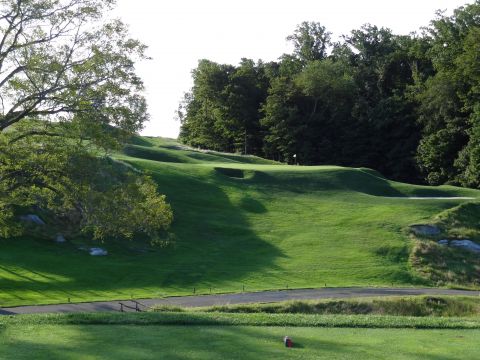
The 3rd is Macdonald’s Eden hole at Sleepy Hollow, modeled after the 11th at The Old Course. Macdonald felt that the original’s only weakness was that it could be played from tee to green with only a putter. Played across a deep gorge, only partially visible here, this “Eden” takes putter out of play off the tee.
Macdonald and Rockefeller were both, no surprise, strong personalities and had a falling out even before the course opened for play. Thus, in the late 1920s/early 1930s, the club hired A.W. Tillinghast, the renowned creator of both courses at Winged Foot, Quaker Ridge and Fenway, to add a third nine for the club. He accomplished this through a substantive change in the routing, adding what are now the 1st and 18th holes -- Macdonald’s routing did not start or end at the mansion-clubhouse, probably because of his concerns about steep slope of the land involved -- as well as a corridor of holes, the 8th through12th, that head off into the woods.
This created a unique existential dilemma for the club in developing its master plan: Were they restoring a Macdonald or a Tillinghast? Given that Tillinghast’s work at Sleepy Hollow, excepting perhaps the uphill finishing hole, was likely not his best (unlike at nearby Winged Foot), the logical decision was to emphasize a return to the design concepts of Macdonald, a decision that was agonized over for a considerable period of time. I’ll gloss over the decades of tinkering with the course, including a most unfortunate appearance by Rees Jones in the early 1990’s. Ultimately the club entrusted Gil Hanse and George Bahto with the restoration assignment, and the course reopened to universally glowing reviews in 2007.
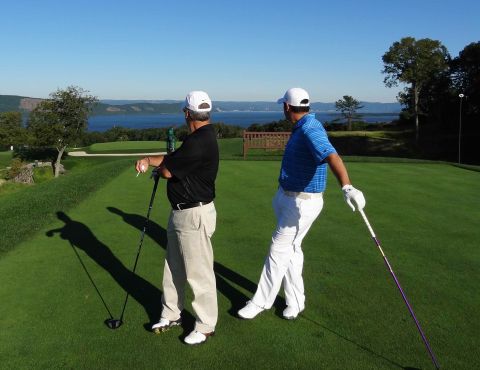
Etiquette would compel Mitch and Anthony to watch their partner hit his tee shot on the 4th, but they’re surely not the first players whose necks involuntarily swivel, Exorcist style, to take in the eye candy behind them. Fortunately it’s not the last time we’ll enjoy this view.
Hanse is a noted designer and restoration specialist who recently had left Tom Doak’s design shop to venture out on his own and has since won acclaim for his minimalist work on venues such as TPC Boston and Castle Stuart in the Scottish Highlands. According to Hanse, “With Tillinghast, the outcome of his work came down to whether or not he was drinking at the time. If he was, the result would be complex and imaginative course design. At the time Tillie worked on Sleepy Hollow, he must have been on the wagon.”
Bahto, a one-time minor league baseball player and owner of a dry cleaning store, followed a serendipitous path to golf course architecture. He was a member of The Knoll Club, a Charles Banks design, at the time a fire destroyed its clubhouse and all club records. Bahto volunteered to research the club’s history after the fire; he discovered that Banks had studied under a man named Seth Raynor, and following that trail, of course, led back to C.B. Macdonald. So absorbed was Bahto by this work that he ultimately wrote and published The Evangelist of Golf, the definitive biography of C.B. Macdonald (unfortunately now out of print). Bahto ultimately was tempted to try his own hand at golf course design, and more recently played a meaningful advisory role in the creation of Old Macdonald at Bandon Dunes.
---
This is the first in a special two-part series on Sleepy Hollow Country Club, one of America's earliest and most noted golf courses. Although Sleepy Hollow is not located in a golf community, we thought Scott Simpson's article a fascinating read, from a historical as well as course analysis perspective. Scott, a resident of Westchester County (NY) and dedicated reader of this blog site, is an itinerant golfer; we are envious of the international roster of golf courses he has played but grateful he writes about some of them here. As he notes in his review of Sleepy Hollow, Scott is headed to the famed Bandon Dunes in a few weeks, and we look forward to his comments about another one of America's most notable -- if not vintage -- golfing venues.
Next: Sleepy Hollow from all angles
Mad Men: Cliffs Communities ads featuring Tiger Woods connection hard to fathom
In its high-flying days, The Cliffs played a bit fast and loose in its advertising copy. Ads for the communities used a line from Resort Living magazine that contended The Cliffs featured “the world’s most comprehensive golf membership”; trouble was that the magazine was published by The Cliffs’ own marketing agency (at the time), hardly an unimpeachable source. In the latest ad in LINKS, The Cliffs repeats three times -– in headline, ad copy and on a postage-paid reply card -- that it offers “The World’s Most Complete Golf Experience.” Despite the rewrite, we think Pinehurst, for example, with eight golf courses actually open for play, could lay claim to having a more complete golf experience. Or the McConnell Group, whose eight courses in the Carolinas -– including a couple by Donald Ross -- may surpass The Cliffs’ in terms of layouts and condition. We recall the golf experience in Scotland’s Kingdom of Fife, an area not much bigger than the area traversed by The Cliffs’ communities, was pretty complete too (St. Andrews, Crail, Kingsbarns, Elie, et al within a 20-mile stretch). The world is a big place, and claiming to be the “most” of anything in the world begs for scrutiny.
So too does using Tiger Woods in a U.S. ad. According to the Wall Street Journal, quoting a study by the Reputation Institute, Woods ranks 47th of 54 public figures worldwide, behind Wikileaks founder Julian Assange and Lady Gaga but ahead of Hugo Chavez, Fidel Castro and Kim Jong-Il, who finished last (click here for full list). Jim Anthony’s continuing wish upon a fallen star is hard to understand.
Not too shabby: The Cliffs golf courses are interesting and typically in excellent condition, but some members think seven choices are more than enough.
Housing forecaster sees silver lining in home price declines, low consumer debt
To some, the sky may be falling, but to one economist who forecasts house price trends, falling consumer debt and the latest home price reports are causes for a little optimism. Ingo Winzer, who runs Local Market Monitor, a firm that forecasts home price trends in hundreds of U.S. markets, published his latest “National Economic Outlook” on September 6.
Winzer admits he is out on a limb in considering a “one month uptick” in consumer spending as a signal of better times. However, with consumer debt (excluding mortgages) falling 13 percent for 28 straight months before spending increased in August, Winzer points out that during the last recession with a real estate crash 20 years ago, consumer debt dropped 14 percent. A few key consumer-related benchmarks increase Winzer’s confidence in a turnaround, such as the credit card delinquency rate (3.6 percent compared with 6.5 percent in 2009); an increase of 6 percent in retail sales this year; and 1.3 million net new jobs created in the last 12 months. In terms of the real estate market, the average home price dropped 4 percent in the second quarter, a good sign according to Winzer because it implies the market is “now wringing out the last problems instead of being delayed by misguided policies.”
“We built 5 million too many homes,” Winzer writes. “We’ll only sell ‘em by cutting the price.”
The Local Market Monitor National Economic Outlook is available at its web site, LocalMarketMonitor.com. You will have to register for access to the report, but there is no charge. As we have written earlier, Local Market Monitor is also extending to readers of Golf Community Reviews a discount of 25 percent off its regular price for individual market reports. The service is the only national publisher that bases its forecasts for single-family and multi-family properties on risk assessment rather than recent transactions. A list of markets covered by Local Market Monitor is available at the web site, along with a sample report; if you decide to purchase one or more of the reports ($48.75 each after the discount), include the word “golf” during the checkout process (don't use the quote marks).Fear, loathing and success: The long par 3
I had that chance earlier this week at Simsbury, CT’s Tower Ridge, a Geoffrey Cornish design and public golf course a few miles from my home. Tower Ridge is a tricky golf course that plays partly along the Farmington Valley floor and partly along the side of the Avon Mountain, upon which stands the Heublein Tower. The founder of Heublein, the company that invented A-1 Steak Sauce but is more closely associated with its line of alcoholic beverages, built the tower as a personal and corporate monument (although local folklore hints that romantic liaisons may have been another motive). The tower lurks over the entire golf course and gives the club its name (although the club was previously called Cliffside, equally appropriate).
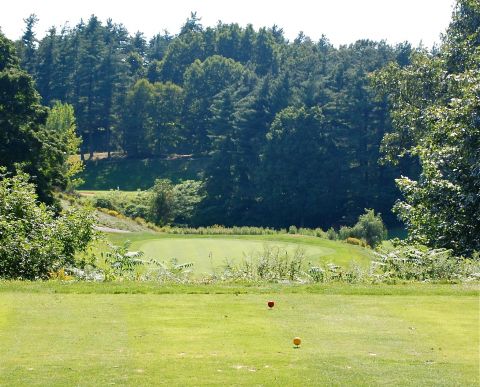
From six stories up, some sense of geometry is called for in figuring out club selection on the 240-yard par 3 8th hole at Tower Ridge. (Note: A photo taken earlier; the pin on the day I played was way back.)
Tower Ridge hugs the Farmington River at one point and had been hit pretty hard by the remnant rains from Hurricanes Irene and Lee. Some holes had been shortened significantly and cart traffic patterns were diverted as the course dried out. But the titanic 8th hole was unaffected since it plays along the midpoint on the side of the mountain, between an elevated tee and a long deep green 235 yards out and about six stories down. Such an elevated tee on a par 4 or par 5 is a welcome sight since it adds 20 or 30 or more yards to a well-struck drive; but on a par 3, it wreaks havoc with club selection. (How did my high school geometry teacher say you figure out the hypotenuse of the isosceles triangle?) The pin on the day I played was just a couple of strides from the back edge of the deep green, and I knew I could not get a 4-wood back there.
Out came the driver, I made a good swing and away the ball went, high against the blue sky beyond and toward the green. My eyes are not good enough to see that far on a sunny day, and as I snaked my way down the mountain, I feared I might have hit it over the back. But when I drove up and the green came into full view, my golf ball sat pin high, about 15 feet left. The putt, which I missed, almost felt like an afterthought.
Although I like to play golf occasionally by myself, this was one of those occasions when I would have liked a witness. How nice for me to have this blog where I can bore you, dear reader, with the details. On the other hand, if you have ever hit driver on a par 3 and made the green, you probably know how I feel.
*
I had three witnesses to a different sort of outcome on a long par 3 at the Course at Yale yesterday, just a day after GolfWeek anointed the Yale layout the best of all college golf courses. The long par 3 9th at Yale is unique. It can play nearly three clubs different depending on the pin position on the 50-yard deep green. But it is not so much the enormity of the green as it is a feature at its core that makes it so lovable and loathsome at the same time. To say the 9th features a double-level green is to say Brigitte Bardot was a woman; the labels do not do either justice. 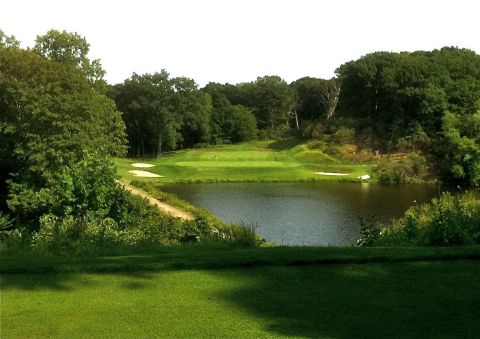
The 9th at Yale is frightening from the tee box, but the real fun begins on the green (see photo at bottom of article), especially if your ball winds up on a level where the pin is not, or in the deep trench that runs across the entire green.
Stretching across the entire width of the Yale green is a deep trench, a hell from which a short shot to a back pin or a too-long shot to a front pin cannot escape, leaving a long putt up a 60-degree incline (and almost never a straight putt, either). The only worse fate on the 9th is if you should so totally miss your tee shot that it comes up short of the green and in the pond or winds up on one of the levels of the green where the pin is not. Only a crazed miniature golfer could love the putt that remains.
I found love in all the wrong places after I hit my rescue club shot
You cannot practice these putts because there is no green like #9 at Yale. Petrified that I might putt the ball off the green, I left my first putt in the trench after the ball reached the crest of the hill in front of the pin. (What a sickening feeling seeing that ball hang on the top of the slope for a mere second before falling backward and down.) Three putts later -– including my missed third putt from 15 feet short -- I registered my first four-putt in over a decade. If it was going to happen, the 9th at Yale is a fitting place to wear the badge of dishonor.
In the course of three days, I had played two long par 3s. On the first, the longer of the two by 40 yards, it took me one shot to get to 15 feet from the pin with a club –- driver -– not known for easily controlled ball flight. On the second, with a putter, it took me two shots from 60 feet to get to that same 15 feet from the pin.
What a game golf is…
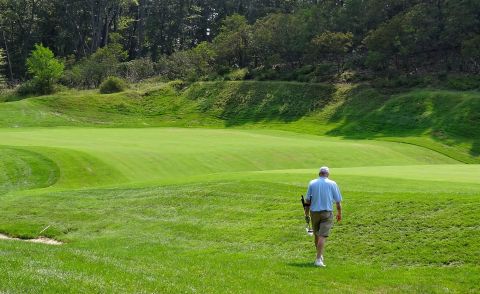
Great Depression: The green at Yale's 9th hole.
Photo courtesy of Scott Simpson.
In Search for Retirement Location, Best Places to Live Lists Make Things Worse
We are not fans of rankings when it comes to the best or worst states for anything, but magazines like AARP and web sites like MoneyRates.com cannot seem to resist taking advantage of the human inclination toward Top 10 lists.
We were reminded of this when we stumbled across a one-year old article at MoneyRates.com, a site that says it finds its users the best bank rates available. Would that it did the same thing with its information about retirement locations. AARP and other media outlets picked up the MoneyRates rankings and ran with them, almost without comment (and certainly no critical comment).
On the face of it, most of the criteria MoneyRates factors into its
Consider, also, the size of Texas, for example, and you have the essence of why it is a foolish exercise to identify a best or worst state for any category as broad as retirement choices. Is Austin, a favored city for retirees over the last few decades, anything like Houston or Dallas? Would a person seriously considering San Antonio as a retirement destination ever seriously consider Fort Worth? People should and do choose a retirement location based on local factors, not irrelevant state data.
The MoneyRates editors must know something baby boomers don’t know. Some of the very states that thousands of boomers flock to each year are on MoneyRates’ worst 10 list, including the two Carolinas (SC at 4th worst and NC at 8th worst); Tennessee at 6th and Arkansas at 10th complete the southern list of bad states. The MoneyRates best and worst lists may purport to factor in climate as an important consideration, but few southern states make the “best” list. New Hampshire, with no state income tax, is anointed the best state for retirement; it’s a beautiful state, especially in spring and fall, but the cost of living (extra clothing, heating costs) goes up dramatically in winter. Bizarrely, Hawaii ranks at #2; it is a great state for climate and golf, but don’t expect family members from the mainland to visit too often and, oh, make sure to bring buckets of spending money (consider the costs of the many foods that must be shipped or airlifted onto the islands). The same person who would retire to New Hampshire for the income tax advantage would never consider Hawaii, and vice versa, yet they hold down the top two rankings.
The top 10 best retirement states list is rounded out, in order from #3, by South Dakota, North Dakota, Iowa, Virginia, Utah, Connecticut, Vermont and Idaho. Perhaps the editors of MoneyRates are skiers or simply can’t stand the heat, in which case they should get out of the ranking business.The right questions to ask when shopping for a golf community home
The choice of a golf retirement home may be the last big financial decision any of us make. Alternately, the purchase of a vacation home could affect the rest of our lives -- for better if it becomes a source of great family enjoyment and relaxation, or worse, if it turns out to be an ill-timed investment. The future, as Yogi Berra might say, is ahead of us, but few of us can predict it. We just make the best decisions we can with the information we have.
When shopping for a golf community home, the best information does not come from marketing brochures, the Internet or even from the
In our latest (September) Home On The Course newsletter (just click on the box at the top of this column to subscribe), we detail a few of the most important questions you should ask to assess a golf community’s financial health and stability. And we also take a look at a few specific markets north and south to see how prices have moved in the last three years; we can’t predict the future, but the past certainly can hold a few clues to what might happen in the coming years. And, finally, we announce our first ever Home On The Course “Discovery Weekend” at one of the U.S.’s best-managed golf communities. Space for the four-day event is extremely limited, and we won’t announce the community’s identity here for another few weeks; if you want to know now which one it is, you’ll have to subscribe to Home On The Course. And before you label that as extortion, understand that the newsletter is free, which makes it the best investment related to golf communities that you can make…at least for now.
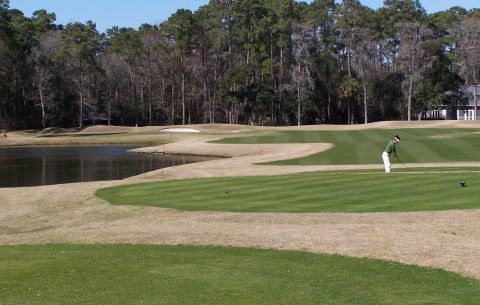
If you know this golf hole, then you know where we will host our first "discovery weekend" later this year. If not, and you really want to know soon, sign up for our free Home On The Course newsletter today. Just click on the box at the top of this column to subscribe and the editor will personally send you a copy of the September issue.
Non-golfer figures out yin and yang of golf
Rick Vogel, one of our most dedicated and careful readers, took our piece on the health benefits of golf (see article below) one giant leap forward. He wrote:
"I liked your latest Golf Community Reviews [piece] but I'm wondering if you may have stopped your logic train ahead of its last station. Consider... The worse you play, the more you walk. The more you walk, the healthier you are. The healthier you are, the more you play. The more you play, the better you get. The better you get, the less you walk. The less you walk, the unhealthier you are. The unhealthier you are, the worse you play. The worse you play, the more you walk...ad infinitum. Could we not therefore conclude that golf is, in fact, a game that is both good and bad for your health and your score?"
Indeed we could conclude that. A brilliant deduction from a guy who doesn't even play golf! Thanks Rick.
Yeah, right: Bad golf scores may actually be good for your health
The next time you top a golf shot or hit your drive into the woods and take the maximum allowed five minutes to look for your ball, consider that you are actually lowering your stress levels and improving your health. The logic may seem counterintuitive, but follow along. (You might want to strap that blood pressure monitor around your bicep while you read this.)
In a Sept. 5 article in the Bergen (N.J.) Record, senior golfers testified that golf has helped them remain vigorous and, in at least one case, alive. “If it wasn’t for golf,” says 87-year-old James Davino, “I think I’d be dead.”
Davino, who took up the game at age 63 and previously had suffered two heart attacks and other health issues, says the walking in fresh air with friends lowers his stress levels. “I don’t even keep score,” he added.
With all health providers in agreement that daily or even weekly
Importantly, the article also points out how lousy golfers actually may have an advantage over those who play golf the way it was meant to be played. Consider that the shortest distance between two points is a straight line. Accomplished golfers hit the ball much straighter than the rest of us. Those poor suckers will walk no more than 4 or 4 ½ miles per round, but the rest of us, searching left and right and high and low for our errant golf balls, might walk as much as a mile farther per round. Following an unassailable logic train, if walking is good for you and high scores promote more walking, then high golf scores are better for you than low golf scores. And bad golfers may live longer than good golfers.
Now instead of moaning over a post-round beer about all my bad shots, I can say with confidence that I feel great about it.
To read the full Bergen Record article, click here.
Connecticut's private Torrington Country Club hides just a few of its charms
Happily married since before Arpanet evolved into the World Wide Web, I have no need for dating services like Match.com or eHarmony. But it doesn’t take much to imagine that a first date with a total stranger could go in one of many directions –- ranging from extreme discomfort to grand seduction.
So it is with golf courses we play for the first time. I recall a few rounds on mountain courses, notably Vermont’s Mount Snow (or perhaps it was Sugarbush) many years ago, that were uncomfortable in the extreme and a drain on my resources. (I lost a dozen golf balls that started straight toward the middle of fairways and disappeared to Lord-knows-where once they bounded down impossibly tilted slopes.) At the other extreme are golf courses whose charms and challenges are in plain view, not hidden beyond elevated fairways or quirkily slanted terrain. Count virtually any Donald Ross golf course among these, as well as many of the other classic layouts from the Golden Age of golf course design in the 1920s and 1930s. Those golf architects respected both the land they worked with and the golfers they challenged.
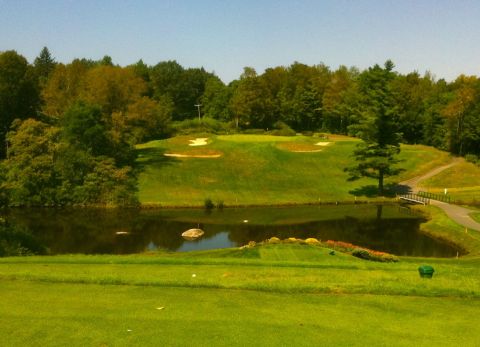
The par 3 11th is one of the most attractive and challenging one-shotters in the state of Connecticut.
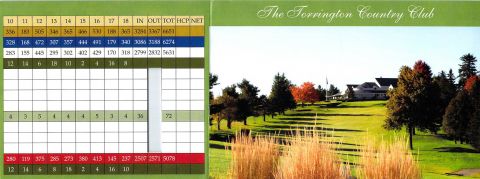
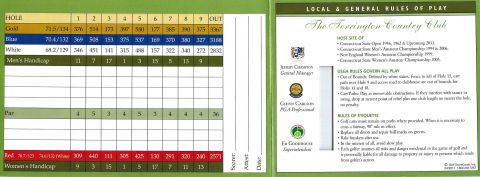
Torrington Country Club, circa 1929 and in the rolling Litchfield Hills of western Connecticut -- a golf course I have driven past dozens of times over the 27 years I have lived in Connecticut and always wanted to play –- was much more a seductive first date than a discomforting one. The frustrations of a few quirky holes of the Orrin Smith layout are more than compensated by some of the most interesting green complexes in the state, as well as a wide variety of green sizes, shapes and topographies. Smith, who worked for Ross in the ‘20s and ‘30s, showed great restraint and respect for the swirling country landscape, resulting in a few holes that are much kinder to the eyes than they are to scores. A few fairways are so tilted that a tee shot landing on one edge can bound across the short grass and almost into the rough on the other side (in other words, some shots down the middle will find the rough). The rough itself, just six days after the torrential rains from Tropical Storm Irene was, needless to say, deep. I tend not to look at slope ratings before I play a course, but I wasn’t surprised afterwards to note our short routing from the blue tees -– 6,274 yards total –- carried a slope of 132, high for such a modest length. (Note: The course plays to only 6,651 from the tips, with a rating of 71.5 and slope of 134.)
Par 5s short on distance, not challenge
The abbreviated distance comes substantially from the four short par 5s. From the blue tees, two of them are a little over 500 yards, and the other two are 472 yards and 491 respectively, both on the back nine. Those are short enough to get long hitters salivating on the tee boxes, but #12, for example, is deceptively long, a hard dogleg right with trees guarding the ideal landing area a good 200 yards out. If you cut the dogleg without a left to right fade on your tee ball, you run the risk of rolling through the left side of the fairway and into the gnarly rough. Pull the ball a bit, and a stream on the left comes into play; push right, and the trees will block an approach toward the green. A hybrid or five-wood off the tee, followed by another fairway wood, leaves an easy wedge to a green that is deep and narrow side to side. Patience is rewarded on such a hole.
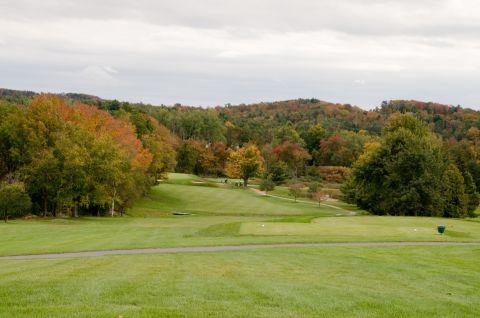
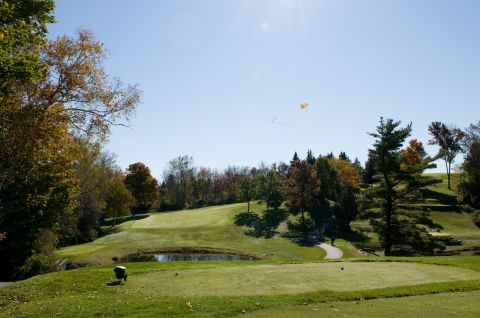
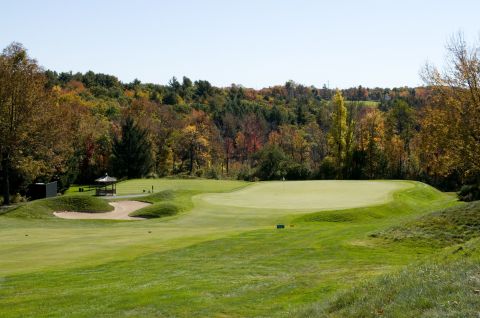
Whether downhill (top, 2nd hole) or uphill (12th), the fairways at Torrington tilt, sometimes significantly.
Above two photos and one below courtesy of Mark Hansen.
With the exception of the comparatively bland 17th, the par 3s at Torrington are a special delight. And although they are in a pretty tight range of distances –- 153 yards to 179 yards -- they are of strikingly different character. Two that stood out were #3 and #11. At 153 yards, #3 is the shortest of the group, but yawning bunkers at right front and left front ensure that a thinly hit shot off the tee has a chance of reaching the green only if it negotiates a narrow neck of grass in front. Like many of the greens at Torrington, this one slopes from back to front, making it inadvisable to be above the hole. As on most of the falsely fronted greens at Torrington, a front pin position will be the most challenging on #3 (it was in the middle on the day my friend Bill and I played, probably the most generous positioning possible).
The par 3 11th – which the club’s web site indicates as its signature hole -- presents an entirely different challenge. The view from an elevated tee to an even more elevated green gives the effect of a hole considerably longer than its stated 168 yards. The carry over a fair-sized pond is the least of the challenges on the hole; the steep hill up to the green exerts a strong gravitational pull on shots that land just inches short of the putting surface, and the bunkers that cover all but the left front side of the green prevent much bailout opportunity. This is one of the most challenging and visually arresting par 3s I have played in the state of Connecticut.
A short par 4 forces 7-iron from less than 100 yards
I recall only one hole without bunkers, the par 4 15th, but at 444 yards from the blue tees, it needed no adornment. Bill and I hit what we thought were pretty good drives, but still had well over 200 yards remaining uphill to a smallish green. But it was the short par 4s that got our attention, none more so than the beguiling 13th, at 307 yards the shortest of them all and, with a hill running down to the green from about 60 yards out, seemingly drivable -- the operative word being “seemingly” since the fairway slopes up to the crest of the hill before it falls down fast. Wedge shots from the fairway are blind to an incredibly small green below, perched on a hill with an almost sheer drop behind leading to a place from which few will return in one shot. From the rough just off the left side of the fairway, I had strong concerns that a wedge shot that landed short of the green would bound down the hill and through the green, or that a play on the fly to the green from the rough would lack sufficient spin to stop. I chose to chip a 7-iron about 30 yards just over the crest of the hill and roll it down the hill. It wound up 6 inches into the rough beside the green, pin high, from where I got up and down for par. Bill had pushed his drive into the trees on the right, from where he had the only view of the green and an open shot. He hit a half-wedge that landed and stopped on the very front of the green, and he two-putted for par. I moved toward the next tee with ambivalent feelings about the 13th hole; quirky, yes, but it provided intriguing options on the approach and, after all, I did make par.
Torrington's greens are a collection of different shapes and sizes, some perched on a knob of land, and others almost in a bowl. All are fast, and tricky to putt, the 5th among them.
Conditions on the course, especially after the heavy rains a few days earlier, were excellent. Although the greens were showing some signs of a recent aeration, they putted true and faster than they looked. On one par 4, Bill hit what we thought was a perfect approach that landed in front of the green, rolled up to pin high and then, in excruciatingly slow motion, began to roll down the front of the green and then faster down the false front, finally coming to rest 20 yards below. From the left hand bunker on the same hole, I made the mistake of aiming my shot at the pin, landed short of it and, long slow story short, wound up 10 yards behind Bill’s ball.
First dates can be challenging, especially if you are not properly prepared. I’ll know better next time.
*
The members-only Torrington Country Club is located on Torrington Road in Goshen, CT. Initiation fees for full-family and single-golf memberships are just $1,000, with monthly dues less than $500 per month for families and less than $400 for singles. The club membership is composed of local residents and part-time residents who own second homes in the beautiful Litchfield Hills area. (The club is two hours from Manhattan.) There are no houses adjacent to the golf course, although a few grain silos add a rustic touch. Web: http://www.enjoytcc.com/. Phone: 860-491-2688.
At 117 yards, toughest par 5 in golf?
Irene barks but doesn't bite too badly
Another spectacular loss for Greg Norman?
Now on Sale
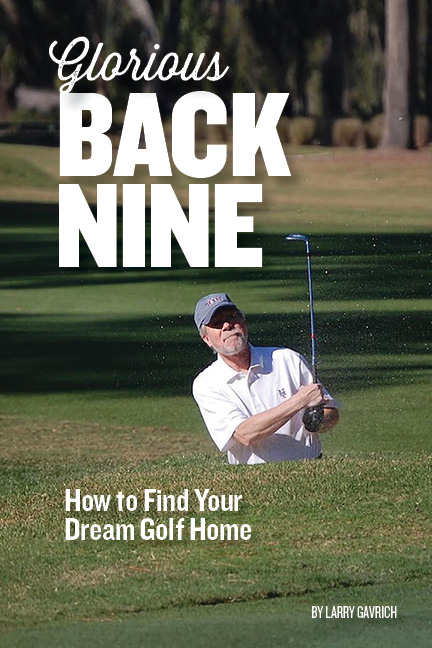
- The only book about golf communities in the last 10 years.
- 156-page step-by-step guide to finding your dream golf home.
- Info on nearly 100 golf communities the author has visited.
- Paperback version costs less than a sleeve of Pro VIs.
Here is what the experts are saying:
“The book is chocked full of information…applicable to anyone looking for a move to the Southeast regardless of whether they are looking for a golf community or not.” — John LaFoy, golf architect (Linville Ridge CC, CC of Charleston, The Neuse GC)
“Larry has done a tremendous amount of work and anyone — like me — who is looking to search for a golf home now or in a few years needs this book.” — Brad Chambers, golf blogger, ShootingYourAge.com
“Wow! What a thorough piece of work…a must for anyone moving South. This book will help many people.” — Brett Miller, owner and founder of MMA, Inc, a golf industry consultancy
Buy It Now at Amazon.com or BarnesandNoble.com.