Uncharitable golf: The CEO game turns ugly
Now, how much would you pay to play a round with Thomas Ryan? What, you've never heard of Thomas Ryan? Well, someone has and, according to the Wall Street Journal, that someone paid $130,000 for the privilege of a round with Mr. Ryan, chief executive officer of CVS, the huge Rhode Island based chain of pharmacies.
CVS sponsors the annual CVS Caremark Charity Classic at the Rhode
The Wall Street Journal reported all this and more today in a front-page story squeezed among articles on the nation's financial mess. The successful bidders for access to Mr. Ryan paid the $130,000 during the auction at the charity event's gala dinner. Let me restate that: The shareowners of the companies that bid on access to the CEO actually paid for the golf. Other suppliers spent similarly lofty sums for access to other CVS executives, including to those who make key purchasing decisions. Why does this seem like déjà vu all over again?
It looks tacky at best, from a corporate ethics standpoint, but by itself seems a pardonable sin (although one wonders where CVS' board members
Ostensibly, the auction bidding is open to anyone, but there seems to be no such open bidding when it comes to donating the proceeds. CEO Ryan is a board member of the Andrade Faxon Childrens Charities in Rhode Island, which receives the lion's share of the 16% from the tournament. The charity is named for its founders, professional tour players Brad Faxon and Billy Andrade, and depends on CVS for most of its income. Faxon is listed as one of the hosts of the annual CVS tournament. He is also Ryan's playing partner at the annual Pebble Beach Pro-Am, where the two won the tournament in 2003.
I cast no aspersions on Mr. Faxon, a genuine good guy. But this is icky stuff, not exactly CEO excess on the Dennis Kozlowski scale but it comes at a time when no CEO wants to appear to be playing the self-interest game. CVS and its CEO have a major public relations problem, but other CEOs may not be able to spin their way out of their predicaments. The FBI announced yesterday that it has started an investigation of AIG, Lehman Brothers, Countrywide Financial and other financial services companies whose greed and bad business practices have been instrumental in bringing our nation's financial system to the brink.
The blood is in the water, and the infamous Kozlowski and Jeffrey Skilling (of Enron fame) had better move over. Roommates are headed their way.
Here is a link to the Wall Street Journal story. If you cannot access it, send me a note (Contact Us button at top of page) and I will forward it.
 Home On The Course newsletter
Click here to sign up for our Free monthly newsletter, loaded with helpful information and observations about golf communities and their golf courses.
A bad day yields nice shots (with the camera)
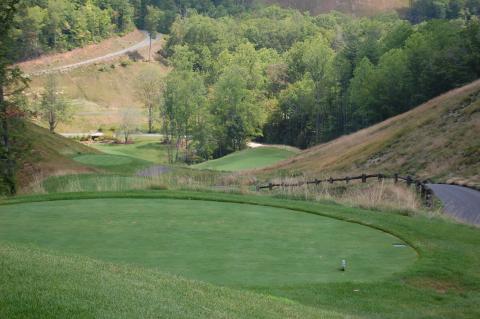
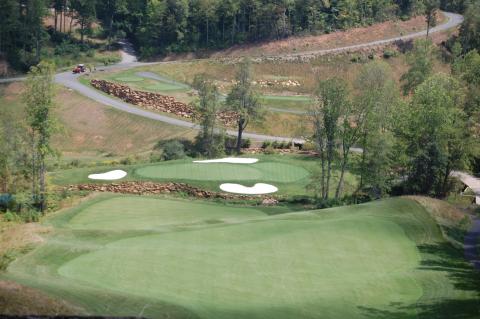
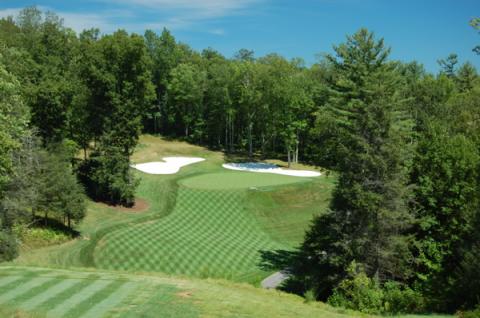
The tee shot on the 8th hole at Balsam Mountain Preserve is a blind one (top photo) to a downhill fairway with a creek at its end, just in front of the green. The approach shot, above, is all hit or miss badly. All photos by L. Gavrich (Note: Click on small photos below for larger versions and captions)
Palmer, Fazio mountain golf courses rate the same but play different
From the tips, the courses at Balsam Mountain Preserve and Bright's Creek are remarkably similar in length and degree of difficulty. Both play to about 6,900 yards and sport identical course ratings of 72.9. From the more moderate members tees of around 6,400 yards, the ratings are almost identical as well, 70.1 for Balsam Mountain and 70.5 for Bright's Creek. The slope ratings from the members' tees almost match up too, 136 and 134 respectively. The settings, routings and player experiences on the courses, though, are considerably different.
Tom Fazio might have wound up designing both courses if he had liked the top of the mountain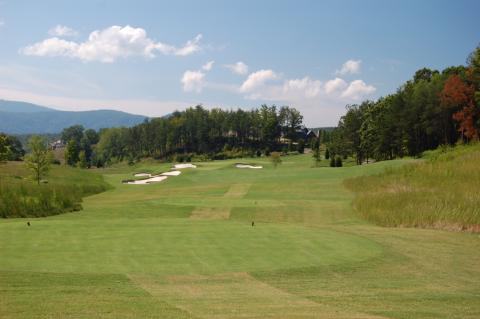 location at Balsam, but sources told me he thought the site would force compromises in the routing. He suggested an alternative site a few miles away and a couple thousand feet down the mountain, an idea rejected by Balsam's developers, Chaffin & Light. Palmer Design literally rose to the occasion to carve 18 holes from the mountain. At Bright's Creek, there was never a doubt it would be Fazio, who had designed the course at developer Barton Tuck's other community, the ultra-private and well-reviewed Forest Creek Club in Pinehurst, NC.
After playing the Balsam Mountain course, I think I understand something of what Fazio saw in the site. Although some of the holes on Arnie's routing are as interesting as they are beautiful, overall I found the layout a little too brawny, especially on a day when I was not hitting the ball straight. There were just too many opportunities for a slightly errant shot to ruin your day. The course is challenging to be sure, but exhausting as well.
Things got off on a bad footing for me on the first hole, which required a play down the middle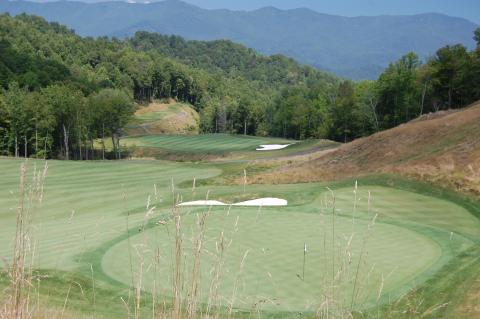 to the left side of the fairway, away from a cliff that ran along the entire right side. I pushed my tee shot and approach shot and lost a couple of balls, my fault, not Arnie's. But on the rest of the course, it seemed the King was forced to squeeze a hole in here and there, nowhere more so than the eye-popping 8th, a short par 4. The tee shot there is entirely blind, up and over a steep hill whose other side is also steeply sloped down toward the creek in front of the green. A choice of driver for all but the longest hitters is fine off the tee, but when you get to the top of the hill, look back up at the tee, and then straight down to the green, you can't imagine how a good drive could stop short of the creek. A waste area beyond the green gobbles up overly aggressive approaches, as it did mine. It is a memorable hole, if not a classic one.
Balsam Mountain is not a course for any but the straightest hitters. I carried shots over the middle of hills and failed to find my ball on the other side. (I lost a dozen balls at Balsam Mountain, my own fault for playing a mountain course without a member.) Local knowledge is just about everything at Balsam Mountain, in addition to hitting the ball straight, and the hints Balsam's friendly pro shop staff offered me before the round were helpful but not enough to staunch the flow of my Bridgestone 330s into the local forests.
I found the hardest-hole designations on the scorecard a little odd. The short par 5 4th hole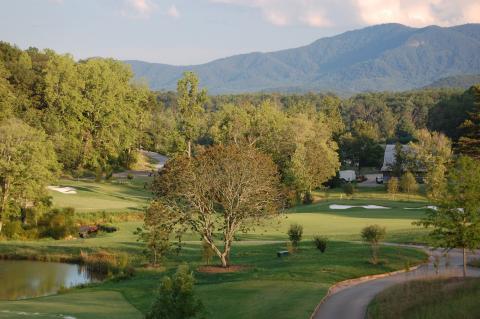 was one of the easiest I played all day, albeit beautiful, but it is down as the #1 handicap hole. My notes on the long (447 yard) par 4 16th hole indicate that it "plays tougher than a #10 handicap"; I wrote a side note that the shorter par 4 15th hole "played easier than its #4 handicap." Although a 450-yard par 4 is longer than my game can accommodate these days, distances at the 3,500 feet high course didn't seem to matter nearly as much as hitting the ball straight. The longer holes feature elevated tees and downhill plays that soften the lengths you go to reach the greens in regulation.
Conditions at Balsam Mountain are remarkably good given that the full 18 holes have been opened barely a year. I didn't have a bad lie all day -- that is, when my tee shots found the short grass -- and greens were smooth and medium fast. Arnie's layout is also long on postcard-beautiful mountain vistas. On a clear day, you can see a few dozen miles in all directions, a pleasant and welcome distraction if your game, like mine, goes in one of those directions...namely south. Tom Maybank, the sales associate at Balsam who kindly showed me around the community, indicated that developers Chaffin & Light do not consider Balsam Mountain strictly a golf community. Do not take that to mean the course is window-dressing, although any of us would be happy to have some of those views to dress up our windows. The course is tough and not for the casual golfer. The better player who sees intimidating carries over ravines and blind shots over hill and dale as one way golf was meant to be played should like it a lot. I liked the course, but my best shots were through the camera lens.
The Bright's Creek golf course takes a lower road, literally, by playing in what looks like a valley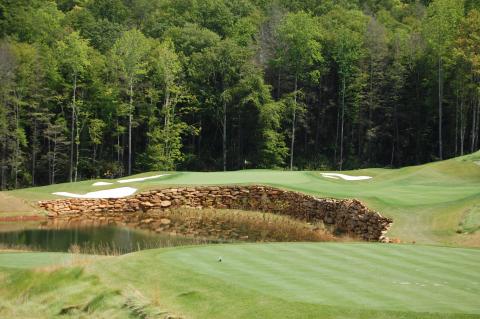 but is actually more than 1,000 feet in elevation. The course, which traverses land that was formerly home to a cattle ranch, is unmistakably Fazio, with all the customary touches and holes that flow one after the other as if the designer had an unlimited amount of land at his disposal. For the eye, the recognizable large Fazio bunkers are there, nestled into the banks on the sides of the fairways and greens and framed by the surrounding mountains that rise 3,000 feet above the course. The banking around the fairways -- Fazio's signature funneling -- rescue some wayward tee shots from finding trouble outside the boundaries of the fairway, but the fairway bunkers will gobble up slightly stray drives. Depending on what end of the bunker you find, you face either a tempting play to the green or a disappointing wedge back out to the fairway because of the bunker's lip in front of you. Fazio's bunkers at Bright's Creek are not there for visual appeal along, that is for sure.
At Bright's Creek, Fazio does not seem his usual manic self about "burying" cart paths, although the paths do not come near the field of play to help or hurt a wayward shot. The course is in supreme condition, the turf maybe just a little immature given its four-year vintage but good enough for pro-tournament conditions. The greens had been aerated the day before we played, and they still putted fairly true and were remarkably speedy. Preliminary rounds of the Nationwide Tour BMW pro-am are played at Bright's Creek before moving on for the finals at The Thornblade Club, in Greer, SC, less than an hour away. (I have played the terrific Thornblade, a 20-year old Fazio classic in a neighborhood where pro golfer Jay Haas lives.) Bright's Creek plays to a robust 7,435 yards for the pros, but the length for them -- and for us mere mortals -- is really in the par 3s, which mostly play beyond 200 yards from the back tees.
Eventually, according to sales associate Michael Waldrop, who played the course with me, Bright's Creek will feature three golf courses, including one to be sited on an adjacent mountain.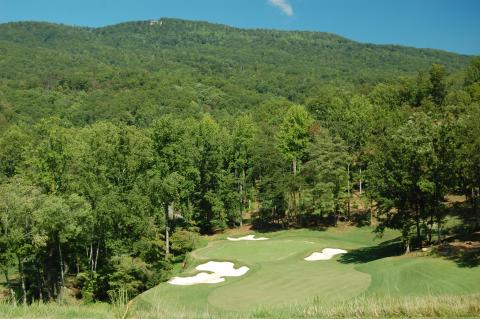 That is a lot of golf holes for just 1,200 homes when the community is fully built, but developer Barton Tuck has experienced great success at his Forest Creek community in Pinehurst, where 36 holes get plenty of play and positive notoriety. Success breeds confidence.
In these tumultuous times, the reputation, experience and financial health of a community's developer is more important than ever. Balsam Mountain Preserve is being developed by Chaffin & Light, a 30-year old organization responsible for the successful Chechessee Creek Club in Okatie, SC, whose well-respected golf course was designed by Bill Coore and Ben Crenshaw. Chaffin & Light has also developed two communities in Colorado and cut their teeth at Sea Pines Plantation on Hilton Head Island in the late 1970s. Bright's Creek is the brainchild of Barton Tuck who has just the Forest Creek community on his resume. But Forest Creek and its Fazio courses are a model for high-status private club communities.
The developers of both these top-drawer communities appear to meet all the standards for high-end properties, and they offer golf memberships half the price of their highest-end competitor in the area, The Cliffs Communities (currently $150,000 but for access to eight courses). The track records of Chaffin & Light and Barton Tuck are solid, and their latest two communities should enhance their reputations, as long as the net wealth of those in their target markets does not erode any more. Neither community provides any clear signage near their entrances, and finding Balsam Mountain and Bright's Creek can be a little challenging. But for those who can afford it, getting there could very well be worth the effort.
Balsam Mountain Preserve, 81 Preserve Road, Sylva, NC. Tel: 866.452.3456. Web: BalsamMountain.com
Bright's Creek, 2222 Palmer Road, Mill Spring, NC. Tel: 866.302.7335. Web: BrightsCreek.com
If you are interested in visiting these communities or in more information, contact me and I will be happy to put you in touch with someone who can help you. Also, if you would like me to email you a copy of the scorecards from either course, just send me a note using the "Contact Us" button at the top of the page.
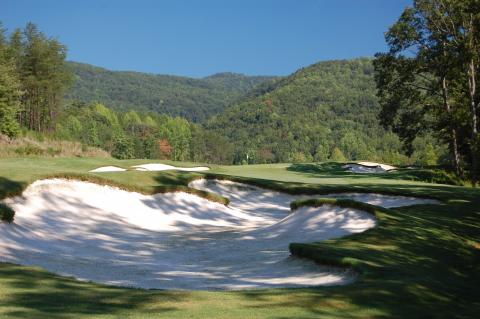
The approach to #12 at Bright's Creek, a par 4, is vintage Fazio, with bunkers that can give you a lot of lip.
Vive la difference...and similarities
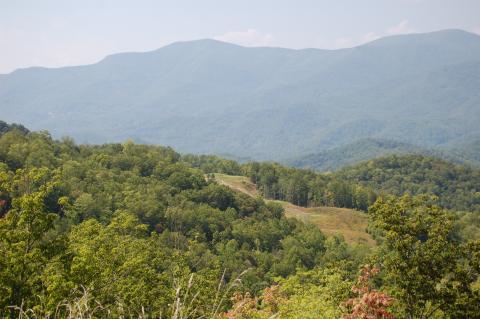
The views from Balsam Mountain Preserve are compelling. From the 8th tee, you can see out to the Arnold Palmer golf course's 14th hole and to the distant mountains. (All photos by L. Gavrich)
Positive altitudes: Balsam Mountain Preserve and Bright's Creek residents breathe a rarified air
Unsolicited advice to the developers of Balsam Mountain Preserve and Bright's Creek: Consider a co-op marketing arrangement. Both your high-end communities play to the same crowd by offering home sites at high elevations, high-class amenities, including lush and scenic golf, and the service to match. Ignore a few differences, like the designer, elevation and degree of difficulty of your golf courses, and your two communities could pass for siblings. Those in your target audience who do their research and make plans to visit one of your communities are likely to visit the other, just an hour away. All you need is to make sure you provide good driving directions.
(No) signs of the times
Balsam Mountain Preserve and Bright's Creek hide their considerable charms behind veils of no-signage, so much so that a gas station owner just a few miles from Bright's Creek had to drag out a map to figure out where the four-year old community was located (it turned out to be only two left turns away). And I almost sped past the road into Balsam Mountain, whose sign is hard to see from across the road; fortunately, I had memorized the directions on a billboard five miles from the community. When I asked my two contacts at the gated communities why the lack of signs, both had almost the same response: "People know how to find us."
The no-signage issue carries over to the golf courses at both communities; neither has a stone or sign at tee boxes to indicate the number of the hole or a layout (needed especially at Balsam
In terms of location, Balsam Mountain gets a slight nod for its proximity to the charming and bustling town of Waynesville, just 15 minutes away. Both communities are about 30 minutes from Asheville and its decent regional airport. As Bright's Creek develops, so too will the services in the immediate surrounding area but, for now, it is fair to say those who count on shopping and a choice of restaurants will make the drive to Asheville.
Plenty of room
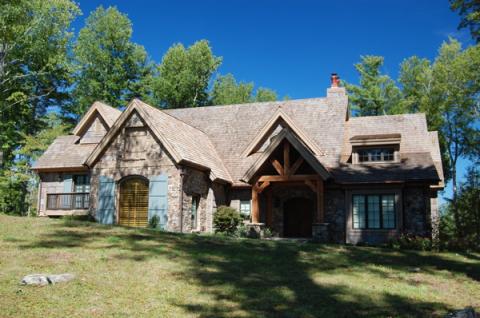
The two communities are attracting primarily second-home owners but they also appeal to retirees. The exteriors of the beautiful homes in both communities feature indigenous materials, like wood and stone that integrate comfortably into the mountain terrain. Although both communities are huge -- Balsam Mountain at 4,400 acres and Bright's Creek 5,000 acres -- the densities are significantly different, at least on paper. With only 350 homes planned for Balsam Mountain, the density is about one home per 12 acres; but on the severely sloped and heavily wooded property, with homes nestled into the sides of hills, it is difficult to tell where one home site ends and the next begins. And you see few homes from the golf course. With almost 3,000 "raw" acres protected by a conservation easement, Chaffin & Light organized the Balsam Mountain Trust, which manages and helps protect the preserve's natural resources. That will certainly help Balsam Mountain retain its rustic and natural look.
Bright's Creek, with 1,200 homes planned for its 5,000 acres, runs at a ratio of about 1 to 4, enough breathing room for any but the most reclusive homeowner. The few homes and staked-out properties I saw from the golf course foreshadow that few of them are likely to encroach on the fairways. Homes at Bright's Creek will rise to elevations as high as 3,200 feet, about 1,400 feet less than the loftiest homes at Balsam Mountain. Bright's Creek currently has 31 homes completed and Balsam Mountain 37, with another 16 under construction.
Strong hands are guiding the architectural guidelines in both communities; anyone looking to build their dream home in a dramatic contemporary style, for example, should look elsewhere.
For the vacation-home owner who will only visit a few weeks per summer and would like to generate some extra income on the off weeks, both communities offer rental programs. Bright's Creek will rent owners' homes as a courtesy, but only to other members and their guests, and at a 30% management fee for housekeeping and maintenance. Balsam Mountain Preserve also permits its residents to rent to other residents who might need some extra space for visiting relatives and friends.
Membership has its privileges
For those who do not want to make the leap into full ownership of a million dollar home, Balsam Mountain offers an attractive fractional ownership plan for one bedroom cottages adjacent to the Boarding House, an inn and dining hall for the use of members and guests. These cottages are available for $260,000 and provide the owner with a guaranteed three weeks stay per season, or a total of 12 weeks per year. Additional weeks are available if other owners are not using the unit. The fractional ownership plan is an excellent way to dip your toe into the Balsam Mountain community and decide later if a single-family home is the way to go, or to spend one-quarter of the year in the mountains.
Bright's Creek also offers a way for future owners to test the waters. Adjacent to its pro shop and overlooking the golf course, the Members Lodge provides units for those considering a
The amenities in both communities, those in place and those planned, are pretty much what you would expect from high-quality developments at these price points. Clubhouses are still on the drawing board, but both will feature dramatic mountain views and warm, rustic materials (lots of logs and beams). Each community features a substantial equestrian center. Bright's Creek offers a 14-stall post & beam barn, 20 acres of pasture and 12 miles of groomed riding trails. The barn at Balsam Mountain also features 14 stalls as well as pastures and riding trails. The other amenities on both properties include the typical fare of fitness centers, tennis courts, pools and walking trails.
For those who prefer to use a golf cart in the community and on the golf course, Bright's Creek charges an annual trail fee of $1,100 (the cart must be of the same style as those rented on the golf course). Balsam Mountain Preserve offers the same cart ownership program for $900 annually. Open-air driving is the best way to enjoy the many visual delights of both these communities.
Coming Tomorrow: The golf courses at Balsam Mountain Preserve and Bright's Creek (with photos)
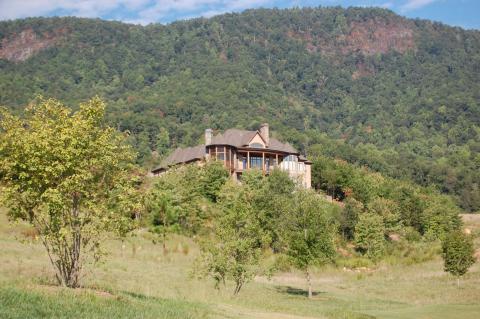
One of the first homes at Bright's Creek looks down on the Tom Fazio course.
Great stuff
I am not quitting my day job to go into the Ryder Cup handicapping business. About the only thing I got right this weekend was that Anthony Kim would play well.
It was the highest quality golf I can recall ever watching. It makes you wonder why these guys don't play this well on the tour, and yet says much about the pride factor; no money at stake and they play their best golf.
Putting under pressure is supposed to be the hardest thing to do in golf, like hitting a high hard one in baseball. Well, tell that to Jim Furyk and Kenny Perry and Ian Poulter who missed nothing when it counted. On the other hand, pressure did nothing for Sergio Garcia's game or putting stroke this weekend, and Kim exposed one way to play Sergio in future Ryder Cup matches -- don't concede three foot putts to him.
That worked at the Ryder Cup, but I wouldn't try it at your club next weekend.
Trillium Links a dramatic complement to stable, attractive community
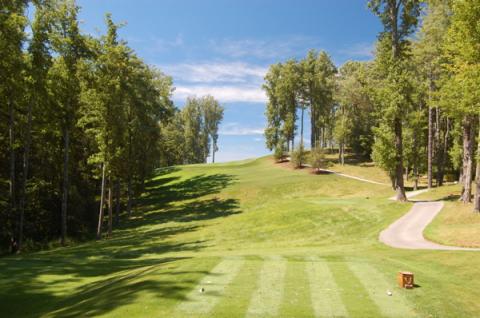

The dramatic par 4 8th hole at Trillium Links requires a medium iron to the top of the hill (top photo). From there (bottom photo), a wedge must be played to the right side of the green as everything kicks left. Good luck keeping from being distracted by the breathtaking view beyond.
Any opinion about the 10-year-old Trillium Links, the Morris Hatalsky designed private golf course in Cashiers, NC, is likely to be a function of reactions to its beautifully bizarre 8th hole, and whether you can reconcile hitting a short iron off the tee at a 257-yard par 4. Of course, you could consider driver or three wood and go for the unseen green -- it is up there somewhere -- but be prepared to rappel down the mountain in search of your ball.
Trillium is not classic golf by any means, and it just may reflect the "go for it" attitude of a competitive professional golfer with a total of seven wins
The rest of the course features additional oddities as well, including one of the narrowest greens in America (see article posted here on Sept. 6). How do I know it is one of the narrowest in the nation, not having played every hole in America? Well, the only legal pin positions on this green are within a narrow band down the middle of its 120-foot depth; by definition, the 9th green at Trillium is among the most narrow.
The 15th hole, a 181-yard par 3, is both pretty and pretty silly. It plays downhill to a green with a
 deep sand bunker guarding the entire left side. Should you pull your tee shot in there, an up and down will be difficult because the green slopes away. But Hatalsky thumbs his nose at convention and the average golfer by putting a high, solid wall on the green side of the bunker. The back of the bunker slopes downward, making it difficult to raise the ball above the wall; and if you are within five feet of the wall, prepare to come out sideways. A bunker is itself a hazard and should not require such a penal embellishment.
Indeed, when I landed in that bunker I thought about the Nicklaus courses I've played and how brutal the Golden Bear's courses can be for the average golfer, as if saying, "See, it isn't as easy as it looks on TV, is it?" Well, no, not when you put walls on bunkers it isn't, but I can't remember the last time I saw that on tour. I felt similarly put upon on the long par 4 12th when my decent drive landed on the right side of the fairway and bounded through too closely mown rough and into the woods. I'll lay that on aggressive grass cutting, but a drive that lands in a fairway should wind up in the rough at worst.
Trillium is not a course you should play without a member. I don't mind playing solo as it gives me plenty of time to take photographs without holding anyone up. But on a course with blind shots and fickle bounces, a guide of some sort helps. The pro shop kindly furnished me with a cheat sheet -- they did not have yardage books -- but the lack of a graphic representation of the holes was a handicap, despite such descriptive words as, "Line is over rocks. Fairway does not slope right to left." Since you would swear from the tee that the fairway did slope right to left, the sheet saved me a few times.
A stretch of holes from #15 through #17 is among the shortest anywhere, less than 700 yards in total and comprising two par 3s and a 288 yard par 4. The 16th & 17th are rated two of the three easiest on the entire course, and the finisher, a 400-yarder, does not add a tremendous degree of difficulty (it is the #10 handicap hole). Trillium, which is in excellent shape with greens that are medium fast and subtly contoured, does not pretend to be a tournament course.
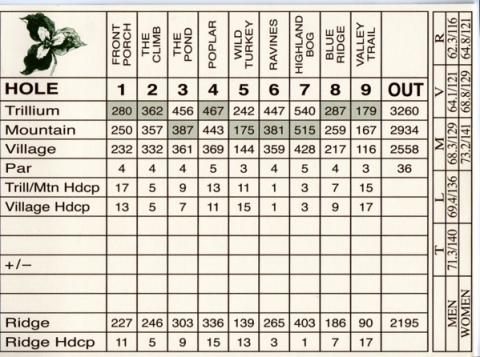
Nitpicks aside, Trillium's course is a fun track, and I am sure its members appreciate the combination of unique and straightforward holes. The club does something that few other courses
 do but should; they combine holes from the back (Trillium) tees and the shorter Mountain tees into a separate 18 hole routing (the holes of the additional course are shaded on the card). The back tees play to a modest 6,477 yards, but in reality the course plays considerably longer because a half dozen holes require lay-up shots off the tee or on the second shots on par 5s. The "men's" tees at just 5,825 yards (rating 68.3, slope 129) may insult the testosterone, but those with handicaps in the mid-teens will find it challenge enough. Those who choose the back tees beware; Trillium is sneaky difficult and the rating of 71.3 may be somewhat understated and the slope of 140 a warning to bogey golfers to move to the next tee forward.
Trillium's membership program is almost as unusual as its golf course, and I mean that in the best sense of the word. For example, I cannot recall another private club that offers the grandchildren of members, and their spouses, free access to the course. The younger grandchildren will especially appreciate Trillium's nine-hole pitch and putt course carved into the woods, a good place for all players to work on their short game. Depending on the type of golf membership chosen, a deposit of up to $50,000 is required, but all of it is returned within 30 days of departure from the club. Full club membership includes privileges at Hatalsky's new nine-hole course at Chinquapin, Trillium's sister community about 15 minutes away. Tennis is popular at Trillium and features three Har-Tru courts under roof for wintertime play, as well as a few outdoor courts, all supervised by an on-site tennis professional.
Of all the fine communities I visited during my week in the mountains of North Carolina, Trillium was the oldest private club, at just 10 years, and the most fully formed, with all promised
 amenities in place and a few playgrounds on the way. Although Trillium's marketing line is "Where Families Belong," the average age of its residents is 56; the "families" tend to be of the three-generation variety. More than 90% of the community's real estate is vacation homes, a figure I found a little surprising (on the high side) given Trillium's proximity to the interesting mountain towns of Cashiers (four miles) and Highlands (12 miles). Still, the clubhouse serves Thanksgiving meals to 330 people, and the club keeps nine holes on the golf course open through the winter. Trillium struck me as a place that could be comfortable during the winter, romantic even, especially if you have a nice fireplace in your home.
The community, which covers a tidy 750 acres, is a mix of all types of houses at a range of prices. Town homes and condos range from the $500s, the prices -- as always -- dependent upon the views, which include the community's large and active lake, the mountains and the golf course. (I did not find the homes on the golf course intrusive at all.) A group of condos called Balsam View offer maintenance-free ownership with views of mountains and/or lake starting at $950,000 for 2,700 square feet. Single-family home prices cut a wide swath, beginning around $400,000 and going all the way up to $3.6 million. Homes on about half the sites in Trillium have been built, and 75% of all available properties have been sold. Remaining lots range from $200,000 for wooded properties to $850,000 for those with the most dramatic mountain and golf views, not unreasonable at all for property in the increasingly popular North Carolina mountains. For those vacation homeowners who want to defray some of their carrying costs, Trillium offers an active rental program.
The golf course at Trillium may not be to a purist's liking, and anyone contemplating property there should definitely play the course once or twice. (I am happy to arrange golf if you are serious about Trillium.) My test of whether I like a golf course is simple; if I pull out of the parking lot after the round and think I want to come back to play the course again, then it passes my test. I would certainly like to give Trillium another go, especially the crazy, dramatic and beautiful 8th hole.
Trillium, Cashiers, NC. 888.464.3800. TrilliumNC.com. Trillium tees, 6,477 yards, 71.3 rating, 140 slope; Links tees, 6,036, 69.4,136; Mountain tees, 5,825,68.3,129; Village tees, 4,913, 64.1,121. If you are planning a trip to the Carolina mountains, please let me know and I will be pleased to help you determine which communities best suit your lifestyle criteria and to work with you to set up an itinerary.
Trillium's downhill par 3s, like the 5th, are as pretty as they are challenging.
Sergio's a tiger in Ryder Cup
I know that clever reverse psychology holds that Tiger Woods' absence is actually a plus for the American team, and perhaps through some filter of twisted logic he never really wanted to compete in Ryder play (therefore all his teammates didn't play their hardest, the story goes).
Baloney. Justin Leonard isn't winless in his two appearances because Tiger didn't play, and
The Euros will win first and foremost because Sergio Garcia, whose record of 14-4-2 testifies to it, was made for this competition. His game is filled with the kind of devil-may-care shotmaking that bedevils opponents and inspires his playing partners and teammates. What some may take for immaturity his fellow European competitors appear to take as infectious enthusiasm.
Forget that Kenny Perry and J.B. Holmes will be playing on home Kentucky bluegrass, that U.S. Captain Paul Azinger is relentless and gritty and that the Americans are hungry for a victory. Look for newcomer Anthony Kim to have an excellent Ryder Cup; he is fearless and solid. But Garcia and Lee Westwood have strongly winning records in the competition -- add their performances together and they average seven points per competition -- and Padraig Harrington, who is a mediocre 7-8-2 in four appearances, is playing the best pressure golf of his excellent career. The rest of the team can almost sit back and watch those three take care of business. Almost.
If it comes down to Sergio needing a five-foot putt on the last hole on Sunday to win or lose, the Americans will have a chance. Sergio's game is not made for late on Sundays. But it won't need to be.
The Euros, 17 to 11.
For best advice on economy, maybe Shakespeare is the answer
But, sadly, the news about AIG and Lehman Brothers and the natural reactions that have ensued have ground lending among banks to a virtual halt. The financial markets hate uncertainty, and there is uncertainty to spare in the headlines of the last few days. If the banks won't lend to each other, they certainly are not going to lend to many individuals this side of Warren Buffet. All the good effects of a lower housing inventory will be delayed, prices will continue to drop in all but the most stable markets, and those for whom their primary homes will provide the cash for their next homes will stay where they are.
However, if you have cash to purchase a vacation home or second home, you can just about name your own terms. That is good news for any of us who have followed Polonius's advice to his son Laertes in Hamlet, "Neither a borrower nor a lender be."
Polonius also said, "Brevity is the soul of wit," and so I will stop here.
High minded: Cold Mountain's lofty "idea" looks out 75 years and beyond
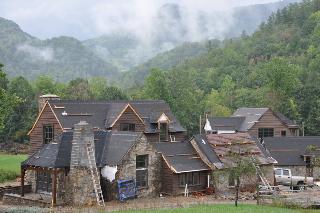
Homes in the Village section of Cold Mountain feature high-end materials and architecture as well as commanding views of the nearby mountains. (Photo provided by Cold Mountain)
The thing that hath been, it is that which shall be; and that which is done is that which shall be done: and there is no new thing under the sun. -- Book of Ecclesiastes
If you visit more than 100 real estate developments in a few years, as I have done, you realize that the formula from one community to the next is essentially the same: Choose an attractive piece of land near the coast, in the mountains or surrounding a lake; and promise a string of amenities that includes golf course, fitness center, tennis, pools, maybe spa and equestrian center (which residents pay for, one way or the other). Each development has at least one or more elements to recommend it, but it can be difficult to distinguish among them in terms of which will best suit our own personal needs and lifestyle. It comes down to feel rather than accountant-type analyses.
It was a refreshing change to visit Cold Mountain. The philosophy at the core of the Canton, NC, community is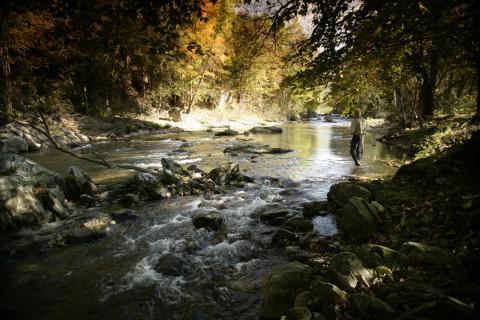 straightforward and reflects the natural instincts, and instincts for nature, of its young developer, Wilton Graves, whose grandfather is credited with helping develop Hilton Head Island in the 1950s. (His grandad's name is on the bridge that leads to the island.) Graves' father is also a developer. Cold Mountain, which lists its address in nearby Waynesville, is Graves' first project on his own, and he is committing body, soul and family to it. He, his wife and two children will be the first residents of the community when their home is finished in a few months
The theme ingredients at Cold Mountain -- and, yes, it is indeed the Cold Mountain of novel and movie fame -- are simply stated in a brief coda called "The Idea," Graves' own words about what he intends Cold Mountain to be. The three paragraphs rise above the customary brochure copy of most communities, speaking to the contradictions many of us feel when considering where we might spend the next couple of decades of our lives rather than our needs to surround ourselves with as many activities as possible. Here is "The Idea," short and sweet:
"Cold Mountain is about creating the modern rural life. It always bothered me that on Green Acres, there had to be a choice between city and country life. It made for memorable comedy, but a lack of compromise rarely produces positive results.
"Most of us have lived in urban environments and don't want to give up the benefits of urban life entirely. Yet, we crave a connection to the beauty of rural living. I wanted to manufacture a new option. One that didn't compromise all of my competing needs.
"Could I catch a trout on fly in the afternoon then that evening, ten minutes away, attend the theatre? Could a strong neighborhood feel be created while integrating the natural beauty of the land that has always been here? Yes, but only with the best architecture, building materials and sustainable practices."
Although some might quibble the statement is perhaps too succinct -- how, for example, do the best building materials, architecture and sustainability necessarily create a stronger neighborhood feel? -- elaboration and explanation is what I am here for. I spent three interesting hours at Cold Mountain with Graves and project manager Keith Jolly, and I have a good picture of what they are out to accomplish.
For the "best architecture, building materials and sustainable practices" part, Graves has engaged Summerour Associates, a youthful, Atlanta-based architectural firm with a studio just down the road from Cold Mountain, in Cashiers, NC. Summerour's award-winning designs focus mostly on high-end residences in the mountains and on the coast, although they are also currently working on the infrastructure at the Aetna Springs Golf Club in California's Napa Valley, a Tom Doak course. Summerour's work is not cheap, but Graves explains that the 25 people who have bought at Cold Mountain in the last two years understand the impact of high-level design and lasting materials on their homes' values. He expects the next 100 people to purchase a home in the community will understand it as well.
"They won't have to worry about whether their neighbors are taking care of the exteriors of their homes," says Graves, "since the materials do not require maintenance. The roofs, for example, will last more than 75 years, so it will actually be cheaper in the long run than more conventional roofs, which must be replaced a few times."
Yes, but none of us will live in a home for 75 years. Agreed, says Graves, but he points out that if an owner sells in 20 years, the roof will still be perfect and, therefore, the value of the home will be that much more than a home down the road with a conventional roof that might be coming to the end of its useful life. Other touches in Cold Mountain's homes include copper flashing for all windows; radiant floors certified by LEED, the organization that rates energy efficiency; and supplementary geothermal heating and cooling.
"We have the answer for those who wonder, ‘If I buy a green home," says Graves, with a smile, "does it have to smell like patchouli?' No it doesn't."
The homes at Cold Mountain are custom designed and built, but they will look as if they belong together, featuring common elements such as slate and stone exteriors and the tile roofs.
"We are combining the classic with the sustainable," says Graves, "marrying Birkenstocks with wingtips."
Of course, well-made Birkenstocks and wingtips are high-end accessories, and although Graves prefers to talk
As Asheville and the surrounding areas draw more and more people, I am worried about traffic problems. It is a sad irony that people move to places to get away from traffic only to find that everyone else has followed them. That is why you see so many Florida license plates in the mountains of the Carolinas, and why some areas of the mountains are likely to mirror Florida's traffic problems in coming years. But, according to Graves, that is unlikely to happen on State Highway 276, which passes Cold Mountain's entrance and is the only path of ingress and egress for the community.
"Most of the land around us is too severe for new development," he says. "Towns like Knoxville and Asheville can expand out, but not the area around Cold Mountain. It is just too difficult to build here."
As for Highway 276, the two-lane road begins to twist and turn just south of the community, toward Brevard, making
Prices for homes of about 2,200 square feet begin just under $1 million, with land prices begining at roughly one-third of that. During my visit a couple of weeks ago, workmen were busy putting the finishing touches on smaller homes in the community's Village section, where prices start around $800,000. There is no minimum square footage for a home in the community -- one of them will be just 1,200 square feet, says Graves -- but he will limit the maximum to 8,000 square feet.
So what about the golf? Cold Mountain, in keeping with the fewer amenities is better philosophy, does not have a golf course, but directly across from the entrance to the community is a nice public track called Springdale Golf Club. I took a 45-minute tour of the course in a golf cart and was impressed with its condition and layout, although it certainly
Springdale's layout opens with a nice par 5 that requires a drive over a stream and then a second shot over an extension of that same stream. Long hitters might want to throttle back on the tee shot as the second stream is about 250 yards from the tee. Water, mostly in the form of streams, comes into play on the first four holes at Springdale and on 11 holes in total. The toughest hole on the course is the 414 yard par four 4th, with a stream the runs down the right side of the fairway a length of 280 yards, then crosses the fairway about 130 yards from the green, and finally proceeds down the left side and below the green. Nice hole.
In the novel (and movie) Cold Mountain, the hero struggles to return from the Civil War to the love of his life. On a promontory a few hundred yards inside the entrance to Cold Mountain, a rustic wooden fence surrounds a 300 square foot patch of green that looks out to the Blue Ridge Mountains in the distance and up to the hulking Cold Mountain itself. It is a favorite spot for area couples to exchange their wedding vows, and an apt metaphor for what Cold Mountain's developer is trying to accomplish -- to marry the old with the new, the rural with the urban, the relaxed with the vital, and Nature with the nature of peoples' souls.
Cold Mountain, Waynesville, NC. Tel: 877.265.4331. Web: ColdMountainLife.com. Contact me (use button at the top of this page) and I will be happy to introduce you to Wilton Graves, the inspiration behind Cold Mountain.
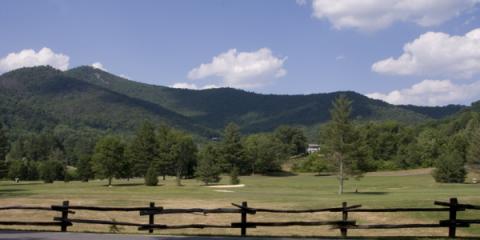
Springdale Golf Club provides a nice layout and excellent mountain views directly across the street from Cold Mountain's entrance.
Exercise caution: Fitness centers and other amenities could be harmful to your financial health
I am constantly amazed at the amenities some golf communities offer, in addition to excellent golf. It is a veritable groaning buffet, with an assortment of activities and services few short of Superman could have the time or energy to indulge in. But in hyping sales of land, developers find the all-things-to-all-people style of marketing effective.
For those who buy into an amenity-loaded community early in its
Either way, there is the risk of sticker shock when, overnight, the fitness centers, pools, tennis courts, spa, equestrian center and maybe even the golf course are no longer subsidized by the developer. You and your neighbors now own them, and if you are golfers and Sally and Ted next door are horse people, negotiations about maintenance and service could become confrontational. The safest amenities play is to buy into a community whose residents already own the amenities and have a track record of fiscal responsibility and only modest, if any, dues increases and assessments.
If you do buy into a newer community with a developer still on site, ask for a copy of the developer's plan, which could very well indicate at what price he intends to sell the amenities to the homeowners. Better yet, get yourself an aggressive real estate agent to represent you. Best of all, ask me. I know such an agent who has traveled extensively to communities in the southern U.S., has great contacts in the region, and is relentless when it comes to reading the fine print in documents and holding developers' feet to the fire for her clients.
You won't pay a thing for her services and she will negotiate the best price in your behalf. Recent negotiations in behalf of her clients saved them tens of thousands of dollars.
Click here, send me a note, and I will put you in touch with her.
A mandatory walk spoiled; Tiger overdoes the language
I was insulted by the announcement because, even if I could afford to buy a home in a Cliffs golf community and pay the $150,000 initiation fee, I would not be able to play Tiger's course. My days of 4 ½ mile walks are over, as I suspect they are for many who otherwise can afford the Cliffs' high price tags.
Well, the issue appears moot now. Local scuttlebutt is that the Cliffs and Tiger have abandoned the "walking only" policy. Cliffs advertisements now refer to the course as "walkable," a far cry from the initial announcement of no motorized carts. Perhaps Tiger's knee problems and the realization that, at least for a while, he could not walk his own course, brought him and The Cliffs down to earth.
Speaking of not down to earth, marketing copy for The Cliffs and most other high-end communities is typically as lofty as the surrounding mountains, but the words they attribute to Tiger, and his apparent sign-off, is unbecoming of an alumnus of Stanford, one of the best universities in the nation. We'll give Tiger a pass on the word "walkable," which my grammar checker doesn't like but which has probably reached the status of common use. But twice at The Cliffs web site, Tiger's comments about his course employ the use of the term "very unique," as if there are degrees of uniqueness. (Tiger himself is unique, not very unique or somewhat unique or kinda unique.) Ugh.
The Cliffs, which in a bad year spends many millions of dollars on advertising and marketing, could stand to invest in a proofreader.
Golf community takes shape in Massachusetts

Now on Sale

- The only book about golf communities in the last 10 years.
- 156-page step-by-step guide to finding your dream golf home.
- Info on nearly 100 golf communities the author has visited.
- Paperback version costs less than a sleeve of Pro VIs.
Here is what the experts are saying:
“The book is chocked full of information…applicable to anyone looking for a move to the Southeast regardless of whether they are looking for a golf community or not.” — John LaFoy, golf architect (Linville Ridge CC, CC of Charleston, The Neuse GC)
“Larry has done a tremendous amount of work and anyone — like me — who is looking to search for a golf home now or in a few years needs this book.” — Brad Chambers, golf blogger, ShootingYourAge.com
“Wow! What a thorough piece of work…a must for anyone moving South. This book will help many people.” — Brett Miller, owner and founder of MMA, Inc, a golf industry consultancy
Buy It Now at Amazon.com or BarnesandNoble.com.