Going through phases: Buying a new golf course home is sometimes more dumb luck than good sense
My wife and I discussed this issue during a nice long walk with the dog this morning. She reminded me that 19 years ago, we faced this very same dilemma during a visit to Lockwood Folly, a community with a nice golf course about 35 miles north of Myrtle Beach. Connie was pregnant with our first child at the time so we were all pumped up with planning for
At first, the long term won out. Lockwood Folly had a sleek golf course I had enjoyed playing, a spanking new clubhouse overlooking the marsh, a few model homes to show, and prices that seemed the most reasonable on the Grand Strand. (We had done our homework.) The salesman was enthusiastic in a non-pushy way, and as we toured what would eventually become a community, we were impressed with the combination of live oaks and marshland and the promise of a beautifully landscaped Low Country home. It seemed like a great investment. We left a deposit on a lot.
We backed out, without penalty, two weeks later, really just a simple case of cold feet. We rationalized the decision on the basis that we weren't going to build for at least a decade; in a new community, we'd basically be holding a non-appreciating asset and paying taxes to boot. We also reasoned that Lockwood Folly would be forever at the far north end of the Grand Strand and, therefore, more remote than two kids from suburbia could tolerate. Connie is a beach lover and the community was a good 20 minutes from the nearest sand. But to be honest, we were simply nervous about being one of the first to commit to the community.
Eleven years after that decision, after several vacation stays in the Pawleys Island area, which is well over an hour south of Lockwood, we bought a new condo in Pawleys Plantation. At the time, the community was about 90% built out and regarded as one of the best and most stable in the area. We opted for what we knew, not the unknown.
Over the last 19 years, we have wondered how Lockwood Folly turned out. I had liked playing the golf course, but it is rarely mentioned in the top rank of the Myrtle Beach area's 120 courses. A few years ago we were driving up Highway 17 in North Carolina and wound up outside the entrance to the community. We drove in and were pretty bummed out by what we saw. Houses were sited close together in most of the neighborhoods, many yards seemed a bit overgrown, landscaping in the common areas seemed indifferent and the entire effect was of a community that maybe hadn't been planned all that well.
We looked at each other in relief and congratulated ourselves on backing out of the deal those 19 years ago. We acknowledged, though, that the decision was more dumb luck than good sense. There are dozens of communities my wife and I visited early in our marriage that we would be the richer for having been first in - and I mean "richer" both literally and figuratively. Kiawah Island near Charleston, SC, comes to mind as having real estate that has appreciated maybe 10 times in 20 years.
But we are still happy with our decision to buy in Pawleys Plantation, mindful that luck plays a big part in making the correct purchase decision (or not making it). With apologies to the oft-quoted Yogi Berra ("It ain't over 'til it's over"), the moral of this story is that, sure, you can always make a better choice, but you can always make a worse one as well.
 Home On The Course newsletter
Click here to sign up for our Free monthly newsletter, loaded with helpful information and observations about golf communities and their golf courses.
Is membership at iconic U.S. golf clubs priceless?
In 1990, a time when the Japanese yen was quite strong compared with the U.S. dollar, Japanese businessmen began buying up iconic U.S. properties such as Rockefeller Center and, yikes, Pebble Beach Golf Links. If it weren't for a Japanese banking crisis and economy that plummeted later in the ‘90s, sushi and sake could be on the menu today at the 19th hole at Pebble (not that we don't love both).
Here we are in 2007 with a banking crisis of our own and a dollar that is in the dumper. As the famed student of malapropism, Yogi Berra, once said, "it is déjà vu all over again"...only worse. The dollar is in free fall, oil prices are going in the opposite direction, the housing market is a total mess and foreign investors, more and more, are holders of U.S. debt. Even the Canadian and U.S. dollars are now at parity. How woulda thunk it?
This may be great news for the U.S. trade deficit, but American chauvinists will start to rebel at
The Euros won't have to look too hard for courses to acquire. At any one time in the States, up to 200 courses are on the market, according to Kathy Bissell, vice president of National Golf Course Sales for real estate firm Coldwell Banker. The courses range from little nine-hole mom and pop operations in rural Mississippi listed for less than $500,000 to entire golf course developments.
"We have a Nevada property available right now for $20 million," Ms. Bissell told me the other day during a phone interview. The Nevada resort property includes two courses; for something less than 10 million pounds sterling, two courses in the mountains of Nevada could look pretty cheap to a British investor.
Ms. Bissell says an increasing number of calls have been coming to her office from places like South Africa, Great Britain and other countries. South Korean investors are always interested in U.S. properties, including golf courses she says, because the Korean government puts a cap on how much land investment a citizen can make in-country; that is understandable since South Korea is a relatively small country. Great Britain, not an overwhelmingly large country itself, has few golf course developments in process, and investors there - as well as individuals - could see the current exchange rate as an opportunity to invest in U.S. properties...perhaps even some of our most elite courses.
Ms. Bissell, pointing to the sale of Pebble Beach just 17 years ago, believes any course could be available if the price were right.
"I suppose there is a price at which the members of Augusta National or Shinnecock could be persuaded to sell," she says.
The American chauvinist golfer in me rebels at the thought. Members of the most exclusive clubs do not need the money. But logic also reminds us that many of those same members are businessmen, and if they can turn, oh, a couple hundred million dollar profit on a $100,000 investment, who knows?

Is there no price at which, say, Augusta National could be sold?
Photo from YourGolfTravel.com
Haig Point: Paradise at a price

Rees Jones gives you many angles from the tee box to the par 3 8th green on the Calibogue Course at Haig Point, but the marsh intrudes on all of them.
One of our favorite golf courses, the Rees Jones 27-hole layout at Haig Point on Daufuskie Island, SC, has been closed for the last few months. It is undergoing a rehab that is part of a $5.5 million overall improvement plan for the community's amenities. Club members voted as well to upgrade their oceanfront meeting and dining facility and the ferry system that is the community's lifeblood.
Daufuskie is a true island that cannot be reached by roadway. Its blessings are mixed, to be sure. On the plus side is the peace, quiet, lack of cars and resulting pollution, and next to no commercial ventures. It is a beautiful and restorative place. On the other side, housing costs can be frightfully expensive because everything - labor and materials - must be shipped in to build a house. And although membership in the golf club, a $60,000 value, is typically free with the purchase of a home, dues are as high as anywhere else, somewhere in the $13,000 annual range (and that doesn't include any assessments arising from the current improvements).
We just received notice of a listing of a nice home in Haig Point with views of the golf course and Calibogue Sound. It includes four bedrooms and 3 ½ baths over 3,200 square feet, and the new oceanfront club is a short walk away. It is priced at $1.2 million. The owner is also kicking in a flooring allowance to update carpets and tile. Based on the listings we see, this home is more or less in the middle of the market in the community.
Haig Point residents are a breed apart, literally and figuratively, and not just because they have the resources for expensive island living. They have made some special accommodations for the
GolfCommunityReviews has qualified a real estate agency in the Hilton Head/Daufuskie area that can help you identify your dream home on the course in the area. Just contact us and we will be happy to help.
Bless you Wall Street Journal
After I reported here a few days ago about some people's dopey proclivities to wring every last dollar out of their homes [see "Life Imitates Art..." ], the Wall Street Journal's helpful columnist Jonathan Clements wrote a column today (Wednesday) that corroborates my own take. In the article titled "Dump This House: Unloading Your Property in a Slow Market, " Mr. Clements quotes financial adviser Bert Whitehead, author of "Why Smart People Do Stupid Things with Money."
"People focus on what their home was worth two years ago, or how much they've sunk into it...", said Mr. Whitehead. "If you really want to sell your house, you have to cut deep."
Mr. Whitehead is a nicer guy than I am. Recounting an animated conversation I had with my wife on the subject of unrealistic pricing of a home, I wrote here a week ago that "people who hold out for the last dollar in this real estate market are idiots."
Chris Mayer, director of Columbia's Millstein Center for Real Estate, piled on. "If you price your house like everybody else, it might take 10 months to sell it," he said in the Journal article, adding that, "The best scenario is that prices fall through the spring and then stabilize. But I'm more pessimistic than that. I would sell now."
Mr. Mayer too is a nicer guy than I am. I wrote here, with some emotion since I was arguing with my wife, that people who are able to sell now but don't "are losing buying power every month. They are sabotaging their dream [of moving south] by treating [a sale] as anything but a business transaction. THEY'RE IDIOTS."
Well, at least the Wall Street Journal agrees with me.
Note: The Journal article is available here. Access may require a subscription, but if you can't access a copy, just send me a note via the contact button above and I will forward one to you.
Taking the full measure of your next home
A dust up between a builder and condo owner near our home in Greater Hartford, CT, reminds us that few things in real estate should be taken for granted.
According to the Hartford Courant's Consumer Watchdog column, Mike Tedford bought an upscale condo in West Hartford from Konover Properties, a major local developer, which was advertised at 1,639 square feet. But when Tedford actually took the measure of the place, he found he only had 1,545 square feet. He was short 100 feet, or the equivalent of a small room.
Tedford claims he overpaid for his unit by about $20,000 since he was calculating a price based on $255 per square foot. Konover, for its part, thinks Tedford is trying to wangle an unfair rebate from them.
"It's almost extortion," said a Konover vice president of Tedford's complaints.
Although we have never heard of any developer advertising anything but livable square feet, no party to the dispute has yet to claim the law is on one side or the other (sounds like blind justice). The best the local building inspector could say is that he had never heard of anyone using the Konover method of measurement.
"You are buying living space," he said, "not insulation."
Konover may not lose any legal battle - Tedford has gotten his deposit back for the unit - but the bad PR could not come at a worse time for the firm. Today, voters in the nearby town of Simsbury are going to the polls to consider whether to enfranchise a newly invented party whose candidates pledge more rational development of the town's remaining space. The race is predicted to be close.
Specifically at issue is whether current town officials have been too lax (and, perhaps, colluding) with a developer who wants to build a "big box" Target department store on a verdant piece of property just across the street from a residential development. The possibility of increased traffic, reduced property values, and the loss of small-town charm has enflamed local opinion. If the new party wins, it is almost a sure thing the developer will lose.
The developer, you may have guessed, is Konover. And its fortunes could turn on a lousy 100 square feet.
Wrenching debate on Isle of Palms a cautionary tale for those who dream of living on the ocean
We reported here that the 18th green at Wild Dunes' Ocean Course, which we played just this last August, is gone, washed away by the tides, and that the homes adjacent to the 18th fairway and green may be next. This is not an isolated incident. Up and down the east coast of the U.S., from Cape Cod to Florida, some homes are falling into the sea and many others are threatened. Wild Dunes is a microcosm of the issues that face these oceanfront homeowners and their fellow taxpayers, and it should be a cautionary tale for those whose dreams of a future home on the oceanfront could turn into a nightmare.
In a nutshell, the debate on what to do about the situation is the same in Martha's Vineyard as it is at Wild Dunes. People faced with losing their homes believe that the beach is a public resource, and that their governments and fellow taxpayers should help bear the burden to save the pubic resource. Those who don't use the beach or are simply content to let Neptune do his work are not willing to help out. They claim, and with some justification, that those who built homes where protective dunes once stood knew they were courting disaster eventually. It is now eventually.
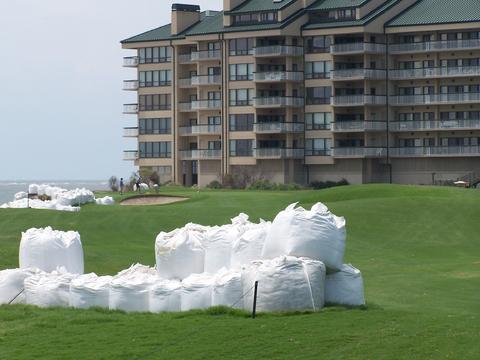
The lines were drawn pretty sharply in a group of letters to the editor a week ago in the Charleston (SC) Post & Courier, the major local paper which had come out earlier in October for removal of the sand bags holding back the sea. Earlier attempts had resulted in shredding of the bags, which were then carried out to sea and, in the Post & Courier's opinion, created "a hazard for marine life as well as an oceangoing litter problem for the state's entire coast." The Wild Dunes owners believe the sand bags are the only way to hold back the sea in combination with sand they want trucked in from farther north, as well as sand from a spit just south of Wild Dunes (bringing in local sand isn't going to happen, according to local officials). The situation is a mess, both literally and figuratively, and it is fraying nerves; and although those of us at a distance may feel sorry for those facing the loss of their homes, some of their fellow citizens are talking like it is Judgment Day.
"...everyone has been forewarned about building too close to the shore," wrote one local citizen who argued for letting the homes fall into the sea. "Wild Dunes residents have chosen to ignore these warnings for decades,"
"We need to stop writing new flood insurance policies on undeveloped land," wrote another. "If an owner wants to develop, then let him self-insure...Once a structure is destroyed, the flood insurance should pay and the land abandoned, never to be developed again."
A Wild Dunes owner, fearful of what will happen to the resort's private oceanfront club and the entire island's economy, wrote, "Unfortunately and inexplicably, it seems that some local critics would be happy to have our buildings and golf course fall into the ocean. For those of us who live and golf along the ocean, and for our supporters in the Charleston area, that attitude is a shortsighted view relative to the long-term viability of the Isle of Palms."
We won't predict the outcome on Isle of Palms, but those Blue Ridge Mountains in the Carolinas are looking more attractive than ever.
B&Bs: Civilized alternative on golf vacations
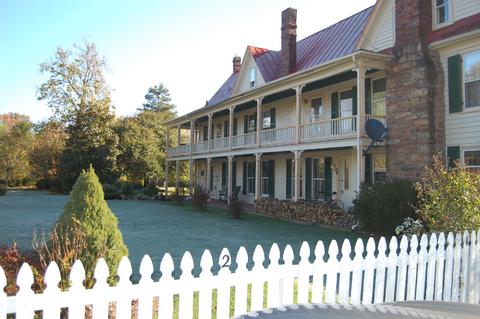
The Hummingbird Inn may seem as if it is in the middle of nowhere, but some excellent golf is within 40 minutes.
A golf vacation shouldn't just be about the golf course. The pre- and post-round activities are an important ingredient to the total golf package. Then there is the lodging. When you are with a group of the guys, the place you stay almost seems irrelevant (especially if one of your buddies made the arrangements). Just make sure there are enough beds for everyone, a good-sized living/dining room for watching television or playing cards, and a refrigerator large enough to hold a case or two of beer. (Yes, I know, I am engaging in stereotypes, but that doesn't mean I'm wrong.)
When I travel alone or with family, I prefer a more genteel approach, the bed and breakfast accommodation. Our readers in the UK and elsewhere will know these as "inns" in which the proprietors, typically a husband and wife, but not always, live in one corner of the house and rent out rooms to visitors.
B&Bs certainly don't have the marketing budgets of the big golfing resorts, but what they lack in notoriety they more than make up for in comfort and personal touches. If you want peace and quiet at the end of the day, there is often no better choice. Compared with chain motels, B&Bs are downright civilized. You will never hear your neighbors yelling or playing the TV too loud - most B&Bs confine the TVs to the living room - and you always see the same proprietor in the morning that checked you in the night before. There are no "staff" problems since the owners are almost always the staff. Moreover, B&Bs, quaint though they are, are mindful that even the most refined travelers want modern
 conveniences. The last two I have stayed in offered wireless internet connections throughout most of the house and scores of stations on the cable TV in the common room.
And then there is the breakfast. Talk about contrast, recently I stayed in a Holiday Inn Express one week (perfectly decent for a chain motel) and the Hummingbird Inn in Goshen, VA, the following week. The highlight of the "free" Holiday Inn breakfast was the warmed up, previously frozen cinnamon buns. The breakfasts Pam Matthews at the Hummingbird prepared for us and the other guests - she owns the place with husband Dick - included omelets, potatoes, fresh fruit, real slab bacon, sausages, and a homemade granola that was so good I begged for the recipe. (Pam emailed it to me, I made it at home, and it was worth at least a night's fee for lodging).
Another thing about B&Bs: You actually talk with the people at breakfast or while relaxing in the evening in the den or living room. That doesn't happen in a motel. During a recent stay at another B&B, I worked on a jigsaw puzzle with a fellow guest, a nice bonding experience. B&B owners are likely to join in the conversation, as Pam and Dick did toward the end of breakfast each morning. When is the last time Bill Marriott pulled up a chair next to you at one of his motels to discuss the issues of the day or where to sightsee locally?
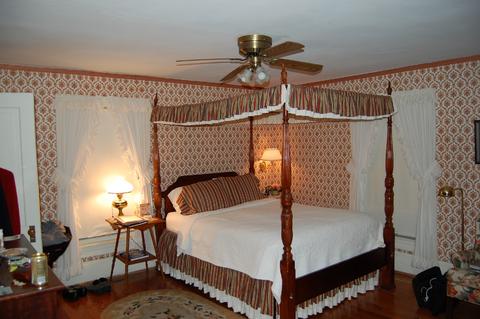
The accommodations at a B&B are much more civilized too, offer some nice surprises and are worth the extra tariff compared with chain motels. If you don't arrive too late, the owners are happy to give you a tour of the house and grounds and point out the refrigerator with the free soft drinks (not all B&Bs offer that, but the Hummingbird does). My wife and I stayed in the Franklin Room, which featured a canopied queen-sized bed, a fireplace we could light with the flip
 of a switch for a little extra heat, a rocking chair, nice chest of drawers, a bathroom with combo whirlpool and shower, and pictures of former President Franklin Roosevelt (thus the name of the room). One was a framed cover of LIFE magazine circa 1949 showing a two-year old Roosevelt in a girl's dress.
I slept wonderfully in the firm queen bed in spite of the image of a former President in a dress, the too-soft pillows and the freight train that rumbled through the front yard during the night, about which my wife informed me in the morning. That is another thing about B&Bs; they have their charming idiosyncrasies, and a working rail line not 10 yards from the front door was the Hummingbird's.
Some B&Bs feel as if they are in the middle of no place, even when they aren't. (I define "no place" as an hour from decent restaurants, shopping, and the like). Goshen certainly feels that way, and with good reason. The town lost its one and only restaurant last summer, and the single place in town to purchase any prepared food at all - a warmed-up pizza, really - is the local gas station. When you leave the Hummingbird in the morning, don't come back until after dinnertime. Except for some breathtaking Shenandoah Valley scenery down Route 39 along the Goshen Pass, the town has little magnetism.
I didn't play golf during my wife's and my three-night stay at the Hummingbird, but I could have. Vista Links (Buena Vista) and Lexington Golf Club (Lexington), both previously reviewed here, and the renowned Cascades courses at The Homestead in West Virginia, are within 40 minutes. If golf had been on my mind, I would have gladly traded the resort convenience of a walk or shuttle to the first tee for the soothing effect of The Hummingbird Inn. Soothing is good for the soul, as well as the golf game.
The Hummingbird Inn is located at 30 Wood Lane, Goshen, VA, about 30 minutes from Lexington and 40 minutes from Hot Springs, WV. Proprietors: Pam & Dick Matthews. Telephone: 800-397-3214. Five rooms, all with private bath. Rates: $130 to $175 per night. Web site: HummingbirdInn.com. There are other B&Bs in the area, some within minutes of the aforementioned golf courses. Check out InnVirginia.com for a list of them.
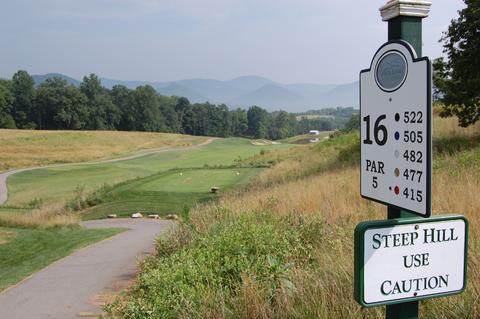
Vista Links in Buena Vista, VA, is one of a half dozen courses within 40 minutes of the Hummingbird.
The nattering nabobs of positivism*
The above piece of wisdom arrived in our email box the other day under the heading "News that may Surprise You." We were surprised all right - surprised at how any organization, even one that exhales the sweet breath of marketing hype, could promote this kind of tripe. Even Pollyanna would blush.
We don't expect a company like Live South, whose income derives from real estate interests, to exhibit the kind of measured logic that is coming from, say, most economists, most unbiased real estate experts and Federal Reserve Chairman Ben Bernanke. But, really, quoting National Association of Realtors predictions? The NAR has been shamelessly wrong about the housing market
Not willing to leave well enough alone, Choose The Right Place also quotes a realtytimes.com article that predicts "2007 will be the fifth highest year on record for existing-home sales." Wow, what an achievement? Since the U.S. population expands exponentially every year and income and employment numbers have not gone backwards, the fifth highest sales year should be nothing to write home about.
The rest of the Choose the Right Place report is full of equivocations such as "sales are slowing overall" but markets like Austin, the South Carolina Low Country and other places "are thriving." But if you check out realtytimes.com itself and click on the tab "Local Market Conditions," you'll find differing opinions from local agents on the state of those markets. We think those who are in denial are afraid to say anything is wrong lest they turn away the shrinking number of potential buyers. Read and decide for yourself.
Choose the Right Place puts some of its opinions under the subheading "The Glass is Half Full." We have to wonder what's in the glass and how much they are drinking.
* This is a perverse inversion of a phrase made famous by a perverse man, former U.S. Vice President Spiro Agnew, who referred in September 1970 to representatives of the media as "nattering nabobs of negativism." In the same speech, he also called the press "hopeless, hysterical hypochondriacs of history."
Life imitates art: Being right is definitely all it's cracked up to be
It is the perfect moment for those of us who know we are right and have the chutzpah to share it with others. Alvie says, "Boy, if life could always be like this!" Well, it can; I had such a moment the other day. It actually began a few days earlier during a 10-hour drive home from Virginia with my wife, who is by far a much fairer and nicer person than I am. Having driven for hours without provoking her into telling me what a jerk I am, I had had enough.
"Honey," I said to the defender of all people great and small, "people who hold out for the last dollar in this real estate market are idiots." I went on to use the hypothetical case of empty
"That's just stupid," she responded, and she wasn't agreeing with me. "People have all kinds of reasons for why they hold onto their homes, and emotional reasons are as valid as financial. Who are you to tell them they should take a certain price?"
Ah, now the tiger was out of a cage and backed into a corner.
"I'm Suzy Orman and Peter Lynch and Jim Cramer and all those other folks who make money from telling people what to do," I said, painfully mindful that I have never made a cent from giving people advice. But that didn't stop me.
"These homeowners had a plan to move," I blustered, "they know where they want to move to, and instead they are going to hold out for $700,000 for a house that is worth $625,000, which is $325,000 more than they paid for it. Meanwhile, the homes in the area they want to move to are depreciating much more slowly. They are losing buying power every month. They are sabotaging their dream by treating it as anything but a business transaction."
"THEY'RE IDIOTS!" I closed.
"And you are a jerk," said the love of my life as she closed her eyes and turned to the window.
Satisfied I had made my point, I decided to leave well enough alone. I tuned the radio back to Dr. Laura, the relationship doctor, who dispenses snap judgments about people issues based on a lot less information than I base mine about people's real estate issues. (And she gets paid for it!)
Fast-forward a few days. My wife and I are at home listening to National Public Radio. I am in the reclining chair in the corner trying to think of the next day's posting here, and she is doing
"They absolutely did the right thing," one of the experts said of the couple, and I am paraphrasing, "by taking the best price they could get. People are not doing themselves any favors by thinking their houses are worth more than they are.
"Selling a house is a business transaction." The other expert heartily agreed.
I cleared my throat in a purposefully obnoxious way until my wife looked up at me (it was starting to hurt, it took so long). "Nice when your husband is right, isn't it?" I said.
"Jerk," said she. Yes, I thought, but I am your jerk.
Remote, welcoming inn near good Virginia golf
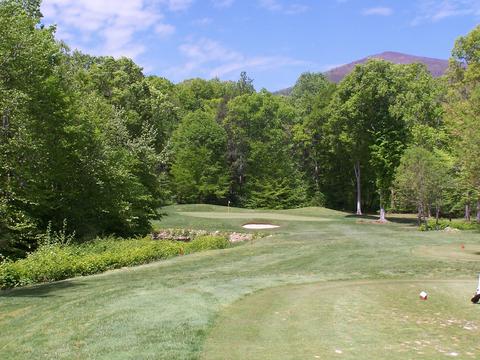
The golf and ski oriented Wintergreen Resort, and its excellent Rees Jones and Ellis Maples layouts, is about 25 miles from Osceola Mill.
Innkeepers who seem genuinely happy to see you have a leg up before they start serving you. If they seem hungry for your business, chances are you won't go hungry by the end of the dinner they serve you.
That was precisely the reception and experience we had last Saturday at the Osceola Mill Inn in Steele's Tavern, VA. Kim Daly, the chef and co-owner with her husband Kevin, greeted us warmly at the door. We learned in short order that the Dalys are originally from up north - she from Long Island, he from New Jersey - and that they purchased the inn only recently after selling another Virginia inn near the West Virginia border.
"It was a little too remote," said Kevin of the former establishment. Osceola, which feels as if it too is out in the wilderness, is just 2 ½ miles from Interstate 81, making it a potential great stopping point for folks traveling the north-south route to Florida. It is also within 40 minutes of some excellent golf, including the Wintergreen Resort (36 holes), Country Club of Staunton,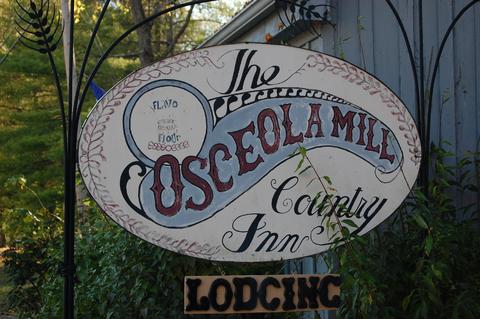 Vista Links and the Lexington Golf and Country Club.
The food that emerged from Kim's kitchen was very good, and a few things were outstanding. For those who don't take bread for granted, Osceola will impress. The rolls were hard crusty on the outside, with a soft surprise inside - a few subtly scented olives. The accompanying olive oil dip had a nice balance between the pungency of the oil and the bite of a liberal dose of salt and pepper. Once we devoured the first three rolls, we were asked if we wanted a refill; we did, and the next group were seeded on the outside, but still hard crusted out and soft inside, with a slight hint of anise. I could have gone for round three, but prudence - and a warning look from my wife -- won out.
Our shared appetizer of bacon-wrapped shrimp and scallops was not the customary cliche. The two large shrimp and two large scallops were bathed in a pleasant garlic-infused oil, the bacon of the slab variety and thankfully not tooth-picked to the shellfish. It was a warm way to start the dinner although next time I might opt for the baked brie with raspberry sauce or the crab stuffed mushrooms (especially if the crab is as generous as it was in the soup; see immediately below).
The soups were memorable, both the crab bisque and lobster bisques loaded with meat, creamy but not thick with too much flour as happens so often. The taste of the shellfish came blasting through. I'll be hard pressed to consider the cream of potato & leek soup next time if the bisques are being served.
Having tested the kitchen's ability with fish, we moved on to land-based entrees, my son opting for the rack of lamb, my wife for the veal oscar and me for yet another cliché, veal cordon bleu. The lamb rack was split into chops that were not dainty in the least, closer to lamb chops than riblets in size, and were cooked perfectly to order, medium rare. Although Tim, an always-hungry teenager, would have liked one or two more ribs on top of the four served, it looked like enough to me, and he thought the lamb had great flavor and was only slightly chewy, the way it should be.
My wife's veal scallopine was pounded perfectly thin and bathed in a nice sauce with just a hint of lemon, very tender. The accompanying South African lobster tail, undoubtedly previously frozen since South Africa is a long way from Steele's Tavern, could have had a little more chew to it and seemed a little salty to my taste. Still, it complimented well the veal and its lemon-cream sauce.
My veal cordon bleu was well prepared, with one minor shortcoming. It could have stood another 30 seconds of heat; the ham and cheese innards, which were well contained in a crusted exterior of tender veal, had not quite reached the hot state, preventing a nice ooze to the cheese. The combination, though, was quite tasty, but in the manner of a good ham a cheese sandwich. All of us were quite pleased with the entrees' accompaniments, three large stalks of excellent asparagus and roasted potatoes that mirrored the bread in consistency - hard exteriors and soft insides.
The restaurant offers a unique touch in that you choose one of the salads from the a la carte menu to accompany your entrée (they are priced at $4.95 each if you were to order them separately). One featured mixed greens with strawberries, mandarin oranges and candied pecans with a poppy seed dressing; the other was a spinach and arugula with tomato, aged parmigiano cheese and a reggiano cheese and tarragon vinaigrette. They were excellent, and it was nice to have choices beyond the customary mixed or Caesar.
In a rush to get back to campus for my son's wind ensemble concert, we passed regrettably on the range of desserts which were written on a blackboard. Most were in the category of familiar, like crème brulee and bread pudding, but the raspberry and blackberry tart caught my eye. Service was professional and friendly, and the prices were more than reasonable for this kind of quality. Entrees range from just $12.95 for a pasta dish to the mid $20s for main dishes that feature steak or lobster tail. Appetizers are well under $10 each, and the soups, at under $4, are a special bargain. The wine list is rather modest in size, with a number of unfamiliar vintages, but the prices were modest as well. We were quite satisfied with our bottle of Gruet blancs de noir at just $24. Gruet is a New Mexico bottler of faux-champagne, and we found the fruity bubbly a nice accompaniment for our veal dishes.
The Daiys have owned the 160-year-old inn for only a few months. They are smart - and practical - to start with dinner only two nights a week, especially in view of Kim's full-time job as a nurse and the challenge of running the bed and breakfast part of the operation. They have the pluck and enthusiasm to do both, and we expect once they work out the kinks and start the marketing machine, they might be able to expand operations. The combination of convenience to I-81 and some good mountain golf courses nearby, as well as their caring and professional service and cooking, could win over golfers and other travellers.
The Osceola Mill, Steele's Tavern, VA. Tel: 540-377-6455. Web site: OsceolaMill.com. Rooms: $110 to $200 per night, including breakfast. Dinner (Friday & Saturday only, reservations encouraged): Entrees $12.95 to $27.95. Nearby golf courses, all in Virginia and within 40 minutes: Wintergreen Resort, Nellysford; Country Club of Staunton, Staunton; Vista Links, Buena Vista; and Lexington Country Club, Lexington. We have mentioned all but Staunton on this site; use the search function above left for more info.
Zillow.com hitting its stride
Graphic drama
Inventories up, up and not away
Expanding my driving distance
Biz Week features "bargain" retiree spots

Now on Sale

- The only book about golf communities in the last 10 years.
- 156-page step-by-step guide to finding your dream golf home.
- Info on nearly 100 golf communities the author has visited.
- Paperback version costs less than a sleeve of Pro VIs.
Here is what the experts are saying:
“The book is chocked full of information…applicable to anyone looking for a move to the Southeast regardless of whether they are looking for a golf community or not.” — John LaFoy, golf architect (Linville Ridge CC, CC of Charleston, The Neuse GC)
“Larry has done a tremendous amount of work and anyone — like me — who is looking to search for a golf home now or in a few years needs this book.” — Brad Chambers, golf blogger, ShootingYourAge.com
“Wow! What a thorough piece of work…a must for anyone moving South. This book will help many people.” — Brett Miller, owner and founder of MMA, Inc, a golf industry consultancy
Buy It Now at Amazon.com or BarnesandNoble.com.