Kiss and score: Banked fairways at Royal Lakes are key to good round
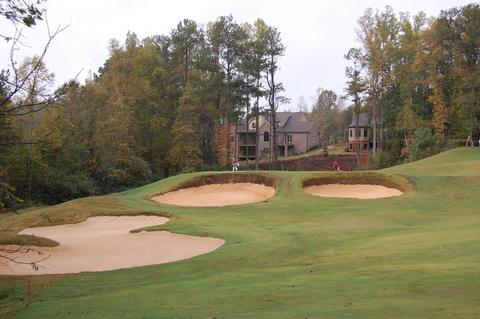
The 5th at Royal Lakes is called "Roc's Monsters" but "Great Spectacle" seems more apt, given the eyeglass shaped traps at the front.
Unless you are very wild right or left, you have to work hard to miss the fairways at the Royal Lakes Golf Club in Flowery Branch, GA, about 40 miles northeast of Atlanta. But that advantage the course gives you can be easily taken away by a course superintendent who wakes up on the wrong side of bed. The course can play a half-dozen strokes more difficult if the pins are front and back on the multi-level sloping greens.
I watched some excellent collegiate golfers take on Royal Lakes over the last two days in the Oglethorpe College Invitational, a 12-team match. Those players who were content to shoot the gap between the left and right sides and play some bank shots into the fairways, and were not too greedy about going for the most difficult pin placements, put up a few nice scores, a half dozen or so in the 60s (including my son, Tim, who scraped out a 69 on Monday before a closing 78 on Tuesday). Others who tried to make it a long-drive contest were greeted with out of bounds stakes above the banks on both sides of most fairways. Some good players registered double-digit scores on a few holes; I watched one hit two out of bounds off one tee on his way to a 9 on a par 4.
Another player dumped a few in the water at the par 5 11th, which is a hole Royal Lakes members and daily fee players probably like and loathe in equal measure. 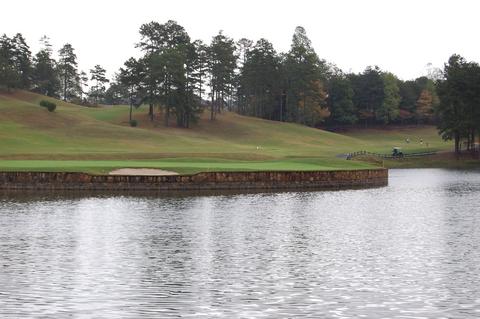 The hole is not long, just long enough for all but the biggest hitters to lay up with their second shot to a fairway area the size of a large green (this after a drive of a 3 or 5 wood to avoid bounding down the fairway and into the pond). The green is totally surrounded by water save for the spit of land players use to walk from rear left to the green. I am not a big fan of holes where, essentially, you are forced to lay up with your first two shots.
The Atlanta area is suffering through its worst drought ever, but except for the water-level markings on the stone walls in front of a few greens, there was not much evidence of a water shortage at Royal Lakes. No one complained about the greens being too fast or too hard (these are teenage golfers, and if there is anything wrong with the greens, they will let you know). The balls rolled medium fast to maybe a little slower than that today, after a night of much needed rain.
Homes look down on the course, which was designed by Arthur Davis and opened in 1990, but are well at a distance from the banked fairways. Some of the homes are enormous, 6,000 square footers, but we also saw some more modest houses. A 4 bedroom, 4 ½-bath home overlooking the 18th fairway is currently listed for $500,000. Judging from a flyer we picked up behind one tee box, other homes in the well cared for neighborhood are similarly priced (Flowery Branch is on the northern edge of the commuting radius to Atlanta).
In the manner of more famous courses, Royal Lakes gives cute little names to each hole; the author must have made them up after a few beers in the nice clubhouse. Among my favorite designs was "Roc's Monsters." I don't know who Roc is, but the huge "spectacle" traps in front - they look like giant eyeglasses - are deep and monstrous. There is only one way into them, from the rear, and the same way out. I have even less of a clue why the intimidating looking 9th hole is called "Bolt Your Nuts," unless that is some reference to the testosterone needed to play the hole. The best tee ball at #9 is a three or five wood down the right side so that the mounds will scoot the ball forward and toward the 150 yard marker, which is perilously close to a lake that runs down the left side. The approach is to a green with a deep, triangular swale that runs from the front to a point about two thirds of the way to the rear of the green. A ball in there must negotiate a fairly steep rise to a hole on either side of the swale.
The aforementioned 11th with water everywhere is named "More Land Please." Indeed, it certainly could use it, while Atlanta could use some of that water.
Here are my ratings for Royal Lakes (scale of 1 to 10):
Layout = 8 (unusual in the extreme)
Playability = 7 (a few weird holes)
Condition = 8 (must be draining the lakes)
Aesthetics = 8 (something about funneled fairways)
Amenities = 7 (it's a very good daily fee club)
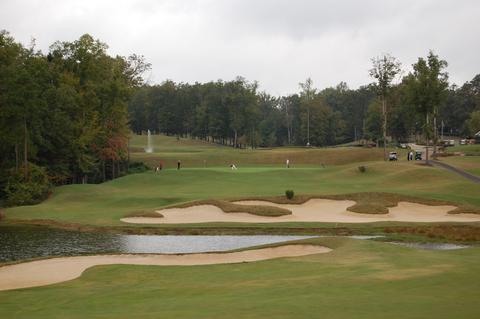
The 9th hole is all about placement off the tee and an approach shot somewhere outside the big swale in the green -- unless, of course, the pin is in it.
Royal Lakes Golf & Country Club, 4700 Royal Lakes Drive, Flowery Branch, GA. (770) 535-8800. Greens fees in the $50 range, depending on day of week. Championship tees: 6,980 yards, rating 73.6, slope 139. Men's tees: 6,550 yards, 72, 131.
 Home On The Course newsletter
Click here to sign up for our Free monthly newsletter, loaded with helpful information and observations about golf communities and their golf courses.
Tough talk: Don't buy without a chat with homeowner's president
In choosing the right home on the course for you, the most important person to talk with is not your real estate agent, or the seller's agent, or the golf pro at the community course or your potential next-door neighbor (or any of the other residents for that matter). The key contacts for your research are the president of the community's homeowner's association and the president of the golf club (if the club is member run).
Nothing can ruin life in a community like an association or club board that is either contentious with residents, contentious among themselves, confused about the priorities of the community, spendthrift in their ways because they don't understand the priorities of the folks they represent or, on the contrary, cheap in the extreme, thereby letting the facilities run down and everyone's investment erode.
I recall a round of golf on Bald Head Island some years ago with a few of their residents. One of them, a member of the homeowner's association, carried on to me about the "idiots" he served with in the association, all of them his fellow residents. I don't recall the issues - there were many he raised - but I do recall thinking to myself, "Would I want to live in a community where no one agrees about the right courses of action and where they talk about each other with such disrespect?" Leaving personalilties and politics aside helps community governing bodies work most effectively. When we visited Champion Hills a few years ago, their association members were focused on a strategic plan, a process that left no room for pettiness.
Homeowners associations are typically responsible for assessing and collecting dues to run the community's operations, including hiring outside agents to manage the community's affairs. The association also enforces the community's covenants and bylaws and can amend the bylaws within the guidelines of proper governance. Typically, though, it is the decisions of the association on seemingly small things that raise the ire of residents, such as additions to existing homes, tree removal, the style of mailboxes and the placement of satellite dishes.
Bylaws and covenant restrictions don't provide the most scintillating reading, but pouring through them before you buy in a specific community could save you a lot of grief later. So can an honest conversation with the head of the homeowner's association and/or club president.
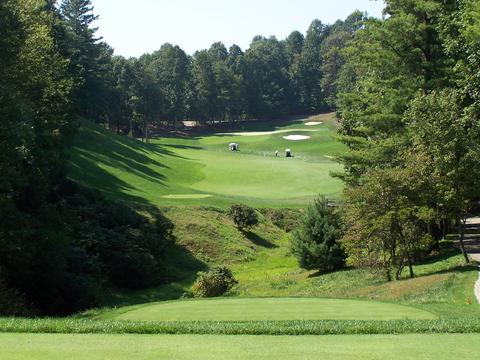
The club board and homeowner's association at Champion Hills in Hendersonville, NC, use a businesslike approach to governing, keeping personality and politics out of decisions. It doesn't hurt to have a fine Fazio layout in which club members are willing to invest.
Dry times: Georgia drought fraying nerves, browning courses
It may not be related to global warming, but some folks in Georgia probably have Al Gore on their minds. More than half the state is suffering through the worst drought ever, the governor is upset with the U.S. Army Corps of Engineers for not stopping the flow of Georgia reservoir water to Florida, and golf courses in the Peach State are starting to show the affects. By some estimates, the city of Atlanta has about three months of drinking water left.
I am staying north of Atlanta, near Lake Lanier, and the headlines in all the local papers are about how the lake has become dangerously low. The Atlanta Journal-Constitution reported today that Georgia Governor Sonny Perdue has appealed to the U.S. Government for disaster relief and to stop the previously contracted flow of water from Lake Lanier to Florida, where it is needed to protect a population of endangered mussels. The governor and other legislators have gone after the U.S Army Corps of Engineers and the Department of Fish and Wildlife for "putting mussels ahead of people."
I drove around the Royal Lakes Golf Club course today following a group of collegiate golfers who will participate in the Oglethorpe College Royal Lakes tournament Monday and Tuesday. The course, just a few miles from Lake Lanier, was surprisingly green, but the lakes were low, water having been pumped from them onto the course. Some brown patches are starting to show, especially on the higher sides of the sloping fairways where there is more runoff. So far, the greens remain green.
In the Journal-Constitution today, a letter to the editor took local state officials to task for continuing to water the state-run golf courses in lieu of more attention to "native areas of our parks [that] encourage people to get their recreation through hiking, walking, biking..."
The lines are being drawn, and here's hoping the rain promised in the next few days is enough to still the accusations and help the golf courses, and mussels, survive.
Travel & Leisure highlights places we know
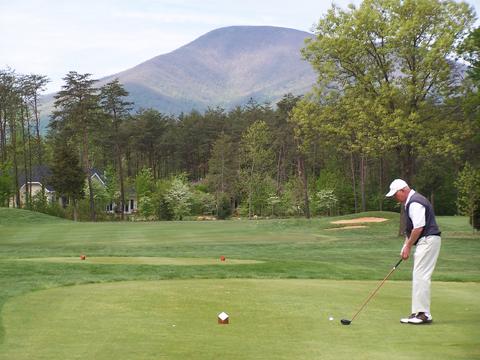
From the first tee at Wintergreen's 27-hole Stoney Creek course, you know you are in for some special views. A second 18, the Devil's Knob, is on top of the mountain.
The latest issue of Travel & Leisure Golf (October 2007) highlights eight excellent southeast U.S. resort courses that stand out for autumn golf. All are either within golf course communities or close to residential areas.
We have played three of the eight and have the rest on our list for visits soon. The three we know offer a range of climates and amenities. As resorts, they make it easy to stay a week or more, "kick the tires" in the community to see if you like the course, the people and the local culture before making any long-term commitments.
The Wintergreen Resort is in the Blue Ridge Mountains of Virginia about 40 minutes west of Charlottesville. It isn't exactly in the sub-tropical belt, but some - especially skiers - will find the four-season climate part of the allure. We played two of the three nines at the Rees Jones-designed Stoney Creek course at the bottom of the mountain at Wintergreen; it was typical Jones, with well-placed bunkers of the tee and at greenside but a fair course all the way around. Residents told us that on some days in January, you can ski on the mountain in the morning and then drive down to the golf course and play in the afternoon (with a sweater on, of course). The other 18 at Wintergreen, called Devil's Knob, is an Ellis Maples design built on the very top of the mountain. Its first tee is a hundred yards from the terminus of the ski chair lifts. The course, which is closed from October to April, features some gorgeous mountain views and precarious edge of the mountain lies. For our extended previous review of Wintergreen as well as contact information, click here.
Pawleys Plantation also makes the T&L list, the magazine noting that Pawleys Island "is removed from Myrtle [Beach's] notorious crowds." Indeed, I maintain a second home at Pawleys Island largely for that reason; far enough away from the honky tonk beach atmosphere but close enough to take advantage of the more than 100 courses in the area. Pawleys Plantation, a muscular Jack Nicklaus design, is tough and beautiful, especially on the back nine as it makes its way out to the marsh. Pawley's 13th hole, a short par 3 that is all carry to a tiny green surrounded by marsh, is a sure par if you keep your ball anywhere on the green, and a sure bogey or worse if you don't.
My son and I still talk about our round at Cuscowilla almost two years ago. It is a most unusual course because of its "normal" layout; no modern affectations intrude on the natural feel and smooth routing of the layout. Bill Coore & Ben Crenshaw are best known for unfussy courses that
Other courses on the T&L list are Kiva Dunes on the Gulf Coast in Alabama, Callaway Gardens in Georgia, St. James Plantation in Southport, NC, the Inn at Palmetto Bluff in Bluffton, SC, and the Resort at Glade Springs, WVA. We hope to play them all in the coming year and report on them here and in the HomeOnTheCourse Community Guide.
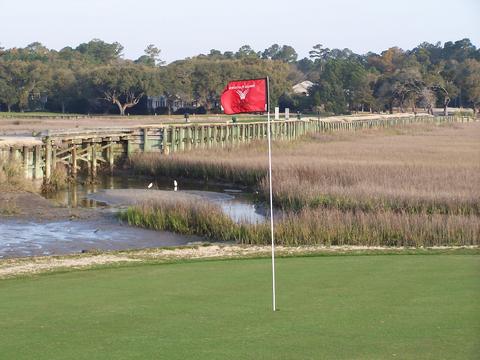
The short 13th at Pawley's Plantation plays from a dike to a tiny green surrounded by marsh.
Dye for a dollar is big deal
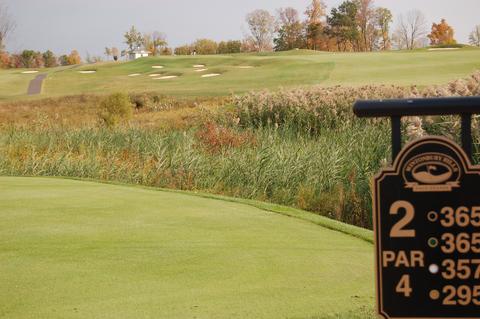
Anyplace but high on the fairway right provides a challenging approach shot to the firm 2nd green at Bloomfield, CT's Wintonbury Hills Golf Club.
Five years ago, Pete Dye donated his design services for the town of Bloomfield, CT's Wintonbury Hills golf course for $1, or an estimated three million less than Tiger will get for his first American design for The Cliffs Communities. Bloomfield got a great deal.
Yesterday I played Wintonbury Hills, which is located about eight miles northwest of Hartford, with Ken, Joe and Bernie. Ken is a HomeOnTheCourse Community Guide subscriber and Joe and Bernie were taking a day off from their management positions at the local Coca Cola Bottling office. They chose a great, sunny day, with temperatures in the high 60s (F) and the course in very nice shape. I have played Wintonbury a number of times, and I expected the fairways and greens to be extremely firm, forcing many bump and run shots to greens with pin positions at front. The course ran true to form yesterday. Shots at the pin just would not hold, and 20 foot putts or chips through fringe were preferable to 40 foot putts from the back of Dye's undulating greens (Tim Liddy, gets co-design credit on the scorecard).
Ken was right on when he described Wintonbury as a course that "looks like parkland but plays like links."
Indeed, from the clubhouse, the views are wide open to fairways and large greens in the distance, and it does affect a links land feel. But once you reach the edges of the course, the holes thread through trees and around a few ponds and marshland hazards.
The course is not without its quirks, which keep it from rating an overall otustanding (I rate the course a 7 on a scale of 1 to 10). Among the idiosyncrasies are two sets of holes - 1 and 10, and 2 and 11 - that are nearly identical in design. The opener is a straight on par four, with hazard stakes fronting the marsh well to the left and bunkers guarding the slightly elevated green. Ditto number 10. The second is an uphill dogleg left, with most of the trouble on the left in the form of rough and trees before an uphill approach to another well guarded elevated green. Number 11, which takes an identical routing up and left, adds a few pot bunkers at the crook of the dogleg and some bailout fairway to the left of the bunkers. The better approach to the green is from top right since the green is blind from the fairway on the left.
The routine par 4 16th, which plays downhill to the green, seems self consciously "tricked up," as if the designers couldn't avoid making it short but wanted to make it much more difficult. The huge mound guarding the front left half of the green is too close to the putting surface; with the pin just over it, as it was yesterday, there was no way for even a well-played short-iron shot from the center to the left side of the fairway to be rewarded with less than a 15 foot putt.
For those who need the practice range before a round of golf, Wintonbury Hills' is up the road, a little too far for a cart ride. Compensation is in the practice green complex just behind the clubhouse, which includes a few sand traps as well as an undulating surface that previews the greens on the course. Wintonbury also permits chipping to the practice green.
Despite the firm playing conditions, the turf was in nice shape for mid-fall, and clearly the grounds crew had preceded us with their leaf blowers and collectors. We never came close to losing a ball in the leaves, not the case at many tree-lined courses in Connecticut. Greens were not as fast as usual - they had not been cut that morning - but you still needed to be careful from above the hole (I'd estimate the stimpmeter reading at about 9). A well-struck wedge shot typically bounded six to 10 feet beyond the slight dent it made in the putting surfaces.
Because of Dye's involvement and positive national publicity in the golfing mags, managers flying into the nearby Bradley Airport for corporate meetings in Hartford have been making detours to Wintonbury for a round of golf before their business discussions. In the summer, tee times are necessary, but the Wintonbury web site makes it quite easy to book a time in advance (or you can call the pro-shop).
Wintonbury's clubhouse is small, but the pro shop is well stocked and the restaurant is first-class for a municipal/daily fee club, serving not only the excellent snack foods (hamburgers, hot dogs) you expect but also including some daily specials. Green fees, with cart (GPS included), were just $60. Memberships are available to town residents and non-residents alike, with annual dues (no initiation fees) beginning around $2,000 for residents for a weekday pass (unlimited play Monday thru Friday). For a course of this quality, that is a bargain, almost as good a deal as getting Pete Dye to design the track for a buck.
Wintonbury Hills Golf Club, 206 Terry Plains Road, Bloomfield, CT. (860) 242-1401. Web: www.wintonburyhillsgolf.com. Tournament tees: 6,623 yards, rating 72.3, slope 130. Back tees: 6,283 yards, rating 70.0, slope 128.

Left to right, Ken, Joe and Bernie were great company at Wintonbury Hills.
Warning: Shameless self-promotion follows
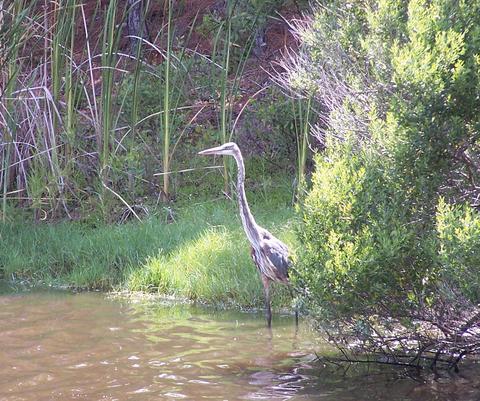
Wild Life: The marsh on the courses near Charleston can bring out the animal in all of us.
Think of golf in Charleston, SC, and the first thing that may come to mind is the Ocean Course at Kiawah Island, plus all the other fine courses there and at the adjacent Seabrook Island. If you can afford it, and don't mind the 30-minute trek to the city on a two-lane cart path that has not accommodated population growth, Kiawah is certainly worth a look.
For other golfers who love Charleston enough to live even closer, the nearby town of Mt. Pleasant offers tremendous variety in housing and golf. We cover the area in depth in the latest issue of the HomeOnTheCourse Community Guide, which has just been released to subscribers. If you subscribe now for just $39 for six issues a year, we will not only rush you this latest issue but we'll also throw in another issue of your choosing, absolutely free (a $15 value alone).
Signing up is simple and secure at HomeOnTheCourse.com. And upon confirmation of your subscription, I will personally send you a list of all the issues we have published from which you can choose the one you want. They include such golf and lifestyle-rich areas as Chapel Hill, Asheville, Jacksonville, Williamsburg and up and coming areas like Aiken, SC, and Knoxville, TN, where relative bargains still abound.
HomeOnTheCourse offers the same kind of no-nonsense reporting that readers of this site have come to expect. In the latest issue, for example, we take a course owner to task for handing out scorecards with the nines reversed, show some mild disappointment in a too-mild Arthur Hills layout and some major disappointment with the service at a former top-notch resort that has seen better days. And just when we thought there were no surprises left, we come upon a clubhouse that would not have been out of place in Communist Russia in the 1950s.
Oh yes, we also have some nice things to say too. And we include our exclusive numerical ratings of the golf courses and the town of Mt. Pleasant. For the price of a few gallons of ice cream or a fancy restaurant steak, we provide a much healthier diet of information to help you find your dream home on the course. So why delay? Subscribe today. Thanks.
Claim jumping: Communities pushing envelope
Like testosterone-crazed teenage farmers competing for the prize of biggest pumpkin at a 4-H competition, golf course communities try to jump each other's claims of having the best this and the biggest that. With more communities competing for fewer customers in the suddenly dried-up market, the claims are getting more far-fetched, ranging from the blindingly self-evident to the inscrutable to the wild.
Trying to appeal to our inner-CEO, the Rarity Communities of Tennessee, for example, reminds us that, "There is no surer way to succeed than to invest in your own happiness." That was news to me. I am going to sit my teenage children down and tell them hard work, as it turns out, isn't the best path to success. And I thought "Don't Worry, Be Happy" was a song, not a life philosophy.
Golf communities, especially those in the mountains, love to invoke Mother Nature in their copy. But we remember the old Chiffon margarine commercial whose tagline was, "It's not nice to fool Mother Nature?" A new community, Dominion Valley in Haymarket, VA, tries to fool the old
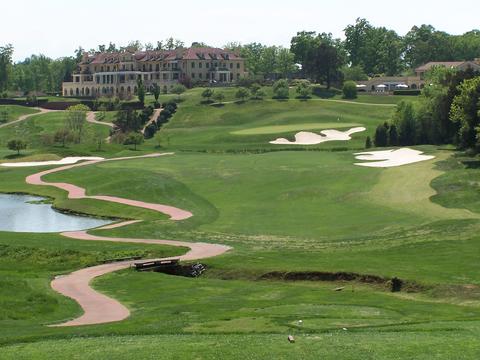
Claims of a paradise on earth are the mother lode of much golf community advertising. "The dazzling beauty of Mount Vintage Plantation will take your breath away," says the Aiken, SC, community at its web site. Indeed, "breathtaking" may be the most over-used word in golf community advertising. "The ways are ancient and the views are breathtaking in this fabled ‘Enchanted Land' of the Cherokee," writes the marketing site U.S. Private Communities about Blue Ridge Golf & River Club, a new community in northwest Georgia. The land may now be "enchanting," but it stopped being "enchanted" when the Cherokee were pushed off of it. How tacky.
We love it when communities advertise that they are a Top 100 choice in Where to Retire magazine. Where to Retire anoints almost exclusively those communities that advertise in its ad-stuffed publication. At least we know publications like Where to Retire for what they are, paid-for-hire promotions. A publication like Resort Living magazine is an entirely other story. The Cliffs Communities' web site quotes Resort Living as saying The Cliffs offers "undoubtedly one of
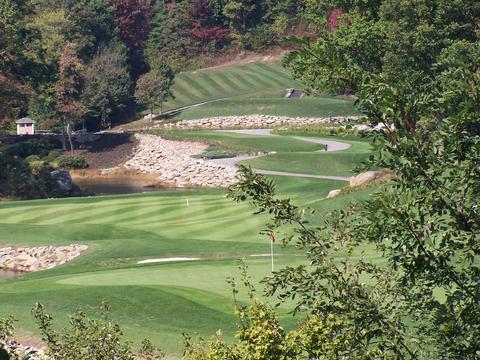
the most comprehensive private club memberships in the world." Eight golf courses and $150 million in amenities certainly speak for themselves, but The Cliffs does not leave well enough alone: Resort Living is actually published by a marketing firm that represents The Cliffs. Nowhere in The Cliffs promotional material is the connection indicated.
Most other upscale communities seem to be content to rein in the over-heated language, especially those developments that emerged where "old money" once flourished. Although Ford Plantation, as in the former playground of Henry Ford, offers only one golf course, a terrific Pete Dye layout, it is more circumspect about its virtues than is The Cliffs (think Vanderbilts compared with newly wealthy hedge fund managers). The Ford Plantation web site home page shows a photo of the Henry Ford-built clubhouse and a one-word tag that says, simply, "Welcome." You are invited to navigate to other parts of the site, and the notes about the golf course and other amenities are also presented without promotional noise. Form follows function as the overall effect is classy, just what Ford Plantation wants you to think about its community.
Ditto Keswick Estate, just outside Charlottesville, VA, another high-end community that keeps the over-the-top adjectives ("glorious," "spectacular") to a minimum and relies on facts and colorful photos to do most of its marketing. Keswick is managed by Orient-Express, a British firm typically associated with classy properties. Keswick's web site is straightforward about its 48-room former estate house, which accommodates guests, and the private Arnold Palmer course, also available to guests.
Mature, member-owned clubs also tend to avoid hyperbole in their promotional materials. Champion Hills, for example, calls itself, "A vibrant, member-owned community outside historic Hendersonvile, in the beautiful North Carolina mountains. And Tom Fazio's home course." Mountains, Tom Fazio and an historic town speak for themselves. We can forgive the private University of Texas Golf Club its claim to be "the best in Texas" and for its overly clever tagline "The Drives of Texas Are Upon You." The rest of its marketing is straightforward, just the facts, and with a personality in its materials that matches the club's sunny disposition (we visited in September).
Up until last year, building a golf course community was like minting money. Now it is more like owning a condo in Miami. For still emerging communities desperate for traffic and sales in a shrinking market, claim jumping may take on an even more urgent tone. These communities were caught up short by the fallout from the sub-prime debacle after they made major investments in their golf courses, other amenities and infrastructures. The big guys, like Bluegreen Corp and Crescent Communities, should weather the storm without stretching reality too much. But as regional and local developers become more and more desperate, their claims of heaven on earth will become even more hellacious.
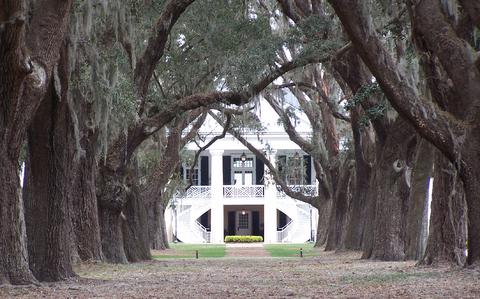
Ford Plantation in Richmond Hill, GA, doesn't make outrageous claims.
Autumn a fine time to play, north and south
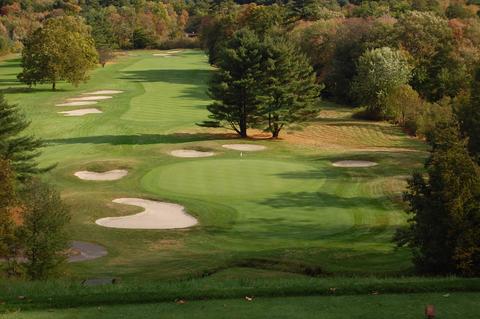
In the fall, the views from the tee on the par 3 16th hole at Hop Meadow CC are impressive, and golfers run the risk of being distracted by the view of the par 5 17th beyond. (Note designer Geoffrey Cornish's conceit with the first bunker on #17, an arrow pointing the way toward the green.)
The leaves have not quite reached their peak colors in Connecticut yet, but even one week short of peak is impressive. I snuck out yesterday, two days before they are going to aerate the greens at my home course, Hop Meadow Country Club in Simsbury, CT. I had the back nine to myself and took advantage of the opportunity to capture with my camera the great contast between the still-green course and the orange/red/browns of the leaves. (The white sand doesn't look bad either, although after a few days of modest rain, I plugged a few in the damp stuff.) It seems that, in recent years, rain has ruined leaf peeping, but not so far this year. Quite a treat.
In the Charleston area in South Carolina, autumn brings no such change of color in the leaves, but the marsh along the fairways of the excellent courses in the Mt. Pleasant provide their own impressive display, especially in contrast with the water at high tide. The latest issue of HomeOnTheCourse is jam-packed with information about the communities and courses in and near Mt. Pleasant, including the Ginn Company-developed Rivertowne Country Club, which features a nice Arnold Palmer course, and the Wild Dunes Resort, which sadly just lost its ocean green on the finishing hole of the sporty Tom Fazio layout but has plans to start rebuilding it soon. We feature other fine community golf courses by Rees Jones, Arthur Hills and George Cobb, as well as helpful information about life in the Mt. Pleasant area.
Don't miss out on this loaded, full-color 13-page issue. A subscription is just $39 annually for six informative issues, and subscribing is easy and secure. Next up in December is Austin, TX. Order today.
It takes three shots, and a bridge, to get to the green on the par 5 11th hole at Rivertowne CC's fine and challenging Arnold Palmer course, site of a women's PGA tournament. It is just one of many fine options in the Mt. Pleasant, SC area.
{mosmap width='400'|height='300'|lat='32.8334428466495'|lon='-79.82528686523438'|align='center'}
Huh?
An ad for golf packages at Kiawah Island, SC, in the Wall Street Journal today had the following simple sentences above a wonderful photo of a hole at the famed Ocean Course:
"There is epic golf. Then there is Kiawah."
Wha? Isn't "epic" a great thing, as in the Iliad, the Odyssey, the Godfather series? "Epic" means beyond imposing and surpassing the ordinary (especially in size). How much better than that could golf get? What the Kiawah copywriters appear to be saying is, "There is epic...and then there is pretentious."
Lots in buffet of golf town
Barefoot features courses designed by Norman, Dye, Fazio and Love III. We've played them all, and although we would not rank any in the top five on the Grand Strand, each is distinctive and fun to play. This being the Myrtle Beach area, more than a hundred other courses are within an hour's drive.
The Centex promotion piece says that golf memberships are available, but they are not necessary since all but the Dye course are accessible to the public - and in the dead of summer we have not had trouble getting on that one.
You will find additional information at the Centex web site.
Breaking story: Nicklaus going lefty
Real deal in Coore/Crenshaw golf community

Now on Sale

- The only book about golf communities in the last 10 years.
- 156-page step-by-step guide to finding your dream golf home.
- Info on nearly 100 golf communities the author has visited.
- Paperback version costs less than a sleeve of Pro VIs.
Here is what the experts are saying:
“The book is chocked full of information…applicable to anyone looking for a move to the Southeast regardless of whether they are looking for a golf community or not.” — John LaFoy, golf architect (Linville Ridge CC, CC of Charleston, The Neuse GC)
“Larry has done a tremendous amount of work and anyone — like me — who is looking to search for a golf home now or in a few years needs this book.” — Brad Chambers, golf blogger, ShootingYourAge.com
“Wow! What a thorough piece of work…a must for anyone moving South. This book will help many people.” — Brett Miller, owner and founder of MMA, Inc, a golf industry consultancy
Buy It Now at Amazon.com or BarnesandNoble.com.