Royal Flush: Hoylake and Lytham at core of Open Championship rotation
The second part of a review of some of England’s great courses by one of our readers, a lover of the links courses of the British Isles.
Because of the wide variety of golf available in the Merseyside area, we were able to park ourselves for an unusually extended period, 11 restful nights, at the comfortable and welcoming Waterford Hotel in the seaside resort of Southport. An attractive town of approximately 100,000 permanent residents, Southport is best known for its Victorian architecture, extensive tree plantings and tony shopping, but I'd be remiss if I didn't mention that it is also home to the famed British Lawn Mower Museum.
Located some 15 miles north of Liverpool, Southport offers some obviously compelling attributes for the traveling golfer, including ease of access (it’s some 90 minutes form Manchester Airport), a wide range of lodging and dining options and, perhaps, the largest cluster of top-tier links course within driving distance of each other (though both the Ayrshire Coast and East Lothian regions of Scotland have compelling cases as well).
Any discussion of golf in the Southport area starts with the three Royals -- Royal Birkdale, Royal Liverpool (more colloquially referred to as Hoylake) and Royal Lytham & St. Anne. Each are currently in the British Open rota. While both Hoylake and Lytham
Hoylake includes an unusual feature that will surprise and likely annoy the first-time visitor, the existence of internal out-of bounds. Interestingly, the severity of Hoylake has been significantly tempered over the years as the two most severe, and potentially unfair, conditions have been eliminated. Hoylake’s 7th hole, Dowie, one of the most famous one-shotters in the world, is named for the club’s first captain and used to feature out-of-bounds just to the left of the triangular green. Because a ball pulled even the slightest bit left could readily hop over the cop, a low grass wall demarcating the boundary, most players would inevitably bail out far to the right. It was decided to consider this area in play for the 1967 Open and has remained so since.

The Royal Liverpool clubhouse looking back from the first fairway. At left is the cop, a low grass wall demarcating the internal out-of-bounds.
The second hole that has been changed is the 17th, known as Royal (the Royal Hotel sits right across the road), where the green originally sat at the corner of the property, resulting in many approach shots leaving the yard. Due to the club’s concerns regarding liability, architect Donald Steel was hired to site a new green some 30 yards from the property line. Notwithstanding the changes above, there remain several holes affected by the internal out-of bounds. The most interesting of these may be the 16th, a potentially reachable par 5 where the most direct line off the tee will require the second shot to be played over the out-of-bounds practice ground. Hoylake disappeared from the Open rota after the 1967 tournament due to the lack of space for parking and amenities, but it returned in 2006 after the club was able to acquire an adjacent parcel. Hoylake will again host the Open in 2014.
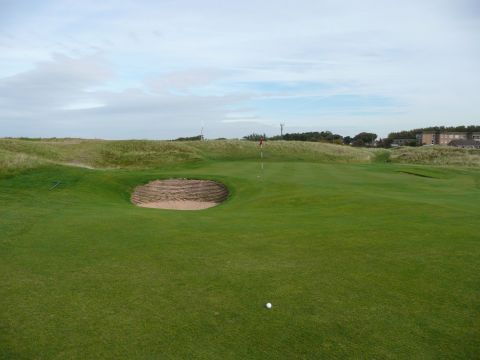
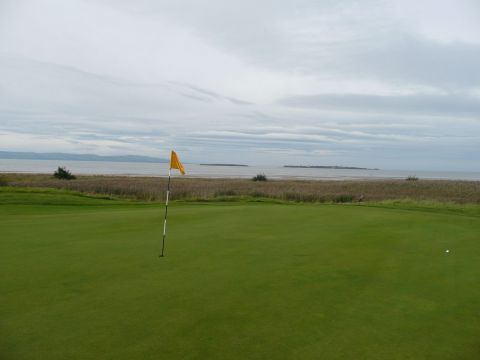
Top, the author’s dilemma on the short Par 4 9th (Punch Bowl) at Hoylake (Royal Liverpool), where a great drive has left him with only bad options. He can either try to hit a soft pitch from the incredibly firm turf, and inevitably skull it, or putt safely to the right and leave himself a 12-15 footer for birdie. Welcome to links golf! Below, the beautiful 11th green at Hoylake (the hole is named Alps). This stretch of holes through the dunes, at the far end of the property closest to the Irish Sea, is quite beautiful but is out of character with the flat terrain of the bulk of the course.
Lytham is the more straightforward of the two, and to our mind the more charming. But links golf is never without its eccentricities, and Lytham is no exception. The course starts with an opening par 3, and in its most recent Open in 2001, this eccentricity facilitated Ian Woosnam’s unfortunate two-shot penalty for having a second driver in his bag. Had the opener been a more traditional driving hole, the oversight would inevitably have been noticed before the penalty was assessed.

The short but treacherous 9th at Royal Lytham, playing only 165 yards from the tips. With a wedge or 9 iron in hand, the player merely has to hit the ball straight and on the exact number (merely). The hole offers the classic links dilemma: Put the ball in the air and challenge the wind, or flight it low with the knowledge that you must carry it the precise distance to stop it on the firm turf. Unfortunately, most of the structures adjoining the rest of the course are not as attractive as the one behind #9.
The other notable quirk at Lytham is that the clubhouse, which abuts the back of the extremely deep 18th green, is in play -- i.e. no relief is granted for stance or swing. In playing to a back pin, the player must be extremely careful not to overclub (or, dare I say out loud, thin it). Gary Player famously hit his approach shot through the green and played his third backhanded while facing the clubhouse in closing out his Open victory in 1974. The Open will return to Lytham in 2012.

The author's bride and her caddy approaching her ball just short of the 18th green at Lytham. Because of the firm turf, it is very easy to run a ball through the green and have the clubhouse, which is in play, affect your next shot.
Lytham and Hoylake also share a connection to Bobby Jones. Jones won the first of his three Open Championships at Lytham in 1926 by virtue of a dramatic shot on the 17th hole in the final round. Tied for the lead, his tee shot found an unkempt bunker to the left of the fairway some 175 yards from the green. The shot played into the wind and he was unable to see the green due to large gorse bushes that ran the entire distance. With his opponent already on the front of the putting surface, Jones gambled and played a remarkable mashie (equivalent to a 3 or 4 iron, but remember they were still in the era of hickory shafts), making the green and rattling his opponent into a three-putt. The club he used is on display in the Lytham clubhouse and it looks more like something you’d toss on the beach for your dog to fetch. Jones also won the Open at Hoylake in 1930, the second leg that year of his historic Grand Slam.
Next: Royal Birkdale and other Southport gems
 Home On The Course newsletter
Click here to sign up for our Free monthly newsletter, loaded with helpful information and observations about golf communities and their golf courses.
Links to golf’s past: Reader makes classic pilgrimage to play the British Isles royals
Since my first trip to Scotland in 1979, I’ve been obsessed with links golf, to the extent that I’ve returned to Scotland five times since in addition to three trips to Ireland. As the addict would say, I can quit at any time…
For those only vaguely familiar with the term, “links golf” refers to a very specific variant of the game that is found only on seaside courses in the British Isles and Ireland. The British Golf Museum defines linksland this way:
A stretch of land near the coast on which the game is played, characterized by undulating terrain, often associated with dunes, infertile sandy soil, and indigenous grasses such as marram, sea lyme, and the fescues and bents which, when properly managed, produce the fine, textured, tight turf for which links are famed.
To add some color to this accurate, if somewhat clinical, definition, let me quote from “To the Linksland,” Sports Illustrated columnist Michael Bamberger’s homage to Scotland:
Do you know what I mean when I say linksland? Linksland is the old Scottish word for the earth at the edge of the sea — tumbling, duney, sandy, covered by beach grasses. When the light hits it, and the breeze sweeps over it, you get every shade of green and brown, and always, in the distance, is the water. The land was long considered worthless, except to the shepherds and their sheep and the rabbits, and to the early golfers. You see, the game comes out of the ocean, just like man himself!
There’s a primal quality to the best of these links, a knowledge that people have been playing them for hundreds of years, and that the land has been largely untouched by human hands. There’s also a remote feel as you find yourself walking amongst the dunes, often times in spots where you can’t see another golf hole or evidence of mankind’s existence. Because of the specifics of this unique terrain, the game is played differently. If you’ve watched a British Open on television, you’ll be familiar with the effects of wind and the importance of avoiding the punitive pot bunkers. First-time visitors are most surprised by the firmness of the turf and its affect on the game. There’s an obvious thrill in the ability to play low, boring shots that will run forever, but many an expletive has been uttered at the difficulty of playing a soft pitch off the incredibly tight lies.
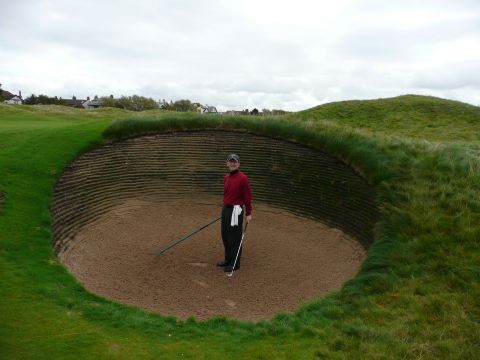
The author tries on a Royal Lytham bunker for size. Fortunately, his ball was not actually in the bunker; otherwise, he says, he might still be there.
Those of us who have become hooked on links golf appreciate that it offers a range of options to the player, both in terms of the type of shot played and the line to the green, in sharp contrast to the more one-dimensional point-to-point golf inherent in parkland golf. In addition to the stark physical beauty of the links, the very changeability of the conditions makes it endlessly absorbing. From day-to-day, sometimes hour-to-hour, the golf course changes its look, its feel and the demands it makes of players. When possible I try to schedule multiple rounds on a given course, partially as weather insurance (you might have heard that the weather in the British Isles can be, let’s be charitable, memorable) but also because the changed conditions invariably result in a completely altered playing experience.
While we could happily return to Scotland and Ireland every year, my wife Theresa has extended family, some of whom are quite elderly, in England. Being a selfless and devoted husband, I insisted that it was long past time for her to pay them a visit. I assure all that the ability to combine this family time with a visit to the highly-regarded cluster of renowned links courses on the Northwest coast of England, known in the tourist trade as England’s Golf Coast, was the merest of considerations.
Next: Royal Liverpool (Hoylake) and Royal Lytham & St. Anne.
Scott Simpson is an avid golfer with a longstanding love of links golf. In those few hours not spent on a golf course, Scott is an investment banker focusing on middle-market mergers and acquisitions. A member of Willow Ridge Country Club north of New York City, Scott makes his home in Westchester County with his wife Theresa, a first generation County Mayo girl (as if he needed further motivation to visit Ireland). The name notwithstanding, Scott has yet to win his first U.S. Open. He says that, with a handicap of 9, “it is very difficult to make a living.”
Like Ike: Battlefield, college and golf made former President at home in Gettysburg
Ask any of us baby boomers born after WWII who was the most notable golfer among U.S. Presidents in our  lifetimes, and the quick answer will be Dwight Eisenhower (most of us will respond with the affectionate nickname “Ike”). So identifiable with the game was Eisenhower that the sprawling pine tree 200 yards from the 17th tee at Augusta National was named lovingly for the former general’s propensity to drive a golf ball into it (he requested the club cut it down, but they didn’t). After leaving the Presidency in 1956, Ike chose Gettysburg, PA, for his retirement home. He and wife Mamie were lured by a beautiful piece of farmland, a huge Civil War battlefield where he could continue to study military history and strategy, a college where he could maintain an office and a connection to the intellectual life, and a 9-hole private country club where he could indulge his true passion.
Today, the Presidential golfer would have a few more choices of golf venues beyond the circa 1948 Gettysburg Country Club, still the only private club in the immediate area. The best regarded alternative is The Links at Gettysburg, a few miles from the battlefield site and, like Eisenhower’s own retirement home, sited on a few hundred acres of rolling farmland. (The Eisenhower farm, purchased by the President in 1950, was his home until his death in 1969 and is now a National Historic Site.)
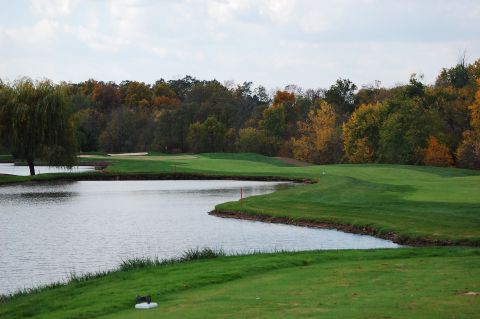
The par 3 13th hole at Links at Gettysburg.
The 18-hole Links at Gettysburg, which is surrounded by a community of estate-sized homes, patio homes and condominiums, is open year round and, since its debut in 2003, the favored upscale public golf course in the area. Given its rural setting 10 miles from the center of Gettysburg (as well as the state of the current economy), I was surprised to find a community with more than 110 homes built and evidence of other construction activity (e.g. ground clearing for a group of “villas”). But as developer Rick Klein explained, The Links at Gettysburg is not as remote as it appears.
“We are within 90 minutes of Baltimore and Washington (D.C.),” he told me. “The airport in Harrisburg (Pennsylvania’s state capital) is an hour away.” In other words, The Links’ location offers the twin benefits of seeming to be in the middle of nowhere but with easy access to big cities and big city airports. When he lived in Gettysburg, Eisenhower was just a 90-minute drive to the White House, and less than a half-hour to Camp David in case one of his successors needed some, ahem, general advice.

From the tee box at the par 5 7th at The Links at Gettysburg.
Because of its relative proximity to the nation’s power center, The Links appeals to retired and employed Federal government workers, including members of the FBI, CIA and the armed forces. The average age at The Links skews toward the late 50s, what with more than three quarters of the residents retired and another 10% or so baby boomers who still work.
“Most of them work out of their home offices but travel to D.C. one or two days a week,” says Klein, who refers to his development as “age targeted” rather than “age restricted.” Only about 15% of The Links residents miss the target; that is, they are families with young children who don’t mind the commute to Gettysburg College or their offices in the nearby town.
The Links at Gettysburg offers the full range of house options, from “vertical” town homes (“The Cottages”) to “Villas” or small homes on patio size lots (starting at $270,000 and 1,800 square feet) to estate-style homes that average around 3,400 square feet (priced from the mid-six figures). A new section of condos dubbed The Retreat will feature low-maintenance residences whose spaces (from 1,400 square feet) will mimic those of single-family homes at prices that begin below $300,000, all wrapped in an attractive French Country architecture.

Many of the homes at The Links at Gettysburg, like this model beside the 2nd tee, feature a French Country style.
The Links uses only two builders, which gives Klein and his team tight control over the look of the golf community. On my drive through The Links, I got it; everything struck me as coordinated and harmonious. Even the condo building looks as if it belongs to the same French Country tradition as the single-family homes.
One thing at The Links that is a bit of a jolt at first is the proximity of the larger homes to each other; I hadn’t seen homes that close since a trip to Austin, TX, where, given it was big old Texas, I was perplexed. But the French Country homes at The Links, many of them larger than 2,500 square feet and just 10 feet from each other in some cases, are grouped around nicely landscaped and lit large courtyards, giving the clusters of homes an old-time, town center feel. Those used to living in the suburbs may feel a bit confined, but city dwellers from Baltimore, Washington or Philadelphia will feel right at home, and then some. Klein told me that the proximity of the homes made it possible for The Links to build large expanses of open spaces into their master plan, both inside the courtyards and beyond the individual properties.
The Links works hard to project the feel and reality of an active lifestyle, not only with the golf course but also with  its members-only clubhouse across the parking lot from the pro shop and snack bar. In the members clubhouse, those who pay a onetime mandatory “amenities” fee (between $3,000 and $4,500, depending on which section of the community they live in), plus modest annual dues, enjoy a fitness center, sauna room, outdoor pool with heated spa, and locker room. Golf membership for those who purchase a home inside The Links costs $10,500, with dues between $265 and $290 per month (non-residents pay a $14,000 initiation fee). For those from the surrounding communities who pay as they go on an annual basis, the fees run from $1,000 for weekday-only golf to $4,500 for what Klein describes as “all golf, all the time.” Members, of course, have tee-time reservation preferences.
I could not give The Links golf course its full due because the greens had been aerated and covered with a heavy layer of sand two days before I visited. But given the course’s popularity (26,000 rounds will be played this year) and the condition of the tee boxes and fairways as I made my way around, I assume conditions most of the time are topnotch. The layout is both interesting and challenging; the design is by Lindsay Ervin, a relatively unknown architect whose other work has been almost exclusively in Maryland and Virginia. The most commanding feature of The Links course, which is “links” in name only since it bears no resemblance to a traditional seaside links golf course, is its use of stone walls –- both manmade and natural.

At the short par 4 8th hole at The Links, a rock wall runs the entire length of the right side of the fairway and ends behind the green.
I hit the wall, literally, on the first hole, a short par four that is anything but a warm-up. At 367 yards from the blue tees (6,666 yards total), the dogleg left forces you to place a drive down the right center of the banked fairway; too far right, however, and the splayed limbs of a tree 75 yards in front of the green can obstruct your view on the approach shot. Beyond the tree lies two stone walls, one more or less free form and lining the back edge of a stream 40 yards in front of the green. The more problematical wall, which snakes seductively up to a few yards in front of the green, compels an approach shot well over it lest you face a straight-up lob shot over it or, worse, a penalty drop. However, a strategically placed bunker beyond the green will catch the overly aggressive play. From that bunker it is straight downhill, in more ways than one, especially if the pin is at the front of the green, with the prospect of rolling back over the wall.
Another wall literally hovers over the par 3 3rd hole. At about 40 feet high, it forms a backstop to the wide green but is not really in play because a thin ribbon of sand bunker separates it from the putting surface. The dark rust color of the wall contrasts with the sunlit green to play tricks with the eye from the tee box for the otherwise routine downhill tee shot.
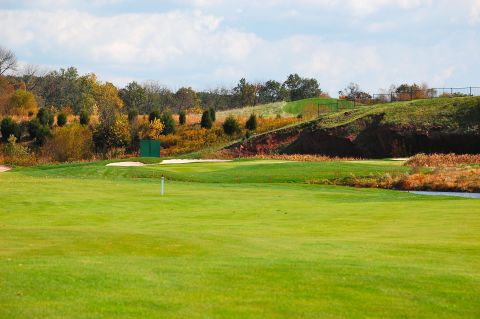
The approach to the 18th hole at The LInks.
The wall along the right side of the short (320 yard) dogleg left par 4 8th hole is much more problematical. With a bunker in the landing area down the left side, the safe play is across the width of the middle of the fairway but not so far that you reach the bunker on the far right side –- or the high rock face that runs a couple of hundred yards down the fairway to frame the back of the green, giving the entire hole a stadium look. I found it impossible to judge the distance across the fairway to the wall and, to compound the degree of difficulty, thick rough ran from the fairway’s edge for about 15 yards to the wall. I never did find my well struck tee ball, which I expected to be in the right hand bunker. If I had it to do all over again, I would have popped a five wood over the barranca in front of the tee box to mid fairway, leaving just an eight iron or so to the green. Or I would have gone directly toward the green, damn the bunkers guarding both sides.
Those kinds of judgment calls, as well as forced carries over water (including a creek appropriately named Lousy Run), longish par 5s and tight bunkering around greens put The Links at Gettysburg squarely in the category of tough public golf course. Give designer Ervin and developer/owner Klein credit; fast play and a leisurely round of golf do not seem to have been their prime consideration in setting up the course. A challenging experience was. With a slope of 141 from the blue tees (rating 72.4) and 130 from the white tees (6,277 yards), The Links at Gettysburg golf course will battle even the most patient golfer.
If you would like more information about The LInks at Gettysburg or would like to arrange for a visit, please contact me and I will be happy to assist you.


Off the tee on the dogleg left first hole at The Links (top), there appears to be plenty of room in the fairway. But if you wind up on the right hand side of the fairway (middle), you will need to negotiate your approach over a tree that guards the right side of the end of the fairway. A short approach could leave you up against the wall (bottom).
False positive? Toll Bros. settles suit; plaintiffs claimed overreliance on high-end
Plaintiffs included the City of Hialeah (Florida) Employees' Retirement System and the Laborers Pension Trust Fund for Northern California. The investors claimed that Toll Brothers overstated demand for its homes and misled investors on its future earnings potential when it claImed that "expensive homes for a niche market of high-end buyers" would help weather negative interest rate and economic developments. The last few years, as we know in hindsight, have been especially rough on the high end of the market.
We recently visited Toll Brothers’ large golf community Dominion Valley in Haymarket, VA, and reviewed it here. The mid-market community (homes generally in the mid-six figures) appeared well organized with a considerable amount of home construction in process. Toll Brothers seems to be in good shape, having posted its first quarterly profit since 2007 just two months ago. And after yesterday’s announcement of the $25 million agreement, a mere blip for a company as large as Toll Brothers, shares of the Philadelphia-based company increased 3.75%, to $18.52 on the NYSE.

Dominion Valley is one of 22 country clubs operated by Toll Brothers' golf division. Its golf course, like most of Toll's portfolio, was designed by Arnold Palmer's group.
Ballyhack makes top 15 of new courses
Golfweek magazine has just published its list of the best new golf courses in America for 2009/10, and only four courses in the Southeast region made the top 25. Ballyhack, the tough and visually arresting Lester
The work is being spread around the golf architecture industry, if the top 15 new courses are any indication. Each was designed by a different architect or pair of architects, including Tom Fazio, Robert Trent Jones Jr., Coore & Crenshaw, Faldo, Nicklaus, Rees Jones, Pete Dye, Arthur Hills and Greg Norman.
If there are 21 new courses better than Cape Fear National and 14 better than Ballyhack, the fortunes of designer
Who among us would guzzle a snifter of 28-year old Scotch? Cape Fear, Ballyhack and all courses of such character are best appreciated, and best played, slowly and deliberately.
Note: Cape Fear National is open to the public. Although Ballyhack is private, the club offers lodging, two days of unlimited golf (for up to 4 people in a group) and dinner for $399 per person. It’s worth it.


Although vastly different high-quality golfing experiences, Ballyhack (top) and Cape Fear National both deservedly are among the best 25 new courses of the last two years, according to Golfweek.
Recovery shot: Resilient Glenmore Country Club recovers smartly from betrayal of trust
I had the opportunity to renew my acquaintance with Glenmore Country Club courtesy of Tom Pace,
Little seems to have changed since my first visit four years ago, except the superfluous hulking green scoreboard behind the 18th green has been taken down (thankfully, in my opinion, as it blocked part of the view of the majestic brick clubhouse). The unfussy, rolling John LaFoy designed golf course, whose few blind shots and undulating greens demand a slight bit of local knowledge, was in fine shape, most of the well landscaped homes set a fair distance from the fairways and greens. Out of bounds stakes are there to keep only the most wayward shots from being played from backyards. The practice facility at Glenmore is one of the most expansive in the area, with a dedicated area for the club’s junior golf program. I’ve included a few photos below to give you a taste of Glenmore’s charms.

Addition by subtraction: Gone is the hulking green scoreboard that once got in the way of views of the clubhouse beyond Glenmore's 18th green.
Glenmore is well situated to the east of Charlottesville, home to the University of Virginia, and an hour from the airport in Richmond. On the Saturday morning we played the golf course, my son and I and Tom Pace and his daughter, who plays for her local high school golf team, had the course to ourselves, which seemed strange until Tom explained that most members had begun their tailgating ritual at the university before that day’s home football game. A number of UVA faculty members live inside the boundaries of the gated Glenmore.
Glenmore offers an interesting blend of single-family houses, with prices that begin in the mid $400s and extend to $1.3 million. One section of cottage-style homes includes exterior maintenance for those who, like me, are allergic to cut grass (except, of course, on golf courses). A three-bedroom, three-bath cottage home is currently listed for $465,000. Home sites run from the low $200s to $599,000 for a one-acre elevated lot with a combo view of the golf course, lake and the Blue Ridge Mountains a few miles beyond.
The Glenmore golf course is open year round. If you would like to arrange a visit, or simply request more information, contact me and I will be happy to put you in touch with Tom Pace.


Glenmore Country Club's golf course features large, undulating greens, lots of ups and downs, and homes set well beyond and above the layout's generous fairways.
New Bern’s Carolina Colours opens lakefront lots; homes start under $300,000
Carolina Colours, which I visited last spring, has been developed under the watchful eye of industry veteran Ken Kirkman. Kirkman is a man of patience, and during our tour of the golf community, he gave me the impression that he is not overreacting to current real estate market conditions by cutting either corners or prices, although pricing in the community is quite realistic. He knows that the 300-year old New Bern is an up and coming retirement area, and that the only real local competition for his golf community is Taberna, whose decade-old homes are smaller and more closely sited to each other than those at the more expansive Carolina Colours.
Colours recently opened its 18-hole golf course, which was designed by Bill Love. I intend to give the course a go on my way to or from the Myrtle Beach area in November. In the meantime, if you would like current golf homes for sale in Carolina Colours, check out GolfHomesListed.com.
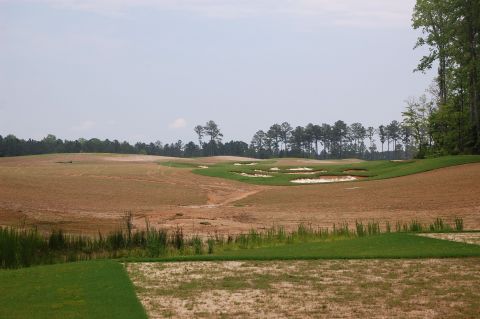
This was the scene in June on the Bill Love designed Carolina Colours golf course. But grass grows quickly in warm climates, and the golf community was able to open all 18 holes for play just a few weeks ago. For now, the course is open to the public.
Question: “Will golf home prices go lower?” Answer: “Don’t worry about it.”
…Given the trajectory of home prices over the past couple of years, there's a large contingent of buyers who are afraid that after they buy, home price(s) will continue to fall and they will lose their hard-earned investment in the home. These are folks who are still waiting for the bottom (although by some accounts, including that of the Case-Shiller Price Index, the bottom is here or has already passed, in many cities) -- from a Trulia.com article entitled “6 reasons Buyers aren't biting (and what Sellers can do to change that)!”
Chances are if you are reading this, you suffer from schizophrenia because you are both a seller and prospective buyer. You want to move to that perfect golf community home but you hate the thought of selling your primary home for 25% less than you could have fetched for it four years ago. And, as Trulia.com indicates, you are probably nervous about buying something that might depreciate in value over the coming years, given the political climate and all the foreclosures and other economic badness that could be on the horizon.
Although our anxieties about the next year or two may be realized, I suggest we put aside those fears
You can do a couple of things to make yourself feel better (and protect yourself) on the buy side (besides deciding to rent for the rest of your life or live out of a Winnebago). Negotiate the best possible price you can, but don’t abuse the seller (remember how it feels as a seller yourself when you have to parry ridiculously low offers). If you find a re-sale home in a golf community that you like, go low with your offer but not so low that a counter offer will seem useless to the seller. On the other hand, if you are negotiating directly with a developer, go as low as you want. Most developers have developed thick skin and many are desperate enough that they just might surprise you with a reasonable counter offer.
The Trulia article suggests that, “Buyers can set themselves up to gain over time, even if they lose equity in the very near term, by making smart decisions about the home they buy and how much they pay for it, and planning to stay in their home for a longer term than previous generations of buyers did.”
The best trick, though, is to put yourself in the mindset that lifestyle is the most important consideration for you at this point in your life, and to get over the fear of falling prices. If the market is not yet at its true bottom, you may lose incrementally more in the sell than the buy transaction. But what you lose in your net worth will be more than compensated by what you gain in lifestyle (golfing as often as you like, for example). So…..
In your life expect some trouble,
But when you worry
You make it double.
Don't worry, be happy

Homesites in Powell's Point, NC's Kilmarlic Estates, close by the excellent Kilmarlic Golf Club, have dropped in price from around $200,000 at peak to around $70,000 today. They are currently bank owned.
Photo coutesy of Kilmarlic Golf Club.
Things get ugly at beautiful Greenbrier
Think of the Greenbrier Resort in White Sulphur Springs, WV, and the word “classic” comes to mind. According to an article by Bradley Klein at GolfWeek, relations between the resort’s owner and the architect who helped get the Old White golf course ready for the PGA event earlier this year have turned into a classic legal battle. A separate landscaping firm is also suing the Greenbrier for non-payment.
The lawsuits by architect Lester George, who oversaw the restoration of the entire Old White
According to Klein and other reports, Justice claims the recent work done by George and Aspen was “completely sub-par” and that Justice and his staff had to take the jobs over to ensure the course and landscaping was ready by the time of the Classic. (Aspen was a subcontractor for a firm that built the resort’s new underground casino and itself had a lien against the resort that was cleared up recently.) The attorney who is handling both the George and Aspen suits has responded that his clients’ work was “excellent” and delivered on time. He added that the architect and landscaper “worked under constant pressure and change orders directed by Mr. Justice, who was told that such change orders would result in extra expenses that he would be billed for.” Justice, the attorney said, agreed to pay for the changes.
Aspen is claiming that Justice owes it $1.275 million for the landscaping work; George claims he is owed $199,885 for his redesign of the 16th hole on the Old White golf course; for a book he was commissioned to write about Old White; for design of the landscaping plan for the golf course; for a logo design; and to perform other work, including the landscaping designs for the tournament entrance and bus drop off.
In a speech delivered to a Charleston, WV, Rotary Club on Monday, Justice called the lawsuits “a typical deep-pockets thing,” according to the Charleston Daily Mail. But he also admitted that the resort’s accounting department had had trouble keeping up with bill payments and, in some cases, may have paid twice on the same invoices.
"When you've got 17,400 on your master vendors' list, you're going to have disputes," Justice told the Rotarians, admitting that invoices in the accounting department were “piled to the ceiling.” The Daily Mail did not indicate if Justice's attorney was in attendance when he made the admissions, but perhaps he should have been.
Justice is something of a folk hero among the locals for having saved the Greenbrier and created hundreds of jobs in the economically strapped mountains. He may be looking elsewhere, though, for a few good accounting people. At the Rotary Club, Justice admitted he had to fire some employees in the accounts payable department. Should the plaintiffs' cases reach court, Justice may get to face those former employees again as witnesses for the prosecution.
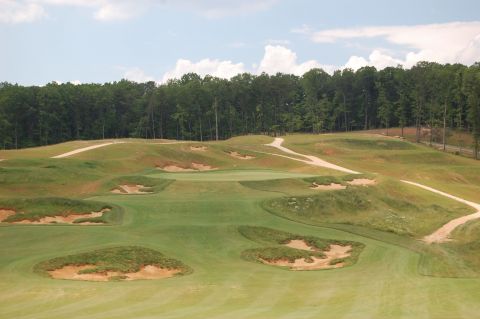
Lester George designed the wild and wonderful Ballyhack Golf Club in Roanoke, VA (above). He is suing the Greenbrier Resort for non-payment of work he did on the Old White course prior to the Greenbrier Classic.
Lease on Life: New owner gives Olde Mill Resort and golf course injection for growth
During the Great Depression, many businessmen made killings. Some killed themselves, by doing two and a half gainers out their office windows. Others made a different killing by taking what cash they had on hand and investing it in severely depressed assets, including property. These days failed investors don’t jump from windows nearly as often as they apply for bailout money. But those who have conserved their cash still buy up depressed assets, among them golf communities. Just yesterday I received an email from a representative of a group of investors looking to purchase developer lots in golf communities. They are betting their patient capital will help them make a killing when the economy straightens out.
I write this from the Olde Mill Resort in Laurel Fork, VA, a community 30 years in the making but stuck on the runway until one of those prescient-type investors bought all 900 acres and the golf club two years ago. Never heard of Olde Mill? Neither had I until I did an Internet search earlier this week, looking for a residential golf community to visit on my way to Chapel Hill, NC. The reviews of their golf course caught my eye, so here I am.
I am glad I stopped because Olde Mill is an interesting story, with a beautifully conditioned mountain golf course and sharply priced real estate. The two-bedroom, two-bath condo I am staying
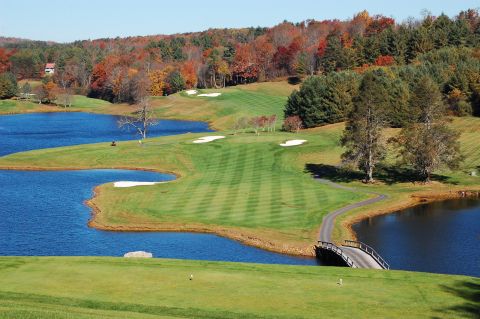
The par 4 10th hole at Olde Mill Resort.
Olde Mill is new owner Norris Mitchell’s first foray into golf community ownership, although his real estate portfolio includes hundreds of properties (apartments buildings, hotels and a few residential communities). Those who worry justifiably about the financial health of developers should find comfort at Olde Mill.
"He [Norris Mitchell] paid for Olde Mill out of his own pocket,” says Bo Goins. “And we have no debt.”
Mitchell is reported to have purchased the golf course and 900 surrounding acres just two miles from the Blue Ridge Parkway for about $8 million. He immediately set about renovating the golf course, which was originally designed as part of a church retreat in the 1970s. According to Goins, Olde Mill was the first golf course that the respected architect Dan Maples worked on with his dad, Ellis, after Dan was graduated from college. In 2008, Dan was commissioned to renovate his father’s course, and he called in his son Brad, just graduated from college, to help him. Total cost to Mitchell of the golf course and other enhancements was a reported $12 million.

Options off the tee at the #1 handicap par 5 13th are limited. The only reasonable play is a tricky shot over the trees and down the right side.
The Olde Mill layout is a wild ride in the foothills of the Blue Ridge Mountains, with some blind drives and large and severely sloping, lightning fast greens. An ornery greens superintendent has plenty of opportunities to fool with the resort guests. Today, for example, the pin on the par 4 6th green was on a knoll at the far right rear of the enormous green. My 30-foot first putt made it to about three feet short before it made a slight right turn and came back down the slope past my feet. Mindful that the 10 feet of green beyond the hole sloped down to the back, I got my second putt a foot closer -- which only served to give it a foot more of momentum on the way back down; it returned past my feet and off the front edge of the green. Based on the speed and slope of the greens, the new course and slope ratings Olde Mill awaits in the coming weeks should be severe. My guess is that the slope rating from the white tees, a mere 6,200 yards, could be as high as 133.
The golf course is characterized by some extremely tight landing areas that, in some cases, force you to leave driver in the bag but other times require a driver to give you a chance of flying past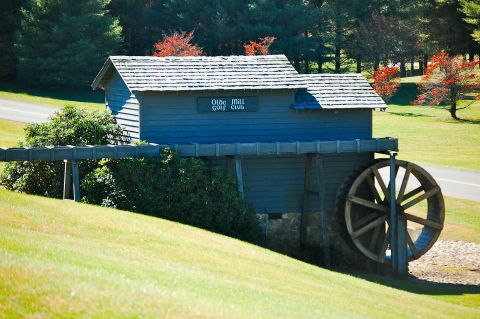 trouble. On the #1 handicap 13th hole, a par 5, the water on the left looks reachable with a fairway wood; the trees on the right side of the fairway beg for a driver over them to reach a slope that should kick the ball down toward the fairway. Left is dead in the water, but right is dead in the woods. The 13th should remain the toughest hole when the course is re-rated.
Condo units in a new building under construction behind the 18th green start at $239,000. Town homes at 3,000+ square feet with beautiful views of the fairways below start in the mid-$400s. For single-family homes, land and structure are sold as a package, at a total of $175 to $200 per square foot (land included). For $500,000, you will live quite well at Olde Mill. For less than $900,000 you will live like a baron. I walked through an impressive 5,500 square foot “spec” home with killer views and every conceivable extra (wine cellar, granite wet bar in the “man cave,” 20-seat entertainment room) and fully furnished by a local decorator, for $850,000 (plus $30,000 for the optional furnishings). I have toured less substantial homes in places like Asheville and Chapel Hill for almost twice the price.
Of course, Laurel Fork is neither Asheville nor Chapel Hill, and isn’t even Lynchburg or Roanoke. The closest towns are named Floyd, Hillsville and Meadows of Dan. The nearest supermarket is 15 minutes away and the closest airport of consequence, in Greensboro, NC, is about 75 minutes. And when the golf course closes for the season around December 1, the resort pretty much does the same, except for meals on the weekends (things get back to full operation again in March). Nevertheless, Olde Mill will appeal to second-home owners looking for reasonably priced real estate, an intriguing and nicely conditioned golf course, and a developer who has the temperament, and the financial profile, to be in it for the long haul.
*
If you would like more information about Olde Mill, please contact me. Next spring would be a good time to consider taking advantage of Olde Mill’s reasonably priced “discovery” package, currently priced at $249 for a couple of nights, golf, breakfast and other extras included.

From behind the 4th green at Olde Mill.
Up against the wall in Gettysburg
October newsletter: Better late than never
Greenville, SC area gets another boost
God bless the leaf rule

Now on Sale

- The only book about golf communities in the last 10 years.
- 156-page step-by-step guide to finding your dream golf home.
- Info on nearly 100 golf communities the author has visited.
- Paperback version costs less than a sleeve of Pro VIs.
Here is what the experts are saying:
“The book is chocked full of information…applicable to anyone looking for a move to the Southeast regardless of whether they are looking for a golf community or not.” — John LaFoy, golf architect (Linville Ridge CC, CC of Charleston, The Neuse GC)
“Larry has done a tremendous amount of work and anyone — like me — who is looking to search for a golf home now or in a few years needs this book.” — Brad Chambers, golf blogger, ShootingYourAge.com
“Wow! What a thorough piece of work…a must for anyone moving South. This book will help many people.” — Brett Miller, owner and founder of MMA, Inc, a golf industry consultancy
Buy It Now at Amazon.com or BarnesandNoble.com.