Rent with option to buy...or not
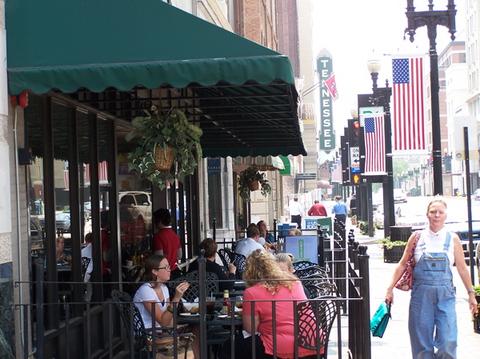
Many of us -- not me -- are too young to remember that Knoxville played host to a World's Fair in 1982. It has come a long way since.
It is no surprise that the highest priced markets for apartment and house rentals are in the cities where home prices are stratospheric. The average rental in New York City, according to a report in the Wall Street Journal , is over $2,700 a month, followed by San Francisco ($1,760), Fairfield County, CT ($1,760) and Boston ($1,590). Indeed, the 10 most expensive rental markets are all either in California or the northeastern section of the nation. (Note: If you cannot access the article by clicking here, then send me a note and I will email it to you. Just click on the contact us button.)
What is most interesting to me are the least expensive metro areas for renting a home, almost all south of the mid-point of the nation. We are quite familiar with two of them, Knoxville, TN (just $560 per month) and Greenville, SC ($580), having spent a week in each in the last few years. These low rents reflect a general trend across the southeast and make our argument that renting can be a sensible path to a more permanent situation. Relocation is a scary proposition, an expensive leap into the unknown. No matter how much research you do or what your local friends tell you, there is no substitute for getting the feel, taste and smell of a place.
Knoxville, for example, is an evolving city, with a lot of rehab activity and a special attraction for those who want to be close to a big-time university, in this case the University of Tennessee. The UT campus is downtown and its football stadium is right on the Tennessee River; some alumni actually float their boats to the game. For many, even those who don't bleed Tennessee orange, the ability to walk from their apartment or house to a football or basketball game, or to one of the hundreds of adult ed classes offered by the university, is reason enough to move there. The golf scene in the area is evolving, the most notable recent development called Tennessee National, about a half hour from town, sporting a classic Greg Norman design. The Shark gussied up the tough layout with bunkers made of layered sod, epoxied together for stability. It had not opened for play when I visited, but I could tell that it was going to make an impression.
Greenville, which doesn't have a major university but does feature its own river, The Reedy, has a thriving art and restaurant scene and a major cultural magnet, The Peace Center, a popular venue for shows and concerts. With the opening of a huge BMW manufacturing facility a couple of decades ago in nearby Spartanburg and all the related companies that have relocated to the area to supply the plant, the local economy is quite
Many of us wish we could dip our toes in the water before making the big leap to relocate to a new city or town. With prices to rent comparatively low across the southern U.S., you can jump in with both feet first, secure in the knowledge that you won't have to live with a bad decision.

The Thornblade Club and its Fazio course are golfer and family friendly.
If you are interested in looking at Knoxville, Greenville or any area in the southern U.S., let us know by clicking on the Contact US tab at the top of the page and we will identify the most qualified real estate agent, one who knows all the local golf communities and private clubs. There is no cost or obligation to you whatsoever.
 Home On The Course newsletter
Click here to sign up for our Free monthly newsletter, loaded with helpful information and observations about golf communities and their golf courses.
Final analysis: Tobacco Road
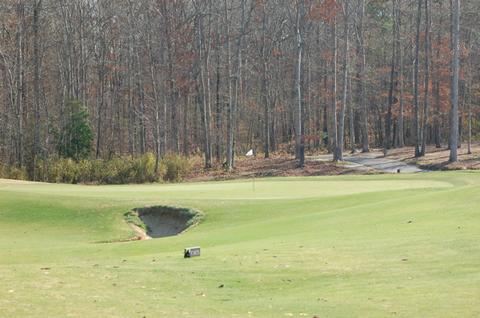
Architect Mike Strantz gives a wink and nod to the renowned Pine Valley, with which Tobacco Road has been compared. His tiny bunker at the 2nd green mimics the Devil's Arsehole at Pine Valley.
I hated Tobacco Road the first time I played it. It might have had something to do with the weather - 35 degrees, sleeting sideways. I held a grudge for the better part of six years. But a week ago Sunday, my son Tim inveigled me to give it another go on our drive back to his college. Under totally different conditions - 60 degrees, sunny with a gentle wind - I felt a little like Alan Shephard taking the most famous swing in history, a drive from a moonscape into the great unknown. Tobacco Road is somewhat otherworldly.
There are no homes adjacent to Tobacco Road, just a few remnants of an old asphalt factory and a hunting cabin. Pinehurst is about 45 minutes away, and there are excellent golf courses even closer, such as Quail Ridge, an Ellis Maples design nearby, and Whispering Pines, another Maples course within 20 minutes.
Tobacco Road is the big kahuna in the area, however, and it is not coy about its mischievous charm. It reveals itself on the very first tee, with two huge hills guarding a narrow gap of fairway 200 yards out. By "narrow," I mean just 15 yards. Fly those hills or else prepare to grab your sand wedge for a small piece of the 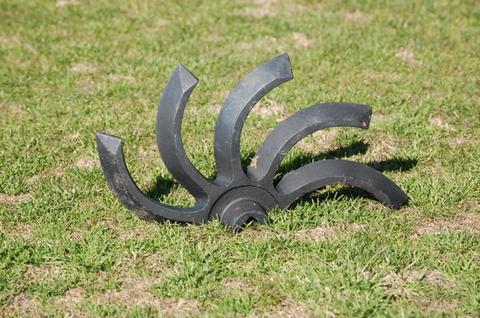 remaining 300-yard approach. After that first hole, the Road is one huge expanse of waste bunkers, interrupted by the occasional patch of green fairway. Overhead views of the fairways in the yardage book are like a bunch of Rorschach blots, with shapes reminiscent of Caspar the (Un)Friendly Ghost, the Headless Horseman and ET. Some holes almost double back on themselves, a few greens at more than right (or left) angles to the fairways.
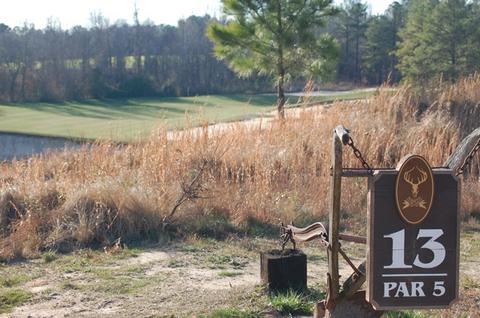
Other nutty touches abound. One green is 60 yards deep, another just 16. Some greens are invisible from fairways, including that 16-yard deep one, on the par 5 13th, necessitating a pegboard grid at the edge of the fairway that indicates the pin position. Some long and straight drives are penalized because the fairways taper down to just a few yards.
It would be impossible for even legions of maintenance workers to rake the hundreds of acres of waste bunkers on a daily basis, so Tobacco Road's local rule permits the smoothing of footprints and the re-dropping of balls in the bunkers (and since all bunkers are considered of the waste variety, you may ground your club
The pre- and post-game facilities at Tobacco Road are rather Spartan. The driving range is a good cart drive from the clubhouse and first tee and nothing special, just a warm-up range really. The practice putting green by the first tee is huge, with an immense hump in its middle, wasted space upon which no hole can be placed, but
 its swoops and swerves serve notice of what awaits out on the course. The clubhouse is modest, and the food and pro shop merchandise is modestly priced. Tobacco Road's employees are a friendly bunch, the starter at the first tee a raconteur eager to share his knowledge of the course and whatever other topics come up. (He chatted us up at length about his time in Lexington, VA, where my son attends college.)
Some compare Tobacco Road to Pine Valley. I've had the great fortune to play both, and although The Road is no Pine Valley in degree of difficulty, its forced carries over waste areas, its swirling putting surfaces and the feeling of pleasant exhaustion after the round did bring back some memories. The late Mike Strantz, Tobacco Road's designer, was certainly aware that his track might be compared to the great New Jersey course; he seems to pay homage on his 2nd hole with a copy of the tiny Devil's Arsehole bunker from the 10th at Pine Valley. But Pine Valley is more difficult - much more difficult in my recollection from 15 years ago when I hit the ball 20 yards farther and a little straighter. I shot 88 then playing considerably better than I did at Tobacco Road where I shot 84 with three double bogies.
Conditions on a January Sunday at Tobacco Road were excellent. I am sure the greens are cut a little closer at other times, but they were fast enough on a course where getting close to the pin is a hit or miss. There was
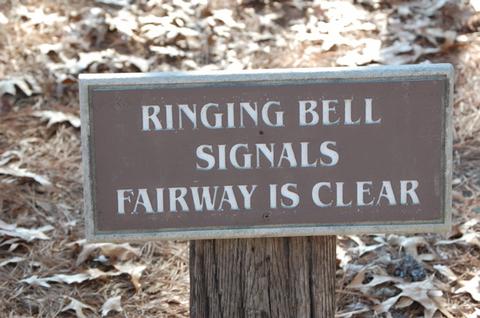 some inconsistency in the texture of the sands on the course, ranging from normal waste bunker sand (a little graininess) to a finer composition, especially around the greens. Occasionally it seemed the course had run out of both and added a red clay and sand mixture to a few bunkers. But when you can smooth the sand and ground your club, sand inconsistency makes less of a difference. My son and I had vowed to "roll ‘em over" in the fairways before the round, but I did not find it necessary to do so more than one time when my tee shot wedged in someone's unfilled divot mark.
A few other flourishes are worth noting. The course is on former farming land, and it pays homage with plows that display the hole numbers, and in its tee markers - a ripper (appropriately for the back tees), disc, plow, and cultivator. The ripper tees, at just 6,532 yards, are recommended for handicaps of 5 and below. The disc, at 6,300, is deemed appropriate for handicaps from 6 to 14. The differences between the course ratings - which predict how a scratch golfer will score - and the slope, which does the same for bogey golfers, are dramatic. At the tips, the rating is 73.2 (compared with par of 71) and the slope a hefty 150 (Pine Valley's ratings are 74.1 and 154, respectively). From the men's or disc tees, the numbers are 70.8 and 141. A bogey golfer should be quite content from the plow tees at 5,886, with a rating of 68.6 but a slope of 131.
I've changed my mind about Tobacco Road. It is occasionally annoying, but if you can escape its clutches over 18 holes, you will feel a great sense of accomplishment. If some member of Pine Valley wants to invite me back, I'm packed and ready. If not, I will be perfectly content to travel down Tobacco Road in the years to come.
Tobacco Road Golf Club, Sanford, NC. Tel: 877-284-3762. Web: www.TobaccoRoadGolf.com. Green fees from $49 to $134, cart included. Click for location on map.
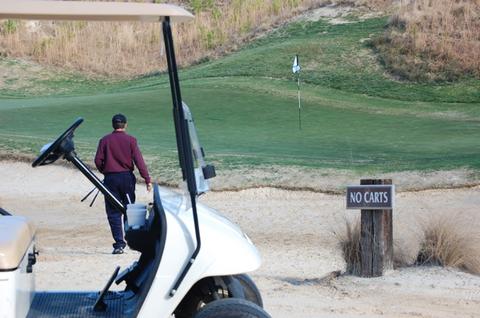
There are only a few sandy places where carts are not permitted at Tobacco Road.
Comments, please
We have upgraded the comments process here at GolfCommunityReviews, making it easier for our readers to add their own perspectives about our reviews and other observations. I hope you will share your own thoughts. As an encouragement and thank you, I will send to the first 10 people who submit a publishable comment a PDF four-color copy of a recent issue of our HomeOnTheCourse newsletter, with more than a dozen pages of reviews and comments about the Mt. Pleasant (Charleston), SC, area.
We look forward to hearing from you.
Larry Gavrich
Publisher
Driving down Tobacco Road's back nine
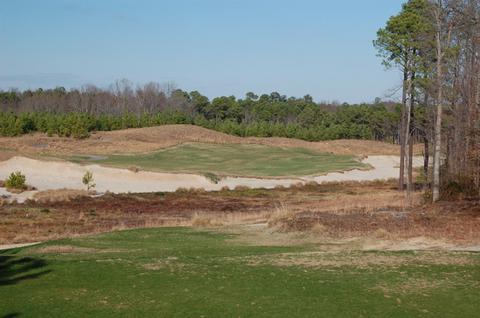
The tee shot at Tobbaco Road's 10th hole is best played down the left side for the best approach to the green.
Tobacco Road's locker room, just a bathroom really, includes a dozen lockers, all bearing nameplates. One is dedicated to Mike Strantz, who designed Tobacco Road and a handful of other courses and who tragically died of cancer at the age of 50 in 2005. The yardage book for the course includes a photo of Strantz, whose longish hair, walrus mustache and mischievous smile betray a certain élan and mischievousness that are on full display at Tobacco Road. The portfolio of work he left behind may not be large, but every course is distinctive and, especially for masochists, fun to play.
I featured the first nine holes at Tobacco Road in previous days. Here is a blow-by-blow rundown of the back nine at a course every golfer should play at least twice in their lives - once for the sheer experience and a second time to try to throw up a decent score. It can be done.
Certainly by the 10th tee, you should at least be used to the surprises and penalties Tobacco Road presents. Nowhere is the age-old advice about "fairways and greens" more appropriate or rewarding than at this unusual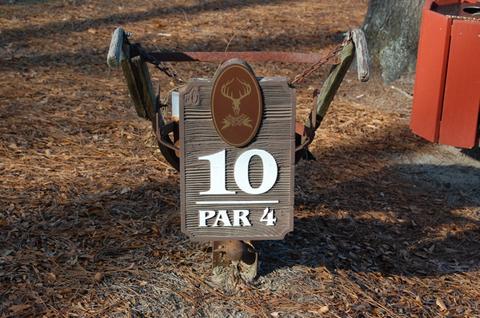 course. The 10th is a long par 4 with a dogleg right. A drive down the left side is necessary to have the best angle at the green with a long iron or fairway wood. If you are going to miss the green, it is best to leave your shot short and left to a generous mown area from which you can chip to the kidney shaped green. The green wraps around one of the smallest but most treacherous bunkers on the course. Miss just right of the green and you are in one of those ubiquitous wastelands with scrub bushes and acres of footprints. (Note: Local rules define all bunkers on the course as "waste" and permit smoothing of footprints and dropping your ball without penalty.)
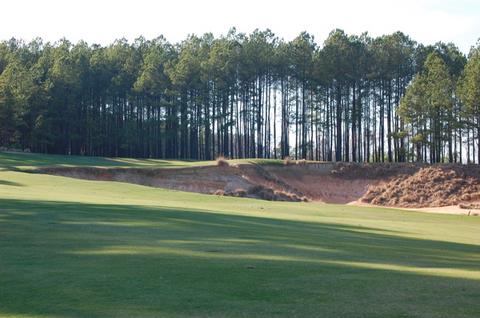
Far left is best for the approach to the elevated 11th green. Otherwise the approach is all carry.
The 11th shines as a great risk/reward par 5, the huge landing area off the tee begging for a drive about 250 yards to the right edge of the fairway, near the waste area, for a potential go at the green. That first challenge accomplished, the approach shot is about 200 yards over a wide expanse of waste and scrub to an elevated green. Land short of the narrow green and up and down will be nigh impossible. The same is true of a play from the deep bunker just over the green. The safe play on your second shot is a long iron to the elbow of the fairway before it turns back more than 90 degrees toward the green, a sand wedge away.
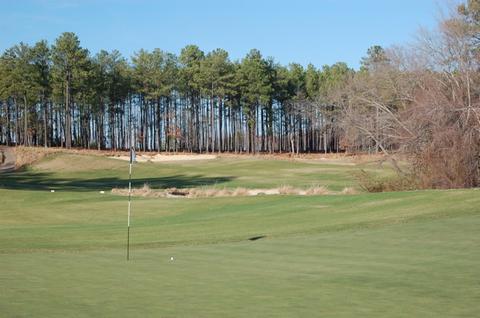
Although long, the par 4 12th hole is one of the more reasonable birdie opportunities at Tobacco Road.
The 12th, a 412-yard par 4, presents a quandary from the tee. Drive the ball more than 220 yards and the fairway narrows to virtually nothing. The wiser approach is to hit the ball about 210 or so for a long iron to one of the more receptive - i.e. least bunkered - greens on the course.
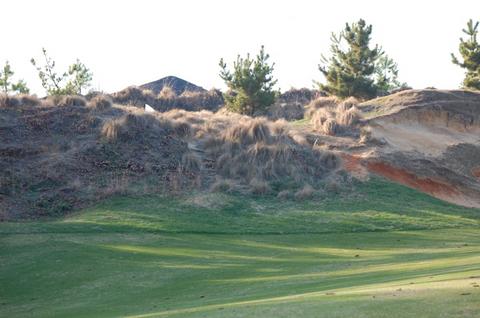
It takes a pegboard marker (inset) to have a clue where the pin is on the blind 13th green.
The double dogleg par 5 13th is vintage Strantz and the essence of Tobacco Road. The landing area off the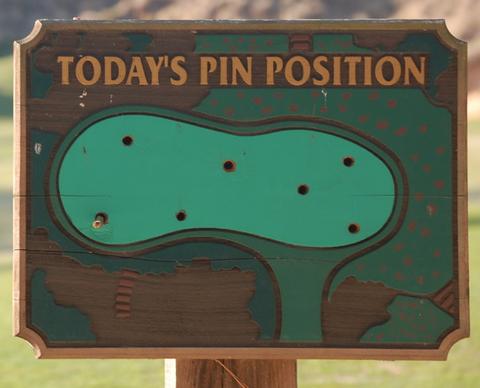 tee is generous as long as you don't try for too much length down the right, where a roll into a waste bunker could make it impossible to get your ball in position for an approach to the green. The
second shot should be approached without greed, a long iron to about 100 yards from the green. Ultimately, though, the 13th is all about the final approach to a green so hidden from fairway view that a pegboard near the second landing area indicates the day's precise pin position (see inset photo). The green is a mere 16 yards deep and a giant 47 yards wide, its only saving grace a bank behind and a little room just off the green way left. It is the toughest hole on the back nine.
tee is generous as long as you don't try for too much length down the right, where a roll into a waste bunker could make it impossible to get your ball in position for an approach to the green. The
second shot should be approached without greed, a long iron to about 100 yards from the green. Ultimately, though, the 13th is all about the final approach to a green so hidden from fairway view that a pegboard near the second landing area indicates the day's precise pin position (see inset photo). The green is a mere 16 yards deep and a giant 47 yards wide, its only saving grace a bank behind and a little room just off the green way left. It is the toughest hole on the back nine.
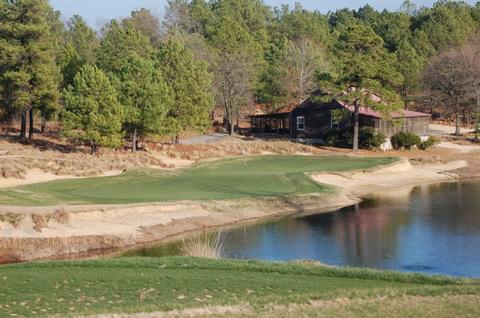
Our stroke of luck of the day was to find the pin in the center of the 14th green, the most accessible position on the multi-tiered surface.
We lucked out with the pin position on #14, a 158-yard carry over water to a 45-yard deep hourglass-shaped green surrounded by sand. The pin was dead center just below a dramatic rise to the back tier, but a 10 mph wind made club choice even more difficult. The water only comes into play if you are a club short or well right; a three-putt comes into play if you are putting from one tier to another.
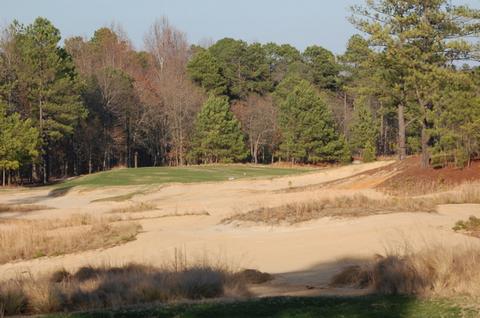
If you can work your ball left to right off the 15th tee, you will have the best look at the 15th green.
The 358-yard 15th demands a close look at the yardage book. From the tee, there doesn't appear to be much landing area, but it is actually quite generous if you don't hit your drive too long or too straight. How often do you hear that about a par 4? But Strantz splits the fairway with a waste area that is more gnarly bushes and grasses than sand; at 240 yards out, it can be reached from the tee. A fairway metal to the right and just short of the waste area provides the best angle to a green shaped like a whale with a huge tail at its front, just a few yards beyond the middle-fairway waste area. A long drive down the left leaves a short approach but to a narrow stretch of green surrounded by waste areas.
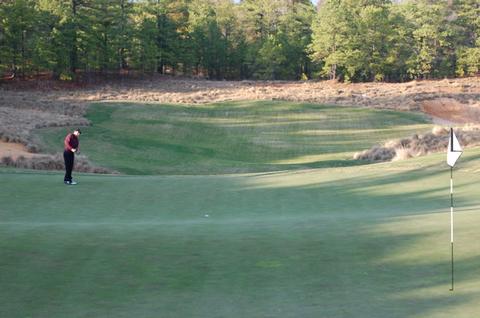
After a well-placed drive over the quarry (on the right), a short approach to a back pin leaves a tricky long putt up a steep slope.
Ahh, the 16th, an even shorter par 4 at just 321 yards but one that demands essentially the equivalent of two approaches to par 3s. It is tough to reconcile a 9 iron off the tee on a par 4 but, incredible as it may seem, that could save you from disaster on this devilish hole. Just a 125 yard shot down the left side leaves a 135-yard approach to a large, round, roller coaster green with a large false front. Otherwise, your play from the tee is a shot of between 170 and 210 yards over a quarry, the benefit being an approach of less than 100 yards, the detriment being that if you are short or long on your tee ball, the next shot may be unplayable from the quarry or a sandy wasteland.
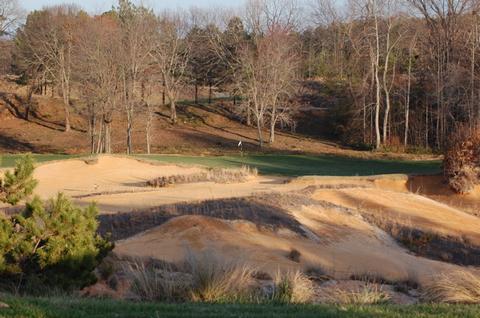
At the 17th, the pin on the day we played was at the narrowest part of the widest green I have every played.
The final par 3 on the course sports the widest green I have ever played, more than 50 yards from one end to the other. Its depth to width ratio and amoebic shape is such that even if you hit the green, you might not be able to putt to the hole. It is possible to leave yourself a 120-foot putt; a shot just short and in the waste bunker could very well be a better alternative.
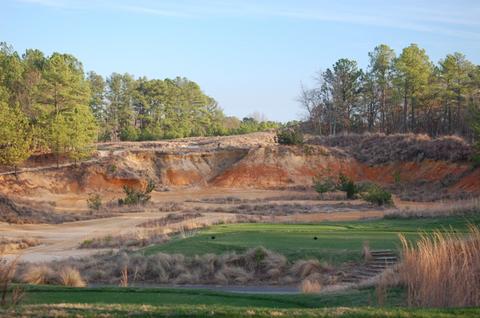
You push exhaustion aside on the teebox at the finishing hole. It is a fitting last drive on a day of intimidation off most tee boxes.
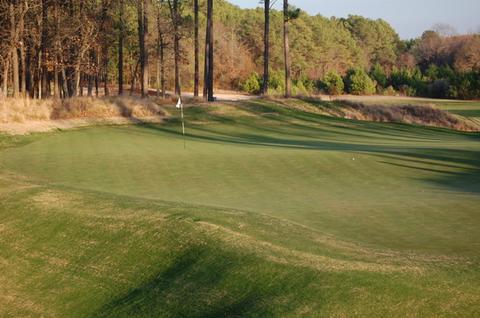
Finally the trek at Tobacco Road ends very much in the way it began as you face an incomprehensible looking tee shot. Where is the fairway, you wonder, even after consulting the yardage book? This is the most menacing drive of the day, a 200-yard carry over a sheer red clay cliff before a long iron to the green. Yes, a little finger of fairway stretches back toward the cliff, but you have about as much chance of stopping your ball on it as you do on the green at the 17th at Sawgrass (and with as much trouble surrounding it!). Grip and rip a drive and be happy anywhere on the short grass, although the right side of the fairway provides the only look at the green (top photo below). As if to add one last insult to a round of injuries, the greens keeper placed the final pin on the crest of a hill at the left rear of the green (see bottom photo). The only reasonable putt was from the right and below the hole, all others breaking wildly and fast.
I'll have some final wrap-up comments on Tobacco Road in the next day or two.
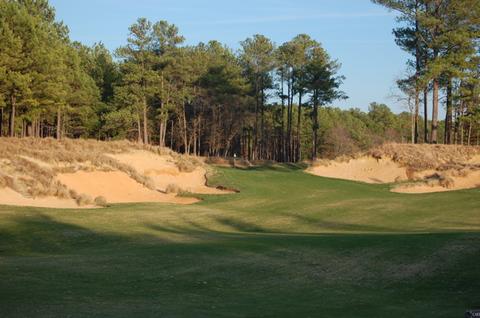
Consider yourself fortunate if you hit the fairway on the 18th, doubly so if you are on the right side of the fairway (above) so you are not flying blind on your approach. Consider it unlucky if the greenskeeper has awakened on the wrong side of the bed and placed the pin on a ridge (below).
From my mailbox...
Note: GolfCommunityReviews has no marketing arrangements with any golf course communities or clubs. We report what strikes our fancy and what we think will be of interest to our readers.
Incentives laden: The incentives keep piling up for those lucky enough to have the ability to purchase a second or retirement home in the current dismal market. Sea Trail, a sprawling Sunset Beach, NC, golfing community about 25 miles from Myrtle Beach, SC, is trying hard to move their Eastwood Bluff town homes, which debuted early last summer. The developer is offering free membership in the 2,000 acre community's three golf courses by Rees Jones, Dan Maples and Willard Byrd, a $15,000 value; no dues for membership in the first year after purchase, a $5,400 value; and $10,000 toward the cost of the town home. The 2,300 square foot and greater units each feature a private elevator and garage; views of fairways, pools, ponds and lakes are still available, and you can walk or ride a bike to the beach. According to one of Sea Trail's sales representatives, the community has plans for a total of 22 buildings, with four units in each, to complete Eastwood Bluff. To date, two buildings are up with just three of the eight units sold. One additional incentive: Current units are available starting at $595,600, but later units will be pegged at over $800,000. Of course, if the market continues its slovenly ways, the next incentive may be lower prices...
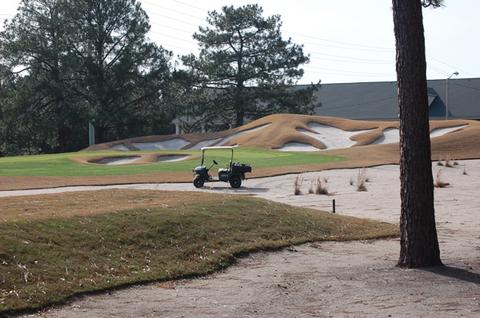
The Founders Club (above) trucked in a lot of sand and moved a lot of earth to transform the old Sea Gull Golf Club into a high-end daily fee club in the Low Country of South Carolina. The shot is from the waste bunker to the right of the 9th fairway.
Laying waste bunkers: The latest Travel & Leisure Golf magazine may have missed the mark with its rankings of the top 100 golf communities in the U.S. (see yesterday's article below), but its "New Course Review" section is always a fun read. The magazine includes the upcoming Founders Club, due to open in Pawleys Island next month, as one new layout to note. It claims the layout, totally redesigned by Thomas Walker, was "inspired by Pine Valley," which is something of a stretch based on my own walk around parts of the course two weeks ago. That said, a lot of sand has been dumped beside the fairways, and the former Sea Gull Golf Club layout has way more waste areas than it ever had. I am looking forward to playing Founders in March and will report here on whether it offers a Pine Valley like challenge...
Lucky 13: LINKS magazine, one of our favorites especially for its lush photographs and go-anywhere-to-get-them attitude, is sponsoring a contest that provides an opportunity to design the 13th hole on a new layout by Arthur Hills, one of the design business's most underrated architects. The prize for the best design will be two visits to the Westhaven Golf Club in Franklin, TN, during construction and for the course opening. And, of course, a kind of poor man's golfing immortality...
True, but still false advertising: You would think that with the signing of Gary Player and Tiger Woods to design The Cliffs Communities' seventh and eight courses in the Carolina mountains, and Jack Nicklaus and Tom Fazio designs already in the fold, no further hyperbole would be needed about the benefits of Cliffs membership. But The Cliffs continues to quote Resort Living magazine, which is published by the Cliffs' own marketing agency, that the Cliffs offers "one of the most comprehensive and impressive club memberships in the world." That certainly is true, but the false advertising is unnecessary and unbecoming.
Proximity, privacy and logic not factors in T&L Golf's sloppily researched community rankings
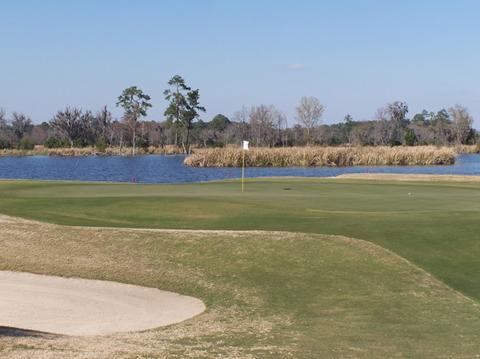
The Ford Plantation, whose Pete Dye course is one of his most restrained and best designs, made the Travel & Leisure Golf magazine's list of top 100 golf communities in the U.S.
Travel & Leisure Golf magazine is out with its annual ranking of the "Top 100 Golf Communities" in America (January/February 2008 issue). Aside from some surprises near the top, the list is noteworthy for playing fast and loose with the definition of "private golf club." "Limited public access to the course," write the editors, "is allowed but may detract from a community's ranking."
Kiawah Island, for example, is listed at #5, but most of the island's courses are accessible to those staying in one of the townhouses or at the hotel on property. I'm not sure I'd consider my course "private" if, every day, dozens of interlopers are out there hacking up divots and leaving ball marks on the greens. Frankly, you don't even need to be a guest of the resort to gain access to the courses; if you want to play Kiawah's famed Ocean Course, for example, all you need to invest is $400 for green fees and an
The magazine rates Sea Island, GA, even more remote than Kiawah, as the top community in the nation. It is indeed a beautiful place of great history, personality and well regarded golf, but it is an almost two-hour drive from the Savannah and Jacksonville airports, neither of which leads the nation in non-stop flights from elsewhere. Of course, if you can afford a multi-million-dollar second home in one of the island's nine neighborhoods, chances are you will be flying by private jet to McKinnon Airport on nearby St. Simons Island. Most of the Sea Island courses are also accessible to resort guests, so you have to wonder how much that really "detract[s] from a community's ranking" in T&L.
T&L gives short shrift to the perennial top two communities in GolfWeek's own annual rankings - Wade Hampton in Cashier's, NC, and Cuscowilla in Eatonton, GA. Wade Hampton, which certainly meets the T&L spec of exclusivity, weighs in at #18; the magazine notes that the accompanying Tom Fazio layout celebrated its 20th year in 2007. Cuscowilla, because its terrific Coore/Crenshaw course is fully accessible to the public, is not listed at all.
But a couple of courses we are familiar with do not stand up to the magazine's "limited public access" only disclaimer. The Pinehills in Plymouth, MA, for example, is on the list, but you can book tee times online or with a phone call at either its Rees Jones or Nicklaus Design course.
A few of my personal favorites are on the state-by-state list, including the Ford Plantation in Richmond, GA (sleek Pete Dye course), The Reserve at Lake Keowee in South Carolina (Jack Nicklaus Signature), and Bald Head Island (George Cobb links-style course) off the North Carolina coast. But Bald Head is no different than Cuscowilla; anyone is welcome to play the course (the club's web site calls it "limited public play" but call ahead and you won't have a problem). You just need to drag your clubs onto the ferry in Southport for the 25-minute trip to the island, well worth it in the estimation of this correspondent (although pure island living is not for everyone). Also, if Bald Head makes the list, where is Haig Point, home to a very private Rees Jones 27 hole course in a lush and historic setting on Daufuskie Island in Scouth Carolina? The community is far more amenable than Bald Head, which is overrun with beach goers in the summer and, frankly, desolate in the winter.
Overall, the T&L golf community list is a jumble. The magazine considers "location" as one of its criteria but seems more concerned with "natural setting" than "proximity to cultural activities." Sea Island's "cultural activities" are notoriously slim, unless you want to take Gullah language courses. And the inclusion of clearly distinctly public golf courses on the list sabotages T&L's attempts to position itself as The Robb Report of golf course communities and makes the ranking less than pristine. Let's hope for better definitions and better research next year. Until then, we still prefer the less stuffy and more clearly detailed rankings in GolfWeek.
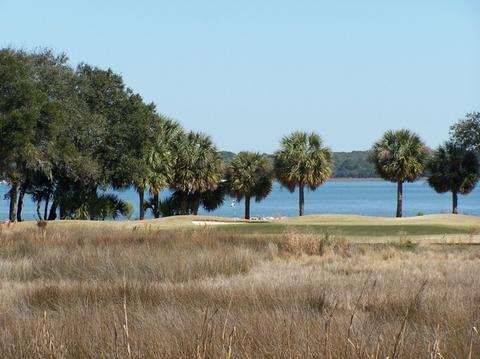
Members at Haig Point on Daufuskie Island in South Carolina should protest being left off the T&L rankings. Their community and 27 hole Rees Jones course, recently refurbished by the designer himself, more closely fits the criteria of the rankings than does Bald Head Island, which made the list.
Tobacco Road redux
The more I think about and write about my round last Sunday at
Tobacco Road, Mike Strantz's signature design in Sanford, NC, the more
I am beginning to understand that there is more to the course than
meets the eye. What meets the eye is a relentless expanse of waste
bunkers and huge greens and swirling fairways that are intimidating to
all but the bravest ball strikers among us. What doesn't meet the eye,
besides the handful of totally hidden greens, is that Tobacco Road just
isn't as tough as it looks.
I left off yesterday at hole #4. Here is a rundown on the rest of the front nine.
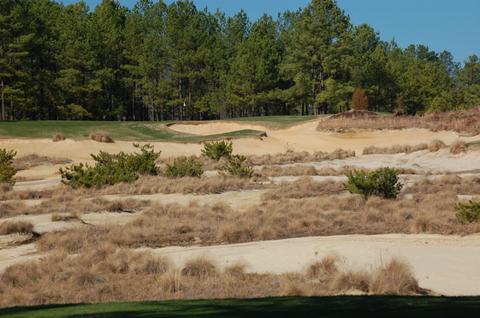
The safest route at the short par 4 5th at Tobacco Road is a fairway wood up the right side (to the right of the edge of the photo above), leaving a short iron or wedge to the green. Long hitters might take a poke at the green, but missing it and the tongue of fairway in front could take away any birdie possibility.
At 322 yards from the men's tees (333 from the tips), the 5th is one of those short par 4s that tempt big hitters to go for the green. Between tee and green stretches more than 200 yards of no man's land, but a swath of about 30 yards of fairway jutting into the sand in front of the green makes an attempt a reasonable gamble with a driver. Fairway to the right is generous until about 115 yards from the green; from there the landing area narrows significantly, as it should, inside 100 yards. A pin at the front of the smallish, false-fronted green provides the greatest challenge since a long approach shot means a downhill curling putt and short of the pin could mean a bunker shot over a steep lip. The 5th is an easy par and reasonable birdie if you resist temptation off the tee.
The par 3 6th is all sand, tees and green, a total hit or miss affair. You won't find a par 3 with more teeing options, nine of them ranging from 117 yards from the left up to 160 from the far right. The green, which is shaped somewhat
The 7th is about as straightforward as Tobacco Road gets. A par 4 at 400 yards, the blind tee shot needs to carry 200 yards to run down the hill to an area inside 150 yards to the green. About 80 yards of wetlands separate the fairway from the tri-cornered green that, of course, is totally surrounded by sand. I met my Waterloo at this hole, not because I was in the marsh but because I pushed my approach into the waste area to the right of the green and tried to get too cute with a high blast over the steep bunker. I left it short, the ball rolled back to my feet, and before I knew it I made one of my three double bogies of the day, a disappointment since anything worse than par at #7 is dispiriting.
The arcing green at #8 is a big challenge if the pin position is right rear, which of course it was last Sunday, in
The longish par 4 415-yard 9th would be a proud finisher on most courses, but at Tobacco Road, it is just another intimidating hole. A drive of 200 yards minimum is a must to not only fly a narrow neck of fairway wedged between waste areas, but also to leave a reasonable approach to an otherworldly green whose depth measures 38 yards and whose width is about the size of Betty Boop's waist (relatively speaking). The approach is straight uphill to the elevated green, and figuring out whether it is an extra club or two clubs is critical to being within 30 feet of the pin. The drive to the right side of the fairway may require skill, but for first timers, a lot of luck is mixed into a successful approach shot.
Look for more on Tobacco Road in this space in coming days. If you have played it, I sure would be interested in your own take on this unusual golf course. Please use the "comments" function below...
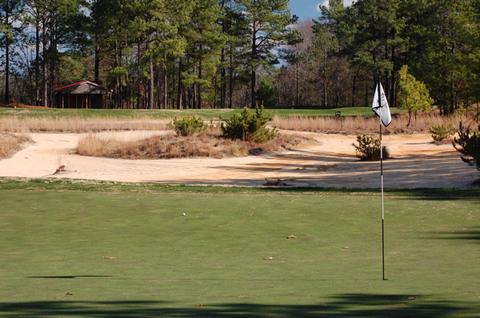
The par 3 6th can be played in any number of ways, all challenging, depending on tee placement.
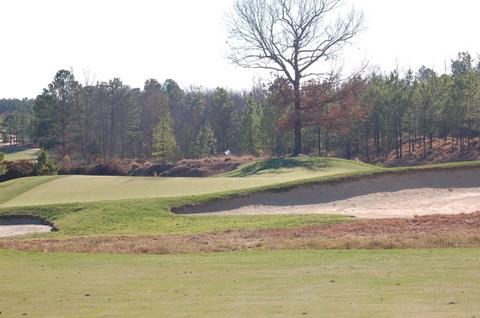
The par 4 7th is a relatively "normal" hole, but the green is surrounded by fearsome waste bunkers.
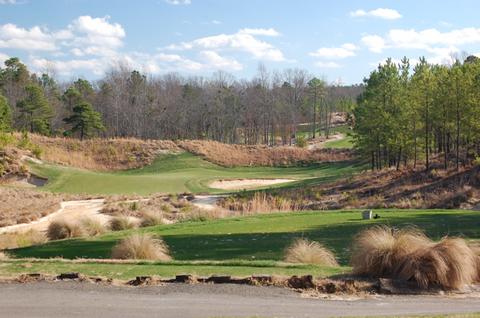
The tee ball on the 8th, the third par 3 on the front nine, must carry all the way to a back pin position or else you risk a 60 foot putt that must negotiate multiple levels.
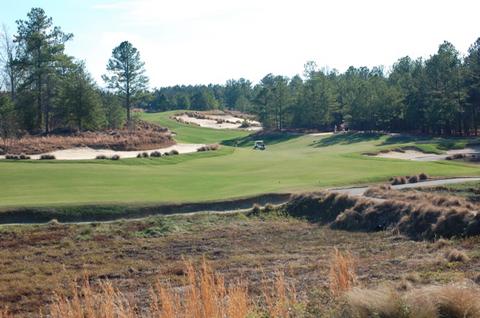
The par 4 9th hole demands a well placed tee shot...
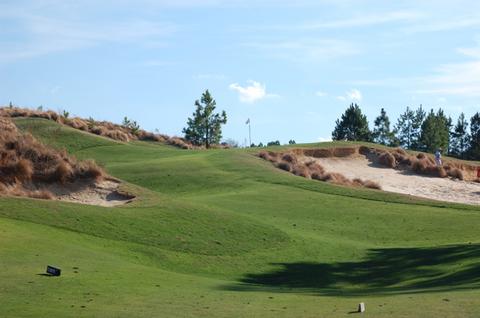
...and a perfect club selection in order to get the ball anywhere near the hole on the elevated and almost totally blind green.
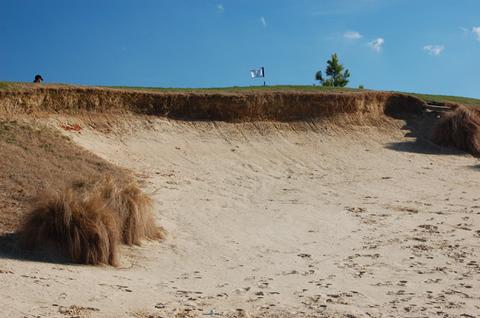
If you miss the green, this (above) is what awaits you.
Tobacco Road: Tough to love or hate
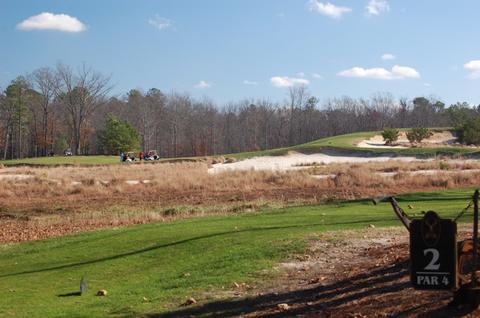
Into a stiff breeze, the carry from the 2nd tee to the raised fairway feels like 200 yards plus.
Tobacco Road in Sanford, NC, made me sick the two times I have played it in the last six years. The first time it rained and sleeted relentlessly for nine holes before I quit with chills that didn't go away for four hours, despite the welcoming circular fireplace in the rather spare clubhouse. Last Sunday, I barely made it through 18 holes in sunny 60-degree weather; the treks up and down the steep faces of sand traps and the steps to the elevated greens took their toll on this out-of-shape 60 something. My feet took me boldly where no cart was free to go, although carts are free to go virtually everywhere through waste bunkers except up their slopes. The final five holes left me literally breathless, and I went six over par.
There is much about Tobacco Road that will take anyone's breath away, in the best sense of the word. At times the course's dramatic expanses of scruffy, sandy wastelands, deep bunkers at greenside and swirling fairways and greens seem to channel Pine Valley, the best golf course I have ever played. This being a public golf course, however, Tobacco Road could not exist as such if it were anywhere near as tough as Pine Valley. Forced
The course ratings and slope ratings tell much of the story of Tobacco Road's schizophrenic personality. From the men's tees I played at a modest 6,300 yards, the rating is just 70.8 (against par of 71) but the slope is a robust 141. In other words, a scratch golfer should not shoot worse than par on the course, but a bogey golfer will have trouble. It played out that way for my son Tim and me. I am a "soft" 10 handicap these days, meaning most of my rounds are between 82 and 86, and I play enough bad strokes to be severely penalized on a course with a high slope rating. At Tobacco Road I shot 84 with three double bogies; I thought I played pretty well except for a few bad drives and approach shots.
Tim, who plays collegiate golf, loves Tobacco Road and all courses designed by the late Mike Strantz and carries a handicap near scratch, shot a splendid 69 from the back tees, which play to a short 6,530 yards. He didn't think he played any better than he did a day earlier at Pawleys Plantation, Jack Nicklaus' tough course in the Low Country of South Carolina, where he shot 76. At Tobacco Road, he hit his drive on #1 280 yards over the huge mound that guards the right side of the fairway (see photo accompanying Monday's posting), then put a solid three-wood shot up into the following wind. His ball wound up just 12-feet beyond the hole. He sunk the putt for eagle and played even par over the next 17 holes.
The yardage book describes the 2nd at Tobacco Road as a "welcome sight after the testy 1st hole" but it didn't look welcome to me from the tee
The 3rd, a short par 3 (147 yards from the men's tees), is all about the narrow green, which runs 60 yards deep. We were fortunate the pin was in the middle of the multi-tiered surface. A shot to above or well below the hole puts a three-putt in play. And the green is just narrow enough to make the bunkers left and right a factor.
The 4th is perhaps the most reasonable birdie opportunity on the front nine, a 507-yard par five that requires a well positioned drive and second shot to a wide fairway about 125 yards from the green. That leaves a pretty simple short iron to a kidney shaped green but, as with every green at Tobacco Road, a pushed or pulled approach will almost guarantee bogey.
I'll have further comments and photos of other holes in coming days.
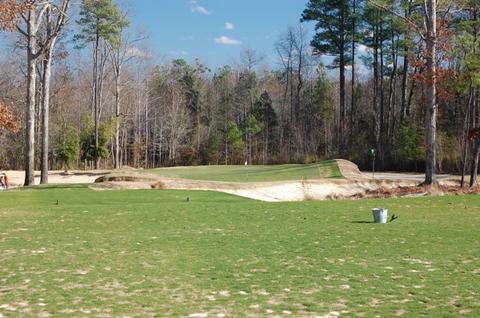
The green at the par 3 3rd hole is deep and narrow and multi-tiered. The only "easy" pin position is in the depression in the middle of the green...
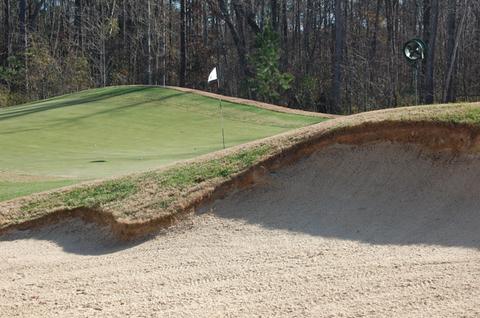
...but if you come up short and right, it will be an uphill battle for par all the way.
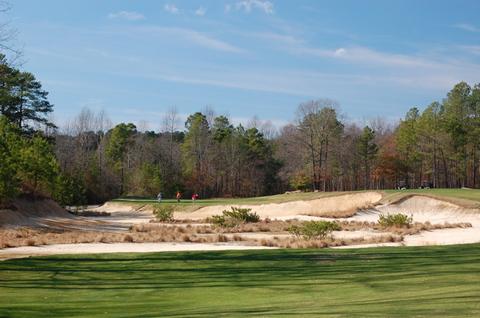
The 4th may be the most reasonable birdie opportunity on the course, a par 5 with a generous landing area for second shots (upper right of photo), leaving a simple wedge or 9-iron approach to the kidney shaped green.
Golf and the race for the U.S. Presidency
However, the kindly Richardson, a former Cabinet official and Ambassador to the United Nations, could be a strong candidate for vice president on either an Obama or Clinton ticket. The bet here is that he would be able to play a lot more vice presidential golf working for the strong-willed Clinton, who will count more on her husband for advice on foreign (ahem) affairs, than for the less-experienced Obama...
Speaking of Giuliani, most of the pundits following his campaign find his strategy of going "all in" in Florida a bit strange. The mayor hardly campaigned in Iowa, made a few appearances in the final days in New Hampshire, and will be a virtual no-show in upcoming primaries in Nevada and South Carolina. But Mike
"Well," he responded, "the mayor loves to play golf, so maybe this [the weather] will spur him along."
Perhaps Giuliani, who carries a 16 handicap at two upscale Long Island courses, figures that if he loses in Florida, he can just stay there for a few days and play...
We tried to find a handicap rating for Mitt Romney, but he isn't listed in Massachusetts, New Hampshire (where he owns a vacation home) or Michigan, one of the other states he claims as his home (he grew up there). A Google search of "Romney" and "golf," however, does yield a number of web sites selling Mitt Romney golf shirts. We're not sure the sartorially correct candidate would wear them, however. They are kinda tacky; one has a garish and large script "Mitt 2008" stitched above the left breast. But the description of the fabric as "mid-weight" could not be more appropriate for a campaign that has finished a disappointing second in two races it expected to win...
Perhaps the most bizarre combination of golf and the politics of the season is a site called GolfVacationsExtra which certainly offers something "extra" beyond golf. The site proprietor appears to be a Ron Paul supporter with a visceral dislike for Romney. The site includes a string of videos purporting to show voting fraud by Romney staffers during a Florida straw poll. They are a bit silly and shrill, so proceed at your own risk.
Free lodging in private homes around the world
The Internet is also one big swap meet, with sites like SwapVillage offering a way to dump stuff you don't want in exchange for someone else's unwanted stuff...or to loan out one of your most expensive possessions in exchange for someone else's expensive possession. In just a few months, I am going to do just that.
For the last six years, I have been a member of Homelink International, one of a number of web sites that serves as middleman for short-term exchanges of homes around the world. HomeLink charges a modest
My brother, who owns a home in San Francisco, has made a number of successful exchanges with other members in Italy, France and New York City. From my own observations as well as online discussions with other HomeLink members, homes in such iconic American cities as San Francisco and New York, as well as properties in Florida, are extremely popular with Europeans. (This could be one of the only good reasons to pick up a distress condo in Miami, to use it as trade bait.)
We are about to conduct our first exchange. I was bound and determined to play golf in Scotland this year for the first time as a 60th birthday present to myself, but the rapid devaluation of the dollar was going to make that expensive, if not impossible. As if by magic, I received an email a few months ago from a retired couple who live in Glasgow offering an exchange of their vacation home in Crail, on the east coast of Scotland just nine miles from St. Andrews, for our place in Pawleys Island. Crail is itself home to two well-regarded links courses at The Crail Golfing Society, and courses at Elie and Lundin are within a few minutes drive. The timing was perfect; in April George and Dorothy will stay at our condo in Pawleys Island, and in mid-June my son and I will stay in Crail.
It has been fun emailing back and forth with George and Dorothy, providing them with recommendations on golf courses they should play near our home and getting the scoop from them on Crail and the local environs. Tim and I will be dropping our names in the ballot box at St. Andrews every day until we win the lottery and get to play the Old Course. Now all I have to do is learn how to drive on the "wrong" side of the road.
HomeLink permits non-members to look at listings around the world, so if you want to check it out, click here. In June, I'll be reporting on our experience in Scotland and our first turn at house swapping.
Chewing (on) Tobacco Road
Brutal reality of golf course ownership
Preview: Founders Club, Pawleys Island, SC
The opposite of the "sky is falling"
Now on Sale
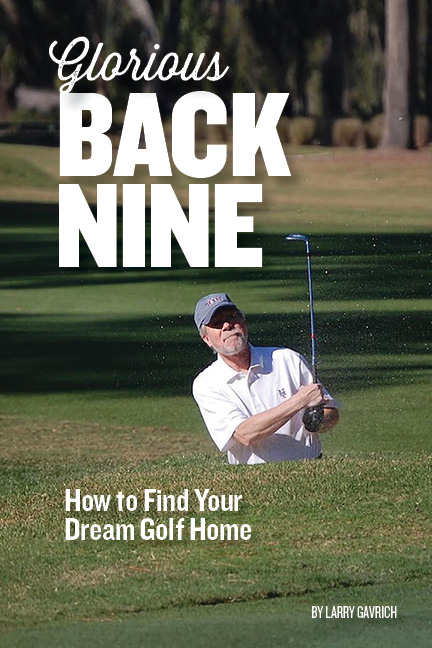
- The only book about golf communities in the last 10 years.
- 156-page step-by-step guide to finding your dream golf home.
- Info on nearly 100 golf communities the author has visited.
- Paperback version costs less than a sleeve of Pro VIs.
Here is what the experts are saying:
“The book is chocked full of information…applicable to anyone looking for a move to the Southeast regardless of whether they are looking for a golf community or not.” — John LaFoy, golf architect (Linville Ridge CC, CC of Charleston, The Neuse GC)
“Larry has done a tremendous amount of work and anyone — like me — who is looking to search for a golf home now or in a few years needs this book.” — Brad Chambers, golf blogger, ShootingYourAge.com
“Wow! What a thorough piece of work…a must for anyone moving South. This book will help many people.” — Brett Miller, owner and founder of MMA, Inc, a golf industry consultancy
Buy It Now at Amazon.com or BarnesandNoble.com.