Talking the walk: One important question for active walkers to ask before they purchase
When asked to rank their number one physical activity, baby boomers say "walking" or "hiking" substantially more often than golf, tennis or any other recreation. Golf courses are great places to walk, and the non-golfers who live in golf course communities do so because the cart paths that wind alongside holes and often along rivers, marsh and forests are pleasant places for a hardy stroll.
But not all courses are walker friendly. Nearly half the courses in communities we have visited have restrictions on walking the cart paths. Okay before play begins and from an hour or two before sundown; not okay during the hours of play.
Some of the better amenitized communities, like the Cliffs in the mountains of the Carolinas, have built in miles of hiking trails nowhere near the golf courses. Some, like Mountain Air outside Asheville, NC, have even hired naturalists to supervise educational walks through the wilderness. Of course, some of these communities pay for the amenities with higher priced real estate and fees.
Our advice when you begin considering seriously the purchase of a home in a golf course community is to ask about any restrictions along the course. Better yet, find a few residents and ask them whether any rules are strictly enforced. At our summer course in Pawleys Island, SC, strollers are frowned upon during play. Yet plenty of our fellow residents do it, and we haven't heard of any incident that spoiled a good walk.
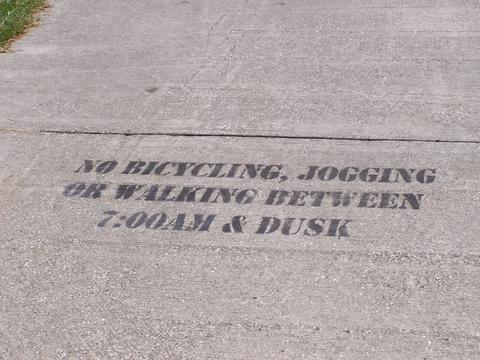
A warning stenciled on the cart paths at Coosaw Creek Golf Club in Summerville, SC.
 Home On The Course newsletter
Click here to sign up for our Free monthly newsletter, loaded with helpful information and observations about golf communities and their golf courses.
Wild Dunes' magic in ocean, wind and Fazio
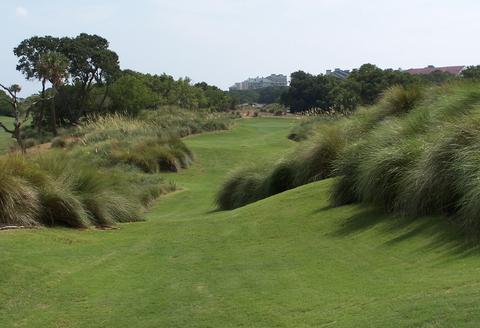
The 12th is the best and most dramatic of the Links Course's par 3s.
by Tim Gavrich
The Links Course at Wild Dunes is a resort/daily fee facility located on the Isle of Palms, 15 miles north of Charleston, SC. Open for play since 1980, it is one of Tom Fazio's earlier designs, and one of his best-regarded. The golf course is solid overall and comes to a dramatic close with the final two holes playing along the ocean. I rate courses on a number of criteria, with my ratings ranging from 1 (Repulsive) to 10 (Exceptional). I invite your own opinions; simply use the Comments function at the bottom of this article.
Golf Course Setting: 8 ~~ The Links Course winds through the Wild Dunes resort area. Although houses line many of the holes, the scenery is quite pleasant and varied. The transitions between a typical, wetland-heavy Low Country setting and dunes (of varying proximity to the ocean) are fairly smooth. True to their billing, the 17th and 18th holes are spectacular. One problem: beach erosion has caused the 18th hole to begin to fall into the ocean (see yesterday's posting, immediately below this review). Dozens of huge sand bags line the left side of the final hole, seriously impeding the landscape, leaving players with a bad taste in their mouths at the end of the round. This is the only quibble with the setting of the course.
Golf Course Condition: 8 ~~ The Links Course was in extremely good condition. The Bermuda fairways were lush and cut fairly tightly; well-struck shots were not met with any resistance, and divots were large. The rough was thick and penal; a missed fairway made reaching the green in regulation a chore indeed. The Champion Bermuda greens, though very smooth, were rather slow. The oppressive summer heat and lack of rain have most coastal courses exercising caution when it comes to mowing the putting surfaces. The golf course would have been even more enjoyable had the greens been faster.
Quality of Green Complexes: 8 ~~ The Links' strongest suit was its set of greens. The greens themselves are smaller than average (appropriate for a golf course of such modest length), but possess quite a lot of undulation. Nearly every greenside bunker was small, deep, and circular -- it is evident that designer Fazio wished to bring the concept of pot bunkers of the British Isles to coastal South Carolina. The highlight among all the green complexes comes at the par 5 5th hole. The elevated green is tucked between dunes, and a large mound with a tiny bunker scooped into it prevents the player from seeing the bottom of the flagstick. The green combines both strategy and quirkiness - I would enjoy hitting hours of shots to the green from a variety of distances.
Quality of Par 3s: 7 ~~ The par 3s at the Links Course do not vary much in terms of distance, but the fact that they play in three different directions means that the winds that blow over the Links Course site necessitate a variety of tee shots. The greens complexes are also sufficiently different to present four different looks on the par 3s. The strongest among them is the 12th hole, which plays to a green set among dunes. The view towards the green is breathtaking, and the constant breezes make the hole all the more intimidating.
Quality of Par 4s: 7 ~~ The par 4s at the Links course vary nicely in length, direction, and difficulty. Although there is no drivable par 4 on the course, there is plenty of fun to be had on the two-shotters. From the drive-and-wedge 10th (331 yards from the back tees) to the brutish 427-yard 13th, the player's long game receives a thorough examination at Wild Dunes. The strongest par 4 on the course is the penultimate hole, which whisks the player to the ocean and sweeps along the beach to a green tucked amid the dunes.
Quality of Par 5s: 5 ~~ The three-shot holes at the Links Course are its weakest point. The 1st and 14th play alongside one another and in the same direction, and due to the beach erosion eating away at the left side of the 18th, what was already an extremely narrow hole is getting narrower by the day (see yesterday's article below). It is becoming something of an eyesore instead of the inspiration it was designed to be. The huge sand-filled plastic bags pollute the scene, leaving players with a bad taste in their mouth at the end of the round. The highlight among the par 5s is the 5th, whose green is discussed earlier in this review.
Routing of Golf Course/A Good Walk?: 6 ~~ As is true with most courses routed among condos and houses, the Links Course is rather spread out (although nothing like the resort's Harbor Course, which runs straight out for eight holes and straight back for 10 and is the least favored of the two Fazio designs). Lengthy green-to-tee walks abound at the Links Course, so walking is all but out of the question. The 14th tee is beside the 1st and 10th tees, so members could potentially walk four or five holes late in the afternoon but 18 are out of the question for all but the hardiest souls.
Overall Rating: 7.5 ~~ At 27 years, The Links Course at Wild Dunes is one of the older resort courses that bump up against the Atlantic, and it has weathered (pardon the pun) the devastation of Hurricane Hugo in 1989, after which its ocean holes had to be rebuilt. The finishing hole once again appears to be in for some restoration as the ocean currents wear away at the dunes that hold the 18th in place. Although homes line most of the fairways on the course, our foursome threatened the out of bounds stakes just two or three times. Overall, the Links layout provides an intriguing test of a player's skills throughout the round and enough of a seaside feel to keep members and daily fee players alike coming back for more.
Wild Dunes Links Course, Isle of Palms, SC. Phone: (800) 845-8880. Web site: www.wilddunes.com
Yardage/Rating/Slope
Black: 6709/73.2/131
White: 6193/70.4/128
Gold: 5536/67.3/118
Red (W): 4907/70.4/120
You must own property in Wild Dunes to be a member of the club, which provides access to both the Links and Harbor courses. Full family golf membership for residents is $25,000, with monthly dues of $342. Non-resident initiation is $15,000 with dues of $206. Access to the club's fitness center requires an extra fee. Daily greens fees for non-members range from $135 to $165, depending on season.
We will discuss the community of Wild Dunes in an upcoming issue of HomeOnTheCourse. To subscribe today and receive the just released August issue, with an exhaustive review of the Williamsburg, VA, golfing communities, click here. It is easy and secure, and at just $39 for six issues annually, quite possibly the best real estate investment you will ever make.
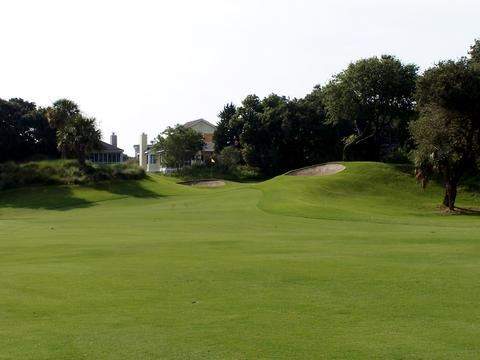
The most intriguing green complex at the Links is at the par 5 5th.
Sandbagged on the 18th at Wild Dunes
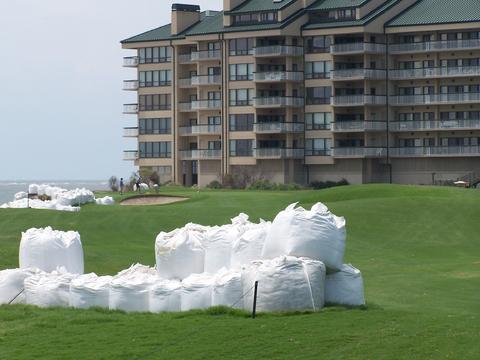
Typically, a hulking condo building behind a green is depressing enough for a golfer, but the sandbags that line the left edge of the 18th fairway and the green at Wild Dunes' Links Course are even sadder. We hope they turn back the sands of time.
Mother Nature won't give a break to the famed Links Course at Wild Dunes on Isle of Palms in South Carolina. In 1989, Hurricane Hugo tore through Charleston and the barrier islands just north of the city, destroying hundreds of homes and the two finishing holes at Wild Dunes. Sand had to be pumped back up onto the beach and reshaped to hold up the ocean side of the par 5 18th hole.
We played the Tom Fazio designed course yesterday - he also designed the milder Harbor Course for the resort -- and were impressed with the layout and condition. Look for Tim Gavrich's review here tomorrow. But we were also depressed by the sight of huge piles of white sandbags beginning 2/3 of the way down the 500-yard finisher and extending to the very edge of the green. The tide was in and the ocean was beating at the sandbags, some of which had disintegrated, the empty bags flapping around at the base of the none-too-stable sand wall. We asked one of Wild Dunes "golf ambassadors" about the status of the hole, and he indicated there were plans to re-pump sand from slightly offshore to prop up the wall. Those plans are on hold, pending the hatching of sea turtle eggs in another few weeks.
The turtles had better hurry, for their sake and Wild Dunes'. This is hurricane season, and Hugo is not the only big storm to erode the resort's beaches in the last 30 years. As you stand on the very edge of the 18th green, you can peer straight down into the normally roiling waters. Any more erosion and the green could soon be the smallest in South Carolina. Also, the fairway has already been encroached to the point of being almost unfairly narrow; it is a tough enough hole to begin with, given the strong left to right winds that force you to aim your tee shot at the beach. I hit what I thought was a perfect drive down the center, but it drifted right and into the dunes near the attractive homes that line the first part of the fairway.
It was an ugly finish on an otherwise fair and fun golf course. We hope the turtles do hurry up, and Mother Nature doesn't.
Raves for Caledonia totally deserved
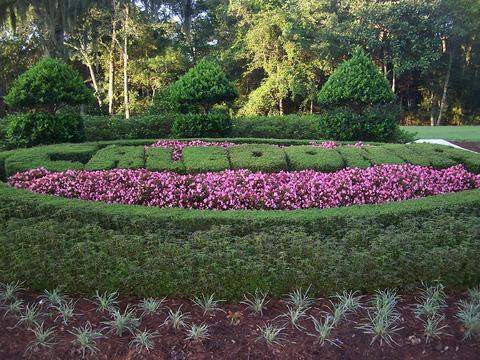
The carved hedges at the first tee hint at the landscaping on the rest of the course.
I can't complain about the golf courses I've played these last few weeks in coastal South Carolina. Most have been in good condition but showing the effects of drought conditions along the coast. I've putted on greens that had been stress-relieved by aeration just a few weeks earlier and were still a wee bit bumpy. (Note: I turned down a chance to play Patriots Point near Charleston when the pro shop, to its credit, informed me they had aerated two days earlier.) Those that hadn't been aerated were less than close cut, for obvious reasons. Until yesterday, I hadn't putted on any green that I could call fast. The layouts of the courses I've played have been good to near-excellent; I'd put Arthur Hills' Coosaw Creek course near the Charleston International Airport and Rees Jones' Charleston National in the near-excellent category.
Yesterday I played the best course this year at the highly rated Caledonia Golf & Fish Club in Pawleys Island, SC. Raters in Zagat's golf guide gave it a 28 of 30, ranking it up there with most storied layouts in the land. The condition yesterday for the dead of summer was phenomenal, and the layout was better than I had remembered it from the half dozen times I had played it previously, the most recent three years ago. The course managers, who also run the companion True Blue Golf Club down the street, spend a lot of money on landscaping and irrigation, and they tend to the course with the fussiness and tender loving care of an Augusta National. Although it hadn't rained the night before, we were relegated to cart path only until 9 a.m. after some early morning watering (our tee time was 7:30). The course drains well and the fairways could have easily handled the cart traffic, but who is going to argue with folks who seem to have every blade of grass in place?
Caledonia was designed by the late Mike Strantz whose eight other golf courses are a little bizarre for my taste. Strantz has his fans, my teenage son among them, because his courses are unique, with landscapes that often seem as if they are of another world. Huge mounds hiding landing areas, greens perched on bulldozer-made hills, misshapen greens with often-severe dips and turns...you can expect the unexpected at such Strantz-designed tracks as Tobacco Road, Royal New Kent, and the sand-surrounded True Blue, which is almost a "normal" routing that had to be modified a few years ago because it was gaining a reputation as too tough for the average vacationing golfer.
But Caledonia can stand up to the best from all the great modern designers. It begins with a fair, routine par 4 whose only "troubles" are a fairway trap and elevated green; and it ends with a par 4 with an all carry approach shot over water that offers all sorts of options off the tee and from the fairway. On the finisher, you can hit something less than a wood off the tee to lay-up just short of the water, but your 160 yard approach shot will have about a 20-yard margin in which to land on the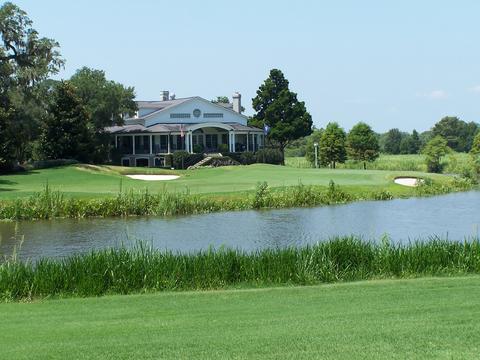 long-but-not-deep green; short is water and long is a menacing trap. Or you can try to bust the ball down the middle, which will leave you an approach over the narrow part of the water to the 50-yard-long green. Push the drive right, and you are hitting three to the green after a drop. Pull it left, and you'll be negotiating a hill and downhill lie over the water. When you get to the green, the fun really begins, not just because it is 150 feet long and severely contoured, but also because the deck of the adjacent plantation style clubhouse almost hangs over the back of the green. Try making a five-foot putt to halve the match while those who have come before you are watching, second and third beers in hand.
What makes Caledonia special is that, unlike Strantz's other courses, the hazards are clear and evident, not hidden, and you have bail-out options that don't necessarily cost you a stroke (if you can handle 60-foot putts on slick greens). The devilish little par 3 11th is an excellent example, especially when the pin is up front, as it was yesterday. A stream runs along the front left half of the narrow green and feeds a pond along the entire left side. The pond isn't really in play, but if you want to get 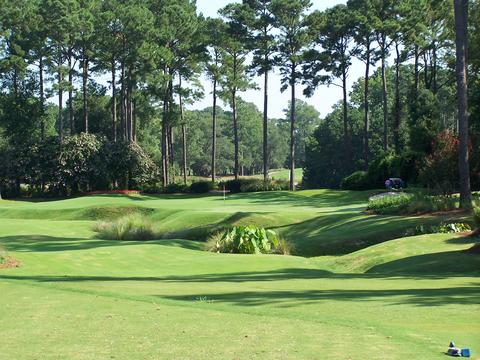 close to the pin, you will need to play a high shot into the prevailing breezes. Too much finesse will put you in the muck in front, from which bogey or double is a sure thing. You can take the more conservative long left route, but that leaves a downhill putt through a valley and up again to the pin. Or you can lay-up - yes, I know, it's a short par 3 - and give yourself a 15-yard flop wedge up the hill and hope for a one putt.
Most of the customary Strantz "drama" at Caledonia is in the greens. The eighth green on the par 5, reachable for the longer hitters, is severely banked with a hill about 1/3 of the way back. Third shots into front pin positions are relatively easy, as you can use the three-foot high bank as a backstop. But make the mistake of hitting up top, and your putt downhill will risk rolling past the pin and over the retaining wall into the water.
The greens were near flawless yesterday, and fast. I did not feel cheated on any putt, even though I lipped out three or four times. Although there was plenty of dew on the fairways before the sun burned everything off, I didn't come close to needing to improve my lie in the immaculate fairways. Workers, who stayed discreetly out of the way, were all over the course raking the flower beds and cutting grass in the rough, demonstrating Caledonia's commitment to live up to its reputation as "Augusta like." Although the course looks its best during spring blooming season, it looked fantastic today, with lots of pinks and reds in the flowered areas to contrast with the bright greens, sand-trap whites and muted blues of the water.
Caledonia is part of the Waccamaw Golf Trail, a newly invented marketing venture that packages the best of the South Strand's courses. Besides Caledonia, the Trail includes its companion course, True Blue, plus Heritage, Pawleys Plantation, the soon to open Founders Club and a few other good courses just 10 minutes north. But Caledonia is easily the best. It is not inexpensive to play, although the Myrtle Beach Passport I described here a couple of weeks ago knocked $30 off the $97 greens fees for my guests and me. (Note: You must be a full or part-time resident of one of the three local counties to qualify for the $39 card.) In the high seasons of spring and fall, fees approach $200, the highest on the Grand Strand. Caledonia is well worth it.
Caledonia Golf & Fish Club, which is not part of a housing development, is located 1 ½ miles off U.S. Highway 17 in Pawleys Island, SC. The club offers annual memberships that provide deeply discounted rounds, but you would have to play nearly 100 rounds to make the investment worthwhile. Phone: (800) 483-6800, or (843) 237-3675. Web site: www.fishclub.com. Par 70. Back tees: 6,526 yards, rating 72.1, slope 140. Middle tees: 6,121 yards, rating 69.9, slope 134. Front tees: 5,710, rating 67.8 (M), 73.0 (W), slope 129 (M), 128 (W). Tees are also available from 4,957 yards.
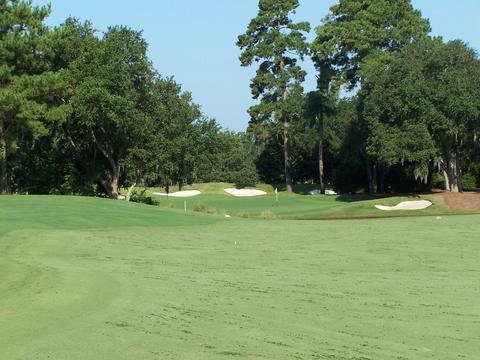
The 8th green is one example of the steeply banked greens at Caledonia. You can play the approach off the bank behind a front pin position. But if you are too long, your comeback putt could be lost in the marsh in front.
Tobacco Road chews you up and spits you out
That these two layouts could be the product of one person's imagination says something about creative possibilities in the human mind. Tobacco Road, about 40 minutes from Pinehurst in the Sandhills of North Carolina, is a roller coaster ride of a golf course, definitely not for the faint of heart, or the uninitiated, as it throws one blind shot after another at you. No course begs for an investment in a yardage book like Tobacco Road does, with its severe mounding, highly elevated greens, and landscape out of Star Trek. Playing it two or three times in succession will shave a few strokes for sure. First timers with a 10 handicap would do well to break 90 on a track whose slope ratings - 150 and 142 for the better players - defy its modest yardages, 6,500 and 6,300 yards respectively. Bring a forecaddie and an extra dozen golf balls when you play Tobacco Road. You can afford them; golf fees are modest in the extreme, never tipping the $100 mark and, during summer, a downright bargain at $59 on weekdays.
Caledonia, on the other hand, is beautiful, sleek, and not at all rough around the edges. It shares only one thing with Tobacco Road, beside its designer pedigree -- no houses encroach on the design (although we heard the sound of pounding nails on one new home behind the 17th hole). Caledonia is also expensive, approaching the $200 mark for greens fees in the high seasons of fall and spring. It is worth every penny, and I will have more to say in this space, with a few photos, later tomorrow.
Recently encountered hazards
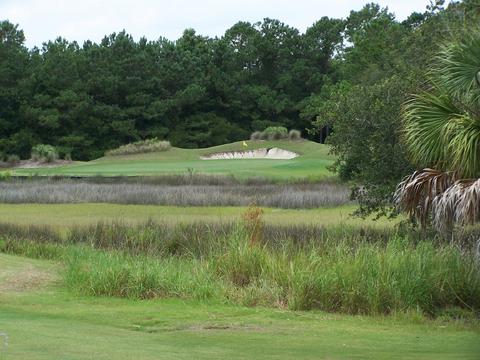
The marsh on Low Country golf courses looks peaceful enough, but danger lurks.
The Charleston National golf course, just east of its namesake city in South Carolina, is a solid Rees Jones layout whose hazards are mostly visible from tee to green. They include a large number of fairway and greenside traps, some of them positioned to snare your wayward shot and make you pay, but others almost a saving grace. That is because they often separate your errant ball from the worse fate of the adjacent marshland. Charleston National has plenty of marshland, and once your ball enters the muck and mire of that terrain, it is lost forever.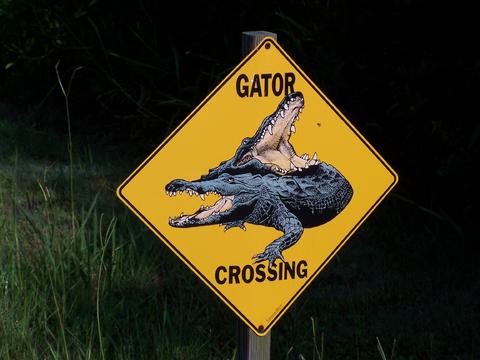
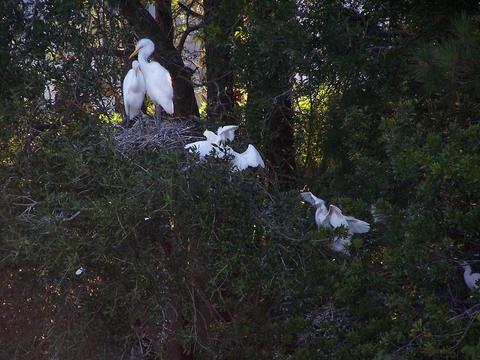
Should you enter the muck and mire yourself, you might be lost forever as well. Although the Low Country marsh is home to many docile and exotic birds, such as the majestic Great Blue Heron and elegant snowy egret, it also hosts more territorial animals who don't appreciate home invasions, alligators and poisonous snakes chief among them. When playing golf in the Low Country, it is wise to heed all warning signs. Gators especially do not usually venture near fairways and greens, but snakes can be slightly more adventurous. Playing golf at a place like Charleston National gives added meaning to the term "keep your head down."
Money talks: Magazine ranks best towns for '07
Lake Mary's position just 30 minutes from Orlando and 45 from Daytona Beach puts it close enough to the hustle, bustle and advantages of big city conveniences and the beach, but far enough away so as not to suffer many of the consequences (traffic, pollution, crime). The area is chock a block with golf courses, and the article in Money is embellished by a photo of a hole at Timacuan Golf Club, which was built in the center of the town. The green in the photo is surrounded by sand. Membership in the semi-private club seems reasonable at $5,500 for full family golf, and $275 a month for dues. Timacuan was designed by Ron Garl and Bobby Weed, two respected, if not first-rank, architects. Money writes that the best things about Lake Mary are its small town nature, a robust economy and zero state income tax. The worst, as you might guess, are the hot summers and threats of hurricanes coming across the Gulf of Mexico.
Suwanee, which is located along the Chattahoochee River about 40 minutes northeast of Atlanta, also boasts a range of fine private and public golf courses, including some inside the gates of communities. Home prices in River Club, for example, with its private Greg Norman course, begin above $1 million. The Arthur Hills' Olde Atlanta Club is also located in Suwanee and is one of 18 clubs in the greater Atlanta area managed by the Canongate organization. Membership in one club makes the 17 others accessible for a modest payment of greens fees (although as a full golf member, you will not pay fees at your "home" club). Bear's Best, a compilation of 18 of Jack Nicklaus' holes from other courses he has designed, is also inside Suwanee's city limits. We are not sure about the flow of a course that borrows the individual holes from elsewhere, but Nicklaus himself designed Bear's Best, and he is fussy about the quality of his work. The course is open to the public.
Only two other towns in the southeast made Money's top 25 best places to live: Apex, NC, and Holly Springs, NC. Both are just at the fringe of the popular city of Raleigh. Best of all for the golf obsessed, the two towns are a straight 45 minute shot down U.S. Highway 1 to some of the best golf in America, at Pinehurst.
Money's web site has data on all its top 100 places.
Myrtle Beach loss Panama City gain?
Panama City, FL, a town that has an almost single-minded orientation toward expansion, is applying for the $48 million federal airport grant money Myrtle Beach is forfeiting. As frequent fliers into Myrtle Beach in the past, we have seen one airline after another either eliminate or cut back on service. Prices for flights from our home in Connecticut to the Grand Strand have risen steadily to the point that we drive the 16 hours to our vacation home 40 minutes south of the airport.
Some cities in the south are not ready for prime time, incapable of building the infrastructure (roads, airports, hospitals) to accommodate the population expansion that has been predicted for years. Put Myrtle Beach in that category when you are considering a home in a golf community. There is still much to like about the area - the assortment of golf courses is second to no 100-mile stretch in the nation - and new hospitals and shopping centers have filled a prior need in recent years. But until the city and county officials can reach an accord to solve the airport issue, local part-time residents may find the car a much better option than the plane.
You can read the details of the airport fiasco in a Myrtle Beach Sun News editorial today.
Ginn again: High-class developer attracts LPGA to Rivertowne
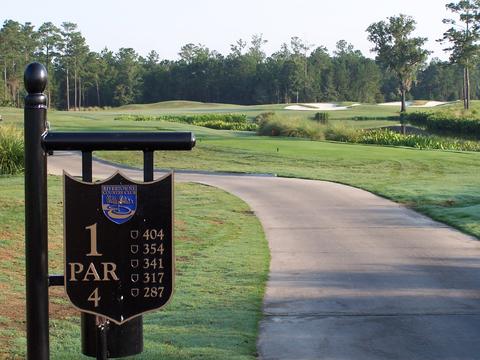
The 1st at Rivertowne is a wonderful starter, and a sign of things to come. The safe play is left of the traps with something less than a driver. But if you have warmed up on the range, you might want to take a flyer over the far trap, leaving less than 80 yards or so to the green. Many drives at the Palmer designed course provide similar options.
Bobby Ginn and the organization that bears his name have a thing for South Carolina, apparently. In recent years, they have developed Cobblestone Park in Columbia and incorporated the University of South Carolina golf course into the plan; and in Mt. Pleasant, just to the northeast of Charleston and adjacent to Isle of Palms, home to the popular Wild Dunes resort, Ginn has taken over the sprawling Rivertowne development and also bought the daily fee Patriots Point course, with scenic holes that play out along Charleston harbor. To promote Rivertowne, Ginn convinced the LPGA to stage a tour event there and engaged Annika Sorenstam as the sponsor. It seems to be working; in the current low-volume real estate market, big homes are sprouting in the community.
I played the Arnold Palmer designed Rivertowne yesterday, and although I am not a big fan of the King's layouts, this one was packed with interesting plays, especially from the tee boxes. It didn't hurt that, in general, I struck my driver better than I had in months, but standing on the tees and noting the landing areas on the GPS systems in the cart, I didn't see much room for error. Without the GPS, some of the blind drives over traps and mounding would have been annoying and frustrating. But with the guidance system, I felt a little like a member in terms of where to aim. (We played the "Members" tees, which also helped us feel like members.)
The GPS, however, didn't help one of my three playing partners, who were all from the Knoxville, TN, area. Jerry striped the ball a good 275, often with a sweeping hook that added distance on the firm fairways. Many times we thought he had bombed one down the middle only to find that he had gone through the fairway and into the rough; a few times, we never found his ball. At Rivertowne, unlike other courses I played in the Mt. Pleasant area this week, it is all about the first shots on most holes, not about the greens. The pins at Rivertowne are quite approachable from most points on the fairways, and the putting surfaces are smooth and medium fast. I found them by far the easiest to read of the four courses I played in the area this week.
Jerry, along with his friend Wes and son Chad, a high school sophomore who would like in a few years to play on the University of Tennessee golf team, were in the area for a week's vacation with their families. As indicated above, we played the "Members" tees which, at 6,267 yards, certainly didn't make for a long routing. And it wasn't a difficult one either as long as you approached the greens from the fairways. Shorter approach shots typically encountered bunkering in the fronts of the greens; longer holes sported green complexes that were more approachable. The greens themselves were firm, with well-struck short irons rolling some six feet or more beyond their pitch marks. On longer irons, you needed to play mostly to the front, no matter where the pin was. Only on one hole was a putt from above the hole unstoppable at the hole, and that was on #5, where the pin was in a gully in the middle of the green, and our foursome was on the hills left and right of the pin. None of us stopped the ball within three feet.
Rivertowne's greens fees top the $100 mark, which for the dead of summer in the area is pretty steep, two to 2 ½ times what the local competitors are charging. But the competitors don't offer the GPS or the insulated boxes of iced-down towels at three of the tee boxes, a blessing on a day with 95-degree temperatures and no wind. The pro shop and on-course staff combined friendliness with professionalism, a Ginn hallmark. After my day before at Charleston National, where the service and accoutrements did not match the course layout, Rivertowne was quite a contrast. Was it worth the relatively steep price? I think so and look forward to a return visit. Thanks to Wes, Jerry and Chad for their spirited play and fellowship.
I'll review fully the golf communities in the Mt. Pleasant area in a fall edition of HomeOnTheCourse. Sign up now to begin your annual subscription with the August issue, which features golfing communities in the Williamsburg, VA, area.

Left to right, Wes, Chad and Jerry bore witness to my best nine holes of the year, a stellar 35 on the front nine (fairways and greens and head still on the putts were the secret). Alas, it did not last, but I still broke 80...barely.
Devil in (lack of) details at Charleston National
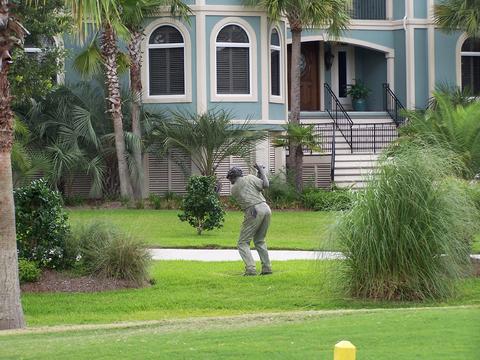
One golfer is a permanent fixture adjacent to the 16th tee at Charleston National. He comes with the house that has breathtaking views of the marsh, the Intracoastal Waterway and the length of the 16th hole. It is listed above $3 million. If interested, let me know .
Charleston National, about 10 miles east of Charleston, SC, is a wonderful Rees Jones layout that winds its way through and around wide expanses of marsh. I spent an engaging four hours on the course yesterday. The layout reminded me of Haig Point on Daufuskie Island, another Jones designed course; that's a compliment to Charleston National. At one point during the round, we drove from green to next tee over two long bridges with nothing but marsh on both sides. The views were spectacular.
Charleston National winds its way through a natural zoo of sorts. Scores of snowy egrets roosting in trees next to one tee box made such a consistent racket that it did not affect concentration. Signs around the course warned that looking for balls in the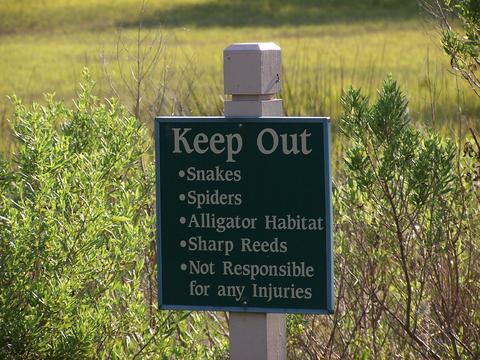 wet stuff might not sit well with the local residents (not the homeowners, but rather the snakes and alligators).
Add to the experience my match-up with Mike, Bill and Jack down from the Myrtle Beach area for the day, which only made the four hours more enjoyable. They are great comrades, clearly, since no one was offended by the constant and aggressive ribbing the gave each other, and two-foot putts they didn't give each other. It had been a long time since I last heard the expression, "A lot of chicken left on that bone" to describe a putt of three or four feet. Yesterday I heard it multiple times. It sounded good.
All in all, it was a near perfect day, tainted only by a few bad swings off the tee - well okay, maybe more than a "few" - and some silly missteps by the management of Charleston National. Forget that we were not offered towels to take along with us to mop up on a 90+ degree day. The towels have become basic at high-end daily fee courses, which Charleston National has the potential to be. What really took the cake was the scorecard. It wasn't until the fourth hole that we realized the scorecard was 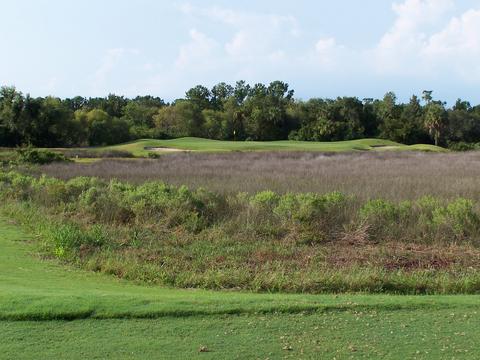 backwards, that we were playing the front nine - according to the nice granite markers at each tee box -- but the layouts and distances on the scorecard were for the back nine. Neither the young man who took our reasonable greens fees ($46) in the pro shop nor the starter who took our receipts on the way to the first hole mentioned a thing. After the round we asked the starter, who clearly didn't think it was his responsibility to alert us, what the story was. "Oh," he said, "they ran out of scorecards and decided to use the old ones [from before the nines were switched]."
I found out later from a real estate contact in the area that the owner of the club is a skinflint. He switched the nines earlier to cut staff in a snack shack out where the original nine ended. Now, golfers wanting a candy bar or hot dog and drink after #9 trudge up a long flight of stairs to the grille. The former front nine ended with a par 3; now the finisher is the par 3. If you are like me, you don't much care to finish on a hole where you have slim chances to save a round with a birdie. I doubt Rees Jones was consulted.
Oh well, maybe management will wake up, spend a little to make a little more, and match the service to the quality of the golf course, which was in good shape. To Mike, Bill and Jack, thanks for letting me tag along.
Note: The area just northeast of Charleston, a wonderful and historic southern city, is rich in golf course communities, including Rivertowne (Arnold Palmer), Dunes West (Arthur Hills), Snee Farm (George Cobb) and the Wild Dunes Resort (Tom Fazio). I'll report on the golf lifestyle in the area of Mt. Pleasant, SC, as well as the real estate options there in an upcoming issue of our HomeOnTheCourse community guide. The latest issue (August), dedicated to the communities in the Williamsburg, VA, area, will be available next week. Don't miss an issue. Subscribe now .
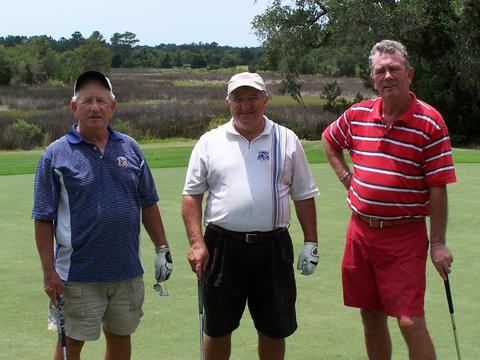
Left to right, Mike, Jack and Bill from Myrtle Beach were great company at Charleston National. When I asked Bill to try one photo without his hat on, he bragged that he had earned the "Best Hair in Myrtle Beach" title in the late '90s. I believe it.
All quiet on the green front...so far
Idle worship: Tiger fetish hurts TV coverage
Now on Sale

- The only book about golf communities in the last 10 years.
- 156-page step-by-step guide to finding your dream golf home.
- Info on nearly 100 golf communities the author has visited.
- Paperback version costs less than a sleeve of Pro VIs.
Here is what the experts are saying:
“The book is chocked full of information…applicable to anyone looking for a move to the Southeast regardless of whether they are looking for a golf community or not.” — John LaFoy, golf architect (Linville Ridge CC, CC of Charleston, The Neuse GC)
“Larry has done a tremendous amount of work and anyone — like me — who is looking to search for a golf home now or in a few years needs this book.” — Brad Chambers, golf blogger, ShootingYourAge.com
“Wow! What a thorough piece of work…a must for anyone moving South. This book will help many people.” — Brett Miller, owner and founder of MMA, Inc, a golf industry consultancy
Buy It Now at Amazon.com or BarnesandNoble.com.