Why of the Tiger: Distractions fell Woods
Focus is the key to success in all professional sports. Try hitting a rising 97 MPH fastball while wondering if your sick father will survive the night in hospital. Or thread through 200 MPH traffic at Talladega while contemplating if your wife is cheating on you. At least in baseball and car racing, though, decisions are made in a split second. Roy Halladay throws you a 3 & 2 fastball up and in or Tony Stewart cuts you off on the back turn, and you have little time to think. You just react.
In professional golf, you don’t have the “luxury” of quick reaction
For Tiger Woods, it is not the swing. Look no farther than his performance on par 5s this weekend at Whistling Straits. What, after all, is a par 5? It is three opportunities (two, for the long hitters) to screw up before they get to the green (in regulation) and two more chances once there. In that regard, the par 5 is probably the best guide to a golfer’s focus, consistency boiled down to just one type of hole played an average four times per round. Par 5s are “money” for the great players, where they rack up the birdies and occasional eagles that, on tough courses like the Straits, give them the luxury of playing a bit more conservatively on the tougher 3s and 4s.
Woods is +1 on the par 5s going into the final round of the PGA Championship, his worst competitive performance on three-shot holes ever. Arguably, those of us who sport high single- and low double-digit handicaps could perform as well hitting a long iron off the par 5 tee boxes, then another long iron to 100 yards or so, and then a short iron or wedge to the greens for a routine par.
Woods is not the only giant struggling out there. Phil Mickelson is barely scratching his way around Whistling Straits. But the contrast is stark; Mickelson’s distractions are not of his making, and include a recently diagnosed disease that has changed his diet and lifestyle, as well as his wife's and mom's battle with cancer. Woods’ well-documented distractions, on the other hand, are not exactly sympathy inducing.
By showing his true stripes off the golf course, Tiger Woods seems to have lost them on the course.
 Home On The Course newsletter
Click here to sign up for our Free monthly newsletter, loaded with helpful information and observations about golf communities and their golf courses.
So far, so good, say Cliffs residents
The Cliffs, the high-end group of golf communities in the upstate region of South Carolina and the Asheville, NC, area, is running a membership special. The next 50 members will pay “just” $100,000, down from the normal $150,000 for The Cliffs’ six golf clubs. Over the next two years, the roster of golf courses is planned to grow to eight with the addition of a Gary Player course and Tiger Woods’ first American design at High Carolina.
The Cliffs Communities made headlines for its hire of Woods to design the course. When Woods crashed his SVU last Thanksgiving, plans
Cliffs residents came to the rescue. Earlier this year, after Anthony made it clear he would have to seek private financing at nearly usurious rates, and that in case of default some bank would wind up as owner, a hardcore group of Cliffs members provided a generous $64 million in loans in exchange for a 12% interest rate, the waiver of dues for the seven-year term of the loan, and the existing clubs as collateral in case of default.
The loan money is already being spent, and spent well, according to a few of our readers.
“Work is moving fast on Player’s Mountain Park course,” says an owner at The Cliffs Valley, “and it will be done next spring or summer. I walked the course last month. It will be a great addition, the most walkable of any Cliffs courses…”
When The Cliffs and Tiger Woods first announced the High Carolina project, they indicated it would be a “walking only” course but later pulled back from that plan.
Another of our readers who is building a home in one of the Cliffs Communities near Lake Keowee wrote that, “There is an upbeat feel as construction is proceeding on a number of amenities with the completion of the bond offering.”
“I can tell you that contractor pricing is very good right now,” he added. “I am building this home for less now than if I had done it two years ago.”
If you are interested in more information about The Cliffs or would like the name of a sales agent there, please contact me.

The Cliffs at Glassy, designed by Tom Jackson, was the first course of the current six in the communities. In the early '90s, a new member paid initiation fees of $25,000. Today, the fee is $150,000, but The Cliffs is running a limited-time special for $100,000.
Pick and Choose: An á la carte approach to buying a golf home can save you money
In shopping for a golf community home, prix fixe is generally more expensive than á la carte, and it limits your choices. Many developers sell you a patch of dirt and make you select one of their preferred builders for your house. Club membership and a roster of other amenities are mandatory in some golf communities. You pay for the amenities up front and through your club dues forever, whether you use anything more than
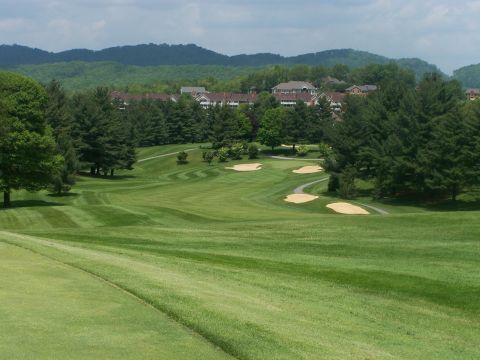
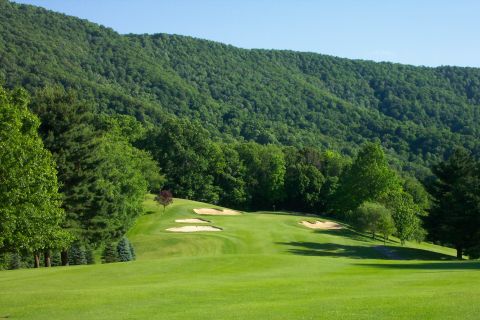
Mountains surround the gently rolling Fincastle Country Club golf course near Bluefield, WV. Other photos of the course at bottom.
All photos courtesy of Fincastle CC.
Some adventurous couples seeking to stretch their dollars farther are opting for a more “hybrid” golfing lifestyle in which they buy “naked” property unadorned with fitness centers, clubhouses, or even a golf course. They wait a few years to build their house and then join a private or semi-private golf club off property but nearby. They wind up with a lifestyle not unlike the one they would have inside a planned golf community development, except without the upfront costs and the payment for amenities they might never use.
One western Virginia development could serve as an example of how this can work. I am on the mailing list for Diamondback Development, a family-owned company that is selling large tracts of land on the far western edge of Virginia, but just 10 minutes from Interstate 77 and less than 15 minutes from the “cool” town of Bluefield, WV, whose motto is -– listen up, Florida residents -- "Nature's air conditioned city, where the summer spends the winter.”
Diamondback first developed Cove Creek, about 15 minutes from Bluefield, where they have sold well over half the 99 multi-acre mountain lots, one of them ranging up to 47 acres for $169,900. Now Diamondback
Diamondback’s VP of Development Jay Shott, who was raised in the Bluefield area, tells me that the company owes no money to any bank and that it is dissuading any speculators from purchasing lots.
“Everyone we have sold to intends to build and live here,” says Shott.
Sited at up to 3,700 feet of altitude, the lots in The Overlook feature 360-degree long-range views of the mountain and the town of Bluefield to the west. Bluefield has about 30,000 residents, but the area surrounding it is home to more than 100,000, enough to attract quality medical and adequate retail services (a WalMart is six miles away). But Bluefield’s key attraction is its mountain scenery and its climate, especially in the summer, when August high temperatures average 76 and the chamber of commerce gives away free lemonade on any days the thermometer passes 90 degrees.
Those looking for high-tech fitness centers and an on-site clubhouse oriented social life will not be looking in these parts for a home. But golfers could find a home just 10 miles away at the private Fincastle Country Club, which opened in 1963 and offers some of the perks of a golf community club membership, including Olympic size pool and Har-tru tennis courts, two of them lighted for
Most of the properties at Cove Creek include streams that flow year round, and all have access to the trout streams that flow through the community. The individual properties are studded with dogwood, holly, rhododendron and mountain laurel. Jay Shott says most of the lots at Cove Creek and The Overlook are flat, even though they are on the mountain, making it easier (and cheaper) to build than in many other mountain communities. A few homes are already up and occupied at Cove Creek; an executive from the Discovery Channel, a couple of NASA employees and the owner of the local Harley Davidson dealership have bought properties in Cove Creek. A college professor who purchased a large tract on the top of the mountain plans to build a small observatory to extend his own view by a few light years.
Make no mistake, this area of western Virginia provides “four season” living, which is a gentle way of saying the golf season runs roughly from April to November and you can expect some snow in winter at these elevations. But for two-sport couples, a ski area is just 35 minutes from Cove Creek and The Overlook. For the rest, beautiful winter views from their homes on the mountain will be on their menus.
If you would like more information about Cove Creek and The Overlook or would like an introduction to Jay Shott at Diamondback Development, please contact me and I will be happy to make arrangements.

August Home On The Course set to mail
However, the newsletter also features some totally new material, a comparison of the cost of living in selected cities in the northern U.S. with the fascinating area around Savannah, GA. I think you will be surprised at some of the numbers.
By the way, I published an entire newsletter a few years ago that was dedicated to Savannah and its golf communities. I would be happy to email it to anyone who sends me a request for it (click here to contact me).
Enjoy the August issue of Home On The Course.

Ford Plantation, like the nearby city of Savannah, is dripping with atmosphere. The August Home On The Course features a cost of living assessment for Savannah.
Ginn gone, mountain prices “normalize”
A bit of altitude sickness may have affected the judgment of those who paid seven-figures for mountain properties at Laurelmor, the ill-fated golf community in the Blue Ridge Mountains that Developer Bobby Ginn was forced to abandon in the wake of a $675 million loan default. The average price of the Ginn lots once sold for $600,000 but now comes word that the new developers have reset prices between $125,000 and $175,000 for those same lots. As the Winston-Salem Journal puts it, “That means [a] buyer could purchase the land and build a home for less than $500,000, less than the cost of the lot alone in Laurelmor.”
A subsidiary of Reynolds Plantation has taken over the 6,200-acre property near Blowing Rock, NC, and renamed it Reynolds Blue Ridge. Work on the golf course, which was partially begun under Ginn, will recommence next year; Rees Jones is the designer. Only 10 homes are built in Reynolds Blue Ridge so far; after his lavish launch party in 2006, Ginn announced the sale of 240 lots. Given the new price levels and Reynolds' fine reputation for its signature Georgia golf community, Reynolds Blue Ridge is worthy of consideration for those with some patient capital and modest risk tolerance.
You can read the Winston-Salem Journal article by clicking here.
The Price of Happiness: Sometimes a higher priced lot is a better deal
There are people who have money and people who are rich.
-- Coco Chanel
There is nothing like finding a true bargain to quicken the pulse and puff out the chest. For those looking for property in most golf communities these days, there is plenty of potential for chest puffing and thumping. Developers and in-over-their-heads private owners are doing all they can to turn their dirt into quick liquid assets, and the quickest way is to lower their asking prices. Someday the textbook definition of “buyer’s market” may include a reference to 2010. In chasing bargains, however, some buyers of golf community property lose sight of the fact that a more expensive choice could be the better one.
Let me explain with an invented example. Jim and Nancy decide that the Pollyanna Springs golf community is the place they
Pollyanna Springs requires that property owners become members at their well-regarded private country club. Since Jim and Nancy both play golf, club membership is not an issue, although they aren’t crazy about the $50,000 initiation fee (non-equity). After
Is the resale lot worth the extra $50,000? Like so many things, it depends on the point of view, or more accurately the length of the view. Jim and Nancy, both in their early 50s, intend to make Pollyanna Springs their home until they are ready for an assisted living facility. With continued good health, they can look forward to 25 years in the home. Assuming an annual appreciation rate of 5% on both properties, the more expensive lot will surpass the value of the less expensive one by more than $50,000 in 14.4 years. If homes in Pollyanna Springs appreciate by an average of 6%, the more expensive lot will be worth $50,000 more than the developer’s lot in 12 years; at 8%, the crossing point is just 9 years. (Of course, appreciation rates of less than 5% will make the time period longer.)
Like many baby boomers, their Pollyanna Springs home will likely be the last that Jim and Nancy purchase. In contemplating which lot to buy, the couple should put a price on happiness.The toughest par 4 in Connecticut
Whenever I get the chance to play at New Haven Country Club in the Connecticut city of the same name, I jump at it. The Willie Park Jr. design -– he contributed Sunningdale in the UK, Maidstone on Long Island, and about 170 other courses around the world – always holds a surprise or two. New Haven may not be Park’s most famous golf course, but it very well could be his most eclectic.
New Haven demands constant focus as you make your way up, down and around its swooping fairways and generally large, swirling greens. I barely broke 90 there on Monday during one of the most bizarre rounds of my life. I threw up a 9 on a par 4 after hitting into the heather and losing my ball, then hitting a tree and losing yet another ball. I quadrupled a par 3 after overcooking a draw into a stiff wind and winding up in the greenside stream. Then I chunked my next shot just over the water and could not handle the tilted putting surface. With two other double bogies, that meant I was 13 over par on just four holes. It was the best bad round in memory.

The shot from the 11th tee at New Haven is just the first challenge on the brutally tough hole.
The natural changes in elevation, a few quite severe, gave the playful Park the opportunity to have some fun without turning New Haven into a circus. The par 4 11th hole (412 yards from the men’s tees), the toughest hole on the golf course and, perhaps, in the entire state of Connecticut, starts with a tee shot to a fairway that swerves to the left and straight up a long hill. A hard hook left puts you into a deep grove of trees at the crotch of the fairway. Play too safe to the right, and tall fescue awaits, from which only a sideways blast is possible. Even if you miss the fescue, the play to the right leaves a 200-yard, straight uphill approach shot to sky and treetops, because there is not even a hint of a green in the distance. A huge tree on the right, about 100 yards from the green, forces a decision to bend the approach around either side. Bunkers short right and to the left of the green further terrorize but at least the green is large.
One Connecticut pro who has played the 11th at New Haven numerous times recommends a pair of two irons to get to the green (at least for fellow pros). I hit driver to just short of the fescue on the right, then played up the hill to the right of the blocking tree and just skirted the bunker beyond it. I got up and down for a 4, the proudest moment of an otherwise dismal day.
The photos below show the dramatic changes in elevation at New Haven. The top photo is the straight downhill approach to a short but tricky dogleg right par 4. The other two are downhill and uphill par 3s.


Sub-60 golf scores, baseball perfection will return to the mean
The two PGA tournament scores of 59 this year by Paul Goydos and, on Sunday, Stuart Appleby at The Greenbrier Classic generated the expected commentary about modern golf equipment making the game too easy. But Appleby, at an average of 283 yards per drive, ranks 69th on tour in terms of distance, and Goydos, at 270 yards per, is near the bottom at 183rd. It is not as if they are hitting nine iron or wedge to every green. It’s not the golf clubs, although some speculate the distance and spin properties of the modern golf ball may have more to do with the low scores.
What is it then? Some believe this may be a watershed moment for golf. All sports have magic barriers that cannot be broken –- until, of course, they are. One theory holds that golf may have reached its “four-minute mile moment.” At one time, no one thought the
Golf is not the only professional sport this year that has seen barriers fall hard. Witness the two perfect games in baseball, by Roy Halladay and Dallas Braden, the latter even less a luminary in his sport than either Goydos or Bannister. (Note: Armando Gallaraga, also not exactly a household name, pitched a third perfect game of the year but was denied his historic moment by a blown call by the first base umpire on the very last play of the game.) In the post-1900 era of baseball, no two perfect games have been tossed in a single season, let alone three, before 2010.
So, should we expect more baseball perfection and sub-60 scores in professional golf competitions this year and into the future? The betting here is that the cluster of these achievements is an anomaly not unlike flipping a coin 10 times and having heads or tails come up nine times. On the next 10 flips, you will have an entirely different result. Nothing last year in either golf or baseball prepared us for this year, and this year is no preparation for a trend next year and beyond. By this time in 2011, the barriers will be back up.Old White gives sporting chance to Sporting Club residents at famed Greenbrier Resort
A quick check of properties available via the Greenbrier Sporting
White Sulphur Springs, WV, may be well off the beaten track, but the resort provides many of the pleasant distractions of a good vacation to its permanent residents. The golf is varied and refined, starting with the par 70 Old White Course, where this weekend’s tour event is being played out. With a reputation for impeccable shape and intriguing throwback design, the C.B. McDonald/Seth Raynor classic has been luring the rich, famous and golf addicted since 1914. (President Woodrow Wilson was one of the first to play the course.) Its fairways are generous but, like many classic designs, most of the challenge is on and around the greens, forcing thoughtful approach shots from the fairways. The Old White’s slope ratings are a bit of an anomaly: From the tips at 6,867 yards, the slope is 137 (rating 73.7); the next tees play at 500 yards less but with a slope of 136 (rating 71.4).
The Greenbrier and Meadows golf courses, the resorts two other 18s may not have the reputation of Old White, but count on them to be in outstanding shape if you visit. In June, the Greenbrier added a casino to its long list of amenities. Resort owner Jim Justice is immensely wealthy and committed to making a success of the grand old resort; in that regard, a home at the Greenbrier Sporting Club, though expensive, should not be too much of a gamble.

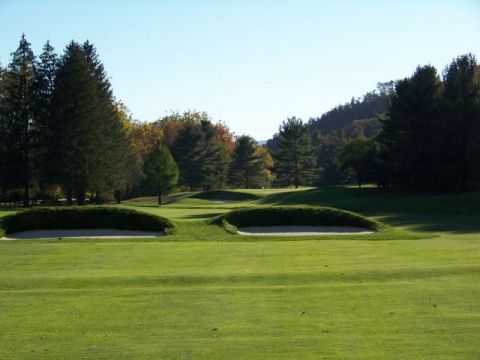
The many faces of Old White in just two holes, the 8th (top) and 12th.
Photos by Tim Gavrich.
Fit for a King: Arnie’s stamp is firmly affixed to Fawn Lake golf community course
Fredericksburg, VA, was named for a prince (Frederick of England), but a King’s name is on the golf course at Fawn Lake. When I visited the golf community in June, plenty of folks at the 20-year old development were abuzz and rolling out the red carpet for a visit the next day from golfing royalty. Arnold Palmer was coming to town for a charity event and to check out his 15-year-old design. The local ad hoc regiment of Arnie’s Army was in high gear.
I quite enjoyed my round at Fawn Lake, a golf course that is much milder than many of the tough brutes credited to Arnie. The
Some tee shots also required forced carries over ravines but no chasm was so wide as to make me swing out of my Foot Joys. Tougher were the ravines that separated the ends of a few fairways from the greens. As it was for Confederate and Union forces that marched against each other in Civil War battles played out on these grounds, these deep carveouts in the landscape are best avoided by golfers as well. A foursome of lady members I passed along the way responded to my question about the golf course by chiming almost in unison that, “We love it, except for those carries to the greens.”
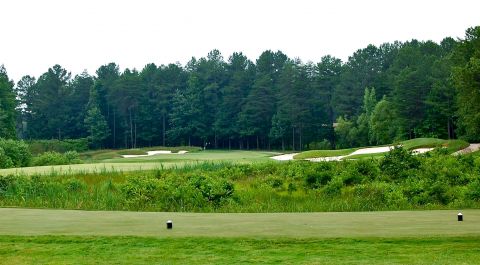
The first tee at Fawn Lake gives a strong hint of the elements that will follow -- forced carry from tee, generous fairways and accompanying bunkers, and large greens.
I found the greens themselves at Fawn Lake to be cleverly constructed -– large, undulating and deceiving. When I have the time, which I did because I was playing alone, I like to read putts from both sides of the hole. At Fawn Lake, I should not have strayed from behind the ball because, consistently, the putting line read differently from each side of the hole. Faced with indecision, I did not putt well, but I can’t blame that on the putting surfaces, which were smooth. I contemplated getting my eyes checked after the round.
The course scenery was certainly pleasant to the eyes, more handsome than beautiful, with bunkering that, again, was uncharacteristically restrained for a Palmer design. Homes, which range in price at Fawn Lake from the $400s to $1.7 million, were set well away from the fairways and hidden in the trees except for one hole on the front nine, where they lined the right side of the fairway. Oddly, though, the first peek of the lake on the Fawn Lake golf course is after the approach shot at the 18th. There was a gap of eight years between the time the developers first started selling property (1988) and when the golf course opened (1996). Clearly, the real estate won out over the golf course in planning discussions about the highest value use of the lake.
The golf course does not offer any tees between 5,850 and 6,450 yards. The 5,850 tees (rating 68.8, slope 129) are girly man territory, but for us aging male baby boomers who can no longer bust drives of 250 yards or longer, 6,450 yards is pushing it (rating 71.3, slope 135). That said, of the par 4s at Fawn Lake, only the 17th and 18th holes measure more than 400 yards (just 410 each) from the White tees. In other words, it is a “short” 6,450-yard course. For the longest hitters, the back tees measure 7,015 yards with a rating of 73.9 and slope of 140.

Although the lake for which Fawn Lake gets its name is never in play, an extension of it reaches across the 18th fairway to make the approach there the final challenge of the day.
Fawn Lake, which is conveniently located within minutes of Interstate 95, is well established if not as well known as communities that advertise and market more extravagantly. Of the development’s 1,400 lots, 975 have been sold and 700 houses have been built, all detached single-family dwelling (no condos or town homes). Obviously the economy has affected Fawn Lake as it has other golf communities, but that is good news for those looking for bargain prices in a pleasant, established community. Since the peak of 2005, prices in Fawn Lake are off an average 30%. Among the current listings is a 3 BR, 3 BA, 3,900-square foot home on a cul de sac that is listed at $499,900. For those eager to build their own home, lots begin at $95,000 (1/2 acre wooded); a golf view lot will run about $150,000, and a one-acre lake view property as much as $700,000. Count on $150 per square foot or more to build. One interesting consideration if you build your home at Fawn Lake: Property taxes are waived for five years if the home is LEED certified (Leadership in Energy and Environmental Design).
The golf club, which the Fawn Lake Homeowners Association is expected to purchase from the developer in the next few months, has 250 members. All residents are being asked to vote on the sale of the club, not just golf club members, and early tallies indicate that 75% are in favor of the acquisition (just six ‘No’ votes so far). The purchase will precipitate a $250 annual assessment for all homeowners for the next three years, bringing the total annual HOA fees to $2,084. That includes all the customary necessities such as common grounds landscaping and road maintenance, plus a more discretionary amenity, two manned gates. Club dues are an especially reasonable $310 per month, with a food and beverage minimum of $165 per quarter.
Fawn Lake should appeal to retirees and other empty nesters -- they currently make up 55% of the resident total -- but the numbers of families in the community has increased steadily in recent years in the growing Fredericksburg area. With its proximity to the east coast’s primary north/south interstate route and a step-up in marketing, Fawn Lake should have little trouble diverting traffic to its gates. Those who stop by will find reasonably priced real estate in an established golf community with substantial room to grow. Importantly, members of the enjoyable and well-conditioned golf course thought enough of it to put their money where their mouths are. That is always a good sign.
Contact me if you would like more information about Fawn Lake or would like me to make arrangements for you to visit the community as a “member for a day.” That includes access to all amenities, a round of golf for two on the Palmer golf course and lunch or dinner. Also, if you’d like to make it an overnight visit, I will be happy to arrange a specially priced “discovery” package.
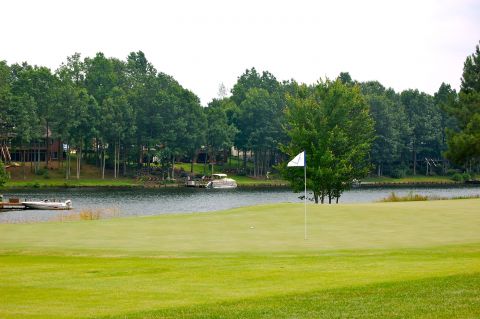
At long last, the lake that gives Fawn Lake its name shows up just off the 18th green.
A house that comes with its own tee box
Golf community newsletter gets it right
Repair your divots, or else

Now on Sale

- The only book about golf communities in the last 10 years.
- 156-page step-by-step guide to finding your dream golf home.
- Info on nearly 100 golf communities the author has visited.
- Paperback version costs less than a sleeve of Pro VIs.
Here is what the experts are saying:
“The book is chocked full of information…applicable to anyone looking for a move to the Southeast regardless of whether they are looking for a golf community or not.” — John LaFoy, golf architect (Linville Ridge CC, CC of Charleston, The Neuse GC)
“Larry has done a tremendous amount of work and anyone — like me — who is looking to search for a golf home now or in a few years needs this book.” — Brad Chambers, golf blogger, ShootingYourAge.com
“Wow! What a thorough piece of work…a must for anyone moving South. This book will help many people.” — Brett Miller, owner and founder of MMA, Inc, a golf industry consultancy
Buy It Now at Amazon.com or BarnesandNoble.com.