True Colours: New Bern developer meets new market pricing realities head on
Most golf communities that had the bad luck to open for business just before the housing market collapsed are working hard to find ever-creative ways to market themselves -– perhaps too hard. Some are making extravagant claims about their amenities in order to distinguish themselves from other developments making equally extravagant claims. That sounds, as Yogi Berra might say, like deja vu all over again.
Carolina Colours, a 2,000 acre community in New Bern, NC, has decided to employ a more straightforward, deceptively simple approach to its marketing and pricing.
“Everyone is scared [about their financial situations],” says the much traveled and experienced Carolina Colours Developer Ken Kirkman about today’s customers. “Two or three years ago, our customers were looking for $400,000 homes. Now they want them in the $300s.”
Kirkman and Carolina Colours seem happy to oblige, although sharp pricing has resulted in a few accommodations, such as pushing back the schedule to finish the community’s pool, fitness center and tennis complex. The much anticipated 18-hole golf course was also delayed but is set to open for members at the end of this month, and for the public a month later. Some potential Carolina Colours prospects have been conditioned by the way many communities were built pre-housing crash -– amenities first, then sell the properties -- and a few have cut and run. But most potential buyers, Kirkman says, appreciate the principle of fiscal responsibility, especially in these post-crash days.
“All we can do is tell the truth about where we are and what our plans are,” he says. “Our community is a long way toward being finished,” he says, adding that, “the golf course is virtually done.”
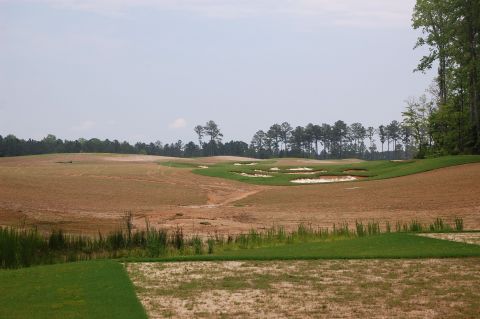
For those who consider choosing a set of tees that push their driving distances to the limit, Carolina Colours will offer plenty of cautionary notes.
I can attest to that based on a recent cart ride around the golf course and community with Kirkman. In early June, the golf course seemed to be approaching completion, with only some minor landscaping and turf growth remaining. Barring any unforeseen weather event, the course should open on schedule in two weeks, and the members who get to play it first should be impressed. The layout by former Society of American Architects President Bill Love will appeal across a wide range of playing styles.
“It will be a good course for retirees,” says Kirkman, which is usually code word for a fun but not overly challenging layout. In this case, though, the six tee boxes that stretch from 5,800 to 7,000 yards will give players of all abilities the opportunity to ratchet up the challenge quotient if
I snuck a pre-opening peak at the scorecard and two things stood out about the yardages from the middle "green" tees at 6,437 yards. One par 3 hole, the 6th, measures a robust 211 yards, while the par 4 10th hole weighs in at a tempting 301 yards. The longest par 5 from those tees is 550 yards and the shortest just under 500.
The semi-private Carolina Colours Golf Club is offering for sale 400 golf club memberships (100 in the fold already) for a modest $10,000 equity payment each ($2,000 discount for property owners), 75% of which will be refundable upon resignation. Dues are a bargain at just $120 monthly for a single and $160 for full family, but those looking for the full traditional country
Carolina Colours features a mix of town homes, condos and single-family homes in a variety of configurations and sizes on lots that range from “patio” size (less than ¼ acre) to full-acre lots. The sweet spot is between ¼ and ½ acre, with prices starting in the $60s and topping out in the high $100s. A 2,700 square foot, 4 BR, 3 ½ BA home, for example, with a view of the 7th fairway is priced under $390,000, one of the more expensive homes in the community. The low to mid $300s seems to be the norm, but some patio-style homes are lower yet.
According to Kirkman, Carolina Colours has found a comfortable niche in the market between lower priced communities, like the nearby Taberna, and more expensive competitors like St. James Plantation,
Kirkman’s own professional experience is unique among his golf community developer peers, and especially relevant to his efforts at Carolina Colours. He has witnessed up close the entire arc of golf community development, from the euphoria of the 1980s and ‘90s to the crash of the mid-2000s, plus every market hiccup in between. As a real estate attorney working in behalf of Weyerhauser Corp., the giant paper company that once was a major residential community developer, Kirkman learned the practical -– and financial -- realities of building communities from the ground up. Weyerhauser had initially planned to develop Carolina Colours itself before it decided to stick closer to its true knitting (forestry and wood-related products). Kirkman was also commissioned to help turn around the sales and marketing efforts for the real estate offices at the golf communities of Landfall in Wilmington, NC, and Bald Head Island. (He still retains overall responsibility for The Landfall real estate office.)
Kirkman’s analysis of the current market for planned communities has informed his market positioning of Carolina Colours, especially in the wake of the housing morass.
“You have some ‘dead’ communities that got caught up in the euphoria of the market,” he says. “They did not know who their customers were.”
“Then you had communities like Brunswick Forest (Leland, NC, near Wilmington) that had their amenities in place and were located in a desirable area. Wilmington is a great draw for them [Brunswick Forest].” [Click here for my review of the new Cape Fear National Golf Club at Brunswick Forest.]
New Bern is something of a mini-version of Wilmington -– not as large and, some might say, not as sophisticated, but with plenty of retail services, a good medical center, and a convenient, if small, airport (Delta and USAir service). And the two rivers that converge in the city, the Neuse and Trent, give it a maritime feel unlike most other near-coast communities. Like many of his peer developers, Kirkman is certainly willing to talk the talk about his community, but he also can walk the talk.
“I’m very much personally invested in this community,” he says of Carolina Colours, “because I live here too.”
If you are interested in learning more about Carolina Colours and would like an introduction to Ken Kirkman, who is a hands-on developer who enjoys talking with anyone about his community, please contact me.
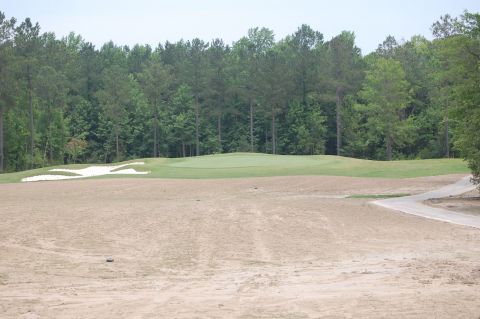
In June, the Carolina Colours golf course seemed ready except for the lack of fairway grasses which, in the Carolina summer heat, should not take long to grow.
 Home On The Course newsletter
Click here to sign up for our Free monthly newsletter, loaded with helpful information and observations about golf communities and their golf courses.
Thornblade Club pros make habit of winning
Another Thornblade Club member has notched a PGA Tour victory. Although it does not rise to the level of Thornblader Lucas Glover's U.S. Open triumph in 2009, fellow pro and club member Matt Bettencourt notched his first PGA tour victory at the Reno-Lake Tahoe Open on Sunday using a borrowed caddie and outstanding putting and bunker play to survive a bogey-bogey finish and win by one over journeyman Bob Heintz. On the bag this weekend for Bettencourt, who lives in the community adjacent to Greer, SC's Thornblade Club, an early Tom Fazio design, was Rocco Mediate's caddy. Mediate did color commentary at the Open Championship at St. Andrews, where Louis Oosthuizen came out of nowhere to make his own mark.
Rounds played this year send mixed signal
The July issue of GolfBusiness magazine includes a map of the U.S. that compares the number of golf rounds played, state-by-state, thru April this year and April last year. The data suggests what we already know, that like politics, the state of the economy is very much local.
Through April, golf courses in half the states increased rounds and half decreased. The strangest comparison was in North Dakota, where rounds played for the first four months this year were up by 334% over the same period last year. Of course, in a thinly populated state like North Dakota, a few abnormally warm days in April could account for the dramatic increase. Of greater significance is that most of the states with increases are in the northern half of the nation and not known generally as magnets for travel golf or golf communities.
Southeastern, golf-rich states run the gamut from mild decreases in rounds played to disappointing numbers. North Carolina rounds are down just 3.6% year-to-year, Virginia 7.6% and South Carolina 8.6%. Alabama and Georgia suffered through an especially tough first one-third of the year, down 13.6% and 14.3% respectively.
The good news is in the comparison of the month of April last year and this past April, when temperatures tend to make play possible in most parts of the nation. East of the Rocky Mountains, every state except for Florida shows an increase in play year to year. Rounds in Florida decreased by 2.9%. Nationwide, rounds increased in April by an aggregate of just over 10%.
It will take more than four months for a clear demonstration that golfers are coming out of their few years of hibernation. But April increases of 20.3% in Virginia, double-digit improvements in Georgia and Tennessee, and modest improvements in the Carolinas imply that things could be moving in the right direction.
GolfBusiness archives older issues at http://www.golfbusiness.com. The full July issue should be available online in a month or two.
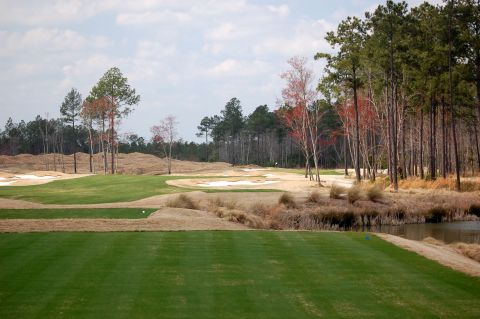
The few newly opened golf courses, like Cape Fear National in Leland, NC, are hoping the trend of increased rounds in April continues.
Bounce off The Rim: Once highly regarded private Arizona golf club faces reality
The web site at the once highly regarded Payson, Arizona community called The Rim Club welcomes visitors with an eerie sign of the times: “There are no homes available at this time. Check back often or visit our Information Center for details on our current offerings.” Only one home site is listed for sale, at $149,900 for an acre-plus. And the owner will pay the initiation fee for the golf club.
That initiation fee is not worth what it was just 15 months ago when developer and club owner Crescent Resources sold memberships for $150,000. Now, in the wake of Crescent’s Chapter 11 bankruptcy from which it emerged one month ago, and the takeover of the club by its members, the new initiation fee is just $10,000. That is largely because the club is now open to the public.
There is no questioning the quality of The Rim golf course, about 75 miles north of Scotsdale. Golfweek magazine has consistently rated the Weiskopf/Morrish layout the best residential golf course in the southwest region since it opened in 2003. Other ratings put the golf course in the top 60 of all courses nationwide. Reports are that it is both challenging and beautiful, with significant elevation changes, dramatic rock outcroppings and killer views of the surrounding mountains.
With dozens of properties in 10 southeastern and southwestern states, it may be many more months before Crescent sorts out a clear direction for itself. Until then, the bad news at The Rim Club is good news for those who have been lusting to play it; now’s their chance, at summer green fees from $99 to $120 at peak times.
Rare bird: Long, short of it at the Road Hole
Golf is like no other game in that on any given hole, amateur players like you and me, even the high handicapper, can produce a score as good as the best professional.
During my one and only round at the Old Course at St. Andrews a few summers ago, I hit a drive just over the left edge of the maintenance building on the famed 17th “Road Hole” and found myself on the left side of the fairway, a six-iron from the green. I won’t ever forget the next shot which I hit straight and true and just short enough to take the required bounce and roll to about six feet from the cup, which was set at center left on the green. Quaking with the sense of where I was and what I was about to perhaps do, I kept my head as still as I could and stroked the putt just into the front door of the cup for my only birdie of the day.
If truth be told, I was half hoping to hit my approach over the green so I could say I had made par (maybe) from the road at The Road Hole. But the unexpected birdie was better because, like most amateur golfers, I can brag to myself that Tiger Woods, Padraig Harrington, Phil Mickelson and every other professional who ascends the tee at 17 at the Old Course this weekend in the Open Championship would love to play the hole exactly as I did.
This weekend, though, the pros will play an entirely different hole than the one I did. Tournament officials have lengthened the Road Hole to nearly 500 yards by moving the tees back about 50 yards. But the maintenance shed still covers the view of the fairway ahead, and the pros will be content with a tee ball that finishes just about where mine did, about 150 yards to the pin. I would never presume to tell them what club to hit from there, but I could tell them, with some confidence, where to hit it.

With so much trouble around the Road Hole green -- the Road Hole bunker and the Road itself -- amateur and pro alike should be happy to be on the putting surface. I was thrilled to be six feet to the right of the pin.
If Ryder Cup played by World Cup rules
I watched as many World Cup games from South Africa as I could, especially in the “knockout” rounds. The tension quotient was high, tension of course being a key ingredient for great sporting matches.
American media tells us Americans that we don’t like soccer because there is not enough scoring and the pace of games is too
Okay, soccer is pretty slow too. And the constant complaints and arm waving makes the games take on a Keystone Cops look. The one unpardonable sin for soccer, though, is how tie games are resolved in a tournament like the World Cup. If the overtime period of the final game between Spain and Netherlands had gone another few minutes without the goal that Spain scored, hundreds of millions around the world would have had to endure a session of five penalty kicks for each side. There is no dopier way to resolve a sporting event of that magnitude, and no more painful reward for great play -– an epic match resolved by a mistake, by essentially forcing someone to be the goat.
Imagine that the American and European Ryder Cup teams are tied at the end of three days, and they go to a series of five two-foot putts until someone misses, and you essentially have the golf equivalent of penalty kicks.
That just doesn’t seem very sporting, at least from an American point of view.
What golf communities don’t tell you in their brochures, we do in Home On The Course
If it weren’t the law, cigarette packs, child car seats, and mutual funds (“past performance is no predictor of future performance”) would carry no safety warnings. The most expensive pack of cigarettes, tax included, costs $14. A home in an upscale golf community can cost $1 million and more. And yet you won’t find any warnings posted in their sales office.
Consider the July issue of our free newsletter, Home On The Course, your guide to some of the key questions to ask when shopping for a golf community home. How stable is the golf club? Does the developer have a completion plan for the community…and the deep pockets to support it? What’s the better deal -– an equity golf membership or non-equity? Forewarned is forearmed in our July issue, ready for mailing later this week.
Also, Greenville, SC, is rising to a place of prominence on more and more “best places to live” lists. We’ve been to Greenville and understand the sentiment. With a thriving downtown restaurant and cultural scene, the city -- known to some as “G-Vegas” -- provides an entertaining respite from the quiet, remote golf communities in the upstate region of South Carolina. In the July issue, we turn to Greenville real estate professional Lee Cunningham for a current assessment of Greenville's real estate market, including The Cliffs Communities, Thornblade Club and others.
Use the convenient box at the top left of this page to sign-up to receive your free monthly copies of Home On The Course. And please know that we will never share your name or email address with anyone.
If Lebron were a serious golfer, his choice might have been different
We take Lebron James at his word, that he chose to play in Miami because it offered him the best chance at an eventual championship. But if he were a serious golfer, his choice might have been different.
According to a chart in the Wall Street Journal today, the Miami area ranks first in the sheer number of golf courses among all the
Not that this week’s most famous athlete, at least until the winning gola is scored Sunday at the World Cup, will ever have to play “trunk” golf at the local public facility. But even then, Miami was not the best choice. New York can boast Shinnecock Hills, The National Golf Club, Winged Foot and dozens of other famous courses within a short-limo drive of Madison Square Garden. In Miami, Lebron would need to ride all the way up to North Palm Beach and the Seminole Golf Club to find a club whose course ranked near the top.
Just in case the star wanted to rub elbows with the common people every once in a while, Bethpage Black, a public course and just 40 minutes from the Big Apple, is the only Zagat-rated club anywhere to attain a perfect 30 rating from those who have played it.
Lebron has made his choice and can count on one thing golf related that Miami courses have that even Shinnecock Hills does not: They are open for play every day of the year.Course closed, open season on discounts
I worked for Otis Elevator Company through a couple of recessions and noted that when sales of new elevators dried up because of a glut of commercial space, the number of elevator modernization jobs increased significantly. It seemed odd, but the explanation was logical: The building owner had to modernize in order to compete for tenants with newer buildings down the street, or with older buildings with more updated accoutrements. Refurbish or perish could have been their mantra.
So it is with golf clubs during this current recession. In just the last few days, I have learned that two clubs I know well have closed for renovations. Both, I might add, were in fine condition, one good enough to hold a pro tournament. The implication is that each will be even better, and better able to fend off their competition. Existing members will benefit, for sure, but so too will a select few new members who take advantage of renovation discounts.
The Reserve Club in Litchfield Beach (SC) changed ownership earlier this year when The McConnell Golf Group added the Greg Norman course and financially strapped club to its portfolio of private Carolinas golf courses. The Reserve gives McConnell its first layout near the ocean (one mile away), a refuge it can offer its members who live and play in the more urban and inland environments of Raleigh, Durham and Greensboro. But The Reserve featured bent grass greens, the classic surfaces that are lovely to putt but hard to maintain in areas where the thermometer can routinely reach into the 90s for long daily stretches.
So it was at The Reserve, where the course is now closed until September to replace the bent grass with a heat resistant hybrid and to spruce up the layout’s many bunkers. At the moment, to encourage new memberships during the down period, McConnell is offering joining fees of just $5,000, which represents a 50% discount of the fee after August and is 1/6 of the original initiation of $32,000 when the course opened in 1999.
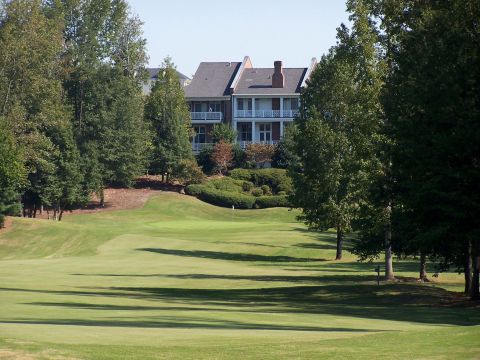
The first hole at Thornblade gives little hint of the bunkering on the rest of the course.
At The Thornblade Club in Greer, SC, near Greenville, the club closed shortly after the last stroke was played in the annual BMW Charity event on the Nationwide Tour. With a total attendance of nearly 60,000 this year, the tournament is a roaring success. (The tournament’s first three days are played at Thornblade, Carolina County Club and Bright’s Creek, with the final round at Thornblade.) Yet like a TV star who goes to makeup before the big show, Thornblade members have apparently decided to make the course look as good as it can for the Golf Channel cameras.
While Thornblade is closed, the club is offering new members an $8,000 buy-in, a discount of $10,000 compared with the customary $18,000 fees. For this classic Tom Fazio course, it is a bargain.
The south’s temperatures will rise again
"I shoot in the mid-eighties. If it gets any warmer, I don't go out."
-- Marty Allen of Allen & Rossi comedy team
Here in New England, we are expecting summer-in-Florida-type temperatures for the next few days. In fact, if you want to beat the heat in Connecticut, hop a plane for Miami, where high temperatures the next three days will average about eight degrees less than the highs in Hartford.
Today, on many of the golf courses in Connecticut, the thermometer hit the 95-degree mark. A couple of days ago, weather forecasters in the Hartford area were in a sweat over the possibility of 100-degree temperatures this week, which would have surpassed the record of 99 set in 1999. It isn’t going to happen, but places like Boston and Concord, NH, may exceed the 95-degree level tomorrow. That is just not normal.
On Wednesday, anyone who braves the fairways at Vermont National Golf Club in Burlington, VT, just a half hour or so from the Canadian border, better carry plenty of liquids. Burlington expects a high of 95, seven degrees warmer than expected highs in Miami, which is a 27-hour car ride away. Mid-eighties in Miami in July may have the natives reaching for their cardigans (if they own them).
If I were advising Florida chambers of commerce, I’d suggest they hustle out as many ads as their budgets permit and point out to those of us sweltering in the north just how cool Florida is comparatively speaking. But they better make it quick. By Thursday, things return to normal, with virtually the entire southeast turning five degrees warmer than in most of New England…except in Burlington, where visiting Floridians will feel right at home.

Golfers at Vermont National in Burlington will struggle with unusual warm weather this week, warmer than Miami.
UPDATE ON TUESDAY: WEATHER FORECASTERS IN CONNECTICUT CHANGED THEIR MINDS (AGAIN) THIS MORNING. NOW THEY SAY THE MERCURY WILL REACH 100 DEGREES IN THE HARTFORD AREA TODAY. AS LONG AS THE POWER DOESN'T GO OUT DURING THE WORLD CUP BROADCAST, WE CAN LIVE WITH IT.
McConnell has eye on another Ross course
Does Reynolds’ reach exceed its grasp?
Forbes magazine gets into Tiger’s business

Now on Sale

- The only book about golf communities in the last 10 years.
- 156-page step-by-step guide to finding your dream golf home.
- Info on nearly 100 golf communities the author has visited.
- Paperback version costs less than a sleeve of Pro VIs.
Here is what the experts are saying:
“The book is chocked full of information…applicable to anyone looking for a move to the Southeast regardless of whether they are looking for a golf community or not.” — John LaFoy, golf architect (Linville Ridge CC, CC of Charleston, The Neuse GC)
“Larry has done a tremendous amount of work and anyone — like me — who is looking to search for a golf home now or in a few years needs this book.” — Brad Chambers, golf blogger, ShootingYourAge.com
“Wow! What a thorough piece of work…a must for anyone moving South. This book will help many people.” — Brett Miller, owner and founder of MMA, Inc, a golf industry consultancy
Buy It Now at Amazon.com or BarnesandNoble.com.