Lack of Appreciation: Greenville, SC, should be on retirees’ radar, but it isn’t...yet
You would be hard pressed to find a city more appropriate than Greenville, SC to the needs of active retirees who also play golf. And, yet, the city is rarely top of mind with northerners seeking a vibrant lifestyle that includes golf. Now, according to an article in the New York Times, the ongoing development of more than 1,000 acres within a five-minute golf cart ride of the vibrant city could put Greenville on the AARP map.
If you are even an occasional reader of this site, you know we love Greenville for its small town sophistication betokened by the Pease Center, a classy venue for concerts and other shows that much larger cities would be proud to call their own. The city and its inhabitants have invested more than $76 million in recent years to clean up a downtown whose potential was hidden under unused parking lots and vacated buildings. Today, the city’s esplanades, which run along and over the Reedy River, feel almost European, and a string of shops and restaurants have transformed the abandoned buildings through an aggressive rehabilitation program. The wealth of activities that includes a minor league baseball team, The Drive, makes Greenville a strong alternative as a retirement location to the more celebrated, but quirkier, Asheville.
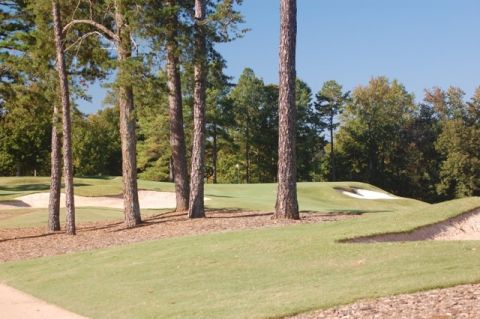
Although surrounded by an upscale community, much of The Thornblade golf course, designed by Tom Fazio, plays as if it is out in the pines.
Verdae is the name of the chunk of land that sat idle for generations along Interstate 85, just outside of town. Its owner, an eccentric millionaire businessman, rented out pieces of the property to a hotel, shopping center and golf course, Verdae Greens which, loosely translated, appears to mean “green greens.” But the only thing redundant about plans for Verdae is that they mimic somewhat the “town center” concept that has proven popular with young and retired couples alike. At Verdae, according to the Times article, living, working and entertainment venues will co-exist in one area, and projections are that 10,000 residents will fill the streets, offices, shops and diverse homes of the community. For those looking for bigger city excitement, a “clean” bus will make the five-minute loop between Greenville and Verdae.
The golf course, which receives a four out of five stars average rating on Internet review sites (we haven’t played it yet), has undergone significant changes, the first of them a name change from Verdae Greens to The Preserve at Verdae (too many “Preserves” out there, but what the heck). Designed by the respected Willard Byrd 20 years ago, the course is owned by the operators of the attached Embassy Suites hotel who invested $3 million in course renovations, which included planting of mini-Verde Bermuda grass, the only golf course within 60 miles to feature the hardier strain. The mini-Verde grass does not require pesticides to maintain its healthy looks.
Membership at the semi-private golf club is reasonably priced at $1,800 annually for a couple, or $1,600 for a single. For a single or couple expecting to play at least once a week, that’s a bargain. Current model homes in Verdae begin in the mid to hi $200s, but the expectation is that the eventual price range will span all six-figure categories as Verdae gains in prestige. An article in the New York Times certainly is a nice start.

The gardens at Furman University are not to be missed.
Editor’s Note: Although Greenville golf is not Myrtle Beach or Pinehurst golf, its comparatively few golf clubs run the gamut from sleek and private to rough and tumble public, with a nice choice inside that range. On the private side, we have always admired The Thornblade Club in nearby Greer, with its classic Tom Fazio layout –- with plenty of signature funneled fairways and cloverleaf bunkers –- that threads its way through a tight-knit community of upscale homes (sweet spot in the mid six-figure range). Club staff is among the most professional we have encountered anywhere, and at initiation fees under $20,000 and a membership that spans generations, there is much to recommend Thornblade…Greenville Country Club, with two well-regarded 18 hole courses, is a more mature private club, surrounded by stately homes, a few getting a bit long in the tooth. The Chanticleer Club layout often makes its way to the top 10 lists in the state; it is on our list of must plays…We did play the Furman University golf course just after the 2008 renovation by Kris Spence, who added a bit of Rossian character (as in Donald) to the formerly flat and boring greens on the circa 1955 layout. Today, the course has plenty of character without being fussy in the least, and it may be the best option for public players in the area. If you go, especially during spring or early summer, do not pass up a stop on campus for some of the prettiest gardens you will ever walk through.
If you would like more information on any of these fine clubs or golf communities, or would like to be put in touch with a professional Realtor in Greenville with whom we have worked, please contact us.
 Home On The Course newsletter
Click here to sign up for our Free monthly newsletter, loaded with helpful information and observations about golf communities and their golf courses.
Does cheaper membership cheapen private club? Plus, two blogs to bookmark
Private clubs suffering the ill effects of the recession that began in 2008 and is hardly over have essentially two paths they can take to securing their futures: They can convince current members to fund improvements that make their club more attractive to future members (and help retain current members); or they can lower their prices to attract
But lower prices come with their own set of problems. One is the obvious one; low or no initiation fees can’t help pay for capital and other improvements (new grass cutting equipment, higher fuel costs, hiring that extra waitress in the clubhouse) and lower dues exacerbates maintenance issues. The only way to properly fund the upkeep of the golf course and other parts of the country club infrastructure is to generate many new memberships. In the current economy, good luck.
Kathleen Kingsbury recently published an interesting overview of the dilemma private golf clubs face in the current environment. It is one of the more balanced we have read in recent memory and should be helpful to those contemplating membership in a private club –- inside or outside the gates of a golf community –- as well as members who are involved in club governance. You can read the Reuters article by clicking here. We know plenty of high quality private golf clubs in the southern U.S. that have lowered their fees. If you want to discuss those in areas you have targeted for a future golf home, please contact us.
*
We learned about the Reuters article from two web sites published by lawyers interested in golf club issues. We have been reading attorney Rob Harris’ Golf Dispute Resolution site for months now and find it both informative and entertaining. Today at his site, Rob noted his new acquaintance with David Cronheim, who publishes Tee, Esq., a similar site that debuted only in March and which noted the Reuters article in a blog post. TeeEsq.com seems a little broader in nature than Rob’s site, going beyond just the legal aspects of golf to include such topics as country clubs for sale, the acquisition of golf retailer GolfSmith by a Canadian company and other issues not of a strictly legal nature. But you certainly do not need anything like a law degree to appreciate Golf Dispute Resolution; on the contrary, its focus on the interesting and unusual aspects of the operational side of the game is refreshing and entertaining. I recommend both sites to anyone interested in the foibles of the golf industry, especially the foibles-loaded topic of country club operations.Pros Know: Nationwide Tour tees it up at short but tricky Thornblade Club
I probably don’t remind readers enough that it is possible to have a deeply satisfying golfing retirement in a community that was not strictly planned as a golf community. In almost all such cases, especially for golf communities that do not maintain a guarded security gate, homeowner costs are cheaper in a non-planned development than in one whose golf course and surrounding real estate were set up together. Often, even though they "feel" like planned golf communities, there are no homeowner dues at all.
The Thornblade Club in Greer, SC, and its surrounding neighborhood are fine examples of how two separate components can appear to live in perfect harmony. The highly rated Tom Fazio golf course, renovated exquisitely a few years ago, is at the core of the community, literally and figuratively. The wide range of home styles, mostly brick, radiate around the layout, which features a number of funneled fairways and Fazio’s customary cloverleaf bunkers. Some of the fairways, especially the 18th, are half a funnel, which is to say sloped on one side with the potential for slipping off the other into danger if your tee shot is not well placed. The course, which is open year round, is always in excellent condition and a fair challenge for all manners of players…
…except, perhaps, the professionals, who now tee it up at Thornblade this time of the year at the BMW Charity tournament on the Nationwide Tour -- and those who practice there. (Former U.S. Open champ Lucas Glover learned the game at Thornblade, and the Haas family owns a home beside one green (it's owned by patriarch Jay). Yesterday, current BMW event leader Cameron Percy shot a 62 on the 6,688-yard layout. Still, the fact that the leader is “only” 14 under par on a course that plays as short as any on the professional tours is testimony that Thornblade is no pussycat. A 66 was the second-lowest score among the other leaders yesterday.
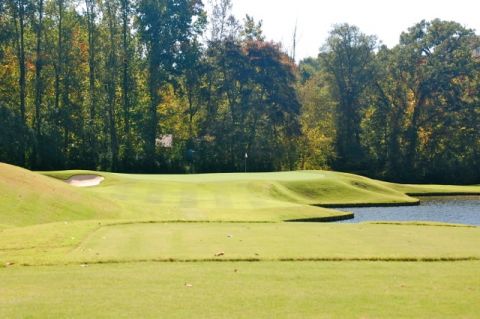
A stream runs through Thornblade, but a pond can wreck havoc too.
Greer is anchored by the enormous operations of BMW of North America. The plant and offices and all the auxiliary businesses that support them has had a stabilizing economic effect on the area. The Greenville area is one of the most under-appreciated locations for retirees looking for an active and golf-oriented lifestyle. The city is as diverse as the more popular Asheville, NC, with real estate prices comparably lower. For those looking for more elaborate and somewhat more rural golf communities, but still within striking distance of Greenville, two of The Cliffs Communities are within a half hour -– Cliffs Valley and Cliffs at Glassy. Given current bankruptcy proceedings, from which we understand The Cliffs might emerge in a matter of weeks, real estate prices are at their low ebb. For those with a slight appetite for risk as well as high-end living at bargain prices, contact us to talk about The Cliffs.
For those oriented more toward a classic golf club with a diverse and engaged membership, and a golf course good enough for the pros but no back-breaker for the average player, Thornblade, with single-family homes ranging from $400,000 to $1 million+, is a great choice. Either way, you will be close to the interesting, stable and up and coming Greenville, SC. Please contact us for more information.
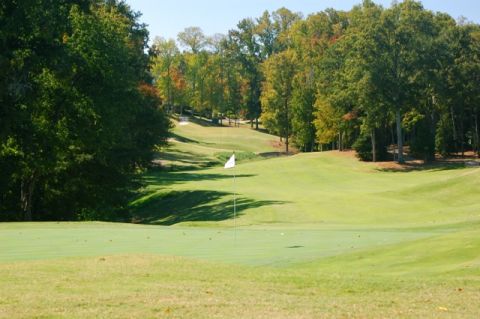
The fairway on Thornblade's finishing hole gives new meaning to "slope rating."
Home Price Trends: Don’t worry, be happy, don't wait for the last dollar for your home
Bloomberg.com and other outlets report that more than half, or 74, of the 146 metropolitan areas surveyed by the National Association of Realtors (NAR) saw median home prices increase in the first quarter of 2012. In the final quarter of 2011, only 29 metro areas saw such gains.
Florida metros, especially hard hit during the housing market collapse, sported some of the highest gains, with Cape Coral up more than 28% and Palm Bay up nearly 17%. Yet prices in Mobile, AL, dropped almost 15% and in Atlanta 12%.
If you check out the Bloomberg article –- click here – and want some post-read entertainment, hang in their for the reader comments at the end. Some contend –- and are quite animated about it –- that the NAR and Realtors in general are pumping sunshine into a market that still has significant problems. After a Realtor in Port St. Lucie described her local market as “HOT” and supported her comment with a positive summary of related conditions (employment, property inventory, low interest rates), another poster said: Housing prices are falling. Why are you realtors lying to the public about it?”
The fact is that prices in some markets are rising and in others they are falling or level. You would think there is a direct correlation between employment and prices. Yet in Mobile, for example, where prices dropped 15% in the first quarter of 2012, unemployment was set at 8.7% in March, but was well off the 10.5% of just a year earlier. Home prices tend to lag employment trends; if you are trying to guess the market, you might want to look for sharp movements in employment at local levels.
Of course, if you are looking for a retirement or even a second home you intend to keep for many years to come, price considerations are less important. Most baby boomers are not looking for short-term purchases of real estate. For many boomers with equity in their current (primary) homes and looking to move to a golf community in the
So the advice here is on the order of “Eat, Drink and Be Merry.” Moving south soon might be more affordable than you think.
If you want a quick snapshot of current prices in 20 of the finest southern golf communities, check out our companion web site, GolfHomesListed, and the dozens of properties for sale that are displayed there. If any of them strike your fancy, just click on the “More Details” button. (We ask for your name and email address, but will never share your personal information with anyone other than the Realtor with the listing.) Or if you would like a personal and private consultation about your search for a golf course home, contact me, Larry Gavrich, founder and editor of Home On The Course, LLC.
It Pays: MetLife gets Reynolds Plantation
The giant financial services company, MetLife, announced today that it has agreed to purchase the troubled Reynolds Plantation in northern Georgia. The acquisition, according to the company whose official press release features a smiling Snoopy, includes the on-site Ritz Carlton Lodge, the community’s six golf courses, four marinas and almost 5,000 undeveloped properties, many of them located on the golf courses or the adjacent Lake Oconee. Ritz Carlton, which had a long-term agreement with former owners the Reynolds family, will continue to manage the hotel.
MetLife will turn management of the property over to Daniel Corporation, a firm it has worked with for 25 years on commercial projects in the Atlanta area. Daniel Corp has 20 years experience operating golf communities and resorts, including its newest development, Ross Bridge, in Birmingham, AL. Ross Bridge features a four-star hotel and a Robert Trent Jones layout (part of Alabama’s famed R.T. Jones Golf Trail).
On the face of it, things could hardly have worked out better for residents and property owners at Reynolds. Deep pockets do not come deeper than MetLife’s, and the company has a solid reputation for well-timed investments. In New York City, for example, MetLife sold the immense Stuyvesant Town community for more than $5 billion just a couple of years before the market tanked. The new owners, Tishman Speyer, later lost the community to bankruptcy.
Of course, the devil is in the details, and coming weeks will test the new owners’ ability to carve out a vision for Reynolds that, owners hope, does not include assessments or higher fees. If any company can figure out a reasonable business model for the strapped golf community, MetLife should be able to.
Colleton River: Two of the best golf courses inside the gates of any community
I had the great opportunity earlier this week to play two golf courses at Colleton River Plantation that rival any combination of courses inside a gated golf community. For those baby boomers and others who are serious about their golf games and willing and able to pay a little extra in dues for the finest examples of Jack Nicklaus and Pete Dye designs anywhere, Colleton River is worth a serious look. Best of all, there are bargains to be had in terms of real estate, a consequence of a recession that left a few non-resident members reeling financially and willing to virtually give away their home sites in order to get out from under homeowner and club fees.
The first impression of Colleton River as you pass through its manned
The reason that Colleton River offers “extreme” real estate bargains is its policy of mandatory club membership for all property owners. Back in the early years of last decade, Colleton River was a magnet, as was its Bluffton, SC, neighbors Belfair and Berkeley Hall, for discretionary money out of Atlanta and Charlotte, especially from executives looking for second homes and baby boomers planning retirement in a half dozen years or so. The recession changed habits and IRA accounts and made Colleton River’s combined $15,000 in annual homeowner and club fees tougher to swallow. Many of those property owners put their lots up for sale in order to get out from under the dues payments; the mini-glut, of course, caused prices to drop, sometimes ridiculously so. (Recently, we wrote about a nicely wooded lot at Colleton River that was listed for just $1; more typical are lots for under $50,000, in some cases 80% off their original selling prices. Golf homes for sale are also way off their selling prices of just five years ago.)
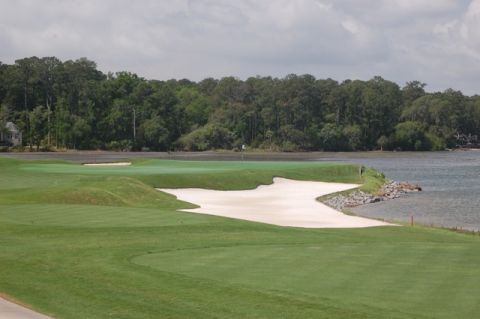
A few of the finishing holes on Colleton River's Nicklaus course, like the par 3 17th, play along the Colleton River.
Although the $15,000 in annual dues (plus a $2,500 annual assessment which ends in 2017) may intimidate some, the initiation fee for the two golf clubs plus the other world-class amenities at Colleton River is just $15,000, way less than what golf courses, clubhouses and staff services of this stripe would normally cost. (Think $150,000 at some upscale Florida clubs.) Combine the low cost of a lot and the low buy-in price for club membership, and the $1,400 or so per month doesn’t seem quite as high, especially when you consider the high-level of the golf courses.
The Dye and Nicklaus courses are utterly different in character, but when you ask members which they prefer, there is no clear winner. The Dye plays out near the ocean, especially its back nine, and its links-like layout is deeply affected by prevailing winds. I noted a three-club difference on many shots on the back nine, and with firm and fast greens -– the stimpmeter, we were told, read 12 -– it was impossible to go directly at many of the pin placements. Greens are large and, typical of Dye, mounded if not quite “moguled.” An early spring still had not quite promoted all the new grass growth on the over-seeded greens, but they were cut and rolled and so fast that those prevailing winds added an extra element to consider when lining up a putt.
Whereas Dye is more links land and, therefore, purposefully a little rough here and there, the Nicklaus, opened in 1991, is an impeccably groomed parkland layout -– but with plenty of sand dunes -- that explodes onto the shores of the Colleton River on the back nine. It features the best greens I have played in years. Greens often look faster than they are; these greens looked fast and actually were faster than they looked, with a stimpmeter reading, according to the superintendent, of 13.1. That is U.S. Open and Masters territory, and the Nicklaus course at Colleton River makes you feel as coddled as a professional. Thankfully, the greens are much flatter than the Dye greens, but when you wind up off the putting surface on the wrong side, count on three to get in. Overall, the course plays tougher than its various ratings indicate (the greens were firm as well as lightning fast). Yet when you screw up at the other course, you might utter an oath about Pete Dye, when you do that at the Nicklaus course, you kick yourself. And with greens that perfect -– the best I have played in years, and getting better over the next few weeks –- you have only yourself to blame.
Currently at GolfHomesListed, Gateway Realty agent Tom Jackson has 10 homes listed for sale at Colleton River, ranging in price from $395,000 to $1.2 million. He will be pleased to share the details on other homes and dozens of lots for sale in the community. Just click on one of his golf properties for sale at GolfHomesListed, provide your name and email address –- we never share your personal information with anyone without your permission –- and you will not only receive the details on that property, but you can also contact Tom with any questions about Colleton River. Or, if you have any questions about Colleton River or any other golf community, feel free to contact me.
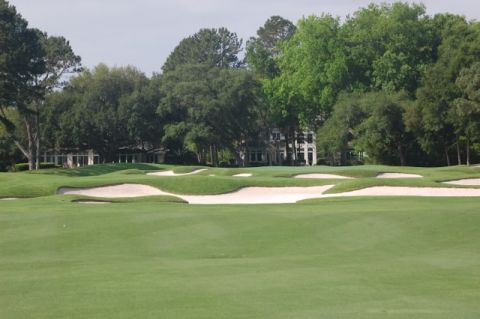
Colleton River is a LowCountry Jack Nicklaus layout; ergo, it must have sand, and plenty of it.
Attention Candidates: We love our homes… and deductions
According to a survey earlier this year, most American voters agree that the Federal government should continue to provide tax incentives to encourage home ownership. Support for the principle crossed all political party lines.
The National Association of Home Builders commissioned the survey of 1,500 likely voters in January. The vast majority of voters said they were against any efforts to reduce or eliminate mortgage interest deductions for primary and second homes, against limiting deductions for those with incomes of more than $250,000 per year as well as other talked-about actions.
About two-thirds of voters said the Federal government should encourage affordable long-term, fixed-rate mortgages; and a whopping 96 percent who own a home indicated they were happy with their decisions to own.
Read the NAHB’s press release on the survey by clicking here.
Classy 19th hole: Golf community features winery, Rees Jones course
I stopped yesterday at Viniterra, a unique golf community halfway between Richmond and Williamsburg, VA, less than two miles from Interstate 64. It is unique in that a working winery, as well as a sleek Rees Jones golf course, is on property and managed by the developer. My tour included a stop in the wine tasting room, a well appointed, neat-as-a-pin spot at the entrance to the community, whose exterior features reclaimed wood and bricks that pre-date the Civil War. In just its first few years, the winery has picked up awards for its toothsome whites. In the absence of a clubhouse -- construction begins soon -- the tasting room and its porch serves as a splendid 19th hole.
I’ll have more to say in this space soon about Viniterra, its golf properties for sale and it golf course.
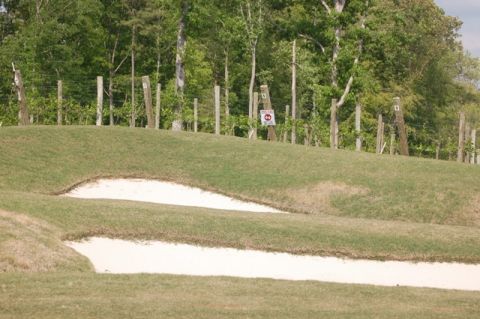
Some grape plantings bump up against the Rees Jones golf course at Viniterra.
South Carolina Golf Rating Panel updates list of top courses in the state
The South Carolina Golf Rating Panel, of which your editor is a member, has published its golf course rankings for 2012. Some of the greatest moves up the list since it was last published two years ago were made by golf courses in residential communities.
Topping the list is the Ocean Course at Kiawah Island, which will host this year’s PGA Championship in August. Although no homes interrupt the sweeping vistas of dunes and ocean from the Ocean Course, you can live within an easy cart drive of the clubhouse (if you can afford the multi-million dollar homes). Ocean Course designer Pete Dye copped another nod from the Panel when his Harbour Town links, which he designed with Jack Nicklaus, grabbed the #2 spot this year. The little known Sage Valley, hailed among golf architecture cognoscenti, was rated third best, just ahead of the May River Club, the Nicklaus layout at the lush Palmetto Bluff Resort, the highest-end golf community in the Hilton Head area. The Chanticleer (#5) at the Greenville Country Club and the Dunes Club in Myrtle Beach (#6) are adjacent to mature housing communities but aren’t as connected to the real estate as they would be in more modern developments (call this "unplanned" development). No homes intrude on #s 7, 9 & 10 on the list -- Yeaman’s Hall, Secession and Palmetto Club, respectively. For three decades, though, Hilton Head Island’s Long Cove, #8 on the list, has been at the heart of an elite community.
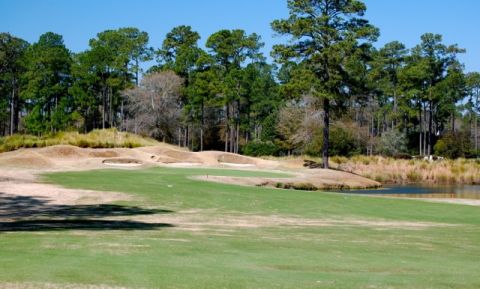
The Tom Fazio-designed Wachesaw Plantation in Murrells Inlet, SC, just south of Myrtle Beach, made the SC Golf Rating Panel list at #32.
It was good to see golf courses in planned developments garner favor with panelists. The beautifully conditioned Reserve Club at Pawleys Island moved up 11 spots this year to #35; residents of the surrounding community have access to a marina and beach club, in addition to the golf club. Members of the Greg Norman-designed Reserve Club course also have privileges at other McConnell Group private golf courses in the Carolinas. TPC of Myrtle Beach, which is actually located in Murrells Inlet, made the most dramatic improvement, leaping from 66th to 38th in the rankings. A huge development with reasonably priced real estate called Prince Creek bumps up against much of the TPC property. Also moving up the list was the Barefoot Resort’s Davis Love course, one of four layouts at the Myrtle Beach complex.
We were pleased to see Colleton River Plantation’s two golf courses –- the Nicklaus at #18 and the Dye at #21 -- rank so highly on the list. We are looking forward to playing the two layouts there a week from now during a Rating Panel outing.
For the full list of the 50 best golf courses in South Carolina, visit the SC Golf Rating Panel web site.
Reynolds Plantation may have a buyer
At just an hour and a half, without traffic, from Atlanta, the beleaguered Reynolds Plantation was a magnet for that city’s business and professional people and their families before bad fiscal management and the recession sent the community into bankruptcy proceedings.
Now, according to the Atlanta Journal-Constitution, a builder of high rises in Atlanta may have the inside track to inherit Reynolds. The newspaper’s online arm is reporting that Daniel Corporation, based in
Daniel Corp. is not unfamiliar with golf community development. The firm owns and manages Greystone, a well-regarded 2,300-acre Birmingham community with George Cobb and Rees Jones 18-hole layouts. Greystone features 3,000 home sites, not inconsequential in size as golf communities go, but way smaller than Reynolds, which already has 3,600 owners and hundreds of acres of property remaining to be developed. Daniel Corp. also is a partner in the community that surrounds Birmingham’s Ross Bridge, one of the highest-profile clubs along the Robert Trent Jones Golf Trail.
A quick scan of properties for sale at Reynolds shows resale homes as low as $299,000 and home sites as low as $40,000, considerably below even the quoted cost of a full membership in the six clubs last year. With The Cliffs Communities emerging from bankruptcy as well in the coming months, it will be interesting to see how these two competitors fight for an admittedly narrower market of wealthy Atlantans who may not feel quite as wealthy as they did in 2005. Look for more aggressive pricing on memberships, lower prices for undeveloped home sites and even re-plotting of some areas of both golf communities to permit more density and more affordable homes. The days of high-five- and six-figure golf memberships are over.
Golf home “value” plays at GolfHomesListed
Cliffs bankruptcy bid process coming to end
The Highs and Lows of prices for golf homes
How Sweet It Is: Our New Web Site Debuts

Now on Sale

- The only book about golf communities in the last 10 years.
- 156-page step-by-step guide to finding your dream golf home.
- Info on nearly 100 golf communities the author has visited.
- Paperback version costs less than a sleeve of Pro VIs.
Here is what the experts are saying:
“The book is chocked full of information…applicable to anyone looking for a move to the Southeast regardless of whether they are looking for a golf community or not.” — John LaFoy, golf architect (Linville Ridge CC, CC of Charleston, The Neuse GC)
“Larry has done a tremendous amount of work and anyone — like me — who is looking to search for a golf home now or in a few years needs this book.” — Brad Chambers, golf blogger, ShootingYourAge.com
“Wow! What a thorough piece of work…a must for anyone moving South. This book will help many people.” — Brett Miller, owner and founder of MMA, Inc, a golf industry consultancy
Buy It Now at Amazon.com or BarnesandNoble.com.