New tee boxes don't make par 3s any easier
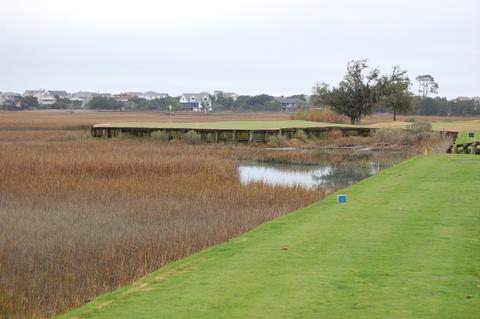
The 13th at Pawleys Plantation is short but capable of ruining a good round.
The par 3 13th and 17th holes at Pawleys Plantation (Pawleys Island, SC) are the scariest duo of par 3s on any back nine. No matter how well you have played or how confidently you are swinging, when you stand on the tee box built across the former rice paddy and stare at the small island green 13th hole, the wind forcing a shot that must start over the marsh to the left, survival mode kicks in. That wind necessitates an extra club but also a full swing. Catch it well but choose the wrong club, and you are one bounce to
Until now, the pair of par 3s presented one other shared challenge. It was difficult to find a decent piece of grass on the narrow tee boxes, and with the thick layer of sand and fertilizer under the thin veneer of what passed for grass, tee shots almost felt like blasts from a sand bunker. I don't like to hit a nine iron off a tee, but sometimes you had no choice.
Now, after an improvement project last summer and fall, the tees on the dike have been built up and planted with a hardy grass that seems to be holding up well against the thousands of rounds a month played on the popular course. As long as Pawleys' superintendent moves the tee markers daily to give the scuffed turf time to re-grow, golfers at Jack Nicklaus's brutal pair of par 3s will just need to worry about the wind, narrow landing areas and their nerves.
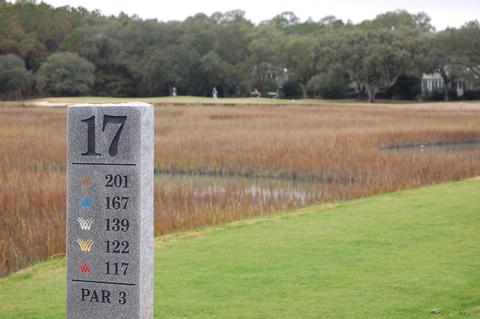
Because it plays downwind, clearing the bulkhead on the 17th at Pawleys Plantation is only half the battle.
 Home On The Course newsletter
Click here to sign up for our Free monthly newsletter, loaded with helpful information and observations about golf communities and their golf courses.
Members play through clubhouse fire
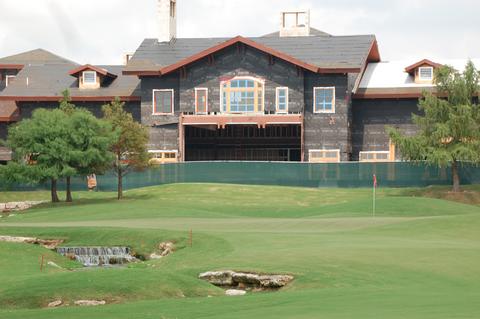
The half-complete University of Texas Golf Club clubhouse late this summer.
This coming March was to mark a highlight in the short, impressive history of the University of Texas Golf Club in Austin, TX. When I visited late last summer, employees and members shared their excitement with me about the impending opening of the club's new $16 million clubhouse. The half-completed structure dominated many of the vistas from the UT Golf Club's roller coaster fairways and was designed to provide some nice eye candy behind the otherwise routine par 4 finishing hole.
But last week during construction, a small fire started on the roof, and with Hill Country winds whipping along at 30 mph, the building never had a chance. Within an hour, the 70-percent completed clubhouse was a total loss.
Club officials told us today that they plan to forge ahead with construction and expect to dedicate a new clubhouse later this year, barring any new catastrophes. Thankfully, the splendid golf course and other buildings at the UT Club, which is set within the huge Steiner Ranch community, were unaffected and, as one news report indicated, some members were totally nonplussed. After arriving for their afternoon tee times to find they had to park their cars 50 yards away from the clubhouse parking lot, they grabbed their clubs, choked back the smoke and, perhaps, a few tears, and headed for the first tee. No sense letting a perfectly good golf course go to waste.
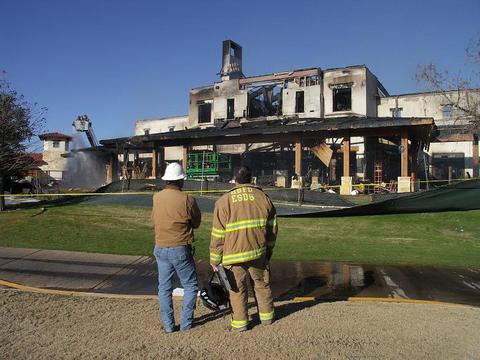
Last week's fire's aftermath, as captured by club member Robert Salas.
California, Florida population growths slowing to trickle
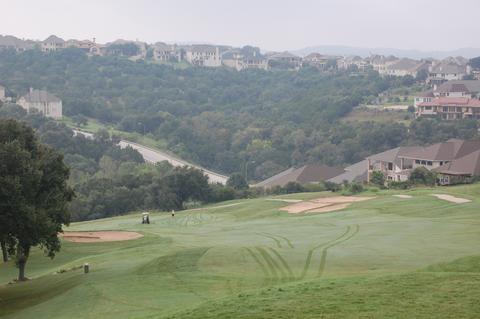
Texas is the 7th fastest growing state, thanks to no state income tax and still reasonable real estate prices. Austin is growing as fast as the rest of the state, thanks to attractive golf communities like River Place.
It used to be that water and climate were the strongest attractions for retirees and others seeking a better life. But the latest U.S. Census Bureau report indicates that residents of California and Florida are paddling out of state at the same rate as those moving in. (We commented initially on the report here a couple of days ago; scroll down for the article.)
The states immediately to the east of California are gaining new residents at a faster rate than is the Golden State. Indeed, Nevada, Utah, Arizona and Idaho grew the fastest of the 50 states from July '06 to July '07. However, Nevada's and Arizona's growth rates were considerably less than in the prior year, reflecting the housing inventory issues in overbuilt Las Vegas and Phoenix, respectively. At .8%, California was the only state west of Kansas that grew at less than the overall national growth rate of 1%, and most of that increase was due to births.
Where is everyone going? Besides the aforementioned Mountain States, only Texas, North Carolina and Georgia grew at rates above 2% in the year-to-year time period. Wyoming and Colorado grew at an even 2.0%. Only Virginia, Mississippi and Alabama among the southeastern states grew at less than 1% (I don't count Maryland or Delaware in the southeastern group, but Delaware actually grew at 1.4%, Maryland at a mere .3%).
South Carolina, where I own a second home, grew at a healthy 1.8%, and although we haven't seen a city-by-city or county breakdown of the numbers for the state, we have noted that construction continues in the Myrtle Beach area even as some residential builders declare troubles. In March, for example, the first occupants will move into homes around Market Commons, a large retail/office/residential complex on the site of a former U.S. Air Force Base less than two miles from Myrtle Beach's commercial airport. Two-dozen golf courses are within a 20-minute drive, and golf course closings, which had reached epic proportions in the last few years, seemed to have slowed to zero for the time being. An example of New Urbanism, Market Commons provides its residents the opportunity to work, shop and be entertained substantially where they live, without starting their cars. Somewhere, Al Gore is smiling.
Michigan and Rhode Island also demonstrated that abundant water is not enough to overcome faltering economies. The two states were the only ones to lose population in the last year, although tiny Rhode Island lost just a net 3,800 citizens. For those contemplating owning homes both north and south, Rhode Island is not a bad choice for the northern complement. Providence, with its excellent colleges and surprisingly busy airport, is an interesting town with good restaurants and cultural attractions, and the excellent golf throughout the state ranges from public (like the funky Donald Ross-designed Triggs Memorial in Providence) to the ultra-private Newport Country Club, site of the LPGA Open year before last. Carnegie Abbey, a high-end residential complex with a lush private golf course, may appeal to the hedge fund manager in you, with price points that begin just short of seven figures.
Florida's growth rate slowed to 1.1%; a whopping 135,000 fewer residents migrated to the state than did the year before. If unoccupied condominiums were counted as people, Florida might have given Louisiana (+1.2%) some competition, but almost as many folks are moving north on I-95 as are going south. Those who plan to relocate to the Sunshine State in a few years had best keep an eye on the property tax structure in the no-income-tax state as well as further escalations in insurance rates. And for those who like to get out and about, check traffic reports every once in a while. The state's roads are a mess.
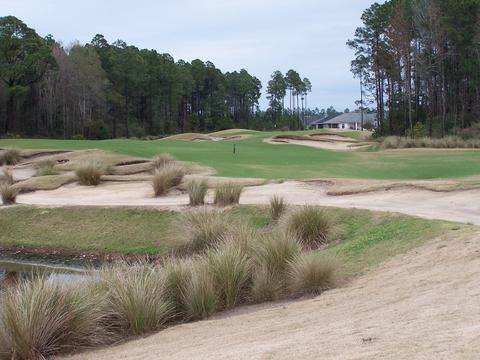
Jacksonville doesn't seem like much of the rest of Florida. It features reasonable real estate prices and manageable traffic. The golf was good too, including the surprisingly testing Palmer layout at North Hampton.
Media taking it easy on housing market story
We scour the real estate message boards, and one constant theme among real estate agents is that the media has fanned the flames of the housing crisis, scaring away precious customers. Au contraire. If anything, the media has been too easy, primarily because they are too lazy to do their homework.
Maybe most of us slack off a little at holiday time, but the mainstream media laziness in reporting on the real estate mess in the U.S. knows no season. Their speed dial always seems set to the chief economist at the National Association of Realtors. Asking the National Association of Realtors about the real estate market is like asking McDonalds about obesity. You are never going to get a straight (read "honest") answer.
The Christmas Day present in my email inbox was yet another piece of lazy journalism, this time by Wall Street Journal Online and Marketwatch reporter Amy Hoak. I offer Ms. Hoak's opening sentences unexpurgated: "After a year of falling house prices in numerous parts of the country and a meltdown in the mortgage market that affected borrowers regardless of their ZIP code, many hope that housing markets will finally start to get better next year...But if there's any improvement in 2008, it may be relatively modest."
How's that for investigative journalism? State the blindingly obvious (prices are falling, the mortgage infrastructure is a mess), the cloyingly banal (many hope the market will get better) and then wrap it all up with the startling conclusion that gains in 2008 "may be relatively modest." Small wonder she gets some of her insights from the NAR's Chief Economist, Lawrence Yun. We thought we were past all this when David Lareah, the NAR's former chief economist and the market's foremost Polyanna, retired to Florida where he is no doubt sitting around the pool telling his fellow 60-somethings that there is no condo problem in Miami.
But Yun and his cronies at the NAR have clearly embraced the Lareah legacy, although without the strictly glass-always-full optimism. Their approach is more three-quarters full, one-quarter empty. "The National Association of Realtors predicts a slight increase in existing-home sales next year, but a decline in new-home sales," Ms. Hoak writes. In the face of escalating foreclosures, tightening of credit, huge unsold inventories of homes, new home starts that have ground to a halt, ugly government data, and most sane economists' predictions of gloom well into 2009, the boys at the NAR still cannot admit the glass is empty. Not content to leave it at that, Yun tells Ms. Hoak that a low interest rate on mortgages "should have provided a lift to home sales, but it has not."
In other words, he wasn't wrong. Those of us who didn't buy over-priced houses were.
No wonder there's a blogosphere.
Population shifts make only temporary census
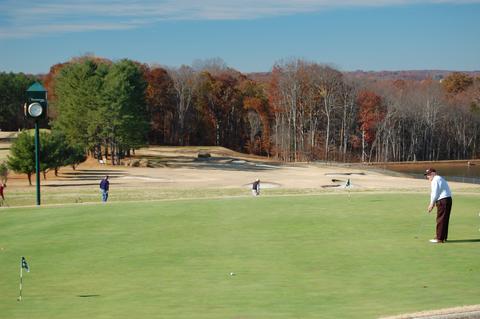
North Carolina is the sixth fastest growing state in the land. Its wide-ranging array of golf courses includes some outstanding and reasonably priced daily fee options, like Tanglewood Park near Winston-Salem.
I arrived in Pawleys Island, SC, this week just in time for the front page headline in Myrtle Beach's The Sun News: "Populations of Carolinas among the fastest growing." South Carolina's population growth in the last year was 4.41%, a bit more than in the prior year, when it was 4.33%. North Carolina's population grew 8.87% and 9.06% respectively in the last two years, making it the 6th fastest growing state in the land, behind (in order) Nevada, Arizona, Utah, Idaho and Georgia. South Carolina was ranked the 10th fastest growing state.
All these numbers made me hungry for more data, and I visited the U.S. Census Bureau site to sate my appetite. Some interesting stuff there that you can check out yourself; if you are American, then you are paying for the service, so why not use it? The following are a few highlights, but keep in mind the Census Bureau made these predictions based on the 2000 census. As you may have noticed, a few things have occurred in the housing market since then which could slow the migrations, although it should not affect the general direction of the population flows.
According to Census Bureau projections , Nevada will be the fastest growing state between now and 2030, up a whopping 114%, albeit on a relatively small population base. Since these projections were made before flipping condos in Las Vegas supplanted gambling and prostitution as the most attractive money-making deals -- at least for about a nanosecond -- we wonder what effect all those empty condos will have on the growth numbers. Arizona takes second prize in the growth wars with a predicted increase of 109% and just over 5.5 million new residents. You have to wonder how that prediction might change if, say, a build-the-fence-high new U.S. President is elected.
Also, Presidential candidate and Arizona senator John McCain, who seems to have the most compassionate plan regarding immigration, is not so sanguine when it comes to water. He has accused California of stealing some of his own state's water supply. Although California will grow only 37% in the 30 years time frame, that still represents an additional 12.5 million thirsty people. What effect
Sometime in the next few years, Florida will finally supplant New York as the third most populous state, the Census Bureau indicates, assuming no catastrophic hurricanes, no catastrophically higher premiums on catastrophe insurance, no catastrophic car jams on the state's under-built roadways, and no catastrophic flight to the Carolinas by fed-up retirees. You might detect a certain theme here. You can't beat the weather in Florida, except perhaps in July and August, but is the quality of weather more important than the quality of life? Do you really want to be forced to endure the 4:30 p.m. early-bird special at the local smorgasbord just to avoid stop-and-go traffic during the normal dinner time and rush hour?
And speaking of water, when I traveled to the state in 1980, I recall that my brother, then an employee with the U.S. Environmental Protection Agency, warned me not to drink the water in Panama City and a host of other cities in Florida. In short, the Sunshine State has grown way too quickly for its overwhelmed local officials to accommodate the demands of three generations of retirees from New York and elsewhere. Note to officials in Asheville and Myrtle Beach: Get ready because many of the so-called disillusioned "halfbacks" are heading your way ("halfbacks" as in New Yorkers who moved to Florida and are now bouncing halfway back).
North Carolina will move from 11th place in total population to 7th by 2030, according to the Census Bureau, reflecting the state's attraction to young workers and families, especially in the Charlotte and Raleigh/Durham areas, its reasonable tax structure, its generally excellent schools (traditionally an oxymoron in other southeastern states) and the best selection of golf courses and communities in the nation, with great options in the mountains, on the coast and everywhere in between. Also, prices in many suburbs of the growing cities of North Carolina, especially 30 to 45 minutes from the city centers, are still reasonable. I recently visited Winston-Salem and was surprised to find some nice-looking four bedroom homes under $400,000 in a few of the communities. Although the city of Winston-Salem does not offer the sophistication or range of activities of Charlotte and Raleigh, it could fill the bill for a young family or retirees who want a quality lifestyle and have a smidgen of pioneering spirit.
I'll continue some reflections on the census data in coming days.
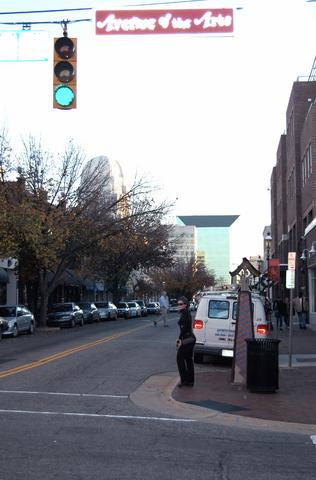
North Carolina cities like Winston-Salem are making their downtown areas more attractive to the thousands of people moving to the state.
Good Charlotte: Southern city market strong
Charlotte, probably the most stable and growing business center in the southeast, may not have the reputation as a center of golf that Pinehurst and Myrtle Beach have, but it is chockablock with a number of
We have commented often here about the consequences if people in soft markets wait too long to accept what the market will give them for their primary homes, especially if they have a plan to move south. Holding out for the last dollar in, say, Detroit (down 11.2%) or New York (-4.1%) is a bad move if you plan to relocate to Charlotte or Dallas (-.1%). On the other hand, if you are willing to buy into one of the markets devastated by speculators, like Tampa (-11.8%) or the empty-condo-infested Miami (-12.4%), you can probably bide your time.
All real estate is local, and these market price movements do not always reflect specific communities within them. If you are interested in a particular area of the south, please let me know and I can put you in touch with one of the most qualified agents in that area. Our HomeOnTheCourse agent will not only know well the golf communities in the area, but also will be able to show you some of the area's finest private clubs that may not be affiliated with a housing development. And they can help you understand which communities in a metro area are the most stable. Hit the contact button above to let me know if you would like a no obligation introduction to a qualified agent knowledgeable about golf course communities and local private clubs.
Have a great holiday season and a happy new year
New articles here will be a little sporadic over the coming days as I enjoy the holidays with my family and head to South Carolina for a week of relaxation and golf. Hey, even the folks running for President of the United States are taking a couple of days off.
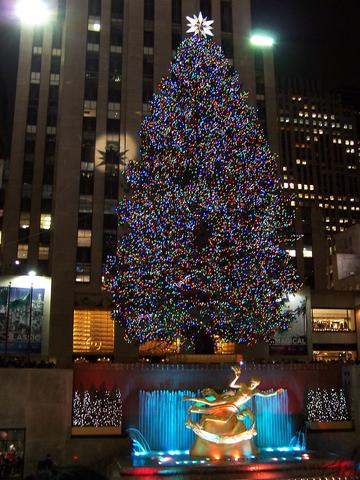
I'll try to post a few photos here over the next few days and will be back with more thoughts later in the week. In the meantime, I took the photo below in New York City on Friday at a very crowded Rockefeller Center. The joint was really jumpin'.
Best wishes to all.
Larry
Tom Jackson hole #1 with a bullet
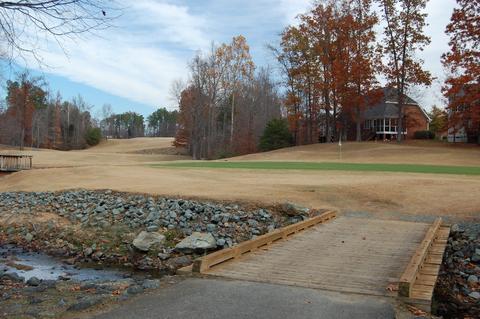
Looking back up the fairway from behind #1 at Stoney Creek, you see all the elements of an excellent starter, including the sloping landing area at mid fairway and the creek that gives the course its name and the hole its character.
In fine French restaurants, chefs often serve tiny little morsels called amuses bouche, meaning literally "a delight for the mouth." These bits are designed to get you off to a nice start on your meal and to hint at the chef's creativity and style.
The best golf course designers create amuses yeux, or delights for the eyes, at the first hole. They tend to ratchet back on the challenge, disinclined to punish the golfer lest the pleasant experience of the round begin on the first tee and end on the first green. First holes are rarely the most memorable of a round. For one thing, you play 17 holes after #1 and four hours later, details of the early holes are a little dim. Memorable holes on most courses are back loaded to leave you with a memory or give you something to talk about with your buddies at the 19th hole. Scan the photo galleries of the best courses in the world and you will find that the last three are generally the most photo-worthy.
A first hole has to indeed be special to be replayed in your head hours after your round. I played one such starter a few weeks ago at Stoney Creek in Whitsett, NC, while driving from Winston-Salem to Chapel Hill. Perhaps it was because I only played nine holes after a three-hour slog behind a few slow foursomes on the front nine, but I am confident that even after 18 I would have re-considered #1 on the Tom Jackson-designed course.
The first at Stoney Creek is a par 5 that plays to 538 yards from the "men's" tees. I am always happy to see a par 5 as the first hole since I rarely warm up on the practice range before a round, having been victimized too many times by leaving my best shots of the day there. So I welcome three shots to get to the first green, especially when the fairway is rather generous, as it is off the tee at Stoney Creek. What is unusual about this first hole is that the second shot is challenging for a first hole, played to a sloped landing area surrounded by the wide and very rocky Stoney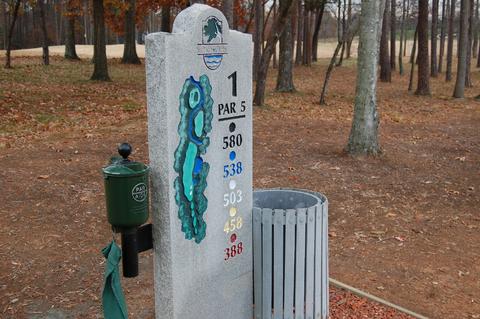 Creek; I played my 3-iron rescue club successfully but not without some trepidation.
The landing area is not huge, perhaps three or four times the size of a typical green, and it isn't by any means flat, so you do have to think carefully about placement in the middle of the area, rather than farther along where the fairway slopes down. A downhill lie just makes the approach shot back over the creek to the green more nerve wracking (I was able to negotiate an eight-iron to about 20 feet for a two-putt par). The creek branches off and surrounds the entire green. The only way to reach the amply sized putting surface is by one of three bridges. With the hazard in play for the second and third shots, the hole seemed more suited to a finisher than a starter.
As I look back on 2007, #1 at Stoney Creek was not the toughest hole I played all year or even the most visually attractive (a modern office building marred the view beyond the green). But it was certainly a candidate for #1 among the #1s. I hope the photos do it justice.
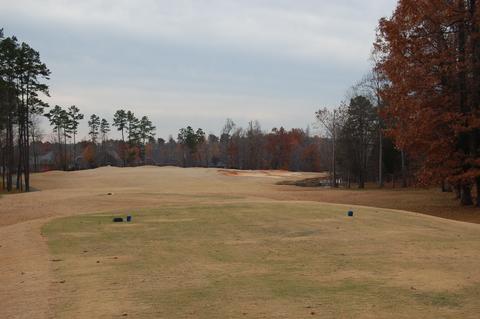
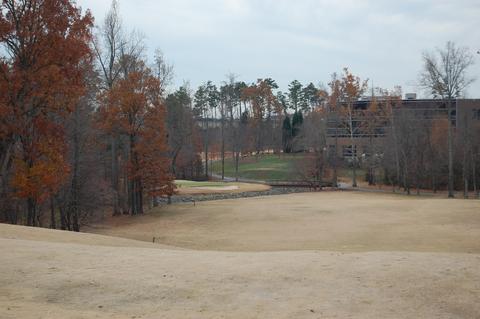
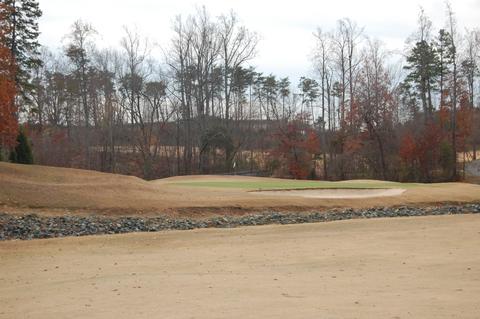
The tee shot at #1 at Stoney Creek (top) is fairly routine if you stay well enough left of the bunkers. The challenge is to keep your long-iron second shot from finding the downslope in the tight landing area (middle) before the tricky approach back over the creek to the large green (bottom).
Not such a loonie idea, eh?
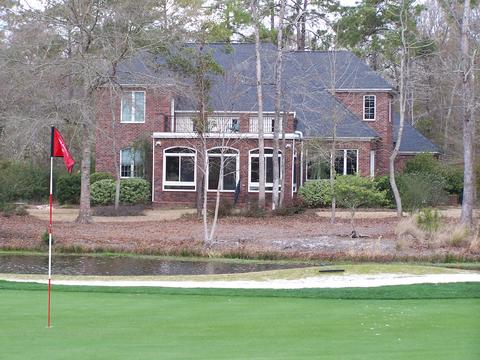
Canadians are a natural market for homes in the Low Country, like this one in Pawleys Plantation.
Open Letter to All Real Estate Agents Along the Carolinas Coast:
I was in my local Barnes & Noble Bookstore in Connecticut yesterday with my daughter, and I called over to her that maybe we should consider buying an audio book to listen to during our 15-hour drive to South Carolina next week. A young man about four feet away asked me where in South Carolina we were going. "Pawleys Island," I responded. "Ah," he said, "Pawleys Island, a wonderful place." I asked him how he knew it and he said he is a real estate agent in Charleston who was home for the holidays in Connecticut. He's been in Charleston for six years.
"How's the market holding up?" I asked, and he responded that it is horrible. Both nature and I abhor a vacuum, and I always feel I must say something in the face of bad or good news.
"Have you thought about a strong marketing campaign in Canada?" I asked him. "The Canadians love the South Carolina coast, and with their newfound buying power in the States, many of them could be ready to buy."
His eyes lit up my moment of triumph. But all patting-myself-on-the-back aside, promoters of places like Charleston and Myrtle Beach ought to be spending most of their marketing budgets aiming at golfers and beachgoers in Toronto and Montreal. The buying power for the Canadian dollar, known affectionately as the "loonie," has improved almost 20% against the U.S. dollar over the last six months, which means that a home valued at $300,000 earlier this year will only cost a Canadian $240,000 in real dollars today. Then factor in the overall real estate market pullback throughout the U.S., and their "savings" could amount to up to 40% in some areas. Their annual golf vacations to the beach are similarly cheaper. So I'd be waiting with open arms for all those visiting Canadians for whom Myrtle Beach in February is downright balmy.
The last time I looked, Myrtle Beach International Airport had some convenient flights to Toronto. I'd be looking to book a table at the real estate trade shows up there real soon, ya hear. Good luck.
Photo finishers: Part two
Yesterday, I shared some notes and photos from a few of the best finishing holes I played this past year. Below are three more.
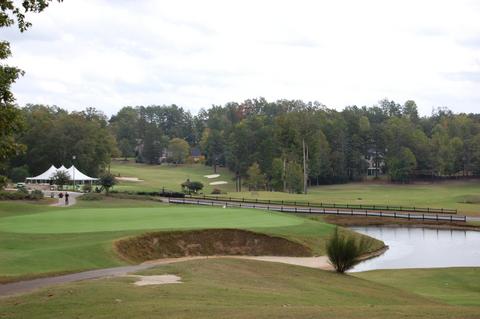
The 18th hole at Royal Lakes presents a quadruple dose of trouble for those who go for the green in two -- two bunkers with 10 foot stone facings, a lake and two-tiered green.
Royal Lakes Golf Club, Chestnut Mountain, GA
Royal Lakes, northeast of Atlanta and close to Lake Lanier, was suffering through the drought that gripped the southeast this summer and fall. But true to its name, a number of lakes came into play when I followed my son around the course during a Division III collegiate golf match in October. After struggling all round, including a soggy double bogey on the par 5 11th, Tim came to the par 5 18th needing a birdie or par to put up a respectable score. At 530 yards straight downhill from tee to green, the green is reachable in two shots, but two bunkers - one directly in front and one at right rear - make the long hitter think twice. They both are more than 10 feet high with sheer stone walls up against the green; no club in the bag is lofted enough to clear a shot from within five yards of the wall. Tim's five-wood skidded along the right edge of the green and found the back bunker, just five feet from the wall. After a few moments of indecision, he took his medicine by dropping in the back of the trap and faced a 25-yard blast down a double-sloped green to a front pin position. It seemed likely he would come up short on the top tier or, worse, skid off the front into the other treacherous bunker. However, he hit the ball clean, it teetered on the top of the ridge and then rolled down to a foot short of the hole. It was the most improbable and best par I witnessed all year.
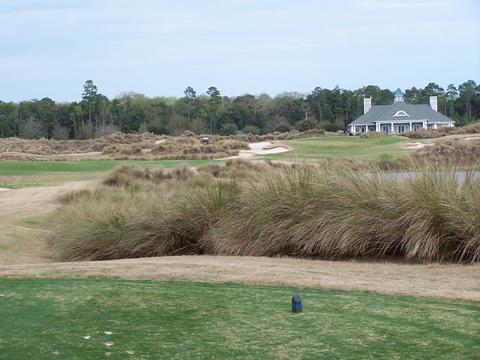
Sand and grasses and good design sense are enough to make North Hampton's 18th a classic.
North Hampton Golf Club, Fernandina Beach, FL
The North Hampton Golf Club near Jacksonville was a revelation for me, the first Arnold Palmer designed course I had played that did not seem overdone. Arnie turned the rather flat land into a links style course that puts a premium on accuracy without his customary garishly sized bunkers. Everything at the daily fee course worked in harmony, and the 18th hole was indicative, an impressive sculpture of tall grasses and natural-looking sand. The finisher at North Hampton and indeed the entire course is worth a return visit and a reminder that sometimes diamonds emerge from rough landscapes.
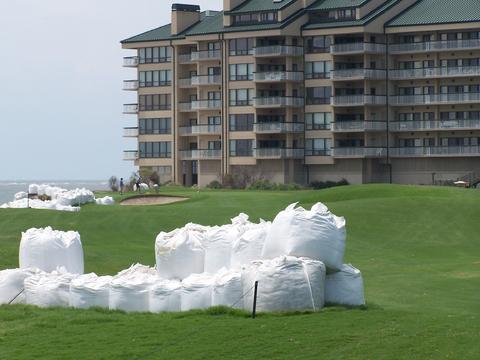
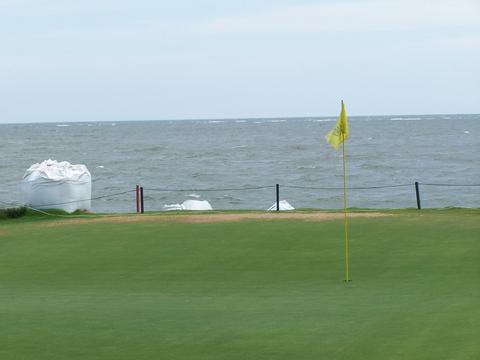
One of the best 18th holes of the year was also the most tragic. Weeks after we played it, its green fell into the sea.
Wild Dunes Links Course, Isle of Palms, SC
The most scenic 18th hole I played this year was at Wild Dunes on the Isle of Palms near Charleston, SC. Under normal circumstances, not even the hulking condo buildings that lined the right side of the fairway could neutralize the drama of a true ocean-side hole. Yet the Tom Fazio finisher was a sight for sore eyes, literally. The huge white sandbags from midway down the fairway to greenside, many of them shredded by the strong riptides, blotted the landscape, and appeared to be fighting a losing battle. Indeed, a few weeks after we putted out on 18 in early August, the green lost its battle with the ocean tides and fell away into the sea. The hole has been relocated and reconstituted as a par 3. This is the second time in its 35-year history that Wild Dunes lost its 18th hole, the first time to Hurricane Hugo in 1989. Mother Nature has not been kind to Wild Dunes, whose fantastic finisher has taken a more severe beating than those of us who tried to master it. That probably makes it unique among finishing holes, a dubious distinction at best.
Emerging trend nothing to sneeze or snore at
Kings North on Myrtle Beach must-play lists

Now on Sale

- The only book about golf communities in the last 10 years.
- 156-page step-by-step guide to finding your dream golf home.
- Info on nearly 100 golf communities the author has visited.
- Paperback version costs less than a sleeve of Pro VIs.
Here is what the experts are saying:
“The book is chocked full of information…applicable to anyone looking for a move to the Southeast regardless of whether they are looking for a golf community or not.” — John LaFoy, golf architect (Linville Ridge CC, CC of Charleston, The Neuse GC)
“Larry has done a tremendous amount of work and anyone — like me — who is looking to search for a golf home now or in a few years needs this book.” — Brad Chambers, golf blogger, ShootingYourAge.com
“Wow! What a thorough piece of work…a must for anyone moving South. This book will help many people.” — Brett Miller, owner and founder of MMA, Inc, a golf industry consultancy
Buy It Now at Amazon.com or BarnesandNoble.com.