3.8% surtax on home sales is small deal for big earners
The silly season of national politics landed in my email inbox last week. I might have ignored the item if a) it had nothing to do with real estate and b) if it wasn’t so deceptive in its implications for home sellers.
It all started when a Realtor I know received an email from a Realtor he knows that referenced a surtax of 3.8% in the Affordable Care Act (you may know it by its pejorative, ObamaCare). Reading mostly only the subject line, and missing its hysterical doomsday implications, my Realtor friend passed the message on to a couple
The original sender commented that Realtors would find it impossible to sell homes because people who wanted to sell their homes wouldn’t do so because of the onerous tax. Her naïve reading of the provision in the Affordable Care Act was that a “transfer tax” of 3.8% would be applied to the selling price of a home. In point of fact, that is nonsense; the tax is on investment income, not on the sale of the home.
Here is how the tax is applied. First of all, if you qualify for a $500,000 exclusion on profits in your home (for joint-filers, $250,000 for singles), then you still qualify for it. Second, the 3.8% is a surtax on investment income for couples earning more than $250,000 annually, not a transfer tax. Even then, such high earners will not be liable for the surtax if their income is “solely earned,” that is from salaries and other income from active participation in a business. Those who derive a sizable portion of their income from dividends, interest, capital gains and rental income may be subject to the surtax but, again, only after the $500,000 exclusion (for a married couple).
In short, the only folks who need worry about the 3.8% surtax are those who make in excess of a $500,000 profit on the sale of their homes and receive most of their other income from passive investments. Ken Harney, a real estate expert writing in the Hartford Courant’s real estate section last Sunday, gave the following example provided to him by the National Association of Realtors:
“Say you and your spouse have adjustable gross income of $325,000 and you sell your home at a $525,000 profit. Assuming you qualify, $500,000 of that gain is wiped off the slate for tax purposes. The additional $25,000 gain qualifies as net investment income under the health care law, giving you a revised AGI of $350,000. Since the law imposes the 3.8% surtax on the lesser of either the amount your revised AIG exceeds the $250,000 threshold for joint filers ($100,000 in this case) or the amount of your taxable gain ($25,000), you end up owing a surtax of $950 ($25,000 x .038).”
The current debate about taxes and their effect on both business and homeowners is silly. I can honestly say that I did not consider tax issues for one second when I conceived my small business, and neither did any of my small-business friends. Couples selling their homes in the near future shouldn’t think about the taxes either.
 Home On The Course newsletter
Click here to sign up for our Free monthly newsletter, loaded with helpful information and observations about golf communities and their golf courses.
The kindness of neighbors
A touching story from Savannah Lakes, the sprawling and rural golf community in South Carolina, near the Georgia border, reminds us of the kindness of strangers, even those with whom you might have been in tough negotiations for the sale of a home. It also says something about extreme customer service by a real estate agent.
Michael Sherard, the principal real estate professional at Savannah Lakes, published a story in his monthly customer newsletter about a couple from Texas he helped to purchase a re-sale home in Savannah Lakes. After the sale of the home but before they moved to Savannah Lakes, the Texas couple’s beloved dog of 15 years passed away. They were crushed and,
I heard another kindness-of-neighbors story recently during a two-day golf outing in a coastal South Carolina community. In our foursome was a resident of the community, and as we passed a home that was nearing final construction, he told us the following story. The man who was building the house paid a visit to check out the late stages of construction. The next-door neighbors, who had lived there for a few years, were away on the day of his visit but heard he had been there. They contacted the golf club for his home phone number up north and called his house to introduce themselves and welcome the couple to the community. His wife answered, and when they said they were sorry they had missed her husband’s visit, she responded: “We aren’t building a house there?”
As it turned out, they weren’t building a house, but her husband was -- for himself and his mistress. He was waiting, the story goes, until the house was finished before telling his wife. We wonder how that first conversation with his new neighbors went after he moved in.
*
If Savannah Lakes, which features two 18-hole layouts and reasonably priced real estate adjacent to large Lake Thurmond, sounds like a place you might consider for a vacation home or permanent home, contact me and I will put you in touch with Michael Sherard. And if your curiosity has the best of you, and you want to know the identity of the golf community in the second story, let me know and I will share it.
Rare new golf community opening in VA
In the wake of the Great Recession that began in 2007, the announcement of a new golf community is about as rare as a Republican’s vote to raise taxes. But Jeffrey Snyder and his financial backers figure that a sylvan lake setting and a golf course that will echo some of the world’s famous holes should convince buyers to take a serious look at Cutalong, a 1,000-acre property on the shores of Lake Anna in southern Virginia, about 40 minutes from Fredericksburg and within an easy drive of Washington and Richmond. That sets Cutalong up as a viable lure to second-home and retiree owners.
Cutalong’s 18-hole, par 71 golf course will be designed by local resident Tom Clark of the Ault-Clark architecture firm and will play up to 7,400 yards. Ron Whitten, who has surveyed and written about golf
The 13,000-acre Lake Anna will provide additional recreational outlets. Some boating enthusiasts will take advantage of a “concierge” service that will attend to all the necessary pre- and post-boat excursion work. All the other customary amenities of a high-end golf community are planned for Cutalong, once lot sales reach a certain point.
Prices for 1/3 to ½ acre lots with golf course views start at just $69,900. To encourage sales, Cutalong is holding an open house every day until a major event on August 18, which they are billing as a “family day.” Gold panning will be one of the highlights, along with a shot at a hole in one to earn a free golf home site at Cutalong. Cutalong's developers are hoping to strike gold with their gutsy venture.
Columnists argue over state of private golf membership; sounds like class warfare
There is a silly little argument going on in the pages of New England Golf Monthly (NEGM), a publication where your editor once penned a column about golf community living. Typically, NEGM editorial material would be of little relevance to this blog, but in the magazine’s “Gorman vs Geary” point/counterpoint section in the July issue, columnists Tom Gorman and Tim Geary go at it over the issue of the future of private golf clubs. The question for the two this month is, “Are private clubs becoming an endangered species?” Their discussion smells like class warfare, and the sniping sounds as angry as a Presidential campaign. You can read the columnists’ diatribes for yourself, but if you prefer the Cliffs notes version, here it is:
Gorman argument: The middle class is eroding and many can no longer afford membership. In addition, cliques and other stuffed shirts make for
Geary argument: No private clubs in New England have filed for bankruptcy (he is wrong about that; one near my home town of Avon, CT, did earlier this year and a golf professional commenting at the NEGM site references two clubs in the New Haven area that were forced to go public because of financial issues). Established golf clubs in Rhode Island, Geary maintains, are not even close to insolvency. The writer knows this, he says, because he asked them. (How many private businesses feel the need to share their financial problems, especially with a journalist?) And, by the way, Tom Gorman, who “belongs to two private clubs,” has to lift up his desk to retrieve a dictionary to look up the words “erroneous” and “discern.” Personal invective as debate technique. Classy.
I thought at any moment, I might read the famous Saturday Night Live words “Tom (or Tim), you ignorant slut!” In any debate between opposites, it is hard to reject both arguments but, in this case, we will try. Yes, the middle class has suffered a hit, and this is a group fundamental to the sustainability of many private clubs. On the other hand, the uber-wealthy are not like the rest of us, as F. Scott Fitzgerald once said; they can continue their club dues payments during a recession. (F. Scott did not say that.) But to imply that cliques and stuffed shirts are driving people away from most clubs is to conclude that the Judge Elihu Smails (played by Ted Knight) in "Caddyshack" was representative. Of cartoon golf, perhaps, but not of any private golf clubs we know.

Part of the cost of a golf outing the editor took part in at the private Madison Country Club in Madison, CT, was a chance at a round for one foursome at the golf course. As private clubs fight to remain competitive, such giveaways can be more about marketing than about largesse. And if the Madison membership, for example, was truly snooty, then they would not permit prizes that invited outsiders.
Geary’s argument, of course, is buttressed by assumptions masquerading –- and not too well –- as facts. He should do a Google search on the terms “golf courses for sale” and he would see the carnage wrought by the recession on both public and private golf clubs. I guess he does not venture on to our site where we have discussed The Cliffs Communities bankruptcy and Reynolds Plantation bankruptcy, both as a consequence of the recession and their own developers’ questionable risk management practices.
I’ve been lucky this summer to play a number of private clubs in Connecticut, and they show every sign of being hungry for new members. Except at the snootiest clubs, vestiges of stuffiness have melted away as the reality of the marketplace has imposed a greater democracy on club memberships. Beggars can’t be choosers and, make no mistake about it, some clubs are begging for members and choosing to be way more welcoming. This is a great time to be a buyer, of club memberships as well as of golf homes in private communities.
Viniterra gives new meaning to 19th hole; Rees Jones 18 something to toast as well
Many golf rounds end in a beer. As you putt out on the 18th hole, how often do your golfing pals ask, “Hey, want to stop for a cold Chardonnay?” And yet, the connection between golf and wine seems to be growing constantly. Consider the ranks of professional golfers who have lent their names and, in some cases (no pun intended), their guidance to the production of world-class wines. Greg Norman. Frank Nobilo. Ernie Els. David Frost. One day, we might be talking about a Tiger Woods line of Sunday Reds (that pun is intended).
For now, those of us who like golf and wine in nearly equal measure can take comfort that a golf community named Viniterra has been able to survive the blight of awful timing, having opened its sales office to customers within days of the collapse of Lehman Brothers in 2008. That little bit of financial history wrecked havoc in terms of new residential developments. Yet Viniterra, thanks to the deep pockets resources of Boddie-Noell Enterprises, its owner and the operator of hundreds of stable fast food outlets in the south, has been climbing out of the hole that credit default swaps and easy money dug for all of us, but especially for new residential communities, and double so for golf communities. Boddie-Noell is also the force behind The Currituck Club, a successful beach and golf resort community at the north end of the Outer Banks.
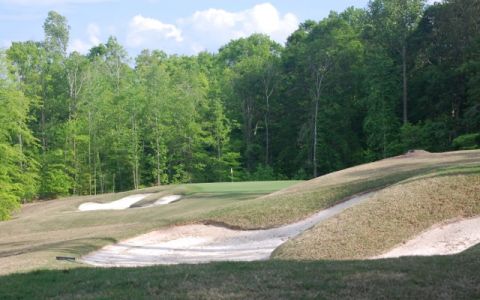
Bunkering on Rees Jones' Viniterra layout skew toward one side of some of the holes. You do not want to be on the left side, for example, on the par 4 16th.
On the strength of its New Kent Winery and sleek Rees Jones designed golf course, as well as sharply priced home sites along its rolling terrain, Viniterra is doing quite nicely. For golf connoisseurs, the Jones
Approaches to the large and swirling Jones green complexes are the key to scoring success at Viniterra; Jones layers a few bunkers on one side of most greens and protects the other sides with a bit of elevation or undulation. I am glad I did not play the longer routing; it would have been difficult to avoid trouble with my customary off-target long-iron approaches. Fairway turf still had some growing to do in late April, but the greens were mere weeks from peak, and they showed every sign of having the seeds of perfection. I look forward to a replay in the fall when cooler nights should compel the superintendent to cut the greens down, although they certainly were not slow on the day I played.
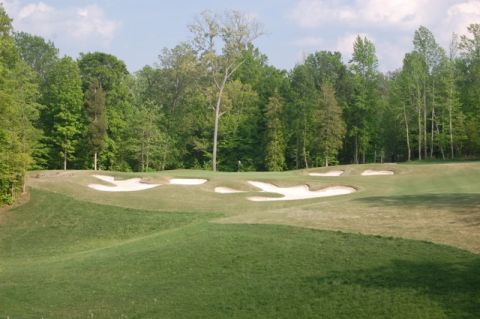
The short holes at Viniterra, such as the par 3 15th, have an extra dose of protection.
The golf course is semi-private for now; after the clubhouse is built –- they plan to start construction within the year –- and the membership roll increases, it could go private, although Viniterra officials will not commit one way or the other. On the beautiful day I played, I saw just a handful of other golfers.
From different vantage points on the golf course, you see some of the winery’s fields of vines, but the real visual treats are the occasional glimpses of the rustic winery that welcomes visitors and residents at Viniterra’s front entrance. Open for business since 2009 and already regaled as producing some of the best white wines in Virginia, the 12,000-square-foot New Kent Winery is abuzz with activity from serious wine connoisseurs and casual sippers alike. Environmentally sensitive visitors will be impressed to learn that almost the entire winery was built of reclaimed materials from historical buildings, including heart-of-pine trusses from a railroad depot (circa 1901), timbers for the floors and ceilings from a Connecticut warehouse (circa mid 19th Century), and bricks that date to well before the Civil War. The winery’s location, a short golf cart ride from the 18th green, could help lead a change in post-round drinking habits, at least in this part of the Commonwealth. I can’t wait to see what vintages the cart girls may be serving on my next visit.
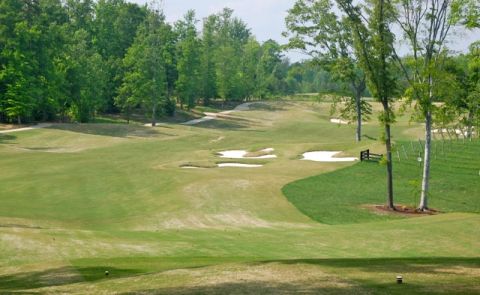
Jones' par 5s at Viniterra may not be long -- at least not from the white tees -- but one errant shot of three can lead to an easy bogey.
Located just off Interstate 64 and midway between Richmond and Williamsburg, Viniterra is positioned geographically between two interesting towns, both of great historical interest as well as modern flourishes. The community also seems positioned well in the market for golf course homes. Prices for one-acre and larger lots begin at $149,000 for wooded sites and reach their peak around $265,000 for panoramic views of the golf course. It seemed to me that as many homes were under construction during my visit as were already built, a proportion that is a better-than-good sign. One home that is nearing completion is called the Kensington Creek model, a 5-bedroom, 3-bath, 3,000+ square foot home on a wooded acre and is available at $599,500. A price of $200 per square foot –- land included –- is certainly worth raising a glass to.
*
I recently referred one of my customers to tour Viniterra with its sales director, Jimmy Forrest. My young customer, who will soon serve out his tour of duty as a U.S. Marine officer, is looking for a place for his family of four. After his visit, he wrote me, “I wanted to let you know how impressed I was with Viniterra. Beautiful facility with plenty of construction going.” He intends a revisit with his wife. Viniterra has signed on to list golf homes for sale at our companion web site, GolfHomesListed.com. Check them out, click through for more details, and plan a visit. If you go, the first one’s on me.
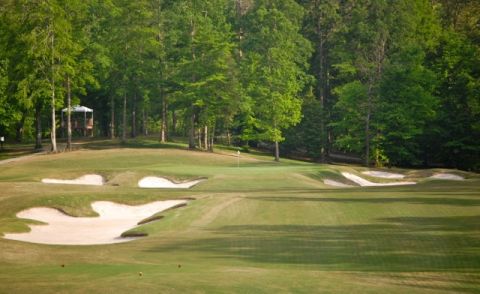
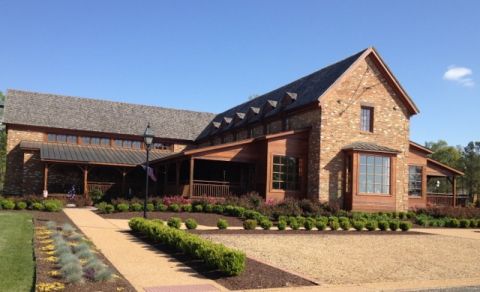
Anything but a well-placed approach shot at the trick 18th at Viniterra (top) could result in a terrible end to the round, but a finish at the rustic and comfortable New Kent Winery will take the edge off.
Their losses your gain? Cliffs, Reynolds, Wintergreen surviving rough patches
Three huge southern golf communities, household names among those searching for high-end residential developments, faced the realities of the recession in the last couple of years -– and lost. But now they all may be on the path back, and that could spell bargains for buyers searching for luxury real estate at a bargain price.
The Cliffs Communities, Reynolds Plantation and the Wintergreen Resort comprise more than 15,000 acres of real estate, golf courses and conservation areas. They feature a combined 261 holes of golf, marinas, equestrian centers, nature walks and virtually every other conceivable amenity an active retired couple would want. Between them, they probably
The Cliffs Communities and Reynolds Plantation are currently working their ways through bankruptcy proceedings, but things are looking up. Wintergreen, which is a bit less tony than the other two, was thrown to the brink by a capricious bank and then yanked back by Jim Justice, a 6 foot 7 inch West Virginian who enjoys owning and running well-known golf communities on both sides of the Blue Ridge Mountains. (He did the same with The Greenbrier Resort in his native state.) These golf communities all once were lost, but now they have found their sugar daddies. The question is whether you should find them as prospective places to live.
We try to answer that question in the upcoming July issue of Home On The Course, our free monthly newsletter. Sign up today at the top of this page and we will be pleased to send you this issue and all others in the future.
Reminders about golf vacation home rentals
One of the best ways to prepare for a permanent home in a golf community of your choice is to first purchase a vacation home there. This gives you a few years to understand the more nuanced aspects of life in a particular golf community -– what the neighbors are like, whether the golf club staff provides excellent service, the quality of food in the clubhouse and, perhaps most importantly, what it may be like to live in perpetuity with vacationers just like you.
One rule you can take to the bank, but not literally, is that you will not
Still, if you and your family plan to use your vacation home and rent it out, you could get some payback on your expenses, especially if you look on the net loss each year as the price you pay for a two-week vacation in a pleasant golf community. But if you decide to go this route, be mindful of IRS rules that govern deductions for your vacation home. Today’s Wall Street Journal online has a few reminders that are worthwhile reviewing.
A few key points:
- If you don’t rent your home out for more than 14 days a year, you do not have to pay any tax on the rental income and do not have to report it. I recall a visit to an Aiken, SC, golf community years ago, just 20 minutes from Augusta National. Some homeowners rented out their home for Master’s week every year for $10,000. I imagine owners of homes on Kiawah Island will see similar short-term incomes for this August’s PGA championship. If you choose a vacation home near a golf tournament or other annual event, you could make back a good bit of your annual expenses.
- If you want to use your home for more than two weeks a year, as well as rent it out at other times, you will need to calculate the ration of personal use to rental use. The resulting percentage of rental time provides the portion of your legitimate expenses that you can deduct from total rental income, including depreciation and mortgage interest.
- Be careful when you permit your immediate family members to use the vacation home, even if they pay you “market rent.” The IRS could count those days against your own 14-days of annual personal use. And don’t try to depreciate the portion of your vacation home’s value that represents the land; that is not permitted by IRS rules, but depreciation of furniture and appliances is.
The Wall Street Journal article, which includes a helpful example, is a good refresher for vacation homeowners, and those who would be. At our companion site, GolfHomesListed, you will find sharply priced vacation homes for sale in excellent golf communities like Pawleys Plantation in Pawleys Island, SC, and Ocean Ridge Plantation on the North Carolina coast, just north of Myrtle Beach. Or contact us to discuss other great spots for your future golf vacation home.
New Cliffs’ member plans face up to reality
Bankruptcy proceedings related to the Cliffs Communities should be completed late this summer, at which time the consortium of new owners will take over officially. In the meantime, the Carlile Group, SunTX Urbana and Arendale Holdings are working hard to convince current members and residents that the sprawling group of communities’ future is bright, even though the consortium does not yet technically own the amenities or the real estate. (Technically not, but the bankruptcy court has blessed the purchase.) If a recent presentation of new membership programs is any indication, the communication job will be complicated.
Golf Community Reviews obtained access to the video of a 90-minute meeting hosted by the new owners for current members earlier this month. The new owners used dozens of slides to sort through all the various
Here is the essence of the new member plan offerings:
New members at The Cliffs will pay an initiation fee of $50,000. (At one point, The Cliffs charged over $125,000.) These new memberships are not deposits, as previous memberships were (see below). Each membership will be tied to the “home” course in the community where the member owns property.
The amount of dues a Cliffs member chooses to pay will determine the level of access to the other Cliffs golf clubs. The more one pays, obviously, the more courses they can play. The “Home” club membership provides for unlimited play year round at the home course and a $65 per round fee at each of the other courses. Dues for the Home plan are $9,340 per year. For those who want to retain free and easy access to all the courses, with no payment of green fees, the annual dues will be $10,380. Non-resident members –- those who own property but reside more than 125 miles from any Cliffs golf club –- pay dues of $8,300 per year but must pay green fees of $65 per round at both their home and the other clubs. On a comparative basis, that seems a bit high, a possible encouragement for those property owners to consider making The Cliffs their primary place of residence. For those who play a limited number of rounds of golf annually, a Sports membership is available. It provides 10 rounds per year at the Home club and up to 5 rounds at each of the other clubs; when Gary Player’s Mountain Park course is complete, that would mean a total of 40 rounds annually. Dues for the Sports package are $5,280 per year.
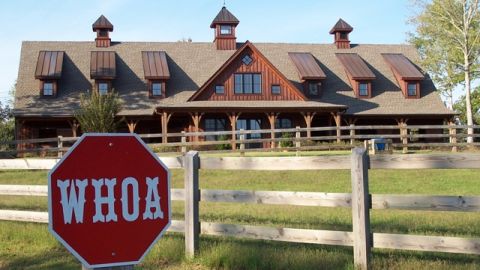
The Cliffs equestrian center did not come up for discussion during the recent members meeting.
Previously, the Cliffs tied membership to property, not the individual. If you did not acquire membership at the time you purchased your property, the person you might sell it to later could never acquire membership (unless they purchased an additional property with membership attached). The new owners are offering an “amnesty” program for property owners
The new owners indicated to the club members in attendance that completion of the Gary Player designed Mountain Park course is high on their priority list. The motivation to finish Mountain Park, one resident told us, is that 240 lots have been sold there and most of the owners are paying greens fees only, no dues. When the course is completed, then they start paying dues. The new owners declined to discuss the future of the Tiger Woods course at High Carolina, citing the bankruptcy process as the reason. But your editor is under no such embargo: Expect that course to be built about the time Tiger wins his 18th major -– unless a resort owner or hotel chain desperate for publicity purchases High Carolina from willing Cliffs owners.
One of the prepared questions referred to a perceived schism between “note holders” –- those who famously loaned developer Jim Anthony $64 million in an ill-starred attempt to keep the developments afloat -– and the non-note holders, some who felt ill-treated in the wake of Anthony’s default. The response from the podium was, as you might expect, that the new owners intend to build a community that will benefit all its residents and members, whether they held a piece of the note or not.
The presentation was long on content if a little short on style (densely designed slides, presenters that read some of those slides line by line, no questions from the audience). The owners clearly understand
For Cliffs residents and golf club members, albeit a wealthy group, the bankruptcy has been a humbling experience. The purchase of a multi-million dollar residence and payment of $125,000 initiation fees in a community that, at least on paper, went belly up, has been a blow to the ego, especially for folks who, in their prior business lives, were firmly in control and probably made good decisions. This is why it seemed odd that at the recent members meeting, in response to a prepared question, Hugh Connerty, the CEO of Arendale, felt compelled to mention to the group of members at the Greenville meeting that, “I belong to 11 clubs…” He later referenced his recent access to the ultra exclusive Cypress Point, a club that mere mortals -– and many Cliffs members –- will never play. After watching Jim Anthony go blind and tone deaf to real estate market realities and his residents' concerns, the new team should understand the importance of humility, at least until success seems assured.
A gift for this Father’s Day…and future ones
I am not playing golf today. I am at our non-golf community home in Connecticut, and I’d have to drive 25 minutes to play, wait a bit to tee off, play a round that would take about 4 ½ hours, be sociable and stop for a post-round libation (and lunch) with my foursome before the 25-minute drive back home for a quick shower and then a sink into the easy chair in front of the TV for U.S. Open coverage. I don’t want to risk missing a minute of play; watching every second of the toughest, most competitive
But if I were at our golf vacation home in Pawleys Plantation in South Carolina, I could walk the 200 yards to the first tee, play my round, stop for a beer and lunch and still make it back well before Johnny Miller starts criticizing somebody’s practice swings. It may seem like a small thing –- being able to get to the first tee in under five minutes –- but on days when you have a personal deadline, whether it is the U.S. Open, an overseas call from a son or daughter, or a blog article about golf communities that you absolutely must post by a certain time, proximity is a big deal.
And, therefore, for all you fathers out there who dream of the convenience of a home beside a golf course, this is as good a day as any for me to say, one father to another, “It can’t hurt to start looking.” Contact me and I will send you a no-obligation questionnaire that will help you –- and me -– assess your particular requirements in a golf home. Fill it out (with your wife’s input, please), send it back to me and I will be pleased to offer you some initial suggestions about what areas and what particular golf communities best match your requirements. After that, we can arrange for a phone conversation to refine the search and find you a golf home in which you can watch the U.S. Open for the next 20 years or more.
Private and semi-private golf clubs have drastically cut their membership fees and property prices to their lowest in a decade, but they are starting to show signs of a rebound. Even if you are not ready to buy a home now, it cannot hurt to start looking and prepare for later. Golf communities are offering attractively priced “discovery packages” that provide lodging, golf and other goodies.
There is absolutely no charge for this assistance in finding your dream home on a golf course. Call it a Father’s Day gift from one father to another. Contact me today.
-- Larry Gavrich, Editor
Note: Reasonably priced homes currently listed for sale in Pawleys Plantation and other fine southern golf communities are featured at our companion web site, GolfHomesListed. By the way, the home that Jack Nicklaus lived in when he built the Pawleys Plantation golf course in 1988 is currently listed for sale at GolfHomesListed.
Asheville, NC makes Forbes Best Places list
Forbes magazine released its annual “Best Places to Retire” list yesterday, and a few of our own favorite places made the grade in the top 25. They include Asheville, Austin, Columbia (SC) and Savannah.
No such list would be complete without including Asheville, the western North Carolina mountain town favored by northerners looking for a laid-back –- some might say “progressive” –- southern mountain retreat, and Floridians tired of traffic, an increasing cost of living (despite no state income tax) and summer heat. Asheville summer temperatures average about 10 degrees lower than the flatter parts of the Carolinas during the summer.

Ball Flight: An airstrip bisects the golf course along the top of the 4,500 foot mountain at Mountain Air.
At GolfHomesListed, our companion web site, we have Asheville surrounded, with golf homes for sale currently listed to the northwest of the city, at Mountain Air in Burnsville, and at Champion Hills in Hendersonville, southeast of Asheville. Given its rarified height, Mountain Air is aptly named and features 50-mile views from its golf course and homes. The golf course, which was designed by Scott Pool, features an element you are unlikely to see anywhere else –- an airplane runway that cuts through the golf course along the very top of the mountain. As you travel from the second green on one side of the runway to the third tee on the other, an alarm and flashing red light may signal a wait for the group in front of you -– traveling by aircraft, not golf cart. Non-pilots too will love the care which owners of the community, the local Banks family, have lavished on the natural surroundings. The substantially wood and stone homes and the rustic clubhouse do nothing to detract from views that can literally take your breath away (at nearly 4,500 feet). At GolfHomesListed, you will find Mountain Air home sites listed from $209,000, villas from under $350,000 and single-family homes from $490,000.
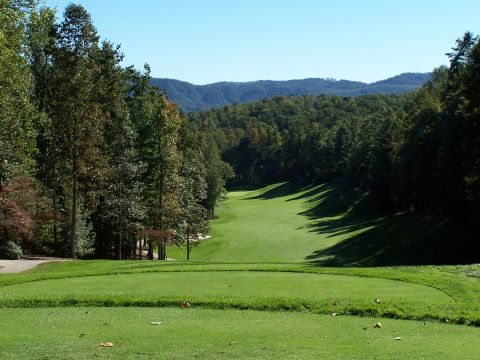
Balls struck just off the funneled fairways at Champion Hills can leave some awkward stances.
A little more down to earth but still up there is Champion Hills, whose core Tom Fazio golf course has always earned plaudits from North Carolina golf raters, but especially so since the course was renovated a few years ago. Fazio, who grew up in Hendersonville, clearly lavished extra attention on the design of his “home course” which features his customary signature cloverleaf bunkers and funneled fairways that can be both forgiving and occasionally frustrating with side-hill lies few of us take the time to practice. The community’s homeowners association is one of the most organized anywhere and, as we have written before, its approach to strategic planning should be the envy of many corporations. Champion Hills is a stable, financially sound and debt-free golf community worthy of a serious look. And you can start looking by browsing current Champion Hills properties for sale at GolfHomesLIsted, where homes start at $339,000 and range above $1 million.
Please note: When you access more information about any listing at GolfHomesListed.com, we ask for your name and email address. We do this to follow up to ensure that we are providing top-notch service and to be able to update you on any new listings in the communities you look at. The real estate professionals who list properties at GolfHomesListed and we will never share your personal information with anyone. If you have any questions, please contact Publisher Larry Gavrich.
Coming Next: Savannah: Ford Plantation & The Landings
Cliffs meeting hints at new membership plan
Justice for all at Wintergreen Resort

Now on Sale

- The only book about golf communities in the last 10 years.
- 156-page step-by-step guide to finding your dream golf home.
- Info on nearly 100 golf communities the author has visited.
- Paperback version costs less than a sleeve of Pro VIs.
Here is what the experts are saying:
“The book is chocked full of information…applicable to anyone looking for a move to the Southeast regardless of whether they are looking for a golf community or not.” — John LaFoy, golf architect (Linville Ridge CC, CC of Charleston, The Neuse GC)
“Larry has done a tremendous amount of work and anyone — like me — who is looking to search for a golf home now or in a few years needs this book.” — Brad Chambers, golf blogger, ShootingYourAge.com
“Wow! What a thorough piece of work…a must for anyone moving South. This book will help many people.” — Brett Miller, owner and founder of MMA, Inc, a golf industry consultancy
Buy It Now at Amazon.com or BarnesandNoble.com.