Golf Community Reviews back in business after snowstorm, loss of power
The lights came back on this morning at our Connecticut home, more than one week after a freak October snowstorm that destroyed thousands of trees and knocked out power to about a million people. Coincidentally, the lights were restored just before 2 a.m., when all clocks were to be reset for the winter months. Having our power back after a week without it gives new meaning to the term “daylight savings.”
Not everything, however, is back to normal. Two months ago we bundled all our communication services –- Internet, television and telephone –- with Comcast Cable. We can certainly endure without television -– I watched the LSU-Alabama game on my mobile phone last night –- and we have our cell phones to receive calls and make a few if need be. But the loss of Internet service is a royal pain; to post articles here at Golf Community Reviews, I need to find a coffee shop with wireless service. Others have exactly the same idea, and the competition for a seat and electrical outlet is fierce. Also, there are just so many cups of coffee a body can take.
The experience of the last week has only encouraged my wife’s and my interest in establishing a more permanent home in the southern U.S. where we already own a condominium at Pawleys Plantation in Pawleys Island, SC. If your experience over the last week has caused you to think along those lines, please contact me. I will be happy to offer some ideas about golf-oriented areas in the south that would match up with your requirements. I can’t guarantee perfect weather, but I can guarantee you will have a better chance of playing golf in January in, say, Charleston, SC, than in Charlestown, RI.
I’ll be posting more articles in the coming days. It’s good to be back.
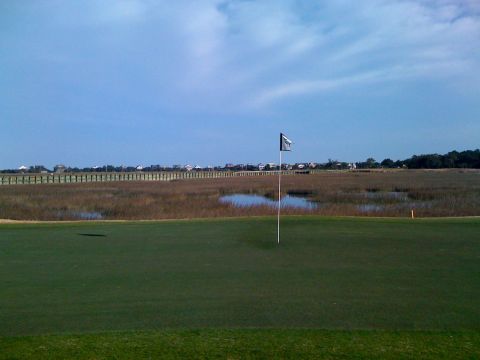
Nothing like an October snowstorm in Connecticut to conjure dreams of the Jack Nicklaus course at Pawleys Plantation.
 Home On The Course newsletter
Click here to sign up for our Free monthly newsletter, loaded with helpful information and observations about golf communities and their golf courses.
October storm got you down? Get up for a weekend of golf and real estate in Savannah
This year, they waited too long.
A freak late October snowstorm has brought more trick than treat for those who waited. Could this finally be the tipping point for all those northerners beaten down by the weather?
Okay, no one wants to overreact to one freak snowstorm, but we also have memories of last winter when we actually had to rake snow off our roof in Connecticut lest the melting snow refreeze at night and send streams of water through the seams in skylights and windows. Some homeowners went so far as to take their snow blowers up on the roof. This is crazy, no?
While we were digging out from this snowstorm in Connecticut,
Long sad story short: It is warmer in the south, it is cheaper to live in the south, the chances of a storm that affects your home life seems more remote in the south -– in short, what are those of us who are ready to move to a golf community waiting for?
If you need a bit more convincing, we have an idea: Join us for the first ever Home On The Course “discovery weekend” at The Landings, just 15 minutes from downtown Savannah, December 1 to 4. The weekend includes golf, dinners, a tour of the 4,800-acre community and its six golf courses and, at your option, a personal visit to homes for sale that fit your requirements and price range. (The Landings features homes from the $300s to the millions.) For more information, please click here.
Note: The Landings and Savannah are about as close to hurricane proof as you can get on the eastern seaboard, with only one storm that included winds of more than 80 mph in the last 100 years. As for snow, it is almost as rare.
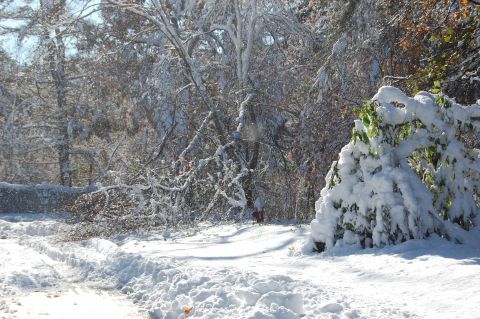
Your editor and his wife lost a dozen trees in the freak October storm. It is enough to make a couple want to move south, and quickly.
Power outage cramps access...and our style
Your editor finds himself, along with wife and dog, camping out in our house in Connecticut. We are among the few millions in the northeast without power. As I write this, only 8 percent of the houses in our town, Avon, have electricity. We have seen long lines at the few open gas stations and coffee shops with wi-fi and power outlets to charge mobile phones. We spent a couple of hours today at a "warming center" and shelter set up at the local high school. We charged our phones and laptops and asked if we could help with cooking since we have natural gas outdoor grill and stove at home.
One couple offered $1,000 worth of frozen meat that was going to be lost to defrosting; we offered to cook and serve it, but officials said they could not permit (regulations, you know). If some of the 100 or so patrons of the shelter, subsisting on a diet mainly of muffins and coffee, only knew they missed out on steaks, roasts and a few lobster tails. It turned out that, toward the end of the day, another shelter was able to accept the gift. We hope to have power in the next couple of days. If ever there was motivation to head south to a warm and welcoming golf community, this storm is it.
Reserved at Lake Keowee: Upstate SC community celebrates lack of pretension
This is the second and final part of a review of The Reserve at Lake Keowee, a golf community in the upstate region of South Carolina, less than an hour from Greenville.
The private and upscale Reserve at Lake Keowee wears its lack of pretension on its sleeve. Conceived by two local men as a community where families could comfortably gather, The Reserve’s demeanor is so understated that it doesn’t even name its golf club on its scorecard. A first-time visiting golfer might think the actual name of the course is “Jack Nicklaus Signature,” since that is the only thing on the front of the card except for the community’s logo of mountains, lake and sun. To someone unfamiliar with The Reserve, this may seem a bit extreme, but it is aggressively consistent with the tone of the place.
The golf course itself echoes the theme of high-quality and low stress, even though typical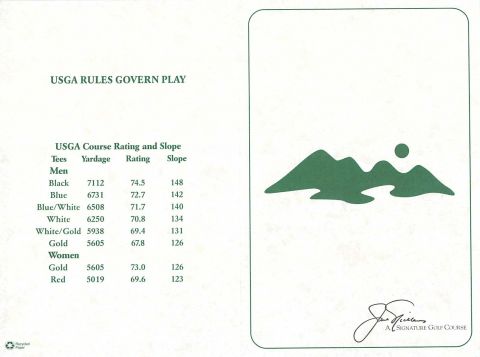 Jack Nicklaus routings are anything but soothing. The Reserve’s course is superbly conditioned, with greens that are easily among the fastest in the upstate region of South Carolina. On the day I played recently with fellow members of the South Carolina Golf Rating Panel, the stimpmeter read a professional-tournament-like 13, according to golf professional Greg Rushing. That is about the only thing “fast” about the experience on the sprawling Reserve layout, which will appeal especially to the low double-digit handicap player looking for a sporting challenge but may force more accomplished golfers (and big hitters) to move back to the tees at 6,700 or 7,112 yards.
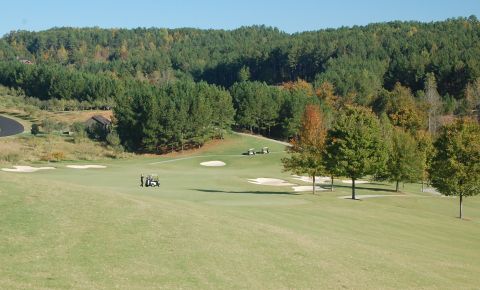
A sliced drive on The Reserve's downhill 1st hole is not the worst outcome if it avoids the bunkers on the right side of the dogleg.
Going to great lengths for a challenge
So does that make The Reserve something less than a “shot maker’s” course? Not at all. Jack Nicklaus always seems to find a way to toughen his designs, and there are enough Golden Bear touches at The Reserve to remind us of that, and to justify a 134 slope rating from the modest 6,250-yard white tees and, gulp, a 142 from the 6,731 blue tees. (Forget about the tips at 7,112, a 148 slope and 74.5 course rating, unless you are a masochist or Jack himself.) But the typical Nicklaus attitude of take it or leave it challenge is missing, or at least much softened, at The Reserve. His fairways here are generous in the extreme, something spray hitters will appreciate right off the bat as they play to the #1 green from the adjacent 18th fairway after pushing their initial drive right. And I don’t recall a single customary Nicklaus tree in any fairways at The Reserve, although plenty of trees line the wide fairways.
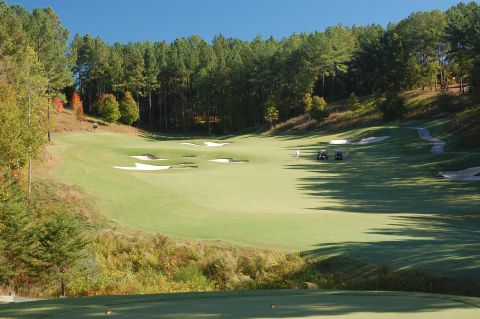
The uphill par 4 3rd hole is a classic short two-shotter, daring big hitters to put the bunkers in play and more conservative players to thread the needle up the right side.
Still, the generous landing areas notwithstanding, appropriate placement off the tee is mandatory given the almost bulletproof vests of sand behind which the Bear protects his greens at The Reserve, making some entry points clearly preferable to others. At #2, for example, a par five, the pin was set just beyond a deep bunker that covered the middle front of the green; not much choice there except to pluck the right club from the bag and hit it perfectly, the consequence of not doing so a long putt from right or left side of the green or, worse, a play from that front bunker to a tight pin. The uphill par 4 3rd featured another two bunkers that blanketed most of the front and right sides of the elevated green. At the iconic par 3 4th, two “spectacles” bunkers that reminded me of the billboard eyes of Dr. T. J. Eckleburg in the Great Gatsby cause second- and third-guessing about distance on the sharply downhill hole. (See photo below; the green really does look like an inscrutable face.) And on it goes throughout the round, almost all the potential damage in the form of bunkers at greenside, with an occasional fairway hazard thrown in to penalize the most significantly errant tee shots.
Now you see it, now you don’t
The course routing keeps the lake at bay until the 15th green, when as you reach the peak in the fairway, there it is below you, about 160 yards in the distance. Between the lake and the back of the green is a stand of trees set there, it appears, to keep too-long shots from reaching the lake. A little finger of the lake cuts in a few yards just short and left of the green, an S-curved stone wall restraining the lake from the front of a greenside bunker. The water at greenside should be of zero consequence to any but the unhappiest hookers. After a tricky par 3 16th, the lake frames the 17th tee but recedes as you move down the fairway on the par 5. The lake is more eye candy than hazard on The Reserve golf course.
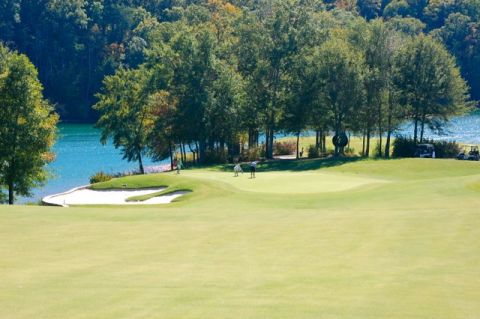
The lake appears quite suddenly behind the 15th green, more eye candy than hazard.
Nicklaus does take the shackles off on the finishing hole, an uphill all-the-way dogleg left par 4 around a grouping of nasty bunkers to a large, two-leveled green that plays 444 yards from the tips. From all but the front two tees (340 yards from the whites), this is a solid par 4.5 or harder.
In addition to the immaculately groomed and speedy greens –- originally planted bent grass -- the Bermuda fairway and tee box turf were as good as it gets. The practice range was special too, one of the finest in our experience, with a wide teeing area, part  of which was covered by a portable bay to keep out rain and searing summer sun. A large bucketed net was set about 20 yards out from the tees, into which you could try to aim pitch shots. Over by the practice chipping green, a two-station area was laid down at long pitch distance. A separate practice bunker was large enough to accommodate a dozen or so players if necessary. The adjacent putting green was as slick as the greens on the course; a second smaller green sat beside and above the first tee (and next to a perfectly shorn croquet court that might have stimped at 20). The practice grounds at The Reserve destroy all excuses for not being properly warmed up. And it will also improve all aspects of your game, especially the short ones.
The quiet genius in The Reserve’s routing could very well be that, like a healthy meal, it leaves you satisfied but not stuffed; post round, you have plenty of energy to enjoy the golf community’s other well-conceived amenities. With a lake of 18,500 acres and 30 miles of shoreline along The Reserve’s boundary, water activities are central to its attraction. The Reserve’s 200-slip marina satisfies the captain in some of the community’s residents, but canoes and kayaks, available for everyone’s use, are popular too, especially for family excursions. For those who take their water chlorinated, the large adult pool and “zero-entry” (no lip) kids pool sit at lakeside, a short walk to the marina and clubhouse. We understand there has been something of a cross-migration in the pool area over time, with the adults taking over the amply sized kids pool -– no struggling to get in or out -- and vice versa.
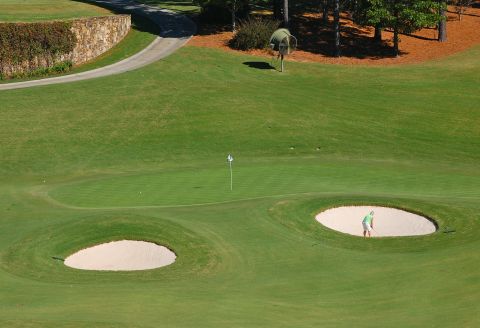
The spectacles bunkers at the par 3 4th play tricks on the mind and the distance from the elevated tee.
The action around the Great Lawn
In fact, there may be no other golf community in America that has managed to compress most of its activities into such a tidy, yet dramatically laid out area, all around the Great Lawn. Looking west, with the marina and a lakeside amphitheater at your back, the view is up an escalating slope of about three football fields worth of lawn to the rear of the stone and wood clubhouse that commands one of the highest points in the community. Along almost the entire lengths of the right and left sides sit attractive Great Lawn Homes designed by the famous architect Keith Summerour of Atlanta. Package prices –- the land and homes are now sold separately to give buyers a choice of home styles –- start in the $800s, but with that you get a minimum 3,000 square feet (optional studio over garage) and to choose among handsome French Normandy, Arts & Crafts, English Country and Classic American Shingle designs -– all a short walk to the lake, the market, the pools, the clubhouse and the first tee. Only a handful of the Great Lawn sites and homes remain unsold.
To the near right with your back to the lake is Founders Hall, used as chapel, community and performing arts center, and just beyond it the pools; to the near left sits a post office and market -– I can vouch for the quality of its sandwiches. At the top of the long sweeping two-level Great Lawn is the clubhouse, which earned an award from Golf Inc. as one of the best new private clubhouses shortly after it was completed in 2002. Out the front door of the clubhouse is the perfectly manicured croquet lawn with some commanding views out across the downhill first hole and equally uphill 18th. I can understand why residents consider sunsets a big deal at The Reserve.
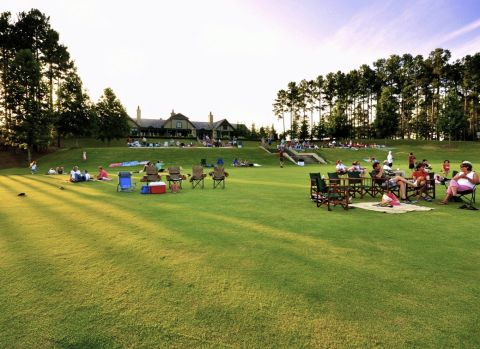
The Great Lawn, on two levels, runs 360 yards up from the lake marina. It is a magnet for families and sun worshippers on a nice summer's day. Photo courtesy of The Reserve at Lake Keowee/Dave Myers Design.
I ate dinner in the clubhouse on the Saturday night I arrived, attended by a young bartender (a grad student from nearby Clemson University) who answered my questions about the community articulately and enthusiastically, despite the fact he worked there just one night per week while attending school. The cuisine in some private club dining rooms can be uneven, especially when there is little competition in the immediate area. (Trust me, you have to work very hard to find a decent restaurant in the Sunset, SC, area.) But the German chef at The Reserve obviously is at the top of his game and especially knows his way around a schnitzel, offering two hard-to-decide-between choices. I opted for the Holstein Schnitzel, with a perfectly runny fried egg on top. The plate-covering piece of veal was perfectly cooked, the potatoes and vegetables accompanying the dish no mere afterthoughts. In keeping with an ethic to never gouge Reserve members, the menu prices were quite reasonable (the schnitzel dish was $17); atypically for private clubs, The Reserve does not require its members to spend a minimum amount on food and beverage. But if that was the rule, it is hard to imagine anyone complaining, given the quality and the lack of alternatives in the immediate area.
Tigers burn bright on Saturday night
On a fall evening in South Carolina, many of the state’s citizens huddle around TVs to cheer for their Clemson Tigers or state university Gamecocks. On a night when undefeated Clemson fell behind early and then made a steady climb back into the game, every completed pass and recovered fumble producing an ear-splitting crescendo from the family of Clemson grads in front of the big screen in the clubhouse’s great room. I met Reserve co-founder Buddy Thompson the following day in that same room, now quiet, giving me an opportunity to scan all the wood, stone and leather that gave it all a feeling of solid warmth, if a bit of old boys club. Thompson and friend Dean Ricker were the inspiration for the community back in the late 1990s after co-owning seven acres on nearby Lake Jocassee.
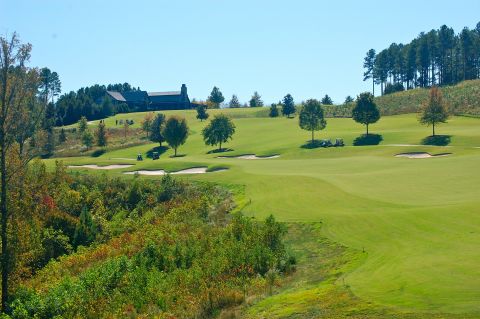
The finishing hole at The Reserve is the toughest par 4 on the course (according to me, not the scorecard), an uphill dogleg-left slog that demands a long and well-placed drive.
The price of admission to The Reserve may seem a little heady for some, but the community portrays the kind of esprit du corps that would seem to be welcoming to all comers. Despite the croquet lawn out front, the adjacent clubhouse is warm without being stuffy, a model of un-pretension. At first I was a little surprised that one resident sidled up to the bar on Saturday night wearing a beat-up old Clemson visor, but the dominant theme at The Reserve appears to be live and let live. Even cell phone use is permitted in the clubhouse, although members are gently dissuaded from taking or making calls on the golf course.
“We really have no cell phone policy,” says Thompson. “Most people are very respectful of each other and ‘police' themselves. I have never been interrupted by a phone or heard anyone complain of a bad experience.”
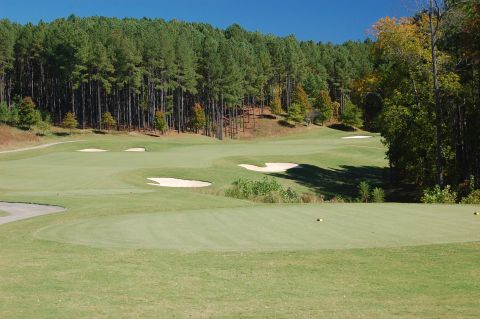
The 10th is one of the trickier driving holes at The Reserve, favoring the player who, like Nicklaus, fades the ball off the tee.
Everyone at The Reserve seems to know everyone else. Thompson touts the friendliness and lack of cliques in the community, a contention that seemed to be proved by the endless stream of club members who stopped by during my conversation with him to offer hearty greetings (but without any ring kissing). Neither did any of them fall all over themselves to try to convince me that The Reserve was a special slice of paradise. And Buddy’s story about his own emotional connection to the land and the community seemed much more narrative than marketing pitch, although he is clearly proud of what he and the original founders have built.
Only one thing at The Reserve seemed a bit disharmonious to me -– the lack of distinction in its name. Plenty of golf communities and clubs include “Reserve” in their names; some Reserve officials admitted that potential buyers have shown up at The Reserve’s gates expecting it was one of The Cliffs Communities (The Cliffs includes “Keowee” in its three local community names). Moreover, for a community whose “DNA,” as Buddy Thompson puts it, is all about being a family gathering place, perhaps something like “Reunion at Lake Keowee” would have been a better branding choice.
Nevertheless, and with that minor observation aside, The Reserve seems to be doing all the right things, and at the proper pace. It walks the talk of conviviality and family. Certainly, The Reserve has a long way to go in terms of dotting its landscape with a lot more homes and generating the income, through land sales, to fund another golf course and the other promised amenities, but the tortoise approach is clearly keeping The Reserve safe from the kind of harm that has befallen other, more aggressive golf communities, including the neighboring Cliffs.
And we know how those tortoise and hare races eventually turn out.
*
If you would like more information about The Reserve at Lake Keowee or to arrange a discovery visit -- The Reserve's package, which starts at $145, is one of the most reasonably priced that we have encountered -- please contact me.
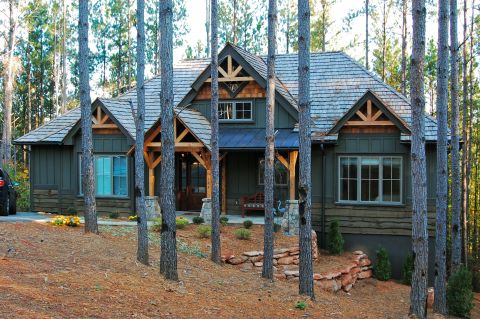
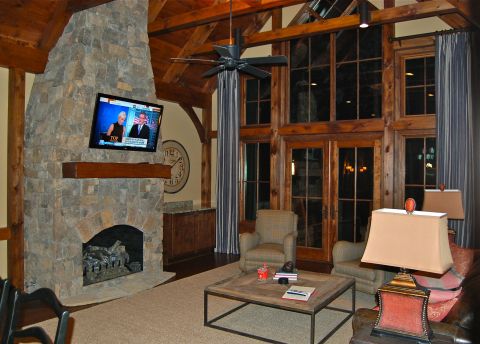
A group of cottages at The Reserve, some with as many as four bedrooms, start in the $500s. They are within a short cart-ride's distance of the clubhouse and are popular as rental units but are comfortable enough to serve as primary homes as well.
A Place For The Ages: Reserve at Lake Keowee appeals across generations
Of course, The Cliffs all-in approach to the luxury lifestyle worked well in attracting wealthy second-home owners and retirees until the economy went poof and property sales dried up and, along with it, cash to pay for The Cliffs’ unfinished amenities, including the first American golf design by Tiger Woods. As any reader of these pages knows, Cliffs developer Jim Anthony was forced to borrow $64 million from his club members, with a reported $8 million payment on that note due this coming January.
Reserve takes road less traveled
The Reserve chose a different, more measured approach, its founders opting to retain a majority interest in the community but bringing in an experienced developer, Greenwood Communities and Resorts, as a strong minority partner, whereas Cliffs founder Anthony chose to build his own development team. (Some Cliffs owners grouse today that the spiritual, plain-speaking and, perhaps too-trusting Anthony was victimized by bad advice from some of his hand-picked executives.) Greenwood had originally developed the successful Palmetto Dunes Resort on Hilton Head and, 30 years later, is still managing that golf community plus a few choice others.
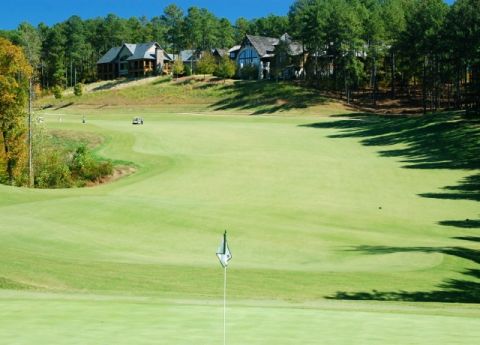
Along most of the Jack Nicklaus layout at The Reserve, you will need to look up to see any homes as they are perched on hills and rarely encroach on sightlines. The view here is from behind the 11th green.
Since it opened in 2002 with an exquisitely conditioned and enjoyable Jack Nicklaus Signature golf course, The Reserve’s founding members, a group of 55 local and Atlanta-based investors that included 19 physicians and two dentists, as well as Greenwood, have taken a steady approach to its evolution. Whereas, for example, The Cliffs’ lush fitness centers could satisfy the needs of a professional football team, The Reserve’s own dreams of a world-class fitness facility are on hold pending a bit more cash flow; anyone who wants to work out today can, but the temporary center operates out of a modestly sized building near the clubhouse. Reserve officials say building the new facility is their “top priority” as soon as the economy improves and, along with it, property sales. The biggest difference between the two communities is that where The Cliffs offers its members six golf courses, with a seventh Gary Player track on the way next year, The Reserve presents just one, with another by Arnold Palmer’s design shop sitting in an architect’s drawer waiting for the right time to execute it, financially speaking.
To ensure bank funding through at least 2015, The Reserve recently promoted a “capital raise” campaign that attracted 67 new members to purchase shares in the community; some of the original 21 investors and Greenwood itself added to their existing financial stakes in the community, demonstrating both commitment and confidence in their vision and fiscal discipline. This year, the Reserve expects to balance its first budget in its 10-year history, and without having increased dues or initiated a food and beverage minimum. Any potential golf community buyers worried about the financial stability question in a high-end development should find their questions answered and their anxieties assuaged at The Reserve, at minimum for the next three-plus years.
Flood of memories
I toured The Reserve recently with A.J. “Buddy” Thompson, one of the two original founders of the community. After purchasing five lots on nearby Lake Jocassee in 1990, Thompson, an ophthalmologist from Easley, SC, fell in love with the unusually lofty views around Lake Keowee, which like Jocassee was formed after Duke Power flooded the area in 1971 for hydroelectric power purposes. Lake Keowee is somewhat unusual in that it features both a lake and mountains, a topographical idiosyncrasy more prevalent in the western U.S. than in the east. Thompson assembled the group of 54 other investors who bought 3,200 acres in June 1999 that comprise most of today's Reserve –- “just before the dot-com bust,” he says. They each contributed $300,000 plus a capital investment of $100,000; one neighborhood in The Reserve, called Founders Cove, celebrates that initial investment. At a time when banks were freely lending money, that initial total pool of $8 million from individuals and Greenwood attracted bank funding to buy the rest of the land and kick start the development.
Lake Keowee comes into view but not really into play on a few of the finishing holes at The Reserve.
The Reserve’s founders were measured in their approach right from the earliest days. In December 1999, the 55 original investors and 25 others met at the Hyatt Hotel in Greenville. They split into eight teams, each challenged to envision their dream communities and then present to the other groups.
“The best bits were pulled from all the presentations,” Thompson told me. “We agreed from the start that we did not want to be a resort community, and that this was a ‘one and done’ community that we all wanted to live in. We would not be building a second Reserve later.”
Aside from a decision to get the golf course built early, the only pre-requisite for the community was that it be built as a place where families and friends would be encouraged to congregate, says Thompson, a grandfather.
“The inspiration for the idea was my fond memories of my family reunions around our lake home on Jocassee,” he says of Keowee’s sister lake, reputed to be the cleanest in the eastern half of the country. “That’s the kind of atmosphere we saw for The Reserve.”
Building a Legacy one large family at a time
The family thing is not mere brochure copy. Earlier this year, The Reserve announced a new, innovative “Legacy” membership that provides full privileges to everyone in the direct family line of a Reserve member –- parents, grandparents, children and grandchildren. Part branding, part reaction to the economy and the need to generate additional club revenues in the face of modest property sales, the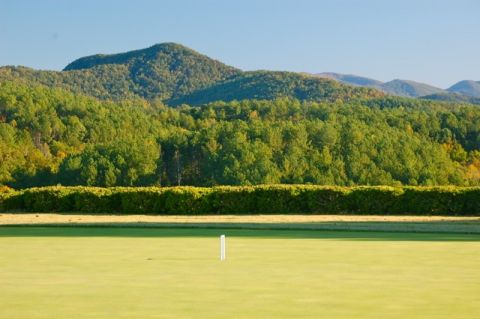 Legacy membership is consistent with The Reserve’s family-centric ethos. It also has proved wildly popular with owners: The club has added more than 650 new legacy members from 163 families since the program was announced in January, building more traffic to the pool, marina, market and golf club, and adding a healthy dose of incremental revenues. What may have struck some competitors as an ill-conceived and sappy giveaway to members appears to be a brilliant business decision that has stoked both member retention and growth -– a prime example of benefitting financially by walking the talk.
The Reserve is somewhat iconoclastic in other ways. Its 4,000 acres were scoped out initially for just 1,630 home lots, but the guiding forces in the community are discussing dropping that to 1,400 (as other developments increase density to appeal to a broader base of buyers). As an aside, Buddy Thompson says he’d like to see that number at 1,100 home sites.
“Our lots must have intrinsic value,” he emphasizes, explaining that The Reserve does not want to offer what other golf communities sometimes define as “interior” lots but are nothing more than leftover home sites with the cheapest price tags. “We prefer to glorify and preserve the natural beauty and surroundings with a significantly lower-density approach.”
At first view, some prospective buyers will consider The Reserve real estate on the expensive side. Although some of the rustic guest cottages begin in the $400s and would be perfectly suitable as a second home or rental income unit, the sweet spot for single-family homes in the community is right around the $1 million mark (single-family homes currently
For a family or retired couple more worried about ongoing charges than the one-time outlay for a home and club membership, The Reserve offers about the lowest ratio of club and homeowner dues to real estate prices that we’ve encountered. And they seem serious about keeping it that way.
Coming Soon: Golf, real estate and the lifestyle at The Reserve at Lake Keowee
Congress considering residence visas for foreigners who invest in U.S. real estate
The U.S. Congress cannot agree on much, but two Senators are reaching across the aisle to introduce a bill that might spur foreign investment in U.S. real estate. If it passes, high-end golf communities struggling to sell homes might want to set up temporary marketing offices in London, Johannesburg and Beijing.
New York’s Charles Schumer (a Democrat) and Utah’s Mike Lee (a Republican) are getting ready to introduce a bill that would provide residence visas to non-Americans willing to invest at least $500,000 to purchase a home in the U.S. The bill is intended as part of a larger basket of immigration measures.
The $500,000 investment could be split; for example, the offshore investor could purchase a townhome (or condo or single-family house)
Given the partisan bickering about budgets, taxation, employment and virtually every other important issue of the day, it is hard for many Americans to reconcile that our nation is still looked upon as the safest haven for investment in the world. Yet, in 2010, foreigners spent $82 billion on U.S. real estate, up $13 billion from 2009, and much of it in some of the hardest hit markets (e.g. south Florida, Arizona, California). The softness of the dollar compared with overseas currencies has increased foreign buying power in the U.S. I recall running into a Englishman earlier this year while touring foreclosed properties in Orlando with a local real estate agent; the Englishman was checking out properties to purchase, rent out, and sell a few years down the road at a profit (he hoped). The real estate agent told me she bumps into such foreign investors all the time.
But the new law about to be put before Congress would encourage a different class of foreign investor to buy homes in the U.S.; that is, those for whom the economies and political issues in their home countries (think Greece, Italy and others) encourage them to consider a more comfortable life in a country that, to them at least, appears relatively stable. Polls indicate we Americans are disgusted with our national politics and fearful about the economy, but to many foreigners, especially those who can afford to invest in a safer, more certain future, the U.S. still looks like a “shining city on a hill.”
Thornblade Club, Greer, SC: Where golf champions live, work and play
My dirty little secret (until now) is that I prefer Greenville, SC, to the lavishly praised Asheville, NC. Asheville’s surrounding elevation may give it a slight edge topographically speaking, but the up country of South Carolina has plenty of natural charms (a river runs through downtown Greenville, for example, and some of the prime restaurants along Main St. use it to advantage). Downtown Greenville, with its angle-in parking under a canopy of trees shielding the city’s main esplanade, gives the city an easy-chair feeling compared with the big-city ethos of Asheville (which is, after all, sometimes compared to San Francisco). And traversing the Interstates that converge on Greenville even during rush hours seems like a Sunday drive compared with the mad-scientist jumble of highways that meet in an explosion of chaos in Asheville.
Moreover, there is no private community and golf club combination in Asheville that matches the value of Thornblade Club and the surrounding neighborhood in Greer, SC, a suburb of both Greenville and Spartanburg, two towns that have weathered the economic mess quite well thanks to their manufacturing (e.g. BMW of North America and Fluor Corp.) and higher education bases (Furman, Wofford, Bob Jones University). At just a $9,000 initiation fee for full-family golf membership, down from $18,000 a few years ago, and the replacement of all 18 of its golf course’s greens last year, Thornblade has stayed one giant step ahead of the problems similar private clubs are suffering across the land and maintained its robust membership levels (520 golf members and 785 members in all).
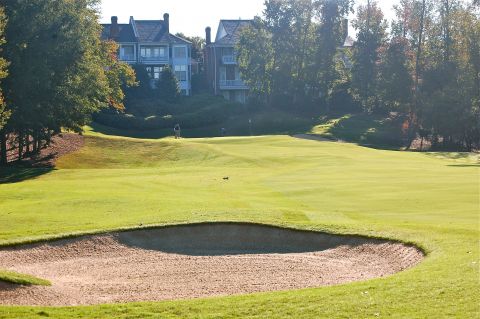
Condos back the first green at Thornblade, the only time during the round in which housing dominates the background.
I made my first trip to Thornblade five years ago, before its 20-year old greens were dug up and replanted with a newer, hardier breed of A1A4 bent grass. Bent grass, of course, is the putting surface of most championship golf courses, and Thornblade, which hosts the final round of the annual BMW Championship on the Nationwide Tour, may very well hold the distinction of having both groomed and housed the best collection of golfers in the world. The Haas family home –- as in father and Champions Tour pro Jay, who is also Thornblade's director of golf, and son Bill, the recent winner of the FedEx Cup and Tour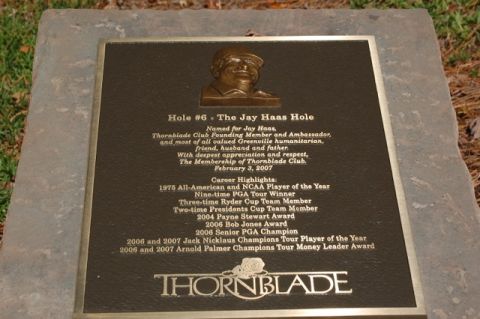 Championship –- sits above the 6th green. Former U.S. Open winner Lucas Glover honed his game as a youth at Thornblade; his grandparents’ house still sits beside the 17th hole, a practice putting green in its backyard. Former LPGA star Dottie Pepper has moved from the community but is still a member of the club, as are tour pros Matt Bettencourt and Charles Warren. That is quite a formidable intra-club team Thornblade could field.
The staff at Thornblade is professional as well. My experience started when I parked at what I thought was a remote part of the parking lot so that I could finish a phone call. One of the red-shirted bag attendants sped out in his cart to take my bag, even though I was two rows from where the last car had parked. Director of Membership Morgan Page answered my questions about Thornblade’s recent history and its fees and dues with refreshing candor. At the snack bar window, I asked for sauerkraut with my hot dog, but none was available. One staff member scurried off to the main kitchen to retrieve some. And after I left my credit card at the snack bar window, the young lady who caught up with me before I sped to the 10th tee gave the impression she would have run as far as it took to catch me and return the card (or maybe it was to ensure I signed the slip, but either way, her seriousness of purpose reflected my overall experience at Thornblade).
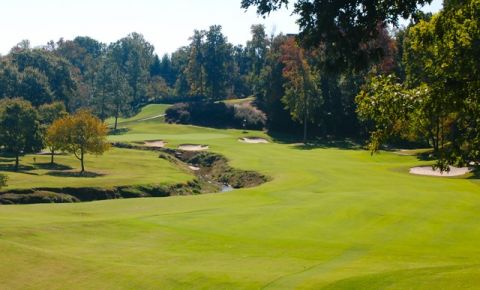
The par 4 8th hole is indicative of the importance of tee shot placement at Thornblade. A drive to the right side of the fairway presents a much better approach than short and left.
Thornblade’s golfing members are also, for the most part, well trained, as demonstrated by the one threesome and two foursomes that graciously waived me through during my 3:45 hour round. (Although golf professional Kevin Schreel might consider offering some sessions on ball-mark fixing, as I found myself fixing mine plus one on virtually every green on the otherwise well manicured course.) I can also attest from my previous visit five years earlier that the food at Thornblade is quite good and the dining rooms near capacity most nights of the week. I can’t imagine members complain about their $60 monthly food minimums at Thornblade Club.
Thornblade’s ranking in the golf rich state of South Carolina may suffer a bit because the sleek circa 1988 Tom Fazio design weaves its way through a neighborhood and, horrors, some homes are close enough to require the protection of out of bounds stakes on their back forty. (The South Carolina Golf Rating Panel, of which I am a member, placed Thornblade in the 37th spot in its 2010 rankings, but those impressions came before the five-month redo of all the greens on the course, as well as some other visual improvements.) In truth, though, most of the closest houses are not more than 100 yards down the fairways, and any homes at mid fairway or around the greens were well outside the field of play, or way above it. Perhaps the condominiums that hang over the back of the first green fix a notion of encroaching real estate in the minds of some, but this is Tom Fazio, he of the funneled fairways, and someone who can bury virtually every cart path can certainly build a course that keeps homes at bay. He does a good job of it at Thornblade.
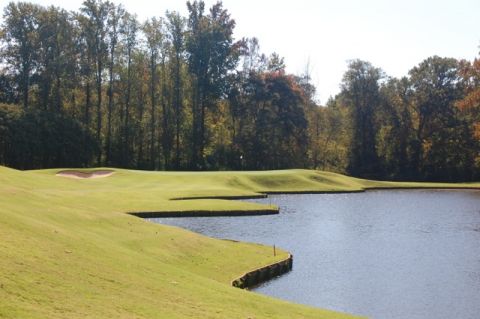
The combination of water and elevated green on the par 3 11th at Thornblade makes you think twice about club selection.
When my colleagues on the SC Golf Rating Panel revisit Thornblade, my guess is the club will move up at least a few spots from its position in 37th place. I certainly would rank it as highly as Cliffs at Glassy (north of Greenville), Belfair Plantation (Bluffton), the Daniel Island Ralston Creek course (near Charleston) and Wachesaw Plantation, south of Myrtle Beach, all of which placed ahead of Thornblade in the 2010 rankings. The reshaping and re-contouring of the greens as part of a $2 million renovation last year has certainly expanded the short-game challenges on the course, but five years after my first visit, the fairway and greenside bunkers appeared more sharply carved and a bit more menacing. The 71.3 rating and especially the 131 slope rating from the “short tees” (6,248 yards) certainly reflected the new premium on placement both off the tee and especially around the greens. (Note: To weather the long, hot summer, Thornblade has positioned a huge fan beside each green to ensure good air circulation and green greens.)
Except for the 190+-yard 17th, the par 3s at Thornblade are on the short side -– one was just 119 yards -- although they are either well bunkered or elevated hit-or-miss affairs (or both). The par 5s offered the best opportunities, as they typically do, to pick up a stroke or two. The major impediments to a good score at Thornblade from the “Enclave” tees I played were the par 4s. On a golf course under 6,300 yards, you don’t expect to play two-shotters of 415 yards (the 13th) and 442 yards (the 18th), easily one of the toughest finishing holes in the state. These were beastly challenges, although the 13th, as befits a long hole, did not offer much in the way of hazards, its fairway bunkers well beyond tee-shot distance yet well inside the approach shot distances. The only in-play bunker was the one that protected the back right of a green that sloped front right to rear left.
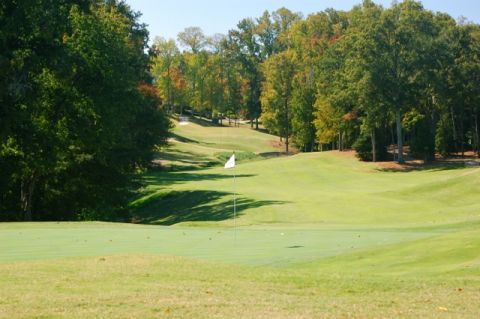
Fazio's longest par 4 at Thornblade, the finishing hole, is also its most narrow, with a fairway bunker in driving range below the hill on the right in the photo, and a creek that runs the entire length of the hole on the other side. The creek encroaches on the right side of the green where a short approach into a bunker that guards the green and stops some shots from rolling into the creek might actually save a stroke or two.
The 18th, however, was an entirely different story, with a menacing view from the elevated tee box to a fairway that tilts from a bunker guarding the left side to a wide creek that guards the entire length of the right side, in play all the way. To say the fairway appears narrow in the landing area is to understate the intimidation factor. The reward for stopping your tee shot on what appears to be the width of a tilted jet wing is an uphill, 200+ yard shot to a green protected by the Sahara at front right and the Gobi along the left side. The two-tiered green offers pin-placement opportunities from soothing to diabolical.
Although the 23-year old Thornblade Club and its surrounding community, where homes range in price from the $400s to well over $1 million, grew up together, it is not a traditional golf community. Although many of its members live within a few blocks of the club, Thornblade’s reputation draws families, empty nesters and retirees from near and farther (average age is 53). For northern retirees not wedded to the idea of a gated golf community with a residents-only membership, Thornblade Club might just expand your horizons…and your short game.
If you would like more information about Thornblade Club and local Greenville area real estate, please contact us.

Thornblade scorecard.
Reader reviews the famed Seaside golf course at the Cloisters Resort
by Elliot deBear
On a recent visit to Georgia, I stayed at the Cloisters in the famed 5 Star Sea Island Resort. While very expensive, it lives up to its ratings in every way, especially with its beautiful Seaside golf course. I have, over the last few years, decided to stay fewer days in fantastic resorts instead of longer vacations in mediocre places. It generally comes out to the same cost and turns out to be more exciting and special. The Cloisters at Sea Island didn’t disappoint.
Seaside’s design was completed in 1929 by Harry S. Colt and Charles Alison, two famed golf course architects from Scotland. They also designed many of the country’s top private clubs, such as Century Country Club in Purchase, NY, as well as a number of tracks in Scotland. The course was updated in 1999 by Tom Fazio and retains a Golf Digest Top 100 rating with 4 1/2 stars.
Seaside is one of the most picturesque courses I have played and certainly one of the best resort courses in the country. The layout plays to a par 70 at 6,557 yards from the back tees, and a rating of 73.2 rating and a 136 slope. The pros at last weekend’s McGladrey Open event played longer than 7,000 yards. The lay of the land as designed by Colt and Alison reflects their Scottish heritage, with many holes framed by dunes and native grasses. There are large bunkers and lots of them guarding the greens. It is said that the greens, which were in perfect condition, are very similar to Augusta National in terms of speed and the crowns on the back nine. Breaks are a challenge to read as they often do not look as big as they are given the speeds. The course rewards straight drives and can provide some nasty challenges if you’re off the short grass, especially on the left sides of many holes.
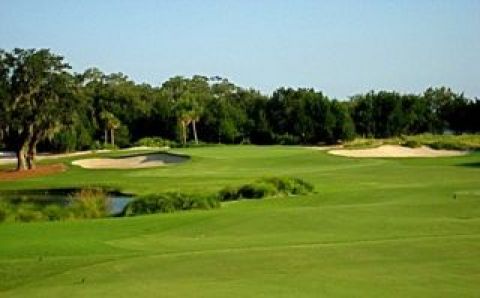
There is a lot of water throughout the course, much of it not in play but providing some beautiful views. Breezes alternate from the ocean and river that borders the land. The par 3’s are special gems.
Seaside was fun to play, aesthetically beautiful and in prime condition. The complex features one of the best learning centers in the country (reportedly) in the country as well as Plantation, a terrific sister course. The Cloisters resort was magnificent and very much like the Sanctuary in Kiawah Island. The spa and fitness center are as good as you will find anywhere, as are the beach facilities. Off site and nearby were a variety of great restaurants to sample seafood and low country fare. The resort is about 1 ½ hours drive from Savannah. We stayed in Savannah for two days and one night to visit the historic district before heading to the Cloisters. It is a fabulous city steeped in culture, spiced with art, architecture and history. Savannah is heavily influenced by its Savannah College of Art & Design whose buildings and exhibitions seem to be everywhere.
Elliot deBear, who lives in Westchester County, NY, has contributed a number of articles and outstanding photographs to GolfCommunityReviews in the past. We thank him for them all.
Gentle Fazio turns nasty on Thornblade 18th
Golf course designers are psychologists too. They know that the popularity of their golf courses are directly related to the memorability of their finishing holes. And, of course, the final hole can leave the deepest impression.
Tom Fazio is one of the more mild-mannered of major architects. If there is any flaw in his game -– he is among my favorites, so I don’t see many flaws -– it could be that he is biased toward the visual occasionally at the expense of the challenging. (Note his obsession with “burying” cart paths behind mounds and the enormous cloverleaf bunkers that splash white shapes all over the relentless green of frequently banked fairways).
To a golfer trying to protect a score, however, there is nothing pretty about #18 at the Thornblade Club, a circa 1988 Fazio design carved into the core of one of the Greenville area’s most upscale neighborhoods (homes from the $500s to over a million). I will have more to say about the community and the fine golf club it surrounds in coming days. As a preview, the attached photos will give a taste of the diabolical finishing hole.
From the elevated tee box, the fairway appears to slant severely from left to right. A bunker protects the landing area on the left side giving the player only two choices to avoid it -– go left purposely into the rough, or hit to about a 20-yard wide patch at the left center of the fairway to bound down to position A on the right half of the fairway. Hit the fairway down the right side and consider yourself lucky to wind up playing from the right rough, as a hole-length deep creek runs down the right side.
Even a ball in the fairway on the 444-yard hole (from the “Enclave” tees, less than 6,300 yards in total) leaves a long and menacing approach, with bunkers guarding both sides of the green, leaving only a 10-yard wide opening to a two-tiered green. Push your approach shot to the right even just a little, and you will find yourself praying “Bunker, please” in lieu of a bounce into the creek just below the bunkers. Even an approach shot that makes one tier can produce bogey if the pin is on the other tier.
The Thornblade Club has an attractive bar area in massive brick clubhouse. It is a good place for members to lick their wounds after after #18.
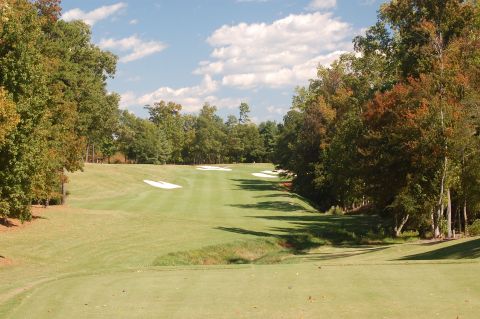
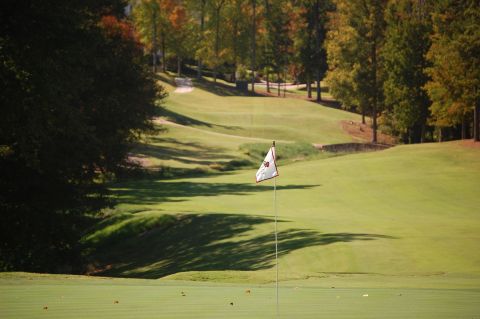
Top, there does not appear to be much room in the fairway on Thornblade's finishing hole, which plays to 444 yards from the third set of tees from the tips. Any approach shot short and right of the green (bottom) stands a good chance of bounding into the creek.
The Cliffs may need a community organizer
In writing recently about The Cliffs Communities and some of its financial issues, I referred to a few residents and club members who had told me they rarely traveled to the Cliffs golf courses beyond their own
“It is [also] a pleasure to take guests to the many communities they could not play otherwise,” he wrote. “Where else can one be a member of six world-class golf facilities and two TBD?”
Of the two pending golf courses my correspondent referred to, one – the Gary Player course at Mountain Park -- is a couple of years beyond its due date, and the other –- the Tiger Woods layout at High Carolina –- is on life support, to put it mildly. Some golf club members who hold the lien on The Cliffs’ amenities after lending developer Jim Anthony $64 million are strongly in favor of letting sleeping white elephants lie.
My conversation over a couple of days with this gentleman, who asked to remain anonymous, opened my eyes to a political challenge that may face The Cliffs and its residents. My pen pal told me he is 70 years old, and when he bought into Cliffs Valley, he paid just $80,000 for his lot. Within a few years, a nearby lot “sold for eight to 10 times that. [The big increase in prices] may have started [The Cliffs’] misdirection.”
With golf initiation fees that once were double what they are now, some Cliffs residents paid $75,000 more than others did. Some members, like our new friend, use all six golf courses while others who don’t might eventually argue for paying lower dues for fewer options.
It isn’t exactly class warfare, but when you have a group of people who invested ‘X’ and another group that invested ‘10X,’ and both groups must agree on the direction of the enterprise, communication will be a challenge. The Cliffs residents would do well to start looking in their midst for a leader with the skills to moderate discussions and build consensus.
You Voted. We Listened.
Top Virginia golf community hosts pro event

Now on Sale

- The only book about golf communities in the last 10 years.
- 156-page step-by-step guide to finding your dream golf home.
- Info on nearly 100 golf communities the author has visited.
- Paperback version costs less than a sleeve of Pro VIs.
Here is what the experts are saying:
“The book is chocked full of information…applicable to anyone looking for a move to the Southeast regardless of whether they are looking for a golf community or not.” — John LaFoy, golf architect (Linville Ridge CC, CC of Charleston, The Neuse GC)
“Larry has done a tremendous amount of work and anyone — like me — who is looking to search for a golf home now or in a few years needs this book.” — Brad Chambers, golf blogger, ShootingYourAge.com
“Wow! What a thorough piece of work…a must for anyone moving South. This book will help many people.” — Brett Miller, owner and founder of MMA, Inc, a golf industry consultancy
Buy It Now at Amazon.com or BarnesandNoble.com.