What Starbucks says about buying real estate
My subject today is coffee, or more specifically how coffee has taught me a lesson about expectations and the proverbial "sure thing." Stick around for the end and I will come round to the subject of buying real estate.
I bought shares of Starbucks a year ago after committing to Wall Street guru Peter Lynch's proven advice that you should "buy what you know." This has worked for me with shares of companies that make other products I own, such as Apple Computer, whose stock I sold at a tidy profit (but way too soon). It is also why I would never own any airline stock, except perhaps for Southwest, whose service is at least tolerable.
No emotions (or addictions) tugged at me to make the Starbucks stock purchase; although I love coffee and drink up to four cups each day, I can take or leave the chain's scorched beans approach. But their stores are too convenient to ignore and their attraction for others is undeniable; every shop I have wandered into over the last five years has been crowded, and most of those in the long queues walk away with high-priced lattes and frappuccinos that may be bad from a nutrition standpoint but good for Starbucks' return on investment (i.e. drinks that cost a few pennies, absent the barista's labor, bring in more than $4 per). The lines in Starbucks are long throughout the day, not just in the mornings, when they are very long. Tables are always filled with an eclectic mix of people, from high school students to retirees. Starbucks is the ultimate social networking site, with obvious appeal across the generations.
I consider coffee recession proof as well. Even as people struggle to make their mortgage payments, they can convince themselves all is well by standing in line with corporate executives and ordering a latte. Many
Starbucks' global expansion plans seem to make a lot of sense too. All those Chinese emerging into quasi-capitalism will want to experience the trappings of capitalist success, and fancy coffee drinks are certainly a cheap, if not healthy, way to do that. In the 1980s, when Japanese cars and other manufacturing companies were beating the pants off American manufacturers and Japanese investors were buying Pebble Beach, Rockefeller Center and other coveted U.S. assets, two Otis Elevator Company executives in Tokyo for business meetings stood outside the then-largest McDonald's hamburger restaurant in the world. They watched in amazement as streams of Japanese came and went through the restaurant's doors. "That's how we'll get them," one exec said to the other, "through the food." I don't know if exporting caffeine to China is part of a grand American business strategy to give the Chinese the jitters, but Starbucks' expansion there does seem to make good business sense.
With all these things going for Starbucks, why is its stock one of the more prominent dogs of the market? The only reason I can conjure is that its strength is its weakness - that is, in trying to be all things to all people, it is turning off those on the margins, those who could join Starbucks nation if only they didn't have to wait so long. In offering customized versions of all its drinks, such as a skim milk decaf caramel macchiato with a triple shot of espresso and no whip, Starbucks overwhelms its employees and slows down the process of serving its
Which brings me the long way round to the subject of planned communities. I've visited a number of popular ones whose range of amenities seemed both breathtaking and unsustainable. How many people do you know are interested in horses, nature walks, boating and golf? Who has the time for all those activities anyway, even in retirement? And what happens when the developer turns over the community eventually to the homeowner's association, and the residents have to pick up the costs to maintain the horse barn, the 40-Nautilus-machine fitness center, the spa and the golf course?
Some tough decisions will need to be made by residents, pitting those who want the equivalent of a plain cup of coffee (i.e. a good golf course and little else) against all those who like it fancy. Consider that before you buy into an amenity-loaded community, or into Starbucks' stock.
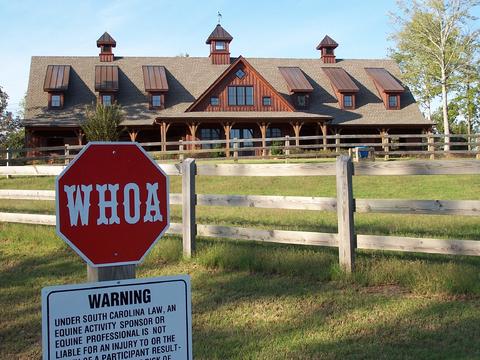
The Cliffs is one of many communities that load up with amenities, like a full-blown equestrian center, to attract high-end buyers.
 Home On The Course newsletter
Click here to sign up for our Free monthly newsletter, loaded with helpful information and observations about golf communities and their golf courses.
Aberdeen to Trump: You're hired!
It's academic: Coldwell Banker survey reveals wide price range for homes in college towns
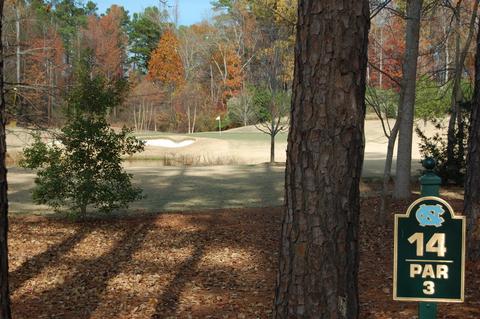
College towns like Chapel Hill, NC, offer excellent golf, such as the University of North Carolina's Finley course.
The most expensive and least expensive houses in college towns in the U.S. are about $1.5 million apart, according to a recent press release from the real estate firm Coldwell Banker. The median price for a 2,200 square-foot 4-bedroom, 2 ½-bath home in Palo Alto, CA, the home of Stanford University, is pegged at $1.68 million. Near Ball State in Muncie, IN, the same size home will cost you just $150,000.
The Coldwell Banker survey, the press release indicated, took some inspiration from a famous game-ending play 25 years ago in November when Stanford and the University of California played their annual football game. Current Coldwell sales agent Kevin Moen scored the winning touchdown for Cal on the final play of the game, threading his way through the Stanford marching band that had run onto the field to celebrate a likely victory just seconds before an improbable defeat.
With our son now at college and essentially forced to live off campus from his sophomore year on, I've considered the practical and financial implications of buying a house near his campus in Virginia. Coldwell Banker's CEO, Jim Gillespie, says I'm not the first to think about it.
"Real estate professionals have been doing this for years," Gillespie said in the press release. "Once their child is able to live off-campus, they do so in the family-owned home with classmates paying rent as roommates. Over time, the home appreciates in value and the family can keep it or sell it with the proceeds going toward the college payments."
That same logic applies to anyone looking for a vibrant place to live, with good golf nearby. College enrollments rarely fluctuate, except upwards, which builds stability into the local real estate market. Prices in the markets below haven't quite taken the hits in prices of other markets with less predictable economies.
All the southern college towns we have reviewed are listed in the Coldwell Banker survey. Prices below are calculated by Coldwell for zip codes popular with middle managers working in local corporations. Prices from one zip code to the next within an individual town may vary significantly. Median home prices listed here were calculated in October 2007:
Columbia, SC (U of South Carolina), $199,000
Knoxville, TN (U of Tennessee), $202,000
Winston-Salem, NC (Wake Forest), $229,000
Durham, NC (Duke), $230,000
Raleigh, NC (NC State), $238,000
Austin, TX ((U of Texas), $243,000
Athens, GA (U of Georgia), $249,000
Atlanta, GA (Georgia Tech), $324,000
Charlottesville, VA (UVA), $374,000
Chapel Hill, NC (UNC), $388,000
You will find the full list of college towns and prices at the Coldwell Banker web site.
More site seeing
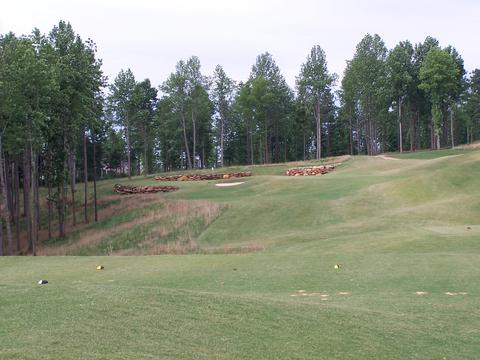
The Chapel Ridge Community near Chapel Hill, NC, is popular with families. Since Chapel Hill is a large city, schools can vary from one district to the next. Sites like Great Schools.net can help parents narrow the choices on where to live.
Yesterday we reviewed the real estate sites Trulia and Zillow. Today we offer a few more sites. Each should be taken with something of a grain of salt but might provide you with helpful information you won't find in community marketing brochures.
RottenNeighbor.com
A sage Greek once wrote that, "Those who plot the destruction of others fall themselves." This could be the unintended motto of RottenNeighbor.com whose raison d'etre is simple, but the consequences less so. Essentially, the site provides the ability to gore the ox of any of our neighbors who have offended us or, in our opinion, community sensibility. It also purports to warn the rest of us about the cantankerous old coot who could wind up as our next door neighbor.
Consider this RottenNeighbor posting by someone in Gulfport, MS: "The old man that lives here constantly stares at young women and gives lude (sic) remarks and gestures toward them. He waits until his wife/girlfriend is in the house and then starts staring. He is disgusting. If you're a young woman, don't live next to this guy. You won't get any sleep for fear of what he might do if he catches you before the door closes."
The letter writer's over-heated prose would make me leery about living next door to him (if it is a him). And who knows whether the allegations are true or not. Let's say, though, for the sake of argument, that the writer is being honest and helpful. If he owns his own home, by definition he has lowered its value by warning away potential buyers from buying next door. At best, this is both noble and stupid and at worst, if he is lying, nasty and destructive. No thank you; I'll spend my limited time on other sites.
StreetAdvisor.com
People stop and stare, they don't bother me,
For there's nowhere else on earth that I would
rather be.
Let the time go by, I won't care if I
Can be here on the street where you live.
-- from My Fair Lady
Equally self-serving, but from a prop-up-your-property value standpoint, is StreetAdvisor.com, another site that offers you the opportunity to praise your neighbors, or to bury them. But since the mission of the site is to advise, rather than to trash, the bias seems to be more toward objectivity.
"Try and write about things that you would want to know if you were moving into a new street," the site implores. "For example, what is the traffic like weekends? Is there a lot of social activity on the street? Are there a lot of dogs that bark at night?"
StreetAdvisor strikes us as a good idea, but it is limited, at this point, by the scarcity of messages from its users. I was invited to be the first one on my block at my Connecticut and South Carolina homes to offer some thoughts about life on the streets. StreetAdvisor posts scores for each street based on its users' ratings. I checked out the densely populated 1st Avenue in New York City where my wife and I once lived. It's nice rating of 88 (on a scale of 100) was the result of just one review, an indication that the site has not yet gained traction.
StreetAdvisor will eventually be useful but, for now, it will satisfy those with an inclination to praise or trash their neighborhoods, not those of us looking to move in.
GreatSchools.net
Okay, so you have raised your children and gotten them through public schools and college. Congratulations. Now, the last thing on your mind is the quality of the schools in a community you are considering a move to.
Not so fast. The quality of life and the stability of an area is often reflected in the quality of its schools, and while we would not put schools at the top of the list of criteria for a retired couple searching for a new place to live, we wouldn't discount it either.
GreatSchools is a simple, efficient way to check out the "report cards" on schools by zip code or town name. The site will help you find the best schools in a particular zip code and then compare them with other schools in other zip codes. This is particularly helpful in a spread-out city with multiple golf course communities and some variation in the quality of schools (such as Chapel Hill, NC, where some schools are near the best in the nation and others are below that level). GreatSchools will also search for top-rated schools by state.
For empty nesters, GreatSchools is a nice tool to have in assessing a particular area. For those with school-age children, it could prove invaluable.
Site seeing your way to a new house...or to selling one
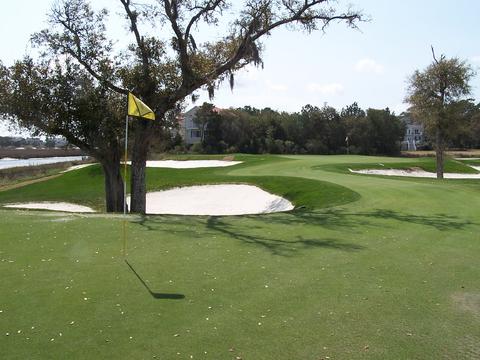
Web sites Trulia and Zillow do not capture most of the properties for sale in Pawleys Plantation, the golf community in Pawleys Island, SC.
The purchase of a new home, whether on a golf course or elsewhere, is always fraught with risk. You can hire a qualified engineering inspector to make sure the pipes don't leak and a rodent population won't steal your gouda, but whether you are paying at or above market price for the house, whether the local schools are good or bad and whether your neighbors mow their lawns or park their cars on them requires more aggressive research and some uncomfortable questions.
According to the Wall Street Journal, some web sites can help you answer a few of these questions. We took some of the sites for our own brief test ride today, using our hometowns of Avon, CT (primary) and Pawleys Island, SC (second-home) as the basis. We report on two of the sites here today and will include others tomorrow.
Trulia.com
When it works, Trulia can provide meaningful information about real estate offerings and prices in a particular area, right down to the zip code and street. We searched by the Pawleys Island zip code of 29585 and Trulia identified 518 homes for sale in all price ranges. The site offers the option of indicating what type of home you are looking for (condo, single-family, etc.) and to specify the numbers of bedrooms and baths, square footage and price range. I filled in as much information as I was asked about what home I was looking for, but clicking on "search" didn't yield a thing; the page stayed where it was. No map popped up in the area it was supposed to, and clicking on the "expand map" button yielded nothing. I was able to invoke the map later, but even though 518 homes were for sale in the area, the map showed only one of those little pushpins that indicate location of homes for sale. Something wasn't clicking on Trulia's server. I had exactly the same experience when I entered our Avon, CT, information.
I tried a workaround by clicking on an area that promised more information on Pawleys Island, and that delivered a range of recent prices for sold properties, as well as a map with a working zoom function. The site also permitted me to input a price range, type of home and numbers of bedrooms and baths. A price range of $300,000 to $600,000 for condos yielded four listings in the zip code, but none in Pawleys Plantation where our home is and where I know there are condos on the market. I then lowered the bottom of the range to $200,000, and Trulia added another five listings. But as for getting down to the street level in Pawleys Island, I could not make that part of the map function work.
Trulia also provides useful information about the overall market, including median sales prices and average listing prices. The site also maintains a discussion area where agents, sellers and buyers can post their questions and thoughts. It led me to a local real estate blog site I found interesting. Trulia's usage and relevance should grow over time, especially once it becomes more user friendly.
Zillow.com
I've written about Zillow here before. Whereas Trulia's strength seems to be in assessing an entire market, Zillow's shtick is to get down to the neighborhood level to provide value estimates. Zillow claims 70 million homes in its database, and although I had some problems a few months ago getting more than just a handful of listings per zip code, Zillow's claims and reality seem now to have converged. When I invoked the Pawleys Island zip code, up popped a map with 56 flags denoting homes for sale, homes recently sold and three whose owners haven't listed their homes but would listen to offers. This latter function is called "Make Me Move."
Zillow's own map function could use some sprucing up too. I found a number of homes recently sold and for sale in Pawleys Plantation, which of course would be useful information if we were intending to sell soon (we are not). But when I clicked on the little pushpins on my street, most of them did not yield an address but rather just said "SC" for South Carolina. I had to try to interpret by the position on the map what the address might be. And whereas condos in our building of six units were once "zestimated," as Zillow calls its algorithm for providing a range of house values, none of the homes in our condo building were listed this time around, although a group of them just down the street were.
As for the three "Make Me Move" homes, they were in the northern part of the zip code, far from our condo, but the fact that the owners listed their "dream" asking price seemed useful to me. Overall, I think Zillow is fun to use and its price ranges on its "zestimates" wide enough that you can probably trust that the value of your home - or the one you might be making an offer on - is somewhere in the target. Still, the best estimator of the right price is the real estate agent representing you as buyer or seller.
A TPC course you can play, and live next to
About two thirds of the 26 Tournament Players Clubs are private, but even those available to the daily fee player can be pricey. The vaunted TPC at Sawgrass in Florida now charges more than $300 per round, a lot for those of us who don't run hedge funds. The others charge well over $100 at peak times. Membership rates tend to follow the pattern of green fees.
TPC Myrtle Beach is not the best TPC course and, indeed, isn't even the best daily fee course within a 10-mile radius on the south end of South Carolina's Grand Strand. That distinction goes to the Caledonia Golf & Fish Club in Pawleys Island; some might quibble as well that True Blue, Caledonia's companion course, and Pawleys Plantation, a tough and scenic Jack Nicklaus Signature Course, are better. I put TPC in their league.
But there is little argument that TPC Myrtle Beach deserves to be on the list for any golfers visiting the area for a long weekend or week. Top prices for daily fee golfers are $165 in the high seasons (spring and fall), but if you are staying on a local golf package, you will do better. Like all TPC courses, the one south of Myrtle Beach conforms to a level of standards and derives the benefits of the resources available from the PGA. And although the TPC courses are all over the place in terms of degrees of difficulty -- TPC Myrtle is on the easier side -- they do share impeccable conditions.
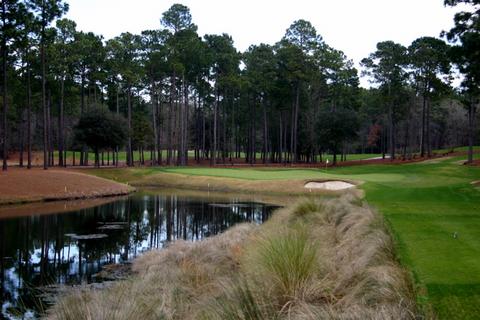
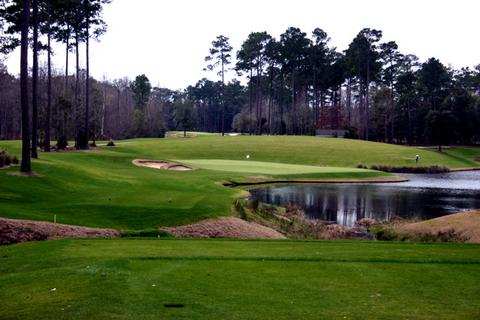
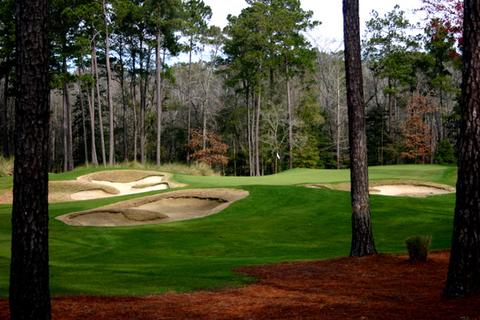
TPC Myrtle Beach has always been in nice shape when I have played it, and in recent months it redid its turf to make it even better and restore it to the glory days when it was a senior tour stop. As our friend Elliot deBear's photos below show, its layout by one of our favorite designers, Tom Fazio, is also visually arresting and challenging.
The course sits inside the large (3,600 homes at full build out) and gated Prince Creek community in Murrells Inlet, a few miles west of Highway 17, the main north/south route along the Carolinas coast. Homes in Prince Creek range from modestly sized and priced town homes (starting in the $200s) to larger homes on larger lots and into the high-six figures. One of the builders in Prince Creek recently went into bankruptcy; therefore, expect prices to have softened a little throughout the community.
Prince Creek residents can join the golf club for a $15,000 initiation fee, which provides unlimited golf and discount privileges at the other TPC daily fee courses (but not the private ones). Those who live outside Prince Creek can join the club on an annual basis for $2,000 (full family) but do not receive playing privileges at the other TPC courses. The TPC Myrtle Beach web site is outdated, but you can call for updated membership information at 888-742-8721.
Elliot deBear's photos follow...
Where they are playing this weekend
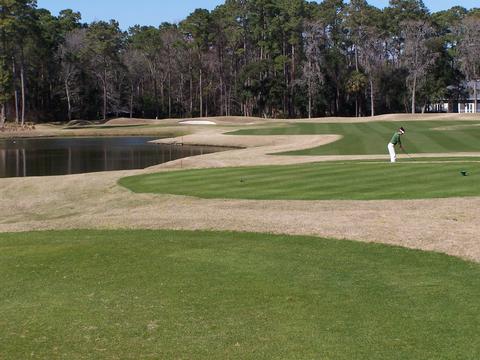
The Landings at Skidaway Island's six courses should be popular this weekend.
The southern U.S. will have plenty of clouds this weekend but, for the most part, will be rain free and warm enough everywhere for a round of golf (or two). We've indicated high temperatures for today and Sunday in some of the most golfing rich areas of the southern U.S. We have marked with an asterisk (*) those places we have visited and reviewed. If you have any questions about golf communities or courses in these areas, please do not hesitate to contact us.
Today/Sunday, high temperatures in Fahrenheit (Centigrade), conditions
Aiken, SC*
76 (24), Partly Cloudy/79 (26), Partly Cloudy
Asheville, NC*
65 (18), Mostly Cloudy/64 (18), Mostly Cloudy
Austin, TX*
80 (27), Partly Cloudy/77 (25), Scattered T-Storms
Biloxi, MS
75 (24), Fog then sun/75 (24), Partly Cloudy
Charleston, SC*
74 (23), Partly Cloudy/77 (25), Partly Cloudy
Charlottesville, VA*
56 (13), Mostly Cloudy/47 ( 8), Cloudy
Jacksonville, FL*
77 (25), Partly Cloudy/75 (24), Fog, then sun
Lexington, VA
54 (12), Mostly Cloudy/52 (11), Cloudy
Naples, FL
83 (28), Partly Cloudy/83 (28), Sunny
Pawleys Island, SC*
73 (23), Partly Cloudy/72 (22), Partly Cloudy
Savannah, GA*
78 (26), Partly Cloudy/79 (26), Fog then sun
Williamsburg, VA*
60 (16), Partly Cloudy/57 (14), Cloudy
Wilmington, NC*
72 (22), Partly Cloudy/70 (21), Partly Cloudy
St. Andrews, UK
41 (5), Cloudy/43 (6), Light Rain
And the award for best designer goes to...
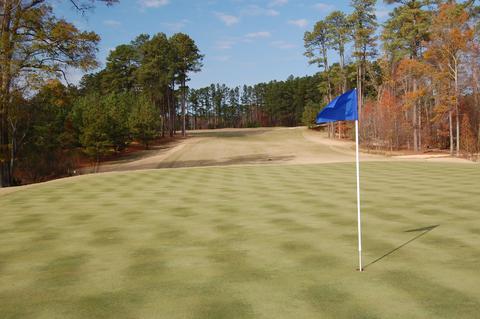
Tom Fazio's propensity to "bury" cart paths, as he does here in the woods at The Finley Golf Club in Chapel Hill, NC, earns him plaudits from those who review golf course designs.
Tom Fazio has five layouts in the top 20 of Golfweek magazine's 2007 list of best residential community courses, more than any other designer. It affirms my notion that Fazio is the most consistently good architect working today.
Wade Hampton, Fazio's design in Cashiers, NC, earned top honors for the second year in a row. Fourth place Black Diamond (Quarry) in Lecanto, FL, and sixth place Briggs Ranch in San Antonio were the other Fazio designs in the top 20. Jack Nicklaus placed two courses in the top 20, both in the top five, including Castle Pines (#2) in Colorado and Mayacama (#5) in Santa Rosa, CA.
Former top pick Golf Club at Cuscowilla, Bill Coore and Ben Crenshaw's minimalist but arresting layout in Eatonton, GA, slipped to third place this year, not too shabby when you consider it placed ahead of the best Pete Dye had to offer - Long Cove on Hilton Head (#7) - and the Jay Moorish/Tom Weiskopf design at The Rim Golf Club (#9) in Payson, AZ. Moorish, both on his own and with Weiskopf, racked up three courses in the top 20.
The list of the top 100 residential courses is at Golfweek's web site.
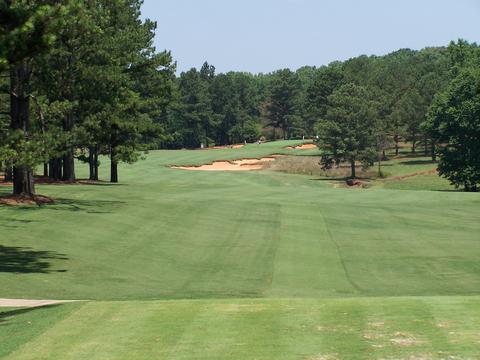
Cuscowilla, the Coore/Crenshaw design in rural Georgia, is stripped virtually all artifice, including homes, which are well away from the layout.
Odds and Sods
The man who made famous the words "You're fired" isn't taking rejection lying down. After a local council in Aberdeenshire, Scotland turned down Donald Trump's plans to build a, gulp, $2 billion resort and golf course on undisturbed beachfront property, the Trump organization went into high gear. Yesterday, a spokesman for the Scottish Parliament, reeking of logic worthy of one of those stuttering interns on the faux business show The Apprentice, said the national legislators "felt the decision [to reject Trump's proposal] has given a worrying message to the rest of the world that Scotland is closed for business." Some local observers complain that The Donald's lobbying machine got to the national ministers to reopen discussions for the two course and luxury hotel resort.
We aren't close enough to render our own opinion on whether digging up perfectly decent beachfront to make way for super-rich golfers is a good idea or not. But it strains credibility to think that turning down this plan will deter other businesses from building a plant in, say, Kiltundon or Plaidisgreat?
This is an earthshaking step for a national government to supercede the wishes of a local planning council. There must be more to the story, and we can only guess at what the Trump organization offered the MPs, but it must have taken something big, like an opening round at the resort's courses, a slot on Apprentice XII, or the phone number of The Donald's hairdresser.
Housing markets continue to list
Like a boat on stormy seas, the U.S. housing market continues to wobble from one month to the next. Yesterday, though, ZipRealty, a California brokerage that tracks real estate listings in 18 metropolitan areas, reported data that, on the surface, might seem like good news. Sixteen of the 18 markets showed a decline in the numbers of homes listed, one (Los Angeles) was unchanged and one, the besotted Miami market, increased. In all, the 18 metros showed a 2.5% decline between October and November.
Although the relentless Polyannas of real estate may look to the numbers and say, "See, things are turning around," those of us with no skin in the game (or 10 condos in Miami) and the unbiased "experts" are more sanguine. Commenting in the Wall Street Journal today, Moody's Chief Economist Mark Zandi said, "Inventories of unsold homes will rise substantially further in coming quarters," a consequence of foreclosures and tighter lending terms for would-be homebuyers. Calling it "capitulation," Mr. Zandi added that the dismal market conditions may finally bring sellers to the point of pricing their homes appropriately for the current market.
Among the markets ZipRealty tracks, Boston had the largest month to month drop in house listings at 8.2%, followed by San Francisco (6.4%) and Chicago and Minneapolis (5.8% each). Florida cities like Tampa (-.6%) and Orlando (.1%) showed only trace declines in listings. Prices in a market generally will move inversely to the number of homes for sale; more homes means more price competition means lower prices. It would be logical to say prices in Orlando and Tampa and for sure Miami may be low enough to inspire buyer interest, especially in second-home buyers, but all the badness is not nearly out of the system yet. Bigger bargains are ahead.
Wrap-up thoughts on a week in North Carolina

Yawning bunkers awaited the PGA pros in 1974 when today's 9th played as the 18th.
Winston-Salem, NC, is not exactly on most foursome's list of places to spend a long weekend or week in the Carolinas, but the fact is you could do worse, especially if you choose your courses - and local barbecue joints - carefully.
My week started at Salem Glen in Clemmons, NC, last Tuesday after a rainout in Roanoke, VA, on Monday. Salem Glen, which has all the affectations of a private club but is available to the daily fee player, is a challenging but fair Nicklaus Design course. It is fun to look for clues about Jack's influence in his firm's designs but, except for the occasional tree directly in play, Salem Glen looked more like a Rees Jones or Tom Jackson course than a layout that Jack built. That is more than faint praise, as I enjoyed Salem Glen thoroughly.
Wednesday found me on familiar ground at the Championship Course at Tanglewood Park, the legacy in Clemmons of Reynolds family tobacco interests. I had walked the course a few rounds earlier this decade following my son in junior tournaments held there, but I had also played it myself once before, in 1970 with my father and brother, four years before Trevino beat Nicklaus by one in the PGA Championship.
Tanglewood is a classic Robert Trent Jones course with fairway touches and green complexes that I would see again later in the week at the massively redesigned Finley course at the University of North Carolina, a Tom Fazio masterpiece. I see lots of similarities in the two courses, in the large and often high-lipped bunkering and the sometimes misshapen greens. I don't intend to wait another 37 years to play Tanglewood, or Finley for that matter, and I'll make a full day of it next time by playing the sporty second 18 on the Reynolds Course.
On my way to Chapel Hill on Thursday, I got a late start and stopped at Stoney Creek, just off I-40 in Whitsett. I like Tom Jackson courses generally, and the first nine holes at Stoney Creek were sporting, if not dramatic. I never got to see the finishing holes; after nearly three hours on the front nine behind a few foursomes that were playing at a six-hour clip, I gave up. I know it is the late fall, but the occasional presence of a ranger might help speed up play a touch.
My round at Finley was great for a number of reasons, not the least of it the fine company of friend Bob Harris, who teaches at the business school at the University of Virginia but recently moved back to Chapel Hill with his lovely wife, Leone. Bob had not played much golf lately, but after the round at Finley, he is vowing to reinvigorate his play. He should. He made four birdies, three with substantial putts on very difficult greens, the last at the 18th, where he went from a stroke behind me to a one stroke victory. I will make sure to have Bob with me the next time I play Finley, since he clearly understood the contours of the greens better than I did (I made one sizeable putt all day). But you know you are playing a fine course when you don't mutter too much about misaligned putts and Donald Ross-like crowned greens that make chipping both necessary and nearly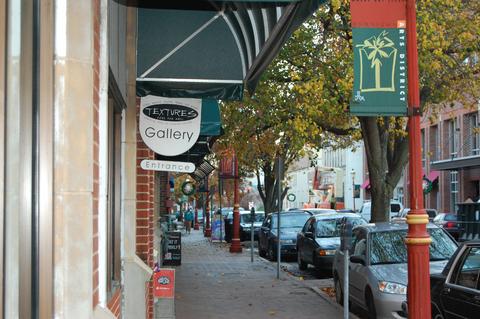 impossible. The layout was phenomenal, the greens lightning fast and the chance meeting with fellow golf blogger Henry Lister, of OffTheBeatenCartPath.com, icing on the cake.
I didn't eat cake at any restaurants during my week, but I did eat well. I am a barbecue fan, and when in North Carolina, do as they do, which is to say lots of pulled pork with that tangy vinegar based barbecue that was invented in the Lexington area, just south of Winston-Salem. Little Richards in the city is widely hailed as the best of the area's Q - along with any number of places in Lexington itself - but I made a strategic ordering mistake. I ordered the large chopped plate, which meant big chunks of pork that were a little dry. My lunch was saved by a good dousing of the tangy vinegar sauce on the table, but the next time I will go with the regular, more shredded pig.
On Wednesday night, I ventured to the Arts District of Winston-Salem where folks are trying to inject some vigor into a fairly moribund city center. I strolled through a nice pottery and crafts shop, bought two bottles of wine for the Harrises at a terrific wine bar and then settled at the bar at the Trade Street restaurant Sweet Potatoes, where the barkeep was friendly and chatty, the pork chops with an apple brandy sauce sweet and tangy, and the atmosphere warm and lively. Count me among those rooting for the Arts District to help turn the downtown around.
After the round at Finley, I had about the best North Carolina barbecue I have ever had, at Allen & Sons in Chapel Hill (they have another outlet in nearby Pittsboro). The shredded pork was beautifully smoked and heavily sauced in the kitchen and came out wet and wild, with crispy hush puppies and excellent, indigenous, chopped cole slaw (which is to say, no mayo necessary). The pork was so good I had them put together a one-pound container in a bag of ice for the 10-hour trip home. The next day we ate it for lunch, and my wife and daughter thought I was their hero...if only for an hour.
Great golf, great barbecue and a great week.
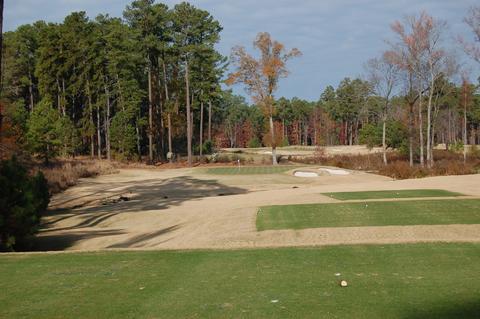
The par 3 5th at Finley forces a precise tee shot.
[where: 27104]
Every picture tells a story
UNC Finley course a brilliant surprise
Small wonderful world of golf
Good golf, good food, good day
A bargain at twice the price

Now on Sale

- The only book about golf communities in the last 10 years.
- 156-page step-by-step guide to finding your dream golf home.
- Info on nearly 100 golf communities the author has visited.
- Paperback version costs less than a sleeve of Pro VIs.
Here is what the experts are saying:
“The book is chocked full of information…applicable to anyone looking for a move to the Southeast regardless of whether they are looking for a golf community or not.” — John LaFoy, golf architect (Linville Ridge CC, CC of Charleston, The Neuse GC)
“Larry has done a tremendous amount of work and anyone — like me — who is looking to search for a golf home now or in a few years needs this book.” — Brad Chambers, golf blogger, ShootingYourAge.com
“Wow! What a thorough piece of work…a must for anyone moving South. This book will help many people.” — Brett Miller, owner and founder of MMA, Inc, a golf industry consultancy
Buy It Now at Amazon.com or BarnesandNoble.com.