Plenty of low-priced golf homes for sale in Myrtle Beach
I am in Pawleys Island, SC, at the lower end of the 90-mile strip of land known famously as the Grand Strand. Housing prices remain not so grand down here -– if you’re a seller -- and there are plenty of excellent golf homes for sale in Myrtle Beach at dirt-cheap prices (and when you can find a patch of dirt for sale, it is even cheaper, relatively speaking, because no one seems to be buying lots these days).
Yesterday, I had lunch with a Myrtle Beach area realtor who sells a majority of his properties in Wachesaw Plantation, one of the three strictly private golf clubs in the Myrtle Beach area; the other two -– DeBordieu Colony and The Reserve at Litchfield Beach –- are also located south of Myrtle Beach, but Wachesaw has the advantage of being less than five minutes from a hospital and less than seven minutes from a shopping mall.
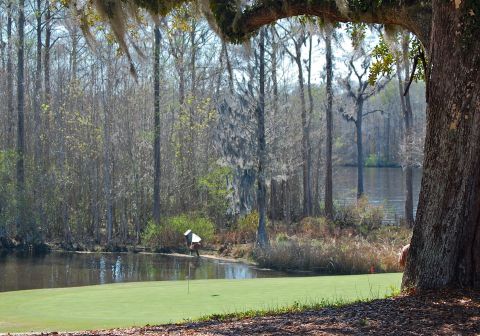
The 18th green at Wachesaw Plantation, wedged between river and pond with, of course, a live oak in splendid view.
Wachesaw, though, tends to defy the notion that market value is a function of location, location, location. On a per-square-foot basis, homes in the community tend to sell at 10% to 20% less than homes in its competitor communities. The reasons are historical. In the early years, some residents say, Wachesaw’s developers alienated local realtors whose disaffection with the community lingered until recently. When I first stopped at Wachesaw nearly 15 years ago, the two-mile ride in from Highway 17
The overhang of the negative early impressions still affects prices in Wachesaw, where many homes can be purchased for less than $150 a square foot. Initiation fees at the classic Tom Fazio course have dropped to around $5,000, and dues are pretty typical of such private clubs (and depend on which membership plan you choose).
I had lunch on Thursday at the golf community’s Kimbel’s Restaurant with Bill Curtis. As we looked out over the sedate Waccamaw River, I asked Bill to describe the lowest-priced property in the community. He detailed a 2-bedroom, 2-bath cottage that 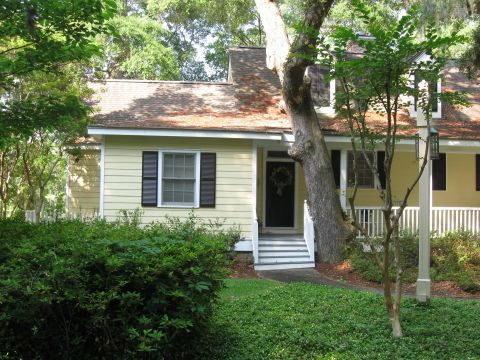 overlooks the 18th green and the marshland and river beyond, and comes fully furnished for just $179,000. At 1,250 square feet, that works out to about $143 per square foot. Earlier in the year, a few other cottages sold as low as $129,000 after one seller in panic mode dropped his price to that level and reset the market value for the others. At $179,000, though, the current cottage for sale appears to be a bargain, especially for those who want to generate a little income from it by putting it on the Wachesaw club’s rental program. At around 25%, Wachesaw’s management fee (which covers housekeeping, marketing and other responsibilities) is among the lowest on the Grand Strand.
There are plenty of golf homes for sale in the Myrtle Beach area. For anyone contemplating a retirement or vacation home on the south end of the Grand Strand, away from the neon lights and honky tonk at the heart of Myrtle Beach, Wachesaw is a must visit. If you would like to arrange for a stop at Wachesaw or any other golf communities in the area, please contact me and I will be pleased to make the arrangements.
 Home On The Course newsletter
Click here to sign up for our Free monthly newsletter, loaded with helpful information and observations about golf communities and their golf courses.
The Donald doesn’t get The Point
“We see hundreds of golf clubs every month,” the younger Trump told Boykin, “and we would have put tens and tens of millions into The Point.”
Now members are left to figure out what to do with a golf club that Crescent Resources, the developer, is set to turn over to them next month. It remains to be seen if members who favored the deal and those who did not can work together to come up with the $3 million required to pay Crescent, or to find a more acceptable new owner. Stay tuned.
Will club members at Point Golf Club near Charlotte bid “No Trump” on deal?
Donald Trump’s organization is attempting to purchase a lakeside golf community country club north of Charlotte, NC, and as in all public Trump dealings, the script reads, “There will be controversy.”
According to local news reports and one club member who spoke on condition of anonymity, the Trump organization, with The Donald’s son Eric leading the negotiations, has been interested in The Point Golf Club
The golf club’s advisory board is coming under fire from some members who say they have been left in the dark on details of the negotiations and that they have proof the board has secretly negotiated a deal with Trump to purchase the club. That “proof” includes attorneys’ invoices that indicate the deal is done, according to our source, even though a majority of members must approve any sale. The dissident members fear that a Trump purchase could result in their private club becoming open to the public, that a hotel could follow, that the club will take on a lot of debt and that members will be asked to pony up dramatically increased fees. Without a clear understanding of Trump’s plans, the dissident members say, they will not know what they are voting for (or against) until shortly before the vote.
According to an article in Friday’s Charlotte Observer, a statement from the advisory board indicates, "There will be plenty of time and opportunities for the members to learn about and debate these options."
One of my current customers will be relocating to a Charlotte-area golf community in the next few months. The Point fits most of his and his wife's criteria except one -- predictable golf fees. "Trump would surely turn The Point into a world-class facility," my customer wrote me after I gave him a heads up about The Point, "but I would bet everything I own he would substantially increase the cost to existing members and make it available to the public, at least semi-private."
The Point's members are considering exactly the same thing.
Home On The Course November/December issue to mail tomorrow
The plot at Dominion Club in Richmond, VA, thickens. A bankruptcy judge has given the go ahead to the golf club’s owners to reorganize and pay off member initiation deposits with pennies on the dollar. Needless to say, some members are not happy. Read all about it in our free November/December issue of Home On The Course (to subscribe, see above).
We also report on new ownership at the high-end mountain aerie of Balsam Mountain Preserve in Waynesville, NC. It is a story of financial rescue in which the lender foreclosed on the property and then decided to run it itself. Now an experienced operator of golf communities and golf clubs has taken over and is hoping to attract more people to the high life.
Since its prices for homes start in the $200s, Brunswick Forest outside Wilmington, NC, does not fit the description of “high-end” but its success in a lousy market is the stuff other golf communities dream of. It is reportedly the fastest selling development on the east coast, and some of that success is alimentary: The golf community has determined that for some prospects, the shortest path to a down payment is through the stomach. Learn how Brunswick Forest has perfected the Art of the Meal in its selling process.
Finally, we can’t let a good thing go and, therefore, once again, we make the case for those of you with homes on the market to consider lowering your prices. It seems to us that in just the last couple of years, the delta between costs of living north and south has widened. In other words, a lower selling price could be made up in a few years of relocating to a lower cost area. I go back to my New Jersey hometown to compare the cost of living there with more than a dozen prime golf community areas of the south. For their sake, I hope my old friends and neighbors are reading.
The November/December issue will be distributed sometime tomorrow. Sign up today so you don’t miss it. (Pssst, if you sign up late, I will personally send you a copy.)
Wish You Were Here: Savannah’s Landings hosts our first Discovery Weekend
The weather was near perfect earlier today on the Oak Ridge Golf Club at The Landings near Savannah, GA, during our first Home On The Course Discovery Weekend. The three couples who participated enjoyed a round of golf on one of The Landings’ six layouts, in bright sunshine and 70 degrees, followed by a chef-inspired three-course lunch in the Oak Ridge clubhouse, part of a weekend that includes another round of golf on the Arthur Hills Palmetto Golf Club, as well as a dinners and lunches in the community’s clubhouses.
The gated Landings golf community is just 15 minutes from the intriguing city of Savannah and is fully owned by its residents and club members, a combination of assets that we have not found in any other golf development. Its successful on-site real estate agency is run by the homeowner’s association and contributes hundreds of thousands of dollars to the community’s kitty annually. At a time when many vacation and retirement home seekers worry about the financial security of golf communities, The Landings can boast that its destiny is in the hands of its residents, all 4,800 of them, rather than a developer. (For a current listing of golf homes for sale at The Landings, click here.)
We will have more to say about The Landings and our Discovery Weekend in the coming days.
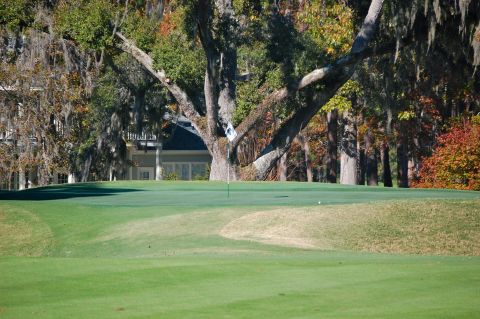
The mature Landings golf community is nearly 40 years old, but its many live oak trees, dripping with Spanish moss, are hundreds of years old.
Bandon Dunes' Old Macdonald Golf Club shows its true links character
This is the third and final installment of Scott Simpson's review of Old Macdonald, the newest course at Bandon Dunes Golf Resort.
When a controversy is hotly contested whether this or that hazard is fair, it is the kind of hazard you want and has real merit
-- C.B. MacDonald
The Outward Nine
No. 6 – Long
Tom Doak and Jim Urbina’s homage at Old Macdonald to the 14th at the Old Course at St. Andrews successfully recreates the classic hole's wide range of options. The safest play off the tee is out to the right, where no trouble can be found. This, however, lengthens the hole, and brings into play the course's memorable version of Hell Bunker, built up from fairway level with railway sleepers to enhance its visual intimidation. The aggressive play is further left, where a series of well-placed fairway bunkers will impede the player’s forward progress. The hole was quite reachable in the downwind conditions I experienced, but against typical summer winds it would most definitely be a 3-shotter and Hell Bunker, some 110 yards short of the green, would be a major consideration on the second shot.
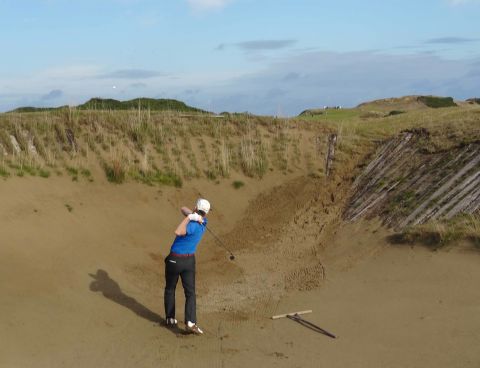 Our playing partner, Stephen Hutchison, a hardy Glaswegian, lives to tell of his visit to Hell Bunker. Playing downwind, the hole was reachable with a good drive. Into the prevailing summer winds, the player must decide whether to attempt to carry Hell on his second to create a birdie opportunity. The bunker was originally built with new railroad sleepers, which were deemed too artificial looking; they were replaced to create a hazard that looks like it’s been there since the beginning of time.
The green complex on the 6th is one of my favorites on the golf course. A well-designed raised knob on the front right section of the green is perfectly placed to repel low-running approach shots, though not in excessively penal fashion. The green is also sloped from front to back, ensuring that all overly aggressive (or, again from personal experience, slightly thin) approach shots will inevitably feed into a truly evil pot bunker tucked behind the green and not visible to the player until it is too late.
No. 7 – Ocean
Irony alert! Perhaps the most talked-about and photographed hole on the golf course has absolutely nothing to do with C.B. Macdonald (unless, unbeknownst to me, Macdonald expressed an opinion on the proper location of turnstands), nor does it have an historical precedent in the Old World. It does, however, boast one heck of a site for a green and is sure to be a highlight of the player’s round.
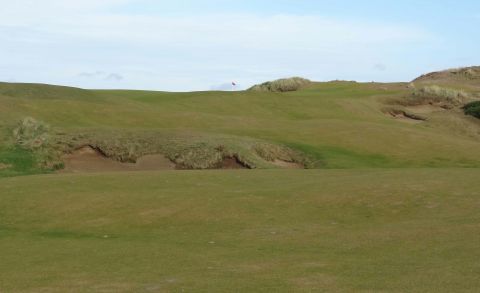 The daunting view of the seventh green, where only the top of the flagstick is visible to the player. The relatively small green (at least by Old Mac standards) is actually a rectangle, though set at an odd angle with the deepest section on the far right, requiring exacting judgment of distance, elevation and wind. As with many of the designs, the player can hit his tee shot as far right as he wants, but the aggressive line to the left, which brings bunkers and rough into play, offers the preferred angle into the green.
The green sits on the dune separating the Old Mac property from the Pacific. Mike Keiser wanted to put the turnstand on the far side of the dune facing the Ocean, affording the player a spectacular vista in which to enjoy a brief respite and also ensuring that it would not be visible from the course. The story goes that Doak was struggling with that particular portion of his routing, and that Keiser’s suggestion to put the green on top of the dune led to a series of pieces falling into place, most notably allowing for the placement of the 8th tee next to the 7th green and utilization of a promising landform for the Biarritz green.
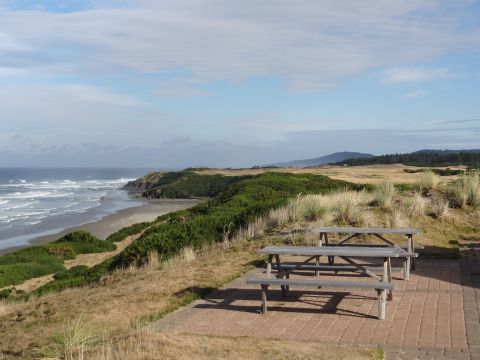
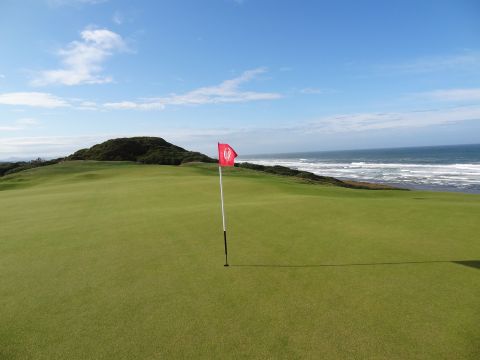 Top, the view from atop the seventh green. Long isn’t good, though throughout the entire resort the Pacific Ocean is marked with red stakes (in fact, most have long since turned pink from their time in the sun) denoting a lateral hazard, which precludes recycling the old joke that the nearest point of relief is Hawaii. Bottom a room with a view, picnic tables near the 7th hole turnstand, which became known amongst the construction crew as the “champagne turnstand.”
The object of a bunker or trap is not only to punish a physical mistake, to punish lack of control, but also to punish pride and egotism -– C.B. Macdonald
The Inward Nine
No. 11 – Road
Designing from a template that is arguably the most famous hole in golf isn’t for the faint of heart, but the Old Mac design team doesn’t disappoint. In fact, if the hole wasn’t named Road, I doubt that many would connect the dots. Admittedly, that’s in part because they didn’t build a replica of the Old Course Hotel to launch tee shots over, and there’s no gravel road or stone wall behind the green, only a tightly mowed collection area.
But despite these minor oversights, they got the essence of the hole dead right. The inherent difficulty of the Road Hole is the angle at which the green sits, canting away from the fairway at a severe right-to-left angle. Because of this angle, a tee shot up the right side affords the far better angle into the green but, and by now the reader will anticipate where I’m going, there’s trouble to be found on that line in the form of a gaggle of deep fairway bunkers. Left is always a safe line on this Road Hole, though it typically results in a more difficult angle of approach, especially to a pin on the back half of the green.
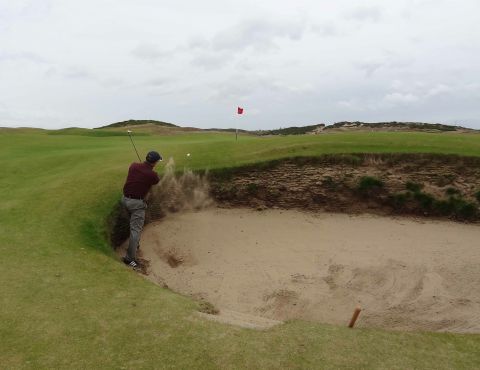 The author escapes from the dreaded Road Bunker, photo courtesy of super-caddy Joe Macarthur. This version of the Road Bunker appeared a bit wider and shallower than the original, but still sufficiently penal to command respect. Alas, a lipped-out ten-footer denied me a rare Road Bunker sandie.
Into the prevailing wind, the hole would certainly be a bear worthy of its namesake, with all but the longest hitters forced to play it as a three-shotter. We necessarily tend to focus on avoiding the Road Bunker, as it inevitably leads to a bogey. But there’s a spot that’s many orders of magnitude more penal, the rock hard turf just short of the bunker. The player simply must keep his second shot well to the right (though long left is also an option), or he might as well pick up and put the six or seven on his scorecard. Jack Nicklaus used to refer to the original as a Par 4 ½, and the same logic applies here. Play for a five, and with luck a four might be found. But the player determined to make four is far more likely to end up with a crooked number on his scorecard.
No. 16 – Alps
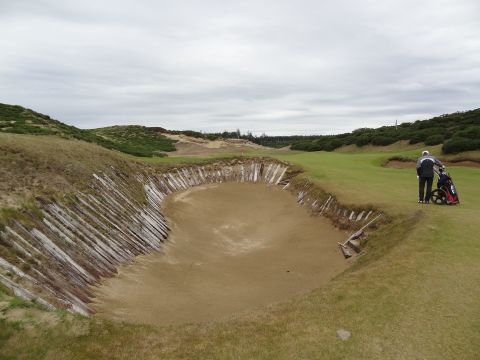
If you’re averse to blind shots, the Alps won’t be your cup of tea. Modeled after the famed 17th at Prestwick, Alps requires a blind second shot over a dune to a hidden green. While the green is appropriately large, more than 45 yards deep, several deep bunkers, including one built up utilizing railroad sleepers, await the imprecise approach shot.
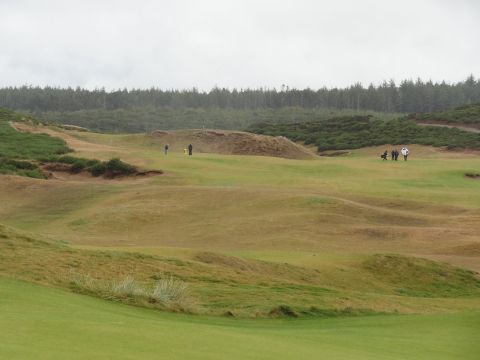
Top, the view from the tee box on Alps. A well struck drive towards the group on the right will reward the player with a partial view of the green. However, because this line carries directly over the most visually intimidating of several bunkers surrounding the green, as in the bottom picture, some players may consider the visibility a decidedly mixed blessing.
In a nod to a bygone era, after holing out the players ring a bell so that those in the fairway behind know that the green is clear.
No. 18 – Punchbowl
The Doak/Urbina rendering of this iconic template is the perfect coda for one’s day at Old Mac. The player’s anticipation of this challenge actually began some four hours earlier, as the Punchbowl to the right of the first fairway, with its unique and seemingly contrived landforms, inevitably engenders confusion. But now the player must give it his full attention and, preferably aided by one of the resort’s extremely helpful loopers, commit to a plan of attack.
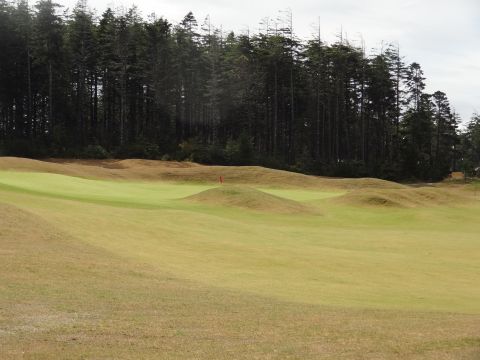 The player’s view of the Punchbowl 18th green from the fairway, offering a wide range of shot options. The severe left-to-right slope is generally the best route to a pin on the left half of the green. For a pin further right the player has front, back and sideboards at his disposal as well.
Unlike the Sleepy Hollow version, this iteration benefits greatly from being entirely above ground. The player selects his intended ball flight and then can watch, for better or worse, the results of his efforts. Also unlike Sleepy Hollow, this Punchbowl works equally well for a short pitch as it does for a longer club. On one short pitch to the green, Joe and I quickly ticked off three viable routes to the pin, each involving a different loft played on entirely different lines utilizing alternative features of the green complex.
The large green, some 18,000 square feet, slopes hard from the player’s left to right. Thus, any ball run onto the left side of the green will make an almost 90 degree right turn, providing an effective path to many cup locations. I simply can’t conceive of how the approach shot into this Punchbowl could be any more fun, given the wide range of shot options available to the player.
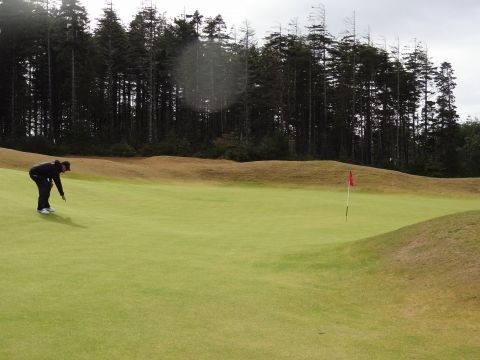 Joe gives a sense of the dramatic slope of the green, demonstrating to the author the line for a putt from just outside the lower right corner of this photo. The backboard visible behind the green was an effective route for pins deeper and further right on the green.
The reader will note that I’ve not discussed many of the better known Macdonald templates, most notably the Redan and Biarritz, largely as a result of the conditions in which we played. Into the wind on all three occasions, the Redan was easily the most difficult Par three on the course. To give the reader a sense of the wind, one afternoon we played it at about 162 yards, and a perfectly struck 20-degree hybrid, usually my 210 yard club, barely crawled onto the front of the green. Under those conditions, it was still a great golf hole; it just unfortunately didn’t play as a Redan.
As noted above, there are several extremely enjoyable holes with more tenuous connections to Macdonald’s design templates. Notable among these is the 14th, a short Par 4 called Maiden, a Seth Raynor design concept featuring a green with three separate sections, with the outside two plateaus significantly elevated. The green is tucked against the face of Back Ridge, offering the player an effective backboard, at least on the left half of the green. While it’s the green complex that gives the hole its name, it’s a cracker of a driving hole, with a hard right-to-left sloping fairway funneling misplaced tee shots into another visually arresting bunker. On a different hole this might be unfair, but the hole is short enough that par is still feasible from the bunker, as the author did by effectively (or luckily) utilizing the backstop.
With the 14th green tucked into Back Ridge, the tee box on the Par 5 15th, Westward Ho, is similarly elevated. After the downhill tee shot, the hole sweeps left to right up the coastal dune parallel to the seventh. The extremely large green, some 60 yards deep, invites the player to have a go, but a well-placed bunker short-right will catch any timid offerings. The 17th hole, Littlestone, also a three-shotter, effectively utilizes a small wetland area to create a second fairway option to the right. Risking calamity in failing to carry the hazard will reward the longer player with a chance to reach the green in two.
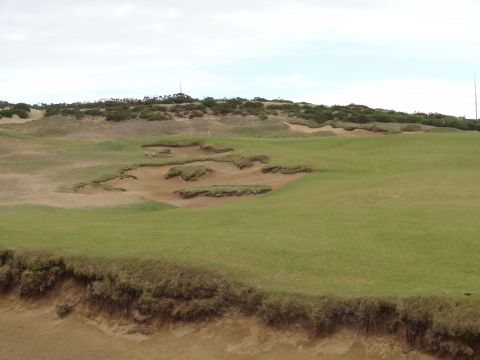
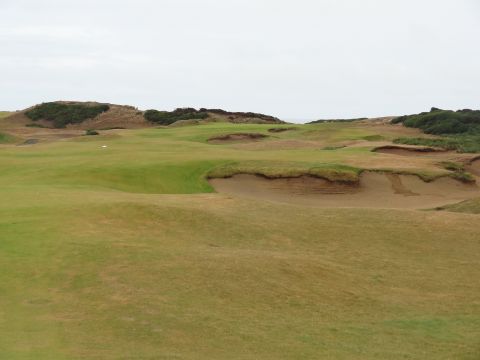
Top, the view from the tee on the short Par 4 14th, called Maiden. The challenge is to start the drive far enough to the right to avoid the large bunker running the entire length of the landing area. Bottom, the 15th hole is a mid-length Par 5 called Westward Ho, which plays in a due westward direction from its tee on Back Ridge towards the Pacific Ocean. It offers the players a last look at the Pacific Ocean and visit to the “champagne turnstand” before turning eastward towards home.
Old Macdonald is a stunning accomplishment, an incredibly bold vision executed perfectly. It’s playable for golfers of all levels of ability, with not a single forced carry and almost no rough, yet will challenge and occasionally torment the low handicapper. And while those who come for the unique Macdonald experience will of course focus on the execution of his templates, those for whom it is just another stop on the Bandon shuttle bus will find a worthy test of golf. To close, I’ll again defer to Stephen Goodwin, who after playing Old Mac for the first time characterized it as “serious fun,” a formulation that perfectly captures the wide array of pleasures that await.
Scott Simpson is an itinerant golfer who lives in Westchester County (NY) and, we are pleased to say, is a dedicated reader of this blog site. We are envious of the international roster of golf courses he has played but extremely grateful that he has chosen Golf Community Reviews in which to recount his entertaining vists to some of the world's great golfing venues.
Old Mac a flat golf course, like St. Andrews, except for where your golf ball ends up
This is the second part of a review of Old Macdonald Golf Club at Bandon Dunes. Text and photos by Scott Simpson
Putting greens are to golf courses what faces are to portraits
– C.B. Macdonald
If the fairways at Old Macdonald are supersized, then the greens are absolutely ginormous. Those that measure such things tell us that the Old Mac greens total 6.3 acres, topping the previous record holder, that aforementioned muni in the Kingdom of Fife (the reader may quickly tire of comparisons to the Old Course at St. Andrews, but there’s no avoiding it, especially as three of the holes are specifically modeled on Old Course templates). The green on No. 5, Old Mac’s Short hole, comprises some 20,000 square feet, and that’s on the shortest hole on the golf course (though, as with typical Macdonald short holes, the green is actually several different plateaus with a 9 to 10 foot elevation change, and the challenge is to hit the far smaller target). The measurement of the greens is amusing in itself, as I would challenge anyone to define where the aprons end and the greens begin, such is the seamlessness of the transition areas.
As the final step in the evolution of Team Keiser’s experience, Old Mac was the first course at Bandon Dunes seeded entirely in fescue. This was the subject of much debate and experimentation in building the original
The property itself is mostly flat, with the exception of two significant dunes lines. The most notable of these is a large dune separating the site from the Pacific Ocean (see below). The second formation is Back Ridge, a large dune line that runs almost the entire length of the Bandon property and serves as the western boundary of both Bandon Dunes and Pacific Dunes. Because the clubhouse needed to be located to the east of Back Ridge, near the road in a small flat section that now contains the first, second, 17th and 18th holes, the routing needed to move the players over and back in the course of play. This was accomplished imaginatively on the outbound trek by having the players launch their tee shots on the third hole, Sahara, over Back Ridge, with the most aggressive line dangerously close to a dramatic dead cedar tree.
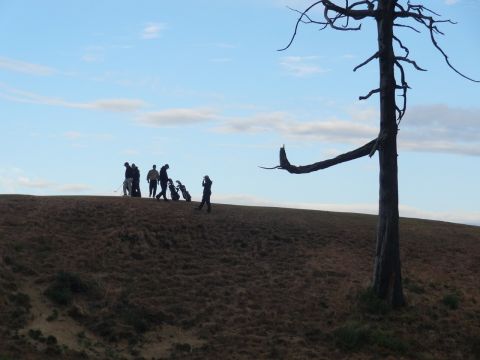
Above, a group of golfers traverses Back Ridge in the early morning light after hitting their tee shots over the dune. The aggressive line comes close to the ghost tree, a distinctive dead cedar visible from most of the course.
From the top of Back Ridge the player gets his first view of the expansive bowl in which the bulk of the golf course is situated. The land initially appears flat, especially from a distance, masking dramatic undulations, which up close resemble nothing so much as an unmade bed. But it was a few days later, scanning Old Mac from the 14th hole at Pacific Dunes, that I saw why so many have compared it to the grounds of the Old Course. It has that same appearance of uniformity when you first scan the breadth of the valley, but any time you focus on a specific section of the course, the furrows and interesting landforms become evident. As I once noted long ago about the Old Course, it’s flat as the proverbial pancake, except inevitably for the specific spot on which your golf ball settles.
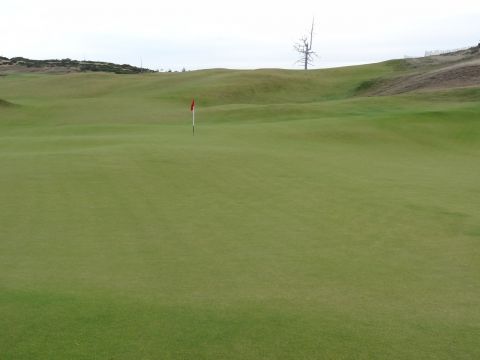
The view looking back from behind the third green, including the ghost tree on Back Ridge. Although any respectable drive leaves only a wedge in, the green is a staggering fifty yards deep. The lag putt may be the most important shot to have in your arsenal at Old Mac, but where does one practice 150 foot putts?
Next: Hole by hole assessment
With golf course here and golf course there, Old Macdonald fits right in at Bandon Dunes
Text and golf photos by Scott Simpson
There can be no really first class golf course without good material to work with. The best material is a sandy loam in gentle undulation, breaking into hillocks in a few places. Securing such land is really more than half the battle. Having such material at hand to work upon, the completion of an ideal course becomes a matter of experience, gardening and mathematics. -- C.B. Macdonald
Imagine for a moment that you’re Mike Keiser, circa 2005. You’re the toast of the golf world as a result of the improbable success of your Bandon Dunes Golf Resort on the remote southern coast of Oregon. You’ve been told repeatedly that you’ll never lure enough golfers to make the project profitable, that golf cart rental fees are necessary to make the economics work and that Americans will never put up with the cold and wet conditions of the Oregon coast. But with the opening of each of your three acclaimed golf courses, you’ve served up a healthy helping of crow to these critics.
You’ve assembled an attractive 300-acre parcel to the north of Pacific Dunes. This parcel has less extensive ocean frontage than the wildly successful Bandon and Pacific Dunes, but provides the same sandy substrate perfect for links golf. Every golf architect on the planet has made a pilgrimage to southern Oregon in hopes of burnishing their reputations on this spectacular canvas. Surely it was just a matter of picking from among these highly skilled architects and awaiting the inevitable fourth masterpiece.
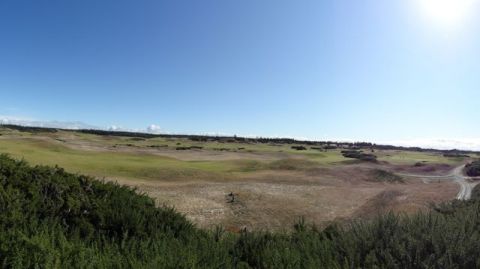
Utilizing the way-cool sweep panorama feature of my new camera, a view of the Old Macdonald property from the adjoining 14th hole of Pacific Dunes. The property appears to be flat from a distance, but up close an endless series of hummocks and landforms are revealed, very reminiscent of the Old Course at St. Andrews.
But if Mike Keiser were prone to conventional thinking, the Bandon Dunes property would still be a gorse-infested blight. If you’re Mike Keiser, you trust your instincts and you go big, commissioning the most architecturally ambitious golf course project in decades, an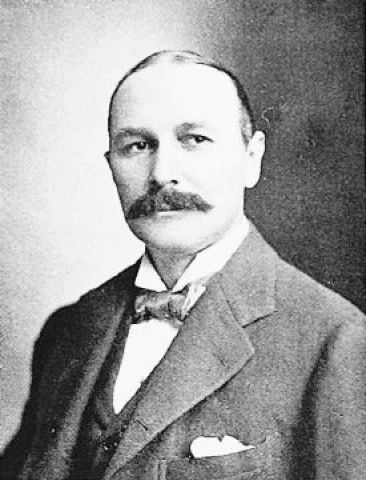 homage to a golf course architect whose name most American golfers wouldn’t recognize and whose design concepts -- such as blind shots, penal bunkering and the importance of the ground game – are alien to the evolution of American golf. Fortunately for us all, Mike Keiser hit it out of the park, creating a golf course one can enjoy as an architectural history lesson, a stout test of golf or both. Then, with tongue planted firmly in cheek, he named it after the most annoying of children’s songs, ensuring that the endeavor not be considered some dry history lesson or museum piece.
Living in Chicago, Keiser undoubtedly became familiar with C.B. Macdonald’s work at Chicago Golf Club and Shoreacres. His extensive golf travels familiarized him with the original courses that Macdonald so revered and he also had ample opportunity to experience Macdonald’s enduring legacy, The National Golf Links of America. And, in a world where timing is everything, it is somehow appropriate that Old Macdonald opened for play almost exactly one hundred years after the opening of The National.
As Keiser focused on incorporating Macdonald’s work into his next project, his first instinct was perhaps even more audacious than the ultimate Old Macdonald concept. He consulted with George Bahto, whom we met during our visit to Sleepy Hollow (read the author's Sleepy Hollow article here), to assess the feasibility of creating a replica of Macdonald’s
In subsequent discussions with Tom Doak, Bahto and others, Keiser’s thinking moved beyond a reproduction of the Lido, as fascinating as that might have been. At Doak’s urging, he gravitated towards the concept of building a golf course as Macdonald might have, replicating not a specific design but the design process itself. Keiser was reportedly brutally honest in his intentions, telling Doak and co-designer Jim Urbina candidly that he already had a Tom Doak course and didn’t need a second. (Urbina had performed the same role, albeit without the design credit, on Pacific Dunes) He wanted and expected a Charles Blair Macdonald course; specifically he wanted his design team to identify and utilize the natural features of the land, as they envisioned Macdonald would do if presented with the site.
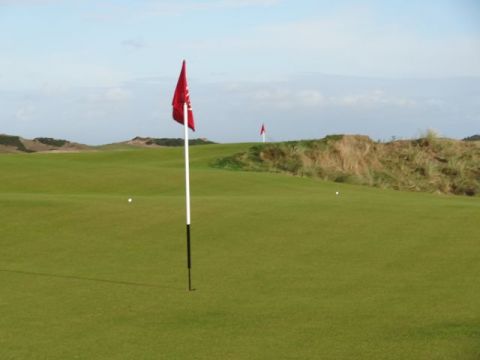
A partial view of the 5th green, Old Mac’s Short hole. This perspective gives a feel for the elevation change on this vast green of more than 20,000 square feet. The 10th green, seen in the background, shares a cavernous bunker with the 5th.
To assure the broadest base of knowledge of all things Macdonald, Keiser assembled a dream team advisory board. Bahto, Macdonald’s biographer and a golf course architect in his own right, was an obvious selection. Keiser additionally recruited Karl Olson, longtime greens superintendant at The National, and Brad Klein, architecture editor and in charge of course ratings for Golfweek Magazine. In one of my favorite vignettes from the development of the project, responsibility for specific holes was allocated to the advisory board through an NFL-style draft. Imagine the dilemmas involved if you were lucky enough to be on the advisory panel: Do you grab the Road Hole in the first round of the draft, or gamble that it will still be there when your turn comes up in Round Two?
Not only did this unwieldy-sounding committee not produce a camel, but the horse they created is a pure thoroughbred. The wonder is less that they successfully incorporated so many of the classic design templates
The course features extremely wide playing corridors, with some of the widest fairways you’ll ever see, inviting the inevitable comparison to the Old Course at St. Andrews. This makes the course eminently playable for golfers of all abilities, and it takes some effort or bad luck to actually lose a golf ball. But the width can be deceiving and is always part of the strategic test of the hole. Again incorporating the design ethic of the Old Course, the player is typically faced with a choice of lines off the tee. The inevitable choice is between the safer line, which will inevitably leave a longer or less desirable angle on the approach shot, versus a more aggressive line which will invariably bring the well-placed hazards, mostly penal fairway bunkers, into play.
Next: Lay of the Land
Bargain golf vacation could lead to bargain vacation home in Myrtle Beach area
Who among us can resist bragging about bargains we have landed? My go-to bargain story is the week in 1969 I spent playing golf in Myrtle Beach with a friend. We took advantage of a golf package that included lodging in an oceanfront room in the heart of town; 36 holes a day (I was much younger then), cart included; a hot breakfast each morning; an oyster roast a couple of late afternoons during the week; and an hour of free beer at 5 p.m. each day by the hotel’s pool. And each of us received a dozen golf balls. Okay, they weren’t Titleists, or even Slazengers, but we were only 21 and not about to look a gift horse in the mouth, especially one bearing free beer. The cost of the entire week of golf and everything else was just $99. And that’s why I brag about it.
Today there are 115 golf courses along the Grand Strand, and intervening years of inflation have pushed “bargain” golf package prices for a week of golf into the $200s and beyond. But those who take advantage of an impressive Myrtle Beach golf package currently on offer for December 10 into February could very well have something to brag about in coming
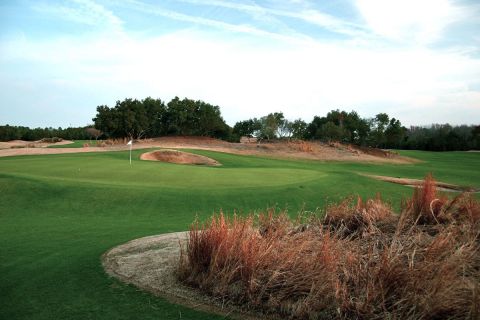
The Heathland on the Legends Resort property is one of five golf courses available on the special $94 golf package.
Photo by Elliot deBear.
Golf courses on the package include the Heathland, Parkland and Moorland courses on The Legends site, Oyster Bay just over the state line in North Carolina and Heritage Golf Club in Pawleys Island, about a half-hour drive from The Resort. And while you are there, you might consider visiting some of the properties for sale on the sprawling Legends Resort property. Condos start at prices under $100,000 making them a viable choice as a getaway vacation home.
Please contact us if you would like more information on The Legends Resort or on any golf community property in the Myrtle Beach area.
A Tiger, a Shark and Jim Furyk
We aren’t used to watching golf until the wee hours of the morning, but the early a.m. crankiness from our abbreviated sleep was a small price to pay for all the story lines that came out of The Presidents Cup (my wife would disagree about the value of the crankiness part). Here are a few of my takeaways, for what they are worth:
Tiger Woods’ Love/Hate Relationship with November
If the event did not end early this morning after all east coast newspapers were put to bed, the headlines would be buzzing with words like “Heeeee’s Back!” Tiger Woods had his best November in two years, by far, since his errant Thanksgiving drive into a tree. At The Presidents Cup this week, he correctedWoods certainly would have been better served if last week’s Australian Open, where he finished a strong third, and this week’s Presidents Cup had been held at the beginning or even in the middle of the PGA Tour season; it would give him something to build on for the intense competition ahead rather than for the non-competitive practice sessions of the coming weeks. But never underestimate the potential of a hard worker with supreme natural gifts, or the positive joss of a straight-shooter new caddy to replace the irascible enabler Steve Williams, Woods’ prior one. The betting here is that, come next season, Tiger Woods will play well, probably win a major and compete for tour-leading status. His play will never again reach its previously legendary heights; but then no one else’s will reach those heights either.
Jim Furyk, a better comeback story
Jim Furyk is the poster child for the mind game of golf, as in mental is more important than physical. He will never have Tiger Woods’ golf swing or physical attributes, but he is the embodiment of mind over matter -– his swing doesn’t matter and he doesn’t mind if people pick on it. He was in a horrible funk this past season, his reliable short game having departed for places unknown. But he traveled halfway around the world to find it at Royal Melbourne, where he seemed to make every putt inside 20 feet and led his team with an unblemished record of 5-0. Gracious as always, he gave full credit to Phil Mickelson for building his confidence prior to the Presidents Cup and during the rounds in which they were paired together.Flamboyant swingers like Woods get the headlines, but golf is a game of steady; Furyk’s eight-piece swing and Keystone Cops pre-putting routine aside, his game is worthy of fawning over too.
Amazing Grace, but Shark Bites Himself
Greg Norman’s captaincy of the International team was a study in contrasts –- just like his playing career in which he was assailed fairly for making poor choices, occasionally even reckless ones, at critical times in major tournaments. His 78 on Sunday at the 1996 Masters, which handed the tournament to Nick Faldo, ranks as one of the biggest collapses ever in golf.
Norman’s on-course decisions came from a strong belief in his own abilities; but over-confidence, especially on tough golf courses, can tilt
Dumb is one thing, but reckless is another, and Norman’s criticism of U.S. Captain Fred Couples’ choice of Tiger Woods as his wild card pick set up the Shark for biting criticism. Allenby went 0 for 5 in his matches, and tanked so badly in the crucial singles match on Sunday that most observers considered the match against Hunter Mahan over well before the turn. Woods smoked the previously well playing Aaron Baddeley in the next-to-last match, although he finished with an overall record of just 2-3 (his playing partners did not cover themselves with glory). If Allenby contributes just two points, the Internationals might have won the Cup, something I suspect the Aussie press will not let Norman forget for a while.
We will say this: Norman was extremely gracious –- and graceful -- in his on-air interviews during the matches, answering all questions forthrightly and heaping compliments on players on both sides. But at the end of the event, when faced with a question about his criticism of Woods as the U.S. captain’s pick, Norman went way off target, like a Sunday at Augusta National.
Can golf be more fun?
Now on Sale
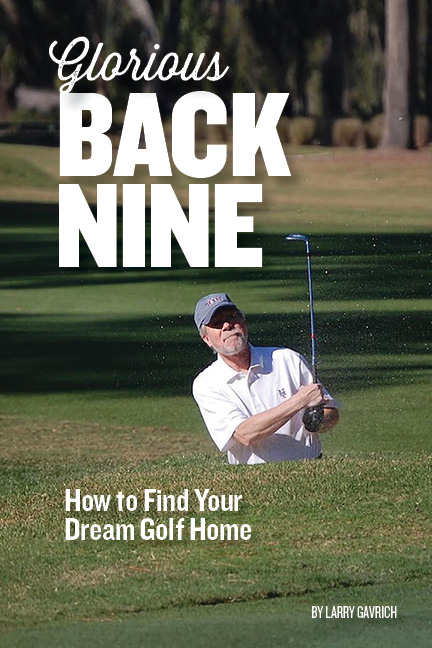
- The only book about golf communities in the last 10 years.
- 156-page step-by-step guide to finding your dream golf home.
- Info on nearly 100 golf communities the author has visited.
- Paperback version costs less than a sleeve of Pro VIs.
Here is what the experts are saying:
“The book is chocked full of information…applicable to anyone looking for a move to the Southeast regardless of whether they are looking for a golf community or not.” — John LaFoy, golf architect (Linville Ridge CC, CC of Charleston, The Neuse GC)
“Larry has done a tremendous amount of work and anyone — like me — who is looking to search for a golf home now or in a few years needs this book.” — Brad Chambers, golf blogger, ShootingYourAge.com
“Wow! What a thorough piece of work…a must for anyone moving South. This book will help many people.” — Brett Miller, owner and founder of MMA, Inc, a golf industry consultancy
Buy It Now at Amazon.com or BarnesandNoble.com.